Table Of ContentPressure Dependence of Insulator-Insulator Contact Charging
The mechanism of insulator-insulator triboelectric (contact) charging is being studied by the
Electrostatics and Surface Physics Laboratory at KSC. The hypothesis that surface ion exchange
is the primary mechanism is being tested experimentally. A two-phase model based on a small
partial pressure of singly charged ions in an ambient ideal gas in equilibrium with a
submonolayer adsorbed film will provide predictions about charging as a function Of ion mass,
pressure, temperature, and surface adsorption energy. Interactions between ions will be
considered in terms of coulombic and screened potential energies. This work is yielding better
understanding of the triboelectrification of insulators, which is an important problem in. space
exploration technology. The work is also relevant to important industrial processes such as
xerography and the application of paints and coatings. Determining a better understanding of
the fundamental mechanism of insulator-insulator triboelectrification wifi hopefully lead to
better means of eliminating or at least mitigating its hazards and enhancing its useful
applications.
Surface impurities, which can be mostly ionic in nature, can play a role in the charging of
insulators. Ion transfer in metal-insulator charging has been advocated by several researchers
to account for charge exchange. Ions can exist on the surface of an insulator either in weak
bonds due to intermolecular forces while residing in vibrational energy states or as solvated
ions in a thin surface water layer.
Since atmospheric pressure and surface moisture layers play a major role in surface charging,
a physical model is presented in which the surface of the insulator is in equilibrium with its
external environment. Equilibrium is used because charge transfer occurs rapidly during
triboelectrification. The surface is modeled as having localized states with adsorption energy,
o, for the surface particles. The particles are considered to be a vapor of noninteracting ions of
single polarity in equilibrium with an adsorbed submonolayer on the surface. The chemical
potential of the vapor is determined using the grand canonical ensemble and then equated to
the chemical potential of the submonolayer to determine vapor pressure. By assigning a charge
(assuming single ionization) to the vapor particles, the surface charge resulting from the
adsorbed monolayer can be calculated as a function of pressure. Including the effective
electrostatic potential felt by the gas-phase particles from the surface charge gives an equation
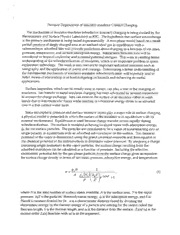
for surface charge density in terms of ion mass, pressure, adsorption energy, and temperature:
(1)
A E2o)(kBTeQ/kBT
+1'
P
where N is the total number of surface states available, A is the surface area, P is the vapor
pressure, kBT is the particles' thermodynamic energy, o is the adsorption energy, and h is
Planck's constant divided by 2t. a is a characteristic distance found by dividing the
electrostatic energy by the thermal energy of a particle and solving for the radius called the
Bjerrum length, X is the thermal length, and z is the distance from the surface. E2(a/zo) is the
second-order E(x) function with a/zo as the argument
Lethng a0 = q and P0 = [! iJE2 I' —o we can put Eq. (1) into a dimensionless
form.
a __
(2)
cr0
P
which is an electrostatic version of a Langmuir isotherm for ions in equilibrium between an
adsorbed surface phase and a gas phase.
HDPE..
0:10.-
0
• . 0:o6: -
&j•:
a)
0
0).
.cl
U
U-.
• CO
GO.
002-
40 BO 80 100 120 140
Figure 1. Surface charge as a function of pressure for HDPE data curve fit to the model
equation.
Experimental surface charge versus pressure data was taken for several polymers after
triboelectrification using a wool wheel. This data was curve-fit to the model equation for each
polymer. An example of these curve fits is shown for high-density polyethylene (HDPE) in Fig.
1.
Expanded curve fit data for various polymers were calculated letting surface adsorption
energy and the total number of surface states, N, float These data are summarized in table 1.
Electrical mduction charging consists of using a charged metal plate to place electrons on a
surface. Several polymers from the test group listed in table 1 were charged this manner. It
was found that lowered pressure did not remove the surface charge as it did for
triboelectrification. This mdictates that the charge exchange mechanism for triboelectrification
between polymers is mostly ion exchange.
TABLE 1
Summary of Curve Fit Values of Adsorption Energy and Total Number of Surface States
Polymer 4 (eV) N (x 1O)
0.0087
HDPE -0.396.o.0028 5.96±0.532
LDPE -0.41 ± 0.00750.0107 6.09 ± 0.768
0.0083
PTFE (all samples) -0.3 66 ± 0.0109 18.4 ± 2.45
PTFE (samples 1 & 2) -0.341 ±0.00580.005 1 4.79 ± 0.444
0.0085
PTFE (samples 3-10) -0.35 ± 0.0043 27.9 ± 3.59
0.0098
Polycarbonate (all samples) -0.332 ± 0.0148 0.353 ± 0.0557
0.0114
Polycarbonate (corner points only) -0.391 ± 0.0185 1.21 ± 0.162
0.0033
Polycarbonate (sample 1) -0.418 L-. 0.0035 2.18 ± 0.061
Polycarbonate (sample 2) I -0.402 ± 0.00260.00 19 0.847 ± 0.02
0.0016
Polycarbonate (sample 3) -0.42 ± 0.0014 0.313 ± 0.00362
0.0014
Polycarbonate (sample 9) -0.409 ± 0.675 ± 0.00596
0.0006
0.005 5
Styrene (corner points only) -0.3 87 ± 0.0062 14.2 ± 0.726
0.008
PVC (corner points only) -0.3 71 ± 0.0106 14.2 ± 1.52
PVC (sample 1) -0.374 ± 0.00320.0032 4.96 ± 0.181
PVC (sample 5) -0.379 ± 0.00090.0001 10.5 ± 0.0962
0.0023
PVC (sample 8) -0.376 ± 15.1 ± 3.45
o.00
Key accomplishments:
• Studied initial surface charge density versus pressure experiments on polymers.
• Revised preliminary model to include effective coulombic and screening potentials.
• Completed expanded triboelectric experiments on polymers.
• Completed induction experiments on polymers.
Key milestones:
Continue corona experiments
Perform metal-insulator triboelectric experiments.
Continue to improve theoretical model and determine its physical limitations.
Contacts: M.D. Hogue ([email protected]), YA-C2-T (321) 867-7549; and Dr. C.I. Calle, YA-C2-T,
(321) 867-3274
Partidpating Organization: University of Central Florida (Dr.E R. Mucciolo and Dr. R. E. Peale)