Table Of ContentExploratory Investigation of Failure Mechanisms in Transition Regions
between Solid Laminates and X-cor® Truss Sandwich
T. Kevin O’Brien*
Isabelle L. Paris**
NASA Langley Research Center
Hampton, Virginia U.S.A.
Abstract
Small sub-component specimens consisting of solid laminates at the ends
that transition to X-cor® truss sandwich in the center, were tested in a
combination of three point bending, uni-axial tension, and combined
tension and bending. The failure process in the transition region was
documented for each loading using digital video and high-resolution
cameras. For the 3-point bending tests, most of the deformation
occurred in the solid laminate regions on either end of the specimen.
Some pin debonding from the skin of the X-cor® truss sandwich was
observed in the transition region and was accompanied by audible “pings”
throughout the loading. Tension loaded specimens failed in the sandwich
skin in the middle of the gage length, accompanied by separation of the
sandwich core from the back skin and by delamination between the top
skin and bottom skin at the transition region. The pinging associated with
pin debonding occurred as the load was increased. However, the
frequency of the pinging exceeded any visual observations of pin
debonding in the video of the transition region. For specimens tested in
combined tension and bending, the greatest amount of pinging occurred
during initial application of the axial load. High-resolution images in the
transition region indicated that the pinging corresponded to pins
debonding and buckling due to the through-thickness Poisson contraction
of the specimen. This buckling continued to a much smaller extent as the
transverse load was applied.
Keywords: Composites, X-cor® truss sandwich, failure modes
* U.S. Army Research Laboratory, Vehicle Technology Directorate.
** National Research Council.
1
Background and Introduction
Figure 1 shows X-cor® truss sandwich panels. The foam/pin preforms
were supplied by Aztex Corporation. Laminates were produced at Sikorsky
Aircraft Company in an autoclave under vacuum pressure as a sandwich of
prepreg skins with a foam core filled with pultruded carbon pins. The foam
stabilizes the pins during the curing process when the pins penetrate the
skins to form a truss core.
Typical X-cor® sandwich panels transition to solid laminate strips to allow
for the attachment of mechanical fasteners (fig.1). Preliminary studies at
Sikorsky Aircraft Company have shown that replacing honeycomb
sandwich laminates with X-cor® truss sandwich laminates may reduce the
weight of a structural component by 10 to 15% while maintaining about
the same compression and shear strength as the baseline component,
with and without impact damage [1]. In order to fully understand the
capabilities of the X-cor®, and to take advantage of this concept in
designing more efficient structures, a detailed investigation of failure
modes and load transfer is required.
In this study, small sub-component specimens, consisting of solid
laminates at the ends that transition to X-cor® sandwich in the center,
were cut from large panels and tested in a combination of three point
bending, uni-axial tension, and combined tension and bending.
Experimental observation of the failure process in the transition region
was documented for each loading. Future work will build on the current
investigation by characterizing the pin debonding mechanism from the
facesheet. This characterization will be used in analyses to predict static
and fatigue failures.
Materials and Specimen Preparation
Square panels measuring twenty-one inches on each side were cured at
350ºF in an autoclave at Sikorsky Aircraft company using a semi-rigid
vacuum bag. The pins in the X-cor® truss consisted of T300/5250-4
carbon/bismaleimide with 65% fiber volume. Pin properties are shown in
table 1. Properties of the Rohacell 31IG polymethacrylimide foam are
given in table 2.
2
The skin laminates contained two ply drops along the span, the first
internal and the second external, as the laminate transitioned from the
solid laminate to the core sandwich. The Sandwich skin facesheets
consisted of IM7/8552 carbon-epoxy plain weave fabric with a nominal
ply thickness of 0.0075-inches and a [(+-45)/(0/90)/(+-45)]
orientation. The fabric properties are given in table 3. At the edge of the
panel where the core ramps down, six more plies were added (on the flat
side only) to have adequate bolt bearing strength. The layup of the solid
laminate (skin plus the doubler) was [(+-45)/(0/90)/(+-45)] . The total
4
nominal thickness of the solid laminates was 0.09 inches. The doubler
plies were added in sets of threes progressing from the ends towards the
center of the specimen. There were distinct recesses or depressions at
the two locations where the doublers were dropped. Each individual ply
drop was staggered from the previous by 0.25 inches.
Test specimens cut from the panels were twenty one inches long, with a
nominal width of one inch. The nominal thickness of the solid laminate
was 0.1 inches and the nominal thickness of the sandwich region was
0.58 inches. Full length specimens were tested under uniaxial tension and
three point bending. The remaining specimens were cut in half along the
length and were tested in uniaxial tension and combined tension and
bending in the Axial Tension and Bending (ATB) load frame described
later. The foam in the sandwich region mounted in the upper grip was
removed via sand blasting and the sandwich was filled with an epoxy
potting material so it could sustain the compressive grip loads.
In order to examine the pin response under load in the transition region,
the foam was removed via sand blasting. Strain gages were mounted on
all the specimens. Solid laminates cut from test specimens were also
tested in tension to obtain axial modulus and strength properties.
Experimental Setup and Procedure
Solid Laminate Tension Tests
Four specimens measuring 3.0-inches long by 0.5-inches wide were
instrumented with a strain gage in the mid-span and tested in uniaxial
tension in a 20-kip hydraulic load frame. Thickness and width were
3
measured before the test and load and strain were recorded during the
test. Tests were performed in load control at a rate of 500 lbs/min.
X-cor® sandwich Three-point Bending Tests
The span for the full-length 3-point bend tests was 20-inches between
the outer load noses, with a distance of 3 inches from the support rollers
to the start of the sandwich on either side. Hence, the total span
consisted of 14-inches of sandwich, including the transition region, and 6-
inches of solid laminate. Ideally, it would have been preferable to have a
smaller core section and a smaller overall span for these tests. However,
because the panel geometry was fixed, it was not possible to obtain
these smaller panels during this exploratory investigation. Tests were
performed in stroke control at a rate of 0.5 in/min. Strains were recorded
at two locations shown in figure 2. Strain gage #1 was mounted on the
tension side of the solid laminate just before the transition to the
sandwich. Strain gage #2 was mounted on the tension side skin of the
sandwich, directly below the center load point.
X-cor® sandwich Tension Tests
Two tension tests were performed on X-cor® sandwich laminates in a 20-
kip hydraulic load frame. The first test was performed on the full gage
length, with the solid laminate region mounted in the upper and lower grip
as shown in figure 3a. The gage length between the grips was 16.4
inches. The sandwich section was 14.0-inches long, and the distance
along the solid laminate from the end of the transition region to the grip
at each end was 1.2 inches. The solid laminate was mounted in the grips
using sand paper and tungsten carbide grit sheet. The test was
performed in load control at a rate of 500 lbs/min. Strain was recorded at
the four locations shown in figure 3a.
The second test was performed on the half specimen gage length, with
the sandwich laminate mounted in the upper grip and the solid laminate
mounted in lower grip as shown in figure 3b. The gage length between
the grips was 5.5 inches. The sandwich section was 4.41-inches long, and
the distance along the solid laminate from the end of the transition region
to the grip was 1.09 inches. The remainder of the solid laminate was
mounted in the bottom grip using sand paper and tungsten carbide grit
4
sheet along with a steel block inserted to align the uni-axial load train.
The test was also performed in load control at a rate of 500 lbs/min.
Strain was recorded at the three locations shown in figure 3b.
For both tests, The deformation was documented using video recordings
with two separate cameras. One camera focused on the X-cor® truss
transition region between the sandwich and the solid laminate, and the
other captured the entire gage length deformation between the grips.
X-cor® sandwich Combined Tension and Bending Tests
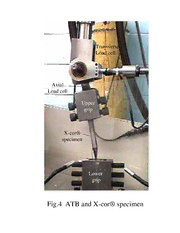
These combined loading tests were performed on the Axial Tension and
Bending (ATB) machine at NASA Langley. Figure 4 shows the X-cor®
truss specimen loaded in the ATB. Figure 5 shows the axial and transverse
loading that was applied to these specimens. A digital video camera was
used to capture the overall deformation and sequence of final failure. A
high-resolution digital camera was used to take close up photos of the pin
behavior in the transition region during holds in the loading.
The gage length between the upper and lower grip for all three tests was
5.5 inches. The solid laminate and steel block insert were mounted in the
lower grip and the epoxy potting filled core section was mounted in the
upper grip. The first test was run with 1.22-inches distance from the
lower grip to the beginning of the transition region between the solid
laminate and the sandwich. The last two tests were run with the
transition region at the lower grip, as depicted in figure 4 and 5. The
orientation was rotated 180 degrees about the vertical for the last two
tests. Strain gage data were collected during each test. Four gages were
used in test #1 and two gages were used in tests #2 and #3.
Test #1
The first specimen was loaded in three sequences.
Sequence 1 consisted of an application of 1,500 lbs. of axial tension,
followed by a loading transversely to the right in increments of 0.5-inches
to a maximum transverse stroke of +2.0 inches. The transverse loading
was then removed. With the 1,500 lbs. of axial load still applied, the
specimen was then loaded transversely to the left in increments of 0.5-
5
inches, to a maximum transverse stroke of -2.0 inches. Some pinging
noise was heard during the axial load and transverse loading.
Sequence 2 consisted of an application of 2,000 lbs. of axial tension,
followed by a loading transversely to the right in increments of 0.5-inches
to a maximum transverse stroke of +2.5 inches. The transverse loading
was then removed. With the 2,000 lbs. of axial load still applied, the
specimen was then loading transversely to the left in increments of 0.5-
inches, to a maximum transverse stroke of -2.5 inches. Some pinging
noise was heard during the axial load and transverse loading.
Sequence 3 consisted of an application of 2,250 lbs. of axial tension,
followed by a loading transversely to the right in increments of 0.5-inches
to a maximum transverse stroke of +1.5 inches. The specimen failed
when the transverse stroke was increased beyond 1.5 inches.
Test #2
The second specimen was loaded in two sequences.
Sequence 1 consisted of an application of 1,500 lbs. of axial tension,
followed by a loading transversely to the right in increments of 0.5-inches
to a maximum transverse stroke of +2.0 inches. The transverse loading
was then removed. With the 1,500 lbs. of axial load still applied, the
specimen was then loading transversely to the left in increments of 0.5-
inches, to a maximum transverse stroke of -2.0 inches. Some pinging
noise was heard during the axial load and transverse loading.
Sequence 2 consisted of an application of 2,000 lbs. of axial tension,
followed by a loading transversely to the right in increments of 0.5-inches
to a maximum transverse stroke of +2.5 inches. The transverse loading
was then removed. Unfortunately, during this process the hydraulics shut
off by accident. This unloaded the axial tension load, putting some
compression on the specimen. Further compression was accidentally
applied when trying to remove the specimen from the machine failing the
specimen prematurely.
6
Test #3
The third specimen was loaded in three sequences.
Sequence 1 consisted of an application of 2,000 lbs. of axial tension,
followed by a loading transversely to the right in increments of 0.5-inches
to a maximum transverse stroke of +2.5 inches. The transverse loading
was then removed. With the 2,000 lbs. of axial load still applied, the
specimen was then loading transversely to the left in increments of 0.5-
inches, to a maximum transverse stroke of -2.5 inches. Some pinging
noise was heard during the axial load and transverse loading.
Sequence 2 consisted of an application of 2,250 lbs. of axial tension,
followed by a loading transversely to the right in increments of 0.5-inches
to a maximum transverse stroke of +2.5 inches. The transverse loading
was then removed. With the 2,250 lbs. of axial load still applied, the
specimen was then loading transversely to the left in increments of 0.5-
inches, to a maximum transverse stroke of -2.5 inches. Some pinging
noise was heard during the axial load and transverse loading.
Sequence 3 consisted of an application of 2,500 lbs. of axial tension,
followed by a loading transversely to the right. The specimen failed
before the transverse stroke reached the first increment of 0.5 inches.
Test Results
Solid Laminate Tension Tests
Figure 6 shows a typical tension stress-strain response for the skin
laminates. Data obtained from these tests are summarized in table 4.
These data were used to anticipate skin failure strains for the following
sandwich laminate tests.
X-cor® sandwich Three-point Bending Tests
Figure 7 shows the load versus strain response for the 3-point bending
test. Because of the large span of the stiff sandwich region, most of the
deformation occurred in the solid laminate regions on either end of the
specimen. The test was terminated when the specimen slipped off the
7
left-hand roller. At this point, strain gage #1 had reached almost 7,500
me . However, this was only half the failure strain of the solid laminate as
determined by the solid laminate tension tests (fig.6). The deflection in
the skin laminate was quite large, and the center load nose stroke was
nearly 1.5 inches. Several pings were heard during the loading. These
were documented on the digital video taken during the test with a digital
video camera.
X-cor® sandwich Tension Tests
Test #1
Figure 8 shows the load versus the strain gage outputs for the full gage
length test. The gages were zeroed before clamping in the lower grip, so
some gages read small compressive strains at the start of the test. The
highest tensile strain throughout the test was indicated by gage #4,
located on the back of the sandwich in the middle of the gage length. The
video indicated that this is the tension side of the bending in the
sandwich region. The video of the full gage length clearly showed the
bending induced by the eccentricity of the load path. However, the solid
laminate region exhibited bending in the opposite direction, with gage #1
showing more tension strain than gage #3 (fig.8). This was also evident in
the video of the local transition region.
The first “ping” indicating pin debonding occurred at 1,250 lbs., with
6,500 me indicated by gage #4. This pinging continued to occur as the
load was increased. However, the frequency of the pinging exceeded any
visual observations of pin debonding in the video of the transition region.
Final failure was at 2,410 lbs., with close to 12,000 me indicated by gage
#4. This was within the range of failure strains (9,000 me -15,000 me )
recorded in tension tests on the solid laminates. The specimen failed in
the skin near gage #4, accompanied by separation of the sandwich core
from the back skin and by delamination between the top skin and bottom
skin at the transition region.
Test #2
Figure 9 shows load versus the three strain gage outputs for the half
gage length test. The load-strain response was similar to the full gage
8
length test, except that the maximum strain achieved was slightly higher.
The video of the half gage length showed the bending response induced
by the eccentricity of the load path. As noted for the full gage length
test, Gage #1 mounted on the transition side of the solid laminate
indicated more tension strain than gage #2 on the opposite side (fig.9).
This was also evident in the video of the local transition region.
The first “ping” indicating pin debonding occurred at 1,150 lbs. of applied
load, with 6,360 me indicated by gage #3. This pinging continued to occur
as the load was increased. However, the frequency of the pinging
exceeded any visual observations of pin debonding in the video of the
transition region. Final failure was at a load of 2630 lbs., with 14,600 me
indicated by gage #3. This was near the top of the range of failure strains
(9,000 me -15,000 me ) recorded in tension tests on the solid laminates.
The final failure sequence in the transition region was captured from the
last several frames from the video camera (fig.10). Failure appeared to
initiate in the tapered skin region, followed by the final failure in the back-
side of the continuous skin.
X-cor® sandwich Axial Tension and Bending tests
Figure 11 shows the axial load vs. strain gage data for specimen #1
recorded during loading sequence 3. As noted previously in the tension
tests that were run to failure, the maximum strain was indicated by gage
#3. Gage #4 was added to the ATB test specimens because the previous
tension tests, that were run to failure, indicated that the failure might
have initiated in the skin at this location. However, the strains recorded in
gage #4 were considerably lower than indicated by gage #3.
Figure 12 shows the strain versus transverse load response for specimen
#1 recorded during loading sequence 3. The axial load was held constant
at 2,250 lbs. during the transverse loading. Gages #1 and #2 show the
anticipated bending response due to the bending moment generated near
the lower grip. However, the strain levels in the skin laminate measured
by gages #1 and #2 are considerably lower than that in gage #3. Also,
the bending load increases the strain in the core skins at gages #3 and
#4, but only by slightly more than the axial loading alone. The highest
strain indicated by gage #3 prior to specimen failure was 14,195 me .
9
Figure 13 shows the high-resolution digital images taken during sequence
3 loading. The left image was taken when the specimen was unloaded
(P=0). The second image was taken when the maximum axial load was
applied (P=2250 lbs). The third image was taken when the transverse
stroke was 1.5 inches. The greatest change occurred during application of
the axial load. The pinging corresponded to pins debonding and/or
buckling due to the through-thickness Poisson contraction of the
specimen. This buckling continued to a much smaller extent as the
transverse load was applied. It was not evident if this pin buckling could
occur in the core regions if the foam was intact.
Figure 14 shows the failure sequence in specimen #1, captured by the
digital video camera during sequence 3. The middle frame clearly
indicated that the failure initiates as a separation of the skin laminates at
the transition region between the solid laminate and the X-cor® truss.
The final frame shows the delamination that grew into the solid laminate
as a result of this separation. Once this has occurred the skin laminate
fails on the right side. The failure went through gage #3. This may also
have been the failure sequence in the previous tension tests run to
failure, as opposed to an initial skin failure at the location of gage 4 as
previously expected.
Test #2
Figure 15a shows the compression deformation on specimen #2
immediately following the loss of hydraulic power, Figure 15b shows the
debonding of the skin from the core that occurred following the
compression loading that was accidentally applied when trying to remove
the specimen from the machine. This accidental failure illustrates the
sensitivity of the X-cor® sandwich construction to compression where
failure may occur without a skin fracture. Unfortunately, there was no
record of how much compression was accidentally applied to this
specimen.
Test #3
Figure 16 shows the axial load vs. strain gage response for specimen #3
recorded during loading sequence 3. As noted previously in the tension
tests that were run to failure, the maximum strain was indicated by gage
#3. Gage #4 was added to this test because the previous tension tests
10