Table Of ContentM O
YSTICAL RIGINS
of the T
AROT
From Ancient Roots to Modern Usage
PAUL HUSON
With illustrations by the author
In loving memory of Olga and Carl
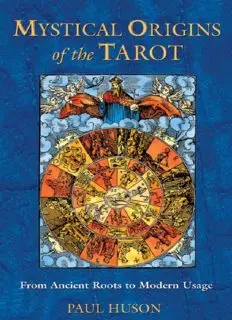
The Wheel of Fortune
The Roman goddess Fortuna was still respected and placated during the Middle
Ages as the ruler of human destinies.
A
CKNOWLEDGMENTS
T
hanks are due to the following for their help in preparing this book: Stuart R.
Kaplan for providing me material on the Mamlûk cards so long ago; Andrea
Pollett for important information about the Mamlûk suit signs; Ron Decker for
sharing with me his expertise on tarot symbolism and Etteilla; Giordano Berti for
his help in trying to locate the elusive tarocchi of Vittoriano Facco; Jess Karlin
for his pointers on tarot and magic; Mary K. Greer for a careful reading of an
early draft followed by learned and constructive suggestions; the International
Playing-Card Society, notably Christopher Rayner, Dr. Michael Cooper, and
Barbara Clarke, for their help in locating valuable playing-card research; the
staff of the British Library, London, for their diligence in locating material on
medieval drama; Susan Jeffers and Mark Shelmerdine for their supportive
enthusiasm throughout the long history of this project; Niki Marvin for her love,
encouragement, and spiritual fortitude; Mel Raab for coming to my assistance
with his timely technical wizardry; Martha Millard for her long-standing faith in
the book; Jon Graham for his persistence and tenacity in bringing the book to
publication; Vickie Trihy and Bronwyn Becker for their erudite and constructive
input to the final manuscript; and last but definitely not least, William Bast, who
made everything possible.
C
ONTENTS
Acknowledgments
Preface
I : O P C T D
NTRODUCTION F LAYING ARDS AND AROT ECKS
The Mamlûk Cards
The Creation of the Court Cards
The Naming of the Court Cards
The Creation of the Tarot Trumps
Tarot in the Sixteenth Century
Further Developments
1
T O S S
HE RIGIN OF THE UIT IGNS
Sufis and the Suit Signs
The Four Cardinal Virtues
The Four Castes of Ancient Persia
2
T O T
HE RIGIN OF THE RUMPS
Petrarch’s I Trionfi
Medieval Drama
The Four Last Things
The Tale the Trumps Tell
3
O C T
F ARTOMANCY AND THE AROT
The Ancient Art of Sortilege
Egyptian Magic and the Book of Thoth
Etteilla’s System
The Kabbala and Éliphas Lévi
The Golden Dawn Attributions
Papus and His “Bohemian” Tarot
4
T M T C : T M A
HE EANINGS OF THE RUMP ARDS HE AJOR RCANA
0 The Fool
I The Juggler
II The Female Pope
III The Empress
IV The Emperor
V The Pope
VI The Lovers
VII The Chariot
VIII Justice
IX The Hermit
X The Wheel of Fortune
XI Fortitude
XII The Hanged Man
XIII Death
XIV Temperance
XV The Devil
XVI The Tower
XVII The Star
XVIIIThe Moon
XIX The Sun
XX The Judgment
XXI The World
5
T M S C : T M A
HE EANINGS OF THE UIT ARDS HE INOR RCANA
The Suit of Coins or Pentacles
The Suit of Cups or Chalices
The Suit of Swords
The Suit of Batons or Wands
6
R T
EADING THE AROT Selecting a Tarot Deck
Getting in Touch with Your Cards
Preparing for Divination
General Rules of Cartomancy
Simple Tarot Spreads
Advanced Cartomancy—Linking the Cards
Complex Systems
Last Words of Advice
Appendix 1. Historical Tarot Decks
Appendix 2. Where to Buy Your Cards
Appendix 3. Where to See the Originals
About the Illustrations
Bibliography
Other Books by this Author
About the Author
About Inner Traditions
Books of Related Interest
Copyright
A I
BOUT THE LLUSTRATIONS
Frontispiece: The Wheel of Fortune, after a ninth-century manuscript in the
John Rylands Library, Manchester.
PREFACE
Page xi: King of Spades and Queen of Clubs, after a fifteenth-century French
hand-painted deck.
INTRODUCTION
Page 3, from left to right: Ace of Cups, Ace of Coins, Ace of Polo Sticks,
and Ace of Swords, after fifteenth-century Mamlûk cards in the Topkapi
Sarayi Museum, Istanbul.
Page 4, from left to right: Two of Swords, after a fifteenth-century Mamlûk
card in the Topkapi Sarayi Museum, Istanbul.
Two of Swords, after a Tarot of Marseille–pattern deck.
Three of Polo Sticks, after a fifteenth-century Mamlûk card in the Topkapi
Sarayi Museum, Istanbul.
Three of Batons, after a Tarot of Marseille–pattern deck.
Page 5: Six Cash (Coins) and Six Strings of Coins (Batons), after Chinese
“money-suited” Dongguan Pai cards.
Page 6, top: The malik at-tûmân, King of the Ten Thousand suit, after a
fifteenth-century Mamlûk card in the Topkapi Sarayi Museum, Istanbul.
Page 6, bottom: Queen and King of Batons, after the fifteenth-century
Visconti-Sforza tarocchi deck painted by Bonifacio Bembo.
Page 7: Knave and Knight of Batons, after the fifteenth-century Visconti-
Sforza tarocchi deck painted by Bonifacio Bembo.
Page 8: Hector, Caesar, and Alexander, After an illustration of the Nine
Worthies from Le chevalier errant, 1394, MS 12559, fol. 1. Bibliothèque
Nationale, Paris.
Page 9, left: King David. After an illustration of the Nine Worthies from Le
chevalier errant, 1394, MS 12559, fol. 1. Bibliothèque Nationale, Paris.
Page 9, right: King Arthur and the Emperor Charlemagne. After an
illustration of the Nine Worthies from Le chevalier errant, 1394, M.S.
12559, fol. 1. Bibliothèque Nationale, Paris.
Page 10: Death, the Devil, the Tower, the Star, the Lovers, Temperance,
Justice, Fortitude, the Queens of Cups, Swords, and Coins, and the Juggler.
After a partial sheet of printed woodcut tarocchi, Florence, fifteenth
century. Rosenwald Collection, National Gallery of Art, Washington DC.
Page 12: Mars, after the fifteenth-century Mantegna engraving.
Page 13: The Female Pope, the Emperor, the Empress, the Moon, the Star,
and the Juggler, after a partial sheet of woodcut tarocchi, probably from
Milan, fifteenth century. Cary Collection, Beinecke Library, Yale
University.
Page 15: The Mamlûk suit signs and their European derivatives.
CHAPTER 1
Page 21: “The Great King,” Darius I of Persia, after a sixth to fifth century
B.C.E. relief from Persepolis.
Page 23: Clockwise from the top left, the angels of Prudence, Justice,
Temperance, and Fortitude, after Luca della Robbia, the ceiling of the
Cardinal of Portugal’s chapel, San Miniato al Monte, Florence.
Page 27: A Persian Magus, after a gold votive plaque in the British Museum,
seventh to sixth century B.C.E.
CHAPTER 2
Page 34, top: Limbo and Hell-Mouth, after a sixteenth-century manuscript by
Hubert Cailleau, showing the setting for the mystery play at Valenciennes,
1547. The blazing towers of limbo and hell lie at the far right of the stage.
Lucifer rises above the tower of hell, mounted on a dragon.
Page 34, right: The Devil trump, after a card in the Tarot of Jacques Viéville,