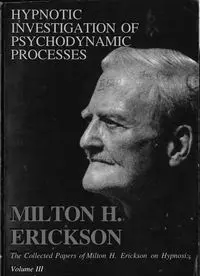
Table Of ContentHYPNOTIC
INVESTIGATION OF
PSYCHODYNAMIC
PROCESSES
MILTON H.
ERICKSON
The Collected Papers of Milton H. Erickson on Hypnosi:
Volume III
Milton H. Erkkson, MD
(1901-19K0)
The paper used in this publication meets the minimum requirements of
American National Standard for Information Sciences—Permanence of Paper
for Printed Library Materials, ANSI Z39.48-1984.
Hypnotic Investigation
of Psychodynamic Processes
MILTON H. ERICKSON
! Collected Papers of
Milton H. Erickson on Hypnosis
Volume III
Edited by Ernest L. Rossi
IRVINGTON PUBLISHERS, INC.
NEW YORK
Contents
Foreword
v
Editor's Preface
xi
I. General and Historical Surveys of Hypnotism
1
Introduction
1. A brief survey of hypnotism
3
2. Hypnosis: A general review
13
3. Hypnotism
21
4. The Basis of hypnosis: Panel discussion on hypnosis
26
II.
Psychodynamic Processes: Hypnotic Approaches to the
Unconscious
35
Introduction
Section 1: Amnesia
36
5. The investigation of a specific
amnesia
38
6. Development of apparent unconsciousness during hypnotic
reliving of a traumatic experience
45
7. Clinical and experimental observations on hypnotic
amnesia: Introduction to an unpublished paper
53
8. The problem of amnesia in waking and hypnotic states
58
9. Varieties of hypnotic amnesia
71
Section 2: Literalness
91
Introduction
10. Literalness: An experimental study
92
11. Literalness and the use of trance in neurosis
100
Section 3: Age Regression
102
Introduction
12. Age regression: Two unpublished fragments of a student's
study
104
13. Past weekday determination in hypnotic and
waking states
112
14. On the possible occurrence of a dream in an
eight-month-old infant
119
15. The successful treatment of a case of acute hysterical
depression by a return under hypnosis to a critical
phase of childhood
122
Section 4: Automatic Writing and Drawing
143
Introduction
16. The experimental demonstration of unconscious mentation
by automatic writing
145
17. The use of automatic drawing in the interpretation and
relief of a state of acute obsessional depression
158 '
18. The translation of the cryptic automatic writing of one
hypnotic subject by another in a trancelike disssociated
state
177
Section 5: Mental Mechanisms
188
Introduction
19. Experimental demonstrations of the psychopathology of
everyday life
190
20. Demonstration of mental mechanisms by hypnosis
203
21. Unconscious mental activity in hypnosis-psychoanalytic
implications
207
22. Negation or reversal of legal testimony
221
Section 6: Dual Personality
229
Introduction
23. The permanent relief of an obsessional phobia by means
of communication with an unsuspected dual personality
231 ?
24. The clinical discovery of a dual personality
261
25. Findings on the nature of the personality structures in
two different dual personalities by means of projective and
psychometric tests
271
Section 7: Experimental Neuroses
287
Introduction
26. A clinical note on a word-association test
289
27. A study of hypnotically induced complexes by means
of the Luria technique
292
28. A study of an experimental neurosis hypnotically induced
in a case of ejaculatio praecox
320
29. The method employed to formulate a complex story
for the induction of an experimental neurosis in hypnotic
subject
336
References
356
Index
361
I. General and Historical
Surveys of Hypnotism
The papers of this section are all of a general nature and were written
by Erickson between 1934 and 1967. The paper entitled "Hypnotism"
from the Encyclopaedia Britannica (Fourteenth Edition, 1954) is repre-
sentative of a range of his contributions to the Britannica as well as
Collier's Encyclopedia from 1946 through 1960. These papers survey the
historical development of hypnosis, the common misconceptions of its
nature, the phenomenon of hypnosis, and a host of major issues about its
induction and utilization. Of particular note is how Erickson has explored,
from the very beginning of his career, the naturalistic explanations of
hypnosis, completely eschewing any tendency to the mystical and mirac-
ulous.
A person's life history of experiential learning forms the repertory of
associations and mental skills that can be evoked as "hypnotic phe-
nomena" and channeled into desirable therapeutic responses. Even the
concept of the "unconscious" is given pragmatic treatment in relation to
hypnosis in the paper, "The basis of hypnosis: Panel discussion on
hypnosis" (1959). Erickson verbalizes it as follows: "In hypnosis we utilize
the unconscious mind. What do I mean by the unconscious mind? I mean
the back of the mind, the reservoir of learning. The unconscious
constitutes a storehouse." Although this view may appear naive in its
simplicity, it is the essential basis for understanding the profound
complexities of the second part of this volume, which deals with
psychodynamic processes and many of Erickson's innovative hypnotic
approaches to the unconscious.
1. A Brief Survey of Hypnotism
Milton H. Erickson
HISTORICAL SKETCH
Hypnotism, or the artifically enhanced state of suggestibility resembling
sleep, has been known for many centuries. In ancient days, however,
there was neither understanding of it nor appreciation of its nature, and it
was attributed to the powers of darkness and magic. It is well known that
ancient conjurers, magicians, and fakirs, particularly among the Hindus,
practiced various forms of hypnotism. Even in the present day Hindu
fakirs are peculiarly adept in this procedure, as observers of their art will
attest. The ancient magicians in the time of Genghis Khan also practiced
group suggestion and hypnosis in order to obtain visual and auditory
hallucinations, of which practices Marco Polo has given several somewhat
unsatisfactory accounts.
The first practice of suggestion as a therapeutic measure, although it
was not recognized as such at the time, began with Mesmer, whose period
was from 1734 to 1815. Because of his development of the art the word
mesmerism was adopted as a descriptive term. Mesmer's practice of
suggestion therapy consisted in the use of "the natural qualities of animal
magnetism" which could be induced to manifest themselves in people,
trees, or any chosen object. In establishing his clinic Mesmer appears to
have had an unusual appreciation of clinical psychology. He had beau-
tifully decorated apartments, illuminated carefully with subdued lights,
the rooms filled with the odor of incense, and the walls covered with
velvet hangings. In addition, there were usually the gentle tinkle of
running water and soft, faint music. His patients waited as a group in a
large treatment room, which he would enter elaborately gowned. He
administered therapy by gently stroking the arms and ailing parts of the
patients, thereby "transferring" to them the healing qualities of "animal
magnetism." Often, as would be expected, he achieved satisfactory and
even startling results with patients who had been abandoned by orthodox
physicians. During his career he discovered that the "quality" of "animal
magnetism" could be transmitted to inanimate objects and that patients
coming in contact with those articles would experience a cure of their ills.
Critical observers at his clinic saw patients sent out to touch "magnetized"
Reprinted with permission from the Medical Record for December 5, 1934
Survey of Hypnotism
5
He made a detailed study of the technique of hypnosis and the various
phenomena obtained in trances. He was a prolific writer and left extensive
treatises which are surprisingly modern in their conceptions. Since Braid,
various other well-known clinicians have been interested in the subjects,
particularly Charcot, Liebault, Bernheim, and Heidenhain. More recent
scientific leaders who studied hypnosis are G. Stanley Hall, William
James, Morton Prince, Sir William Crookes, and Pierre Janet.
METHODS OF HYPNOTIC TRANCE INDUCTION
The methods employed in inducing hypnotic trances vary widely among
hypnotists. A good operator varies the details of his technique from
subject to subject, fitting it to the peculiarities of each personality.
Mesmer's method was to put his hands upon the shoulders of the patient
and then to stroke the arms downward to the fingers. In addition, he made
various passes and gentle, soothing contacts with his hand over forehead
and the part to be healed. Esdaille usually put his subjects in a darkened
room and told them to sleep, and then made passes without contact over
the entire body. Braid customarily had his subjects look at some bright
object and instructed them to relax and to fall asleep. Later he modified
his technique to that of the direct verbal method in which repeated
suggestions of fatigue and sleep were given. As a result of the present-day
scientific understanding of the phenomenon, the direct verbal suggestion
technique has become the more common. Drugs also may be utilized to
produce hypnotic states, but the results are unsatisfactory since the
narcotic effects frequently interfere with trance manifestations. Drugs
which may be used are paraldehyde, barbital compounds, and amytal.
Usually the best method of inducing a trance consists in placing the
subjects in a relaxed and comfortable position, giving them at the time a
few brief explanations in order to relieve any misapprehensions and at the
same time afford them some idea of what is about to happen. Then,
suggestions are given in a carefully graduated form to the effect that they
are getting tired and more tired, that they are getting sleepy and more
sleepy, and that they will gradually go into a light sleep and thence into a
deeper and deeper sleep. The period of time required varies with every
subject, some taking less than one minute to go into the deep sleep for the
first time and others requiring hours of effort. Once the subject is asleep
the same manner of technique is utilized to elicit any of the characteristic
manifestations of the trance state. Repeated suggestions to the effect
desired are given until the subject responds. The trance is usually
terminated by the request to awaken, but occasionally it becomes
4
Hypnotic Investigation of Psychodynamic Processes
trees, thereby becoming healed. However, it was noticed that patients
were cured even though they touched the wrong tree. Consequently the
opinion developed that Mesmer was a charlatan and there was no
realization of the psychological truths of this therapy. Despite the
unfortunate reputation Mesmer received, many physicians visited his
clinic and acquired valuable ideas and information.
The next great figure in hypnotism was John Elliotson. He was born in
1791, studied medicine at Edinburgh, and in 1817 was appointed assistant
physician at St. Thomas' Hospital, where he aroused much antagonism
because of his liberal and radical attitudes toward the practice of
medicine. He was one of the first men in England to approve of Laennec's
stethoscope, thereby incurring great ridicule for having accepted the "silly
fad." In 1837 he was appointed professor of the practice of medicine at
the University College in recognition of his outstanding clinical ability. At
about the same time he began his researches in hypnotism, or "mesmer-
ism" as it was called. He practiced it on patients, received much
condemnation for this, and in 1846 for this reason was made the victim of
a bitter attack by the Lancet. Unfortunately, Elliotson believed in
phrenology, clairvoyance, and odyllic forces with the consequence that his
researches in hypnotism were placed in a similar category. Nevertheless,
he had a wide practice and left a great many records of bona fide cures.
Elliotson was succeeded as the champion of "mesmerism" by James
Esdaille (1808-1859), who began his work in India, stimulated in the study
of hypnotism by reading EUiotson's reports. Under governmentat protec-
tion he succeeded in the application of hypnotism to medical cases, and
was instrumental in the founding of a hospital for this express purpose.
Before he left India, he had utilized it in thousands of minor and in about
300 major operations. Records of these cases are still available to the
scientifically curious. Despite the protection of the government, he was
subjected to much persecution by his fellow-practitioners.
Following Esdaille came James Braid, an English surgeon who was
born in 1795 but who did not take up the study of hypnotism until 1841.
At that time he witnessed a "'mesmeric trance" and was loud in his
denunciation of the entire scene as a fraud. By chance he was induced to
make a medical examination of the subject, following which he became
intensely interested in the phenomenon and devoted himself to a thorough
investigation of the manifestation. It was due to the researches of Braid
that hypnosis was placed on a scientific basis, and his coining and
application of the terms hypnotism and hypnosis to the phenomenon
instead of the misnomer of mesmerism facilitated its acceptance by the
medical profession. In the course of his investigations Braid reached the
conclusion that hypnotism was wholly a matter of suggestion, which
constituted the first attempt at a scientific and psychological explanation-
Survey of Hypnotism
5
He made a detailed study of the technique of hypnosis and the various
phenomena obtained in trances. He was a prolific writer and left extensive
treatises which are surprisingly modern in their conceptions. Since Braid,
various other well-known clinicians have been interested in the subjects,
particularly Charcot, Li^bault, Bernheim, and Heidenhain. More recent
scientific leaders who studied hypnosis are G. Stanley Hall, William
James, Morton Prince, Sir William Crookes, and Pierre Janet.
METHODS OF HYPNOTIC TRANCE INDUCTION
The methods employed in inducing hypnotic trances vary widely among
hypnotists. A good operator varies the details of his technique from
subject to subject, fitting it to the peculiarities of each personality.
Mesmer's method was to put his hands upon the shoulders of the patient
and then to stroke the arms downward to the fingers. In addition, he made
various passes and gentle, soothing contacts with his hand over forehead
and the part to be healed. Esdaille usually put his subjects in a darkened
room and told them to sleep, and then made passes without contact over
the entire body. Braid customarily had his subjects look at some bright
object and instructed them to relax and to fall asleep. Later he modified
his technique to that of the direct verbal method in which repeated
suggestions of fatigue and sleep were given. As a result of the present-day
scientific understanding of the phenomenon, the direct verbal suggestion
technique has become the more common. Drugs also may be utilized to
produce hypnotic states, but the results are unsatisfactory since the
narcotic effects frequently interfere with trance manifestations. Drugs
which may be used are paraldehyde, barbital compounds, and amytal.
Usually the best method of inducing a trance consists in placing the
subjects in a relaxed and comfortable position, giving them at the time a
few brief explanations in order to relieve any misapprehensions and at the
same time afford them some idea of what is about to happen. Then,
suggestions are given in a carefully graduated form to the effect that they
are getting tired and more tired, that they are getting sleepy and more
sleepy, and that they will gradually go into a light sleep and thence into a
deeper and deeper sleep. The period of time required varies with every
subject, some taking less than one minute to go into the deep sleep for the
ntst time and others requiring hours of effort. Once the subject is asleep
«e same manner of technique is utilized to elicit any of the characteristic
manifestations of the trance state. Repeated suggestions to the effect
desired are given until the subject responds. The trance is usually
terminated by the request to awaken, but occasionally it becomes
6
Hypnotic Investigation of Psychodynamic Processes
necessary to arouse subjects slowly by suggesting wakefulness in the same
manner that sleep was suggested.
EXPLANATORY ASPECTS
There are a number of questions concerning hypnosis that must be
mentioned since they arise at every discussion of the topic. In the first
place many ask, "Is it harmful?" A study of the scientific literature reveals
no good evidence of harm inflicted, or any very logical theoretical
possibility of injury other than that which might accrue from ordinary
personal contact in the waking state (Erickson, 1932).
Nevertheless, many unscientific writers, some of whom frankly confess
their inexperience with hypnosis, are emphatic in their denunciation of it,
basing their attacks upon medieval conceptions of the phenomenon.
Earnest, thoroughgoing students, however, seriously question the pos-
sibility of harm. In the author's experience, in which some of his subjects
have been hypnotized from 300 to 500 times each over a period of years,
no harmful effects have been noted. Nevertheless, hypnotism is not a
matter for superficiality and carelessness, but should be utilized only by
capable and trained workers even as are other complex and difficult
techniques.
The second question is, "What would happen if you could not awaken
the subject?" The experience of capable investigators who have ques-
tioned this possibility, as well as the author's, indicates that such a
likelihood could not occur. It is possible, and occasionally happens, that
subjects are so comfortable in the hypnotic sleep that they are unwilling to
awaken, but if the operator allows a subject to sleep despite commands to
awaken, it would indicate merely his ignorance of proper hypnotic
technique. Subjects can always be awakened by a series of suggestions
paralleling those which put them to sleep. Further, even if the subjects did
continue to sleep, as soon as they were left alone the hypnotic sleep would
spontaneously change into a natural sleep—an important though little
appreciated fact. This is also true for sleep states induced by posthypnotic
suggestion. As for the question of what would happen if the hypnotist
suddenly died or left the subject in a deep trance, there would occur one
of two possible things. Either the trance sleep would lapse into a natural
sleep or the subject, becoming aware of the absence of the hypnotist and
sensing the loss of contact with him, would awaken spontaneously to
ascertain the nature of the situation. Essentially, hypnosis is a relationship
between two people, and when one of them is removed from the situation,
the phenomenon then ceases because there can no longer be the
cooperation necessary between the two.
Survey of Hypnotism
7
But there is another and indirect implication of these questions which
deserves an answer. This is the assumption that the sudden and absolute
removal of the hypnotist or his unwillingness to awaken the subject would
wreak irreparable harm. This idea is a continuance of the ancient
superstitition of "strong mind/weak will" arising from the mistaken idea
that hypnotism in some subtle, occult fashion altered the very being of the
subject, thereby giving the hypnotist unlimited power and control over the
entranced person. This power had then to be relinquished formally and
personally or otherwise the subject would be psychically crippled.
Fortunately, the light of present-day psychological knowledge as well as
experimental findings exposes the absurdity of such ideas.
Another problem which arises is the question of whether or not an
unscrupulous hypnotist could make use of the art for malicious and
criminal purposes. Briefly, the answer obtained by careful and thorough
investigators is negative. Suggestions leading to antisocial acts or even to
mere improprieties are rejected, and if pressed upon them, the subjects
will invariably awaken with a disturbed and uneasy feeling and usually
become uncooperative regarding further hypnosis. In unusually coopera-
tive subjects when this is attempted there will be a seeming compliance
with the suggestion but it will be executed in such a fashion as to defeat its
purpose. The subject instructed to stab the first comer will pick up a strip
of rubber or some such harmless object and simulate the act. If given a
real dagger, the stabbing will be done slowly and carefully in empty space
or else not at all. Authentic reports to this effect are given in the
literature. In the author's experimentation his siblings were used as
subjects, since there was a possibility that the realtionship offered greater
opportunities for positive findings and at the same time would enhance the
value of negative ones. The results of repeated attempts to induce them to
commit various improprieties can be summed up best in the uneasy and
worried remark of one sister in the trance state, who said in her effort to
explain her utter unwillingness to do as asked, "Well, if you want me to
do that, you can wake me up and let me do it while I'm awake." The same
and additional experiments were repeated on friends and acquaintances,
all with negative results. Schilder and Kauders (1927), after extensive
experience, have declared that hypnotism is a dubious aid for antisocial
purposes.
The author's own experience indicates that the loss of environmental
orientation in trance states constitutes an actual obstacle to the misuse of
the art.
Also in this regard there should not be an oversight of the significance
of the actual social contact of two personalities in the hypnotic situation.
With this in mind there is the realization that harmful results may be
attributed more properly to such social contact rather than to the hypnosis
Per se. Further, when it is considered that the hypnotist must implant his
8
Hypnotic Investigation of Psychodynamic Processes
suggestions in the vast aggregate of mental reactions and patterns
accumulated throughout the subject's lifetime, the great difficulty of
causing extensive changes and alteration of behavior and personality
reactions is apparent. Indeed, what marvels of mental catharsis and
psychotherapy could be achieved were it possible to establish significant
and meaningful alterations of personality reactions by a few suggestions
given in a time-limited situation.
A fourth question is, "What is hypnotism? Some mystic occult magical
thing based upon the overwhelming influence of a strong personality upor
a weak will and accompanied by the emanation of a secret power?'
Actually, of course, it is not this. On the contrary, it is a psychological
phenomenon as little understood as most psychological phenomena. It
requires no unusual personality or strong will on the part of the hypnotist
or weak will or feeble intellect on the part of the subject. Any person
willing to learn the psychological principles involved can perform hypno-
sis. It is purely a matter of technique, a technique of convincing and
persuasive suggestion similar to that utilized every day in ordinary
commercial life for quite other purposes. Just as anyone may be a
hypnotist, so may anyone be a subject, whether man or woman, old or
young, excluding only the extremes of age and those of too pronounced
mental abnormality. The best subjects are the highly intelligent, highly
sensitive people with good control of their mental faculties, while those of
lesser endowments are more difficult and less satisfactory to work with
and are limited in their performance.
What hypnosis actually is can be explained as yet only in descriptive
terms. Thus it may be denned as an artificially enhanced state of
suggestibility resembling sleep wherein there appears to be a normal,
time-limited, and stimulus-limited dissociation of the "conscious" from
the "subconscious" elements of the psyche. This dissociation is manifested
by a quiescence of the "consciousness" simulating normal sleep and a
delegation of the subjective control of the individual functions, ordinarily
conscious, to the "subconsciousness." But any understanding of hypnosis
beyond the descriptive phase is purely speculative.
THE PHENOMENA OF HYPNOTISM
The phenomena of hypnotism vary in degree and variety with every
subject, depending, of course, upon the innate endowments of the person-
Furthermore, all phenomena do not necessarily occur in every subject,
but manifest themselves only as a rule, some subjects failing to show this
or that particular characteristic.
First of all, hypnosis is a result of cooperation. Without full cooperation
Survey of Hypnotism
'
"'
'9
between the subject and hypnotist there can be no hypnotism. Unwilling-
ness to be hypnotized, admitted or concealed, signifies the failure of the
essential cooperation, and consequently a trance does not and cannot
occur. This necessity for cooperation constitutes a further indication of the
improbability of inflicting harm upon the subject and also exposes the
fallacy of the belief that one can be hypnotized surreptitiously.
As the subject goes into a hypnotic sleep, the field of consciousness
narrows and external stimuli, except those given by the hypnotist, lose
their significance. Ultimately the subject loses contact with the external
world except for the operator. Essentially, the "consciousness" is in a
state of sleep, while the "subconsciousness" is left in control and in
rapport with the hypnotist. This rapport, which constitutes a fixed
phenomenon of hypnotic trances, may be defined as a state of harmony
between the subject and hypnotist, with a dependence of the former upon
the latter for motivating and guiding stimuli, and is somewhat similar to
the "transference" of the psychoanalytic situation. It enables the hypno-
tist to remain in full contact with the subject while to the rest of the world
the hypnotized person remains an unresponsive object. This rapport may
be transferred by the command of the operator to any designated person,
and subjects who distrust the hypnotic state but permit hypnosis may
spontaneously retain rapport with anybody they wish as they go into the
trance.
Another phenomenon is the marked suggestibility occurring in the
trance. Any suggestion not objectionable to the subject will be accepted
and acted upon. Thus he will become paralyzed, anaesthetic, deaf, blind,
hallucinated in all spheres, accept as the truth any variety of suggestions,
and act upon them provided they are not objectionable. If they are
offensive, there is a failure of cooperation and the suggestions are without
effect.
A fourth phenomenon which characteristically appears without direct
suggestion is catalepsy, which resembles cerea flexibilitas. In this state the
subject's arm may be lifted and it will remain fixed in any position. The
subject appears to be unable to move the arm, nor does he seem to
experience any sense of fatigue. Some experimental work done in this
regard suggests that there is a definite lessening of the sense of fatigue,
Permitting the performance of work actually past the point of normal
opacity (Williams, 1929; Nicholson, 1920).
A fifth feature of the trance is that of posthypnotic suggestion. While in
tl*e trance state subjects may be given a suggestion to be performed or
a«ed upon at a designated time after awakening, and they spon-
taneously—as they think—respond in the designated fashion with no
Realization of why they do so. In this phenomenon lies the greatest
""apeutic advantage of hypnosis, since thereby the subjects can be given
suggestions to guide their later conduct.
10
Hypnotic Investigation of Psychodynamic Processes
A sixth characteristic of hypnosis is amnesia. The subject's recollection
of events occurring during the trance is approximately inversely propor-
tional to its depth. One who has been in a profound trance has a complete
amnesia for all events, suggestions, and experiences occurring therein,
even though he has walked down the street, talked to friends, and eaten a
meal. However, this amnesia may not remain total, since the subject may
at a later date recall everything spontaneously as if in a dream. But for
practical purposes there is essentially an actual amnesia.
Still other manifestations, similar in nature, are automatic writing and
crystal-gazing. The activity involved in these is perhaps one of the best
"proofs" of the existence of a "subconscious mind." They afford a wide
avenue of approach to experimental studies and to therapeutic and
exploratory measures.
Finally, there can be induced in trances by means of posthypnotic
suggestions a state of somnambulism wherein the subjects appear to be
normally awake. They may perform all the routine duties of daily life or
successfully cope with any chosen situation, but they do so in a trance
state and upon awakening have no recollection of any events which
occurred. In appearance and nature this somnambulistic state is an
experimental equivalent to the states of dissociation in dual personalities
met in psychiatric practice. It differs only in being benign, time-limited,
and wholly dependent upon definite suggestions from the hypnotist.
APPLICATION OF HYPNOTISM
Hypnosis has a definite value in the practice of medicine, which was
shown very early in its history, and as medical men acquire a better
understanding of psychology, its value will probably increase. In general
practice the technique can be utilized to quiet and reassure the patient and
to establish that desirable state of rapport between physician and patient
connoted by "the bedside manner." In Europe, particularly in Germany
and France, it has been used to some extent as a direct surgical aid in both
major and minor procedures. In certain patients it can be used as a
substitute for drugs in producing anaesthesia, and since the time of
Esdaille it has been used repeatedly for this purpose. It has the advantage
over anaesthetics of affording the patient peace of mind, a sense of
security and confidence, and it has no aftereffects. However, even at the
present day its application in the field of surgery should be limited
properly to the minor field until the genera! medical practitioner as well as
the laity have a better understanding of psychological manifestations, ft
has also been used successfully in obstetrics and undoubtedly would be