Table Of ContentA Study of the Villages of MarkrawShe, HsolyarKu,
Daw HsoShay and Daw MuKlah
Military Confiscation of
Karenni Ancestral Land in
Karenni State, Burma
June 2016
Published by Karenni Social Development Center, Nai Soi Village, Thailand, June 2016.
_______________________________________________________________
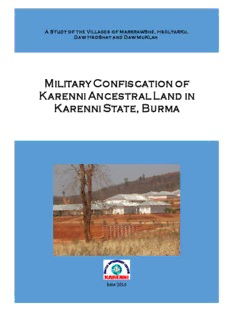
Photograph: No. 14 Military Advanced Training School, MarkrawShe, February 18, 2015.
ii
Military Confiscation of Karenni
Ancestral Land in Karenni State, Burma:
A Study of the Villages of MarkrawShe, HsolyarKu,
Daw HsoShay and Daw MuKlah
Prepared by: Aung Sun Myint Steven
Coordinator of Karenni Social Development
Center
Researched by: Alumni of Karenni Social Development Center
Edited and Translated by:
Foreign volunteers and teachers and the Alumni
of Karenni Social Development Center
June 2016
iii
Table of Contents
Acknowledgements ........................................................................................ 3
Methodology................................................................................................ 3
Research Objectives ....................................................................................... 3
Executive Summary ........................................................................................ 5
Introduction ................................................................................................. 7
History of Karenni State ................................................................................... 7
Karenni National Progressive Party ..........................................................................................8
Peace Process.........................................................................................................................9
MarkrawShe............................................................................................... 11
Map of MarkrawShe village............................................................................................... 11
History of MarkrawShe ......................................................................................................... 11
Land Confiscation and Related Problems................................................................................ 12
Villager Resistance ................................................................................................................ 16
The Current Situation for the Villagers ................................................................................... 16
HsolyarKu .................................................................................................. 19
Map of HsolyarKu village................................................................................................... 19
History of HsolyarKu ............................................................................................................. 19
Land Confiscation and Related Problems................................................................................ 20
Daw HsoShay.............................................................................................. 22
Map of Daw HsoShay village ............................................................................................. 22
History of Daw HsoShay ........................................................................................................ 22
Land Confiscation and Related Problems................................................................................ 23
Daw MuKlah............................................................................................... 25
Map of Daw MuKlah village .............................................................................................. 25
History of Daw MuKlah ......................................................................................................... 25
Land Confiscation and Related Problems................................................................................ 26
Other Problems Encountered by the Villagers from Losing their Land......................... 27
Education............................................................................................................................. 27
Health .................................................................................................................................. 28
Food and Livelihood.............................................................................................................. 28
Conclusion ................................................................................................. 28
Recommendations ....................................................................................... 29
Recommendations to the new NLD government:.................................................................... 29
Recommendations to the KNPP: ............................................................................................ 29
Recommendations to NGOs: ................................................................................................. 30
Appendices ................................................................................................ 30
Appendix A – Maps of Karenni State, Burma .......................................................................... 31
Appendix B – Photographs .................................................................................................... 33
Page | 1
Appendix C: Transcripts of 40 villager testimonies translated into English ................................ 39
2
Acknowledgements
We would like to thank everyone who supported us so that we could conduct this
research and compile this report. Thank you also to our Karenni Social Development
Center coordinator, Aung Sun Myint Steven, and to our donors for supporting us with
materials. Thank you to the villagers in Karenni State who assisted us in our research
and gave us valuable information for this study.
Methodology
This report is based on direct testimony provided through interviews with 40 villagers
between February 16 and March 28, 2015. The villagers come from four villages in
Karenni State: MarkrawShe, HsolyarKu, Daw HsoShay and Daw MuKlah. Interviews
were conducted in the Karenni language and in the Burmese language by two graduates
of the Karenni Social Development Center, researchers Aung and Myint,1 and later
translated into Burmese and English by one of the researchers and foreign volunteers.
All photographs that are used in this study were taken by the two researchers during the
same period of time.
The historical information about Karenni State is taken from a variety of secondary
sources in order to provide a picture of the complex history of conflict in the region. At
the time of writing Burma has recently transitioned to a new government. The outgoing
government (led by President Thein Sein) was replaced by the National League for
Democracy (NLD) government following elections in November 2015. President Htin
Kyaw was sworn in as the new President at the end of March 2016.
The general conclusions in this report are based on the information provided by the
villagers in their interviews and the observations of the researchers. Every effort has
been made to objectively transcribe and translate the testimony of the villagers. Due to
time, budget and security limitations, the study only focuses on four villages in Karenni
State, and does not comment on land confiscation that has occurred in other areas within
the region. Due to the lack of published qualitative and quantitative data documenting
land confiscation in Karenni State, as well as resource constraints, the main body of this
report does not include references to secondary sources analysing the problem.
Research Objectives
To provide assistance and hope to the Karenni people who have lost their
ancestral land.
1 Names of researchers have been changed for safety and security reasons.
3
To improve the human rights situation in Karenni State by providing the villagers
with information and knowledge about citizens’ rights.
To document the process of land confiscation and the related problems that the
Karenni villagers are facing in order to bring awareness to the international
community and to hold the government accountable.
To provide political leaders with specific action-based recommendations to
support effective solutions to the land confiscation problem.
4
Executive Summary
In Karenni State, the people and their ancestors have traditionally depended on
agricultural land for their livelihood. The traditional way of life of the Karenni people
has been complicated by the unlawful confiscation of villagers’ ancestral lands by the
Burmese military which intensified after the leaders of the different ethnic groups in
Burma signed ceasefire agreements with the Burmese government between 2011 and
2013. Some of the interviewed villagers see the confiscations as a continuation of the
Burmese military's aggression in the area after the ceasefire. Decades of conflict have
made the local people fear the Burmese military.
While a study of the situation across the entire state is beyond the scope of this project,
the research presented in this report hopes to provide a picture of a larger trend across the
region. The main focus of this study is on four farming villages in Karenni State. These
villages are MarkrawShe (in MarkrawShe village tract), HsolyarKu (an urban area), Daw
HsoShay (in Law Pi Ta village tract), and Daw MuKlah (in Chit Kel village tract). The
ancestors of the villagers in these four villages have used their lands for generations,
following a traditional way of farming known as shifting cultivation agriculture. This
way of life has been complicated by the unlawful confiscation of local lands by the
Burmese military, claiming that land used for shifting agriculture is vacant, abandoned
land. The military has referred to a 2012 enacted “land law,” which says that
uncultivated land belongs to the state,2 to justify the military’s confiscation of villagers’
traditional land.
The confiscation of traditional farming land has caused problems for the local people
who are unable to plant and harvest food. As a result, local people do not have enough
food to eat or enough income to provide for their basic needs. They are unable to pay for
their children to attend school. They are unable to pay for hospital fees. People whose
land has been confiscated are suffering from stress and health problems. Many villagers
are in conflict with the military because they do not want to lose their ancestors’ land.
The military has claimed it is developing the areas by bringing roads and electricity to the
villagers. In reality, villagers have explained that the roads are built to replace older roads
that crossed the areas where a military compound was built on confiscated lands. The
roads are poorly made dirt roads that do not contribute to the development of the areas.
The villagers have been told by the military to build electric poles and have been
promised a share of the electricity that goes through their villages, but in fact, the
electricity is solely used by the military compound. The military has offered some
compensation to some villagers for the land that has been confiscated, but it has not been
satisfactory to the villagers, as the compensation has been below market value and does
2 In March 2012, Burma’s Parliament passed the Vacant, Fallow and Virgin Lands Management Law,
Pyidaungsu Hluttaw, No. 10, 2012 and Farmland Law, Pyidaungsu Hluttaw, No. 11, 2012. These laws
codify a broad government right to expropriate land.
5
not allow the villagers to continue their traditional way of life by depending on
agriculture.
It is difficult to provide an exact estimate of the size of the land that has been confiscated,
as there is no formal written documentation system of land ownership in these four
villages. By villagers’ accounts, it is approximately 10,300 acres across the four villages.
Land confiscated from villagers in MarkrawShe is being used as a military training
ground. The Burmese military has cleared large portions of the land of vegetation and
levelled large portions of the ground for this purpose. They have used cement, steel, and
other permanent building materials to build a military base, as well as landing pads for
helicopters. The military base is large and intimidating to the villagers.
In HsolyarKu, Daw HsoShay, and Daw MuKlah, the military simply controls the land.
Villagers report that the military does not use the land but they have not returned it to the
villagers.
According to villager testimony, just prior to the villager interviews in HsolyarKu, five
farmers were arrested by the Burmese military for working on their farms. In Daw
HsoShay 10 people were arrested in the same way. They were taken to court and put on
trial for trespassing on land in the military-occupied area. Some of the farmers who were
prosecuted had no education and no knowledge of the law. The trials used up a lot of the
farmers’ time, preventing them from being able to work and earn money. Villagers
reported that many of the farmers involved became poorer because of this process and the
worry, fear, and anxiety that they have felt has affected their health.
People whose land has been confiscated have started organizing demonstrations in
MarkrawShe. The villagers from all four villages have sent letters to local administrators
as well as state officials and continue to work together against the military. Despite all of
this, they are beginning to feel hopeless. They no longer believe that they will get back
their land.
6
Introduction
The people of Karenni State have depended on their land for their agricultural livelihood
for many generations. They use their land following traditional methods of farming,
depending on three main crops: rice, beans, and corn. When the rainy season starts in
May, farmers in Karenni State begin to prepare their farm and plant their crops. After
they harvest the crops, the land is left fallow for a period of time. This is known as
shifting cultivation agriculture.3
The traditional way of life of the Karenni people has been complicated by the unlawful
confiscation of villagers’ ancestral lands by the Burmese military. While land
confiscation has occurred since the 1990s, the practice of the military seizing local land
has intensified since the signing of the ceasefire agreement between the Burmese
government and the leaders of the different ethnic groups between 2011 and 2013. While
a look at the situation across the entire state is beyond the scope of this report, this study
hopes to provide a picture of a larger trend across the region. This report focuses on four
villages in Karenni State: MarkrawShe (in MarkrawShe village tract), HsolyarKu (an
urban area), Daw HsoShay (in Law Pi Ta village tract) and Daw MuKlah (in Chit Kel
village tract). It draws from direct testimony of local farmers to explain how villagers’
lives have been disrupted by the confiscation of their ancestral lands, and the problems
that they have encountered following the loss of their land.
History of Karenni State
Karenni State is the smallest state in Burma, both geographically as well as in population
size, with a total population of approximately 287,000.4 Shan State is to the north. Karen
State is to the south. Thailand is to the east. There are many diverse ethnic groups living
in Karenni State. Some examples are PeKu, Kayah, Kayan, Kayaw, YinThaLe, and
ManuManaw.
Long ago, Karenni State was an independent state ruled by the Karenni kings. On 21
June 1875, the British government representative, Sir Douglas Forsyth, and the Burman
minister of foreign affairs, King Wounmingui, signed an agreement recognising Karenni
State as an independent state.5 After the British annexed Burma in 1885, they started to
3 Shifting cultivation agriculture preserves soil fertility by field rotation. An area of land is cleared
and cultivated for a short period of time, then it is left to return to its natural vegetation for a longer
period of time, while the cultivator moves to another area. See: definition of “shifting agriculture,”
2016 Encyclopaedia Britannica Inc., online: http://www.britannica.com/topic/shifting-agriculture.
4 UNDP Myanmar, The State of Local Governance: Trends in Kayah, 2014 at p.1, online:
http://www.mm.undp.org/content/myanmar/en/home/library/poverty/TheStateofLocalGovernan
ceChin/the-state-of-local-governance-in-kayah-state.html.
5 Karenni Independence Through Education, “The Karenni: About the Karenni,” online:
http://www.karenni.org/about_the_karenni.php.
7
Description:Ancestral Land in Karenni State, Burma: A Study June 2016 The villagers of MarkrawShe had to carry water from a spring called Htyae Ra Khu,14 13 festival, where they would bring offerings to the creator god and ask for a.