Table Of Contentliterature
McDougal Littell
ii
acknowledgments
introductory unit
Houghton Mifflin: Excerpt from Number the Stars by Lois Lowry. Copyright © 1989 by Lois Lowry.
All rights reserved. Reprinted by permission of Houghton Mifflin Company.
Simon & Schuster: “Quilt,” from A Suitcase of Seaweed and Other Poems by Janet S. Wong.
Copyright © 1996 by Janet S. Wong. Reprinted with the permission of Margaret K. McElderry Books,
an imprint of Simon & Schuster Children’s Publishing Division.
Plays/Sterling Partners Inc.: Excerpt from “The Little Princess” by Frances Hodgson Burnett, adapted
by Adele Than, from Plays from Famous Stories and Fairy Tales and Plays, the Drama Magazine for Young
People. Copyright © 1989 and © 1985. Reprinted with the permission of the Publisher Plays/Sterling
Partners, Inc., P.O. Box 60016, Newton, MA 02460.
Sterling Lord Literistic: Excerpt from Steven Spielberg: Crazy for Movies by Susan Goldman Rubin.
Copyright © 2001 by Susan Goldman Rubin. Reprinted by permission of Sterling Lord Literistic, Inc.
Francisco Jiménez: Excerpt from “The Circuit” by Francisco Jiménez from Arizona Quarterly.
Autumn 1973. Reprinted by permission of Francisco Jiménez.
Continued on page R142
art credits
cover, title page
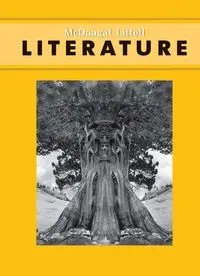
Detail of Tree Goddess (1994), Jerry N. Uelsmann. © Jerry N. Uelsmann.
Continued on page R148
Copyright © 2008 by McDougal Littell, a division of Houghton Mifflin Company. All rights reserved.
Warning: No part of this work may be reproduced or transmitted in any form or by any means, electronic
or mechanical, including photocopying and recording, or by any information storage or retrieval system
without the prior written permission of McDougal Littell unless such copying is expressly permitted by
federal copyright law. With the exception of not-for-profit transcription in Braille, McDougal Littell is
not authorized to grant permission for further uses of copyrighted selections reprinted in this text without
the permission of their owners. Permission must be obtained from the individual copyright owners as
identified herein. Address inquiries to Supervisor, Rights and Permissions, McDougal Littell, P.O. Box 1667,
Evanston, IL 60204.
ISBN 13: 978-0-618-56864-2
ISBN 10: 0-618-56864-6
Printed in the United States of America.
1 2 3 4 5 6 7 8 9—CKI—12 11 10 09 08
literature
McDougal Littell
Janet Allen
Arthur N. Applebee
Jim Burke
Douglas Carnine
Yvette Jackson
Robert T. Jiménez
Judith A. Langer
Robert J. Marzano
Mary Lou McCloskey
Donna M. Ogle
Carol Booth Olson
Lydia Stack
Carol Ann Tomlinson
EVANSTON, ILLINOIS • BOSTON • DALLAS
janet allen Reading and Literacy Specialist; creator of the popular “It’s Never Too Late”/“Reading
for Life” Institutes. Dr. Allen is an internationally known consultant who specializes in literacy work
with at-risk students. Her publications include Tools for Content Literacy; It’s Never Too Late: Leading
Adolescents to Lifelong Learning; Yellow Brick Roads: Shared and Guided Paths to Independent Reading;
Words, Words, Words: Teaching Vocabulary in Grades 4–12; and Testing 1, 2, 3 . . . Bridging Best Practice
and High-Stakes Assessments. Dr. Allen was a high school reading and English teacher for more than
20 years and has taught courses in both subjects at the University of Central Florida. She directed the
Central Florida Writing Project and received the Milken Foundation National Educator Award.
arthur n. applebee Leading Professor, School of Education at the University at Albany, State
University of New York; Director of the Center on English Learning and Achievement. During his varied
career, Dr. Applebee has been both a researcher and a teacher, working in institutional settings with
children with severe learning problems, in public schools, as a staff member of the National Council
of Teachers of English, and in professional education. Among his many books are Curriculum as
Conversation: Transforming Traditions of Teaching and Learning; Literature in the Secondary School:
Studies of Curriculum and Instruction in the United States; and Tradition and Reform in the Teaching of
English: A History. He was elected to the International Reading Hall of Fame and has received, among
other honors, the David H. Russell Award for Distinguished Research in the Teaching of English.
jim burke Lecturer and Author; Teacher of English at Burlingame High School, Burlingame,
California. Mr. Burke is a popular presenter at educational conferences across the country and is the
author of numerous books for teachers, including School Smarts: The Four Cs of Academic Success; The
English Teacher’s Companion; Reading Reminders; Writing Reminders; and ACCESSing School: Teaching
Struggling Readers to Achieve Academic and Personal Success. He is the recipient of NCTE’s Exemplary
English Leadership Award and was inducted into the California Reading Association’s Hall of Fame.
douglas carnine Professor of Education at the University of Oregon; Director of the Western
Region Reading First Technical Assistance Center. Dr. Carnine is nationally known for his focus on
research-based practices in education, especially curriculum designs that prepare instructors of K–12
students. He has received the Lifetime Achievement Award from the Council for Exceptional Children
and the Ersted Award for outstanding teaching at the University of Oregon. Dr. Carnine frequently
consults on educational policy with government groups, businesses, communities, and teacher unions.
yvette jackson Executive Director of the National Urban Alliance for Effective Education.
Nationally recognized for her work in assessing the learning potential of underachieving urban students,
Dr. Jackson is also a presenter for the Harvard Principal Center and is a member of the Differentiation
Faculty of the Association for Supervision and Curriculum Development. Dr. Jackson’s research focuses
on literacy, gifted education, and cognitive mediation theory. She designed the Comprehensive
Education Plan for the New York City Public Schools and has served as their Director of Gifted Programs
and Executive Director of Instruction and Professional Development.
robert t. jiménez Professor of Language, Literacy, and Culture at Vanderbilt University. Dr.
Jiménez’s research focuses on the language and literacy practices of Latino students. A former bilingual
education teacher, he is now conducting research on how written language is thought about and used
in contemporary Mexico. Dr. Jiménez has received several research and teaching honors, including two
Fulbright awards from the Council for the International Exchange of Scholars and the Albert J. Harris
Award from the International Reading Association. His published work has appeared in the American
Educational Research Journal, Reading Research Quarterly, The Reading Teacher, Journal of Adolescent
and Adult Literacy, and Lectura y Vida.
senior program consultants
iv
judith a. langer Distinguished Professor at the University at Albany, State University of New
York; Director of the Center on English Learning and Achievement; Director of the Albany Institute for
Research in Education. An internationally known scholar in English language arts education, Dr. Langer
specializes in developing teaching approaches that can enrich and improve what gets done on a daily
basis in classrooms. Her publications include Getting to Excellent: How to Create Better Schools and
Effective Literacy Instruction: Building Successful Reading and Writing Programs. She was inducted
into the International Reading Hall of Fame and has received many other notable awards, including an
honorary doctorate from the University of Uppsala, Sweden, for her research on literacy education.
robert j. marzano Senior Scholar at Mid-Continent Research for Education and Learning
(McREL); Associate Professor at Cardinal Stritch University in Milwaukee, Wisconsin; President of
Marzano & Associates. An internationally known researcher, trainer, and speaker, Dr. Marzano has
developed programs that translate research and theory into practical tools for K–12 teachers and
administrators. He has written extensively on such topics as reading and writing instruction, thinking
skills, school effectiveness, assessment, and standards implementation. His books include Building
Background Knowledge for Academic Achievement; Classroom Management That Works: Research-
Based Strategies for Every Teacher; and What Works in Schools: Translating Research Into Action.
donna m. ogle Professor of Reading and Language at National-Louis University in Chicago,
Illinois; Past President of the International Reading Association. Creator of the well-known KWL strategy,
Dr. Ogle has directed many staff development projects translating theory and research into school
practice in middle and secondary schools throughout the United States and has served as a consultant
on literacy projects worldwide. Her extensive international experience includes coordinating the
Reading and Writing for Critical Thinking Project in Eastern Europe, developing integrated curriculum
for a USAID Afghan Education Project, and speaking and consulting on projects in several Latin American
countries and in Asia. Her books include Coming Together as Readers; Reading Comprehension: Strategies
for Independent Learners; All Children Read; and Literacy for a Democratic Society.
carol booth olson Senior Lecturer in the Department of Education at the University of
California, Irvine; Director of the UCI site of the National Writing Project. Dr. Olson writes and lectures
extensively on the reading/writing connection, critical thinking through writing, interactive strategies
for teaching writing, and the use of multicultural literature with students of culturally diverse
backgrounds. She has received many awards, including the California Association of Teachers of English
Award of Merit, the Outstanding California Education Research Award, and the UC Irvine Excellence in
Teaching Award. Dr. Olson’s books include Reading, Thinking, and Writing About Multicultural Literature
and The Reading/Writing Connection: Strategies for Teaching and Learning in the Secondary Classroom.
carol ann tomlinson Professor of Educational Research, Foundations, and Policy at the
University of Virginia; Co-Director of the University’s Institutes on Academic Diversity. An internationally
known expert on differentiated instruction, Dr. Tomlinson helps teachers and administrators develop
effective methods of teaching academically diverse learners. She was a teacher of middle and high
school English for 22 years prior to teaching at the University of Virginia. Her books on differentiated
instruction have been translated into eight languages. Among her many publications are How to
Differentiate Instruction in Mixed-Ability Classrooms and The Differentiated Classroom: Responding to
the Needs of All Learners.
v
english learner specialists
mary lou mCcloskey Past President of Teachers of English to Speakers of Other Languages
(TESOL); Director of Teacher Development and Curriculum Design for Educo in Atlanta, Georgia. Dr.
McCloskey is a former teacher in multilingual and multicultural classrooms. She has worked with
teachers, teacher educators, and departments of education around the world on teaching English as a
second and foreign language. She is author of On Our Way to English, Voices in Literature, Integrating
English, and Visions: Language, Literature, Content. Her awards include the Le Moyne College Ignatian
Award for Professional Achievement and the TESOL D. Scott Enright Service Award.
lydia stack International ESL consultant. Her areas of expertise are English language teaching
strategies, ESL standards for students and teachers, and curriculum writing. Her teaching experience
includes 25 years as an elementary and high school ESL teacher. She is a past president of TESOL.
Her awards include the James E. Alatis Award for Service to TESOL (2003) and the San Francisco STAR
Teacher Award (1989). Her publications include On Our Way to English; Wordways: Games for Language
Learning; and Visions: Language, Literature, Content.
curriculum specialist
william l. mCbride Curriculum Specialist. Dr. McBride is a nationally known speaker, educator,
and author who now trains teachers in instructional methodologies. A former reading specialist,
English teacher, and social studies teacher, he holds a Masters in Reading and a Ph.D. in Curriculum
and Instruction from the University of North Carolina at Chapel Hill. Dr. McBride has contributed
to the development of textbook series in language arts, social studies, science, and vocabulary. He is
also known for his novel Entertaining an Elephant, which tells the story of a burned-out teacher who
becomes re-inspired with both his profession and his life.
media specialists
david m. considine Professor of Instructional Technology and Media Studies at Appalachian
State University in North Carolina. Dr. Considine has served as a media literacy consultant to the U.S.
government and to the media industry, including Discovery Communications and Cable in the Classroom.
He has also conducted media literacy workshops and training for county and state health departments
across the United States. Among his many publications are Visual Messages: Integrating Imagery into
Instruction, and Imagine That: Developing Critical Viewing and Thinking Through Children’s Literature.
larkin pauluzzi Teacher and Media Specialist; trainer for the New Jersey Writing Project.
Ms. Pauluzzi puts her extensive classroom experience to use in developing teacher-friendly curriculum
materials and workshops in many different areas, including media literacy. She has led media literacy
training workshops in several districts throughout Texas, guiding teachers in the meaningful and
practical uses of media in the classroom. Ms. Pauluzzi has taught students at all levels, from Title I
Reading to AP English IV. She also spearheads a technology club at her school, working with students
to produce media and technology to serve both the school and the community.
lisa k. scheffler Teacher and Media Specialist. Ms. Scheffler has designed and taught media
literacy and video production curriculum, in addition to teaching language arts and speech. Using her
knowledge of mass communication theory, coupled with real classroom experience, she has developed
ready-to-use materials that help teachers incorporate media literacy into their curricula. She has
taught film and television studies at the University of North Texas and has served as a contributing
writer for the Texas Education Agency’s statewide viewing and representing curriculum.
vi
Virginia L. Alford, MacArthur
High School, San Antonio, Texas
Yvonne L. Allen, Shaker Heights
High School, Shaker Heights,
Ohio
Dave T. Anderson, Hinsdale
South High School, Darien,
Illinois
Kacy Colleen Anglim, Portland
Public Schools District,
Portland, Oregon
Beverly Scott Bass, Arlington
Heights High School, Fort
Worth, Texas
Jordana Benone, North High
School, Torrance, California
Patricia Blood, Howell High
School, Farmingdale, New
Jersey
Marjorie Bloom, Eau Gallie
High School, Melbourne,
Florida
Edward J. Blotzer, Wilkinsburg
Junior/Senior High School,
Wilkinsburg, Pennsylvania
Stephen D. Bournes, Evanston
Township High School,
Evanston, Illinois
Barbara M. Bowling, Mt. Tabor
High School, Winston-Salem,
North Carolina
Kiala Boykin-Givehand,
Duval County Public Schools,
Jacksonville, Florida
Laura L. Brown, Adlai
Stevenson High School,
Lincolnshire, Illinois
Cynthia Burke, Yavneh
Academy, Dallas, Texas
Hoppy Chandler, San Diego
City Schools, San Diego,
California
Gary Chmielewski, St. Benedict
High School, Chicago, Illinois
Delorse Cole-Stewart,
Milwaukee Public Schools,
Milwaukee, Wisconsin
Kathy Dahlgren, Skokie,
Illinois
Diana Dilger, Rosa Parks
Middle School, Dixmoor,
Illinois
L. Calvin Dillon, Gaither High
School, Tampa, Florida
Dori Dolata, Rufus King High
School, Milwaukee, Wisconsin
Jon Epstein, Marietta High
School, Marietta, Georgia
Helen Ervin, Fort Bend
Independent School District,
Sugarland, Texas
Sue Friedman, Buffalo Grove
High School, Buffalo Grove,
Illinois
Chris Gee, Bel Air High School,
El Paso, Texas
Paula Grasel, The Horizon
Center, Gainesville, Georgia
Christopher Guarraia,
Centreville High School,
Clifton, Virginia
Rochelle L. Greene-Brady,
Kenwood Academy, Chicago,
Illinois
Michele M. Hettinger, Niles
West High School, Skokie,
Illinois
Elizabeth Holcomb, Forest
Hill High School, Jackson,
Mississippi
Jim Horan, Hinsdale Central
High School, Hinsdale, Illinois
James Paul Hunter, Oak Park-
River Forest High School, Oak
Park, Illinois
Susan P. Kelly, Director of
Curriculum, Island Trees School
District, Levittown, New York
Beverley A. Lanier, Varina High
School, Richmond, Virginia
Pat Laws, Charlotte-
Mecklenburg Schools,
Charlotte, North Carolina
Diana R. Martinez, Treviño
School of Communications &
Fine Arts, Laredo, Texas
Natalie Martinez, Stephen F.
Austin High School, Houston,
Texas
Elizabeth Matarazzo, Ysleta
High School, El Paso, Texas
Carol M. McDonald, J. Frank
Dobie High School, Houston,
Texas
Amy Millikan, Consultant,
Chicago, Illinois
Terri Morgan, Caprock High
School, Amarillo, Texas
Eileen Murphy, Walter Payton
Preparatory High School,
Chicago, Illinois
Lisa Omark, New Haven
Public Schools, New Haven,
Connecticut
Kaine Osburn, Wheeling High
School, Wheeling, Illinois
Andrea J. Phillips, Terry Sanford
High School, Fayetteville, North
Carolina
Cathy Reilly, Sayreville Public
Schools, Sayreville, New Jersey
Mark D. Simon, Neuqua Valley
High School, Naperville, Illinois
Scott Snow, Sequin High
School, Arlington, Texas
Jane W. Speidel, Brevard
County Schools, Viera, Florida
Cheryl E. Sullivan, Lisle
Community School District,
Lisle, Illinois
Anita Usmiani, Hamilton
Township Public Schools,
Hamilton Square, New Jersey
Linda Valdez, Oxnard Union
High School District, Oxnard,
California
Nancy Walker, Longview High
School, Longview, Texas
Kurt Weiler, New Trier High
School, Winnetka, Illinois
Elizabeth Whittaker, Larkin
High School, Elgin, Illinois
Linda S. Williams, Woodlawn
High School, Baltimore,
Maryland
John R. Williamson, Fort
Thomas Independent Schools,
Fort Thomas, Kentucky
Anna N. Winters, Simeon High
School, Chicago, Illinois
Tonora D. Wyckoff, North Shore
Senior High School, Houston,
Texas
Karen Zajac, Glenbard South
High School, Glen Ellyn, Illinois
Cynthia Zimmerman, Mose
Vines Preparatory High School,
Chicago, Illinois
Lynda Zimmerman, El Camino
High School, South San
Francisco, California
Ruth E. Zurich, Brown Deer
High School, Brown Deer,
Wisconsin
teacher advisors
These are some of the many educators from across the country who played a crucial role in the
development of the tables of contents, the lesson design, and other key components of this program:
vii
part 1: literary elements
what’s happening?
unit 1
Plot, Confl ict, and Setting
reader’s workshop: Setting, Confl ict, Plot
writing workshop: Writing a Short Story
person to person
unit 2
Analyzing Character and Point of View
reader’s workshop: Character, Narrator, Point of
View, Methods of Characterization
writing workshop: Describing a Person
the big idea
unit 3
Understanding Theme
reader’s workshop: Identifying Theme
writing workshop: Analyzing a Story
part 2: language and culture
writer’s craft
unit 4 Mood, Tone, and Style
reader’s workshop: Mood, Tone, Style
writing workshop: Comparison-and-Contrast Essay
word pictures
unit 5
The Language of Poetry
reader’s workshop: Form, Speaker, Sound
Devices, Imagery, Figurative Language
writing workshop: Personal Response to a Poem
timeless tales
unit 6 Myths, Legends, and Tales
reader’s workshop: Characteristics of Traditional
Stories, Cultural Values in Traditional Stories
writing workshop: Problem-Solution Essay
introductory unit
The Power of Ideas
reading literature workshop
• Fiction
• Poetry
• Drama
• Nonfi ction and Informational Texts
• Types of Media
reading strategies workshop
• Preview
• Set a Purpose
• Connect
• Use Prior Knowledge
• Predict
• Visualize
• Monitor
• Make Inferences
writing process workshop
• Writing Process Review
• Key Traits
viii
contents in brief
mcdougal littell literature
part 3: focus on nonf iction
life stories
unit 7
Biography and Autobiography
reader’s workshop: Characteristics of
Biographies and Autobiographies
writing workshop: Personal Narrative
know the facts
unit 8 Information, Argument,
and Persuasion
reader’s workshop: Text Features, Preview,
Main Idea and Supporting Details, Take Notes
reader’s workshop: Claim, Support, Persuasive
Techniques
writing workshop: Persuasive Essay
investigation and discovery
unit 9 The Power of Research
research strategies workshop: Choosing and
Evaluating Sources, Collecting Data
writing workshop: Research Report
student resource bank
reading handbook
writing handbook
grammar handbook
vocabulary and spelling handbook
speaking and listening handbook
media handbook
test-taking handbook
glossaries
literature and reading center
• Author Biographies
• Additional Selection Background
• Literary Analysis Frames
• Power Thinking Activities
writing and grammar center
• Writing Templates and Graphic Organizers
• Publishing Options
• Quick-Fix Editing Machine
vocabulary and spelling center
• Vocabulary Strategies and Practice
• Multi-Language Glossary of Academic
Vocabulary
• Vocabulary Flash-Cards
• Spelling Lessons
media center
• Production Templates
• Analysis Guides
research center
• Web Research Guide
• Citation Guide
assessment center
• Assessment Practice and Test-Taking Tips
• SAT/ACT Practice and Tips
more technology
eEdition
• Interactive Selections
• Audio Summaries
WriteSmart
• Writing Prompts and Templates
• Interactive Student Models
• Interactive Graphic Organizers
• Interactive Revision Lessons
• Rubric Generator
MediaSmart DVD
• Media Lessons
• Interactive Media Studies
ix
classzone.com
l i t e r at ur e
unit
x
1
What’s Happening?
plot, conflict,
and setting
• in fiction • in nonfiction • in poetry • in drama • in media
reader’s workshop: what makes a good story?
24
short story
Boar Out There
Cynthia Rylant
28
fiction
short story
The School Play
Gary Soto
30
short story
The Good Deed
Marion Dane Bauer
42
Connect
The Pasture poem
Robert Frost
58
short story
All Summer in a Day
Ray Bradbury
62
Reading for Information
Weather That’s Out of This World! magazine article
75
Space Settlements online article
76
Artists’ Views of a Space Colony illustrations
80
short story
Lob’s Girl
Joan Aiken
82
Great Reads: Historical Novel
from Bud, Not Buddy a newbery medal winner
Christopher Paul Curtis
100
Skills and Standards
Setting, Characters, Conflict,
Stages of Plot
Plot, Monitor
Conflict, Connect
Setting, Make Inferences
Use Text Features,
Compare and Contrast
Foreshadowing,
Identify Sequence
xi
media
film clip
from Lemony Snicket’s A Series
media
smart
dvd
106
of Unfortunate Events
nonfiction
memoir
from Woodsong
Gary Paulsen
110
Reading for Information
A Life in the Day of Gary Paulsen newspaper article
118
memoir
The Horse Snake from The Land I Lost
Huynh Quang Nhuong
122
Reading for Information
Le Mat Village Holds On to
Snake Catching Tradition radio transcript
133
poetry
poem
The Walrus and the Carpenter
Lewis Carroll
134
drama
drama
The Prince and the Pauper
Mark Twain
142
dramatized by Joellen Bland
writing workshop: short story
158
speaking and listening: telling a story
165
assessment practice: plot, conflict, and setting
166
short story
The Fish Story
Mary Lou Brooks
more great reads: ideas for independent reading
172
vocabulary strategies
Denotations and connotations, p. 40
Literal and figurative meanings, p. 98
Suffixes, p. 60
Prefixes and Latin roots: ject, p. 120
Synonyms, p. 72
Word origins, p. 132
Skills and Standards
Setting and Conflict in Movies
Setting in Nonfiction,
Identify Author’s Purpose
Narrative Nonfiction,
Trace Chronological Order
Narrative Poetry, Visualize
Conflict in Drama,
Strategies for Reading a Play
Organization, Revision
Stages of Plot, Setting, Conflict,
Sequence, Make Inferences
unit
xii
2
Person to Person
analyzing character
and point of view
• in fiction • in nonfiction • in poetry • in media
reader’s workshop: character and point of view
176
fiction
short story
Eleven
Sandra Cisneros
182
short story
Ghost of the Lagoon
Armstrong Sperry
190
short story
Tuesday of the Other June
Norma Fox Mazer
204
Connect
Primer poem
Rita Dove
218
Reading for Information
The Problem with Bullies magazine article
223
comparing characters
short story
President Cleveland, Where Are You?
Robert Cormier
228
short story
Aaron’s Gift
Myron Levoy
242
Skills and Standards
Character, Narrator,
Point of View,
Methods of Characterization
First-Person Point of View,
Connect
Third-Person Point of View,
Predict
Characterization, Visualize
Take Notes,
Develop Research Questions
Character,
Set a Purpose for Reading
xiii
Skills and Standards
TV Characters
Personal Essay,
Identify Author’s Purpose
Author’s Perspective,
Identify Symbol
Speaker, Strategies
for Reading Poetry
Sensory Details
Point of View, Character,
Characterization, Visualize
media
television clip
from Smallville
media
smart
dvd
254
nonfiction
essay
Role-Playing and Discovery
Jerry Pinkney
258
Reading for Information
Invisible Hero magazine article
265
memoir
The Red Guards from Red Scarf Girl
Ji-li Jiang
266
Reading for Information
An Interview with Ji-li Jiang interview
276
poetry
poem
Life Doesn’t Frighten Me
Maya Angelou
280
poem
On Turning Ten
Billy Collins
285
writing workshop: describing a person
288
speaking and listening: interview
295
assessment practice: character and point of view
296
short story
from Phoenix Farm
Jane Yolen
novel
from Ruby Holler
Sharon Creech
more great reads: ideas for independent reading
302
vocabulary strategies
Easily confused words, p. 189
Context clues, p. 252
Words for water, p. 202
Latin roots: press, p. 264
Figurative language, p. 220
Prefixes that mean “not,” p. 278
unit
xiv
The Big Idea
understanding theme
• in fiction • in poetry
reader’s workshop: understanding theme
306
japanese folk tale
Gombei and the Wild Ducks
Yoshiko Uchida
309
fiction
short story
The Dog of Pompeii
Louis Untermeyer
312
Reading for Information
from In Search of Pompeii book excerpt
329
Italians Trying to Prevent a
Modern Pompeii online article
334
short story
Nadia the Willful
Sue Alexander
336
short story
Scout’s Honor
Avi
348
Reading for Information
Wilderness Survival handbook excerpt
365
3
Skills and Standards
Topic Versus Theme,
Clues to Theme, Identify Theme
Theme Versus Topic, Strategies
for Reading Historical Fiction
Synthesize,
Evaluate Historical Fiction
Conflict and Theme,
Compare and Contrast
Character and Theme,
Predict
xv
Skills and Standards
Fables,
Set a Purpose for Reading
Theme in Poetry, Visualize
Recurring Theme,
Make Inferences
Thesis, Evidence
Theme and Topic, Compare and
Contrast, Make Inferences
comparing fables
fable
Ant and Grasshopper
Aesop
366
retold by James Reeves
short story
The Richer, the Poorer
Dorothy West
370
Great Reads: Coming-of-Age Novel
from Esperanza Rising
Pam Muñoz Ryan
378
a pura belpré award winner
poetry
poem
Words Like Freedom
Langston Hughes
384
poem
Dreams
Langston Hughes
388
poem
Same Song
Pat Mora
390
poem
Without Commercials
Alice Walker
394
writing workshop: analyzing a story
398
speaking and listening: discussion
405
assessment practice: understanding theme
406
fable
The Wolf and the House Dog
Aesop
poem
Your World
Georgia Douglas Johnson
more great reads: ideas for independent reading
412
vocabulary strategies
Latin roots: rupt, p. 326
Slang, p. 363
Noun-forming suffixes, p. 346
Multiple-meaning words, p. 376