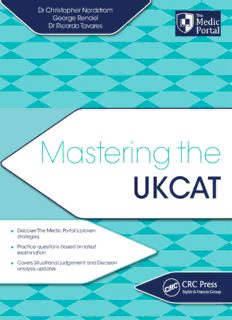
Table Of ContentDr Christopher Nordstrom
George Rendel
Mastering the Dr Ricardo Tavares
UKCAT
Drawing on The Medic Portal’s proven track record, Mastering the UKCAT takes
you, step by step, through the proven techniques that have helped thousands of
students achieve top UKCAT scores. Our expert authors deconstruct all question
types before highlighting core strategies, common pitfalls and top tips – as well as
the tactics examiners use to trip you up.
Uses The Medic Portal’s proven strategies for succeeding in the UKCAT
Provides repeatable methodology for every question type
Systematically takes candidates through worked examples
Mastering the
Explores common traps so you can avoid them on the day
Offers bite-sized chunks of information with its accessible design
Theory and numerous practice questions of the UKCAT:
UKCAT
Overview
Verbal reasoning
Quantitative reasoning
Abstract reasoning
Decision analysis
Situational judgement
N
Dr Christopher Nordstrom o Discover The Medic Portal’s proven
r
d
strategies
George Rendel st
r
o
T
am Practice questions based on latest
Dr Ricardo Tavares va, R examination
ree
sn
d Covers Situational judgement and Decision
e
l analysis updates
a
n
d
K24196
ISBN: 978-1-4822-5966-7
90000
9 781482 259667
K24196_Cover.indd All Pages 3/27/15 9:38 AM
Mastering
the UKCAT
Mastering
the UKCAT
Dr Christopher Nordstrom
George Rendel
Dr Ricardo Tavares
Mastering
the UKCAT
Dr Christopher Nordstrom
George Rendel
Dr Ricardo Tavares
0
8
8
9
7
8
4
3
4
1
7|
0
7
3
5
4
n|
ut
CRC Press
Taylor & Francis Group
6000 Broken Sound Parkway NW, Suite 300
Boca Raton, FL 33487-2742
© 2015 by Taylor & Francis Group, LLC
CRC Press is an imprint of Taylor & Francis Group, an Informa business
No claim to original U.S. Government works
Version Date: 20150402
International Standard Book Number-13: 978-1-4822-5967-4 (eBook - PDF)
This book contains information obtained from authentic and highly regarded sources. While all reasonable efforts have been made to
publish reliable data and information, neither the author[s] nor the publisher can accept any legal responsibility or liability for any errors
or omissions that may be made. The publishers wish to make clear that any views or opinions expressed in this book by individual editors,
authors or contributors are personal to them and do not necessarily reflect the views/opinions of the publishers. The information or guid-
ance contained in this book is intended for use by medical, scientific or health-care professionals and is provided strictly as a supplement
to the medical or other professional’s own judgement, their knowledge of the patient’s medical history, relevant manufacturer’s instruc-
tions and the appropriate best practice guidelines. Because of the rapid advances in medical science, any information or advice on dosages,
procedures or diagnoses should be independently verified. The reader is strongly urged to consult the relevant national drug formulary
and the drug companies’ and device or material manufacturers’ printed instructions, and their websites, before administering or utilizing
any of the drugs, devices or materials mentioned in this book. This book does not indicate whether a particular treatment is appropriate
or suitable for a particular individual. Ultimately it is the sole responsibility of the medical professional to make his or her own profes-
sional judgements, so as to advise and treat patients appropriately. The authors and publishers have also attempted to trace the copyright
holders of all material reproduced in this publication and apologize to copyright holders if permission to publish in this form has not been
obtained. If any copyright material has not been acknowledged please write and let us know so we may rectify in any future reprint.
Except as permitted under U.S. Copyright Law, no part of this book may be reprinted, reproduced, transmitted, or utilized in any form by
any electronic, mechanical, or other means, now known or hereafter invented, including photocopying, microfilming, and recording, or in
any information storage or retrieval system, without written permission from the publishers.
For permission to photocopy or use material electronically from this work, please access www.copyright.com (http://www.copyright.
com/) or contact the Copyright Clearance Center, Inc. (CCC), 222 Rosewood Drive, Danvers, MA 01923, 978-750-8400. CCC is a not-for-
profit organization that provides licenses and registration for a variety of users. For organizations that have been granted a photocopy
license by the CCC, a separate system of payment has been arranged.
Trademark Notice: Product or corporate names may be trademarks or registered trademarks, and are used only for identification and
explanation without intent to infringe.
Visit the Taylor & Francis Web site at
http://www.taylorandfrancis.com
and the CRC Press Web site at
http://www.crcpress.com
Contents
About the Authors .......................................................................................vii
Introduction ..................................................................................................ix
Chapter 1: Verbal Reasoning .....................................................................1
Chapter 2: Quantitative Reasoning ......................................................... 47
Chapter 3: Abstract Reasoning ................................................................85
Chapter 4: Decision Analysis ...................................................................131
Chapter 5: Situational Judgement Test ..................................................161
v
About the Authors
Dr Christopher Nordstrom graduated from University College London with a prize-winning
degree in medicine and a first-class honours degree in neuroscience. He undertook medical
training in London before starting specialist training in anaesthetics and critical care. Christopher
has been involved in medical education for over eight years and has received written praise for
his teaching from hospitals and universities, including Imperial College London and University
College London. His academic achievements include publications in world-renowned journals,
published original research and regular presentations at national and international conferences.
He is one of the UK’s leading UKCAT and BMAT tutors, regularly speaking at national events
including the Royal Society of Medicine’s Career Day and the Futurewise Careers Day.
George Rendel graduated from the University of Leeds with a prize-winning, first-class degree
in English. He has used his academic understanding of the English language and his experience
in journalism and publishing to become a leading expert in the verbal reasoning and essay-
writing components of the UKCAT and BMAT examinations. He has worked in educational
publishing for Pearson and in consulting for Accenture.
Dr Ricardo Tavares completed his prize-winning Medical Sciences Masters undergraduate
degree at Oxford University and went on to finish his medical MBBS training at University
College London Medical School. He carried out his foundation training within the Imperial
College Deanery before starting specialist registrar training in radiology. Ricardo has several
years of experience teaching medicine, both as part of a select group at Imperial College and as
a clinical methods teaching tutor for Imperial College medical students. He has been published
in leading international journals, spoken at numerous national conferences, and teaches on the
clinical MD programme for the University of Buckingham Internal Medicine degree.
vii
Introduction
Background
The United Kingdom Clinical Aptitude Test (UKCAT) was first introduced in 2006. Since
its introduction, it has been widely used by medical and dental schools across the UK to aid in
the selection of future doctors and dentists. Unlike the traditional A-Level and International
Baccalaureate examinations, the UKCAT tests aptitude, rather than knowledge. By focusing on
innate skills, it is designed to reduce the inequality which may arise between applicants from
different backgrounds. This helps to widen access into medicine and dentistry.
The UKCAT consists of a two-hour computerized test. This can be sat in Test Centres across
the UK. For international applicants, there are now official Test Centres in 89 countries, ensur-
ing almost all candidates have easy access to a Test Centre.
You can choose when you sit the examination. Testing dates are available from July to the start
of October, annually. Each student who takes the examination during this three-month window
will get a different combination of questions. This prevents students who sit the examination
later from finding out which questions will come up.
!
Top Tip: We recommend booking your test early, even if you wish to
sit it at the end of summer, as test dates fill up quickly and the price
increases.
The UKCAT examination consists of five sections, each testing a different skill set. These
sections are:
• Verbal Reasoning (VR)
• Quantitative Reasoning (QR)
• Abstract Reasoning (AR)
• Decision Analysis (DA)
• Situational Judgement Test (SJT)
The Verbal and Quantitative Reasoning sections are logical tests. They assess a candidate’s ability
to evaluate, problem-solve and draw conclusions, based on written and numerical information.
Abstract Reasoning tests both spatial awareness and pattern recognition. This helps to identify
your aptitude for constantly developing and modifying hypotheses. Decision Analysis, mean-
while, introduces complex information and tests your skills of logic and reasoning in the face of
uncertainty.
ix
Description:Drawing on The Medic Portal's proven track record, Mastering the UKCAT takes you, step by step, through the proven techniques that have helped thousands of students achieve top UKCAT scores. Our expert authors deconstruct all question types before highlighting core strategies, common pitfalls, and t