
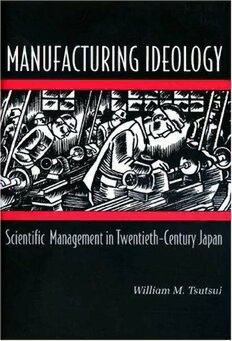
Download Manufacturing ideology: Scientific management in 20th-century Japan PDF Free - Full Version
Download Manufacturing ideology: Scientific management in 20th-century Japan by William M. Tsutsui in PDF format completely FREE. No registration required, no payment needed. Get instant access to this valuable resource on PDFdrive.to!
About Manufacturing ideology: Scientific management in 20th-century Japan
Japanese industry is the envy of the world for its efficient and humane management practices. Yet, as William Tsutsui argues, the origins and implications of "Japanese-style management" are poorly understood. Contrary to widespread belief, Japan's acclaimed strategies are not particularly novel or even especially Japanese. Tsutsui traces the roots of these practices to Scientific Management, or Taylorism, an American concept that arrived in Japan at the turn of the century. During subsequent decades, this imported model was embraced--and ultimately transformed--in Japan's industrial workshops. Imitation gave rise to innovation as Japanese managers sought a "revised" Taylorism that combined mechanistic efficiency with respect for the humanity of labor. Tsutsui's groundbreaking study charts Taylorism's Japanese incarnation, from the "efficiency movement" of the 1920s, through Depression-era "rationalization" and wartime mobilization, up to postwar "productivity" drives and quality-control campaigns. Taylorism became more than a management tool; its spread beyond the factory was a potent intellectual template in debates over economic growth, social policy, and political authority in modern Japan. Tsutsui's historical and comparative perspectives reveal the centrality of Japanese Taylorism to ongoing discussions of Japan's government-industry relations and the evolution of Fordist mass production. He compels us to rethink what implications Japanese-style management has for Western industries, as well as the future of Japan itself.
Detailed Information
| Author: | William M. Tsutsui |
|---|---|
| Publication Year: | 1998 |
| ISBN: | 9781400813698 |
| Pages: | 293 |
| Language: | English |
| File Size: | 1.76 |
| Format: | |
| Price: | FREE |
Safe & Secure Download - No registration required
Why Choose PDFdrive for Your Free Manufacturing ideology: Scientific management in 20th-century Japan Download?
- 100% Free: No hidden fees or subscriptions required for one book every day.
- No Registration: Immediate access is available without creating accounts for one book every day.
- Safe and Secure: Clean downloads without malware or viruses
- Multiple Formats: PDF, MOBI, Mpub,... optimized for all devices
- Educational Resource: Supporting knowledge sharing and learning
Frequently Asked Questions
Is it really free to download Manufacturing ideology: Scientific management in 20th-century Japan PDF?
Yes, on https://PDFdrive.to you can download Manufacturing ideology: Scientific management in 20th-century Japan by William M. Tsutsui completely free. We don't require any payment, subscription, or registration to access this PDF file. For 3 books every day.
How can I read Manufacturing ideology: Scientific management in 20th-century Japan on my mobile device?
After downloading Manufacturing ideology: Scientific management in 20th-century Japan PDF, you can open it with any PDF reader app on your phone or tablet. We recommend using Adobe Acrobat Reader, Apple Books, or Google Play Books for the best reading experience.
Is this the full version of Manufacturing ideology: Scientific management in 20th-century Japan?
Yes, this is the complete PDF version of Manufacturing ideology: Scientific management in 20th-century Japan by William M. Tsutsui. You will be able to read the entire content as in the printed version without missing any pages.
Is it legal to download Manufacturing ideology: Scientific management in 20th-century Japan PDF for free?
https://PDFdrive.to provides links to free educational resources available online. We do not store any files on our servers. Please be aware of copyright laws in your country before downloading.
The materials shared are intended for research, educational, and personal use in accordance with fair use principles.

