Table Of Content;l> '"%j
0 ~
0
::<:I H LONGACRE'S LEDGER
tx1 t-el !Z
Cf) PJ ~ (') Q
Cf) t-' 1 -.]0
0 ::J"t-'t'Il
(') ~~m t-';l>
0 tz1Q
~ t-'O'"zjClt'"' Vol. 1, No.1 January. 1991
It l-<>-:Itz1
t'Il .0 '..q 0
Cl t;;t:I I ::<:I>
>-:I 0 H\r.l!Z
H 0:><: ~ 0
0 ~ tfl Single Copy: $4.S0
Z 'OC"lOH
\O~l-<ClZ
::<:I -P-V1C;: HO
t'Il W O"tz1>H
,c0:: t0v ~ O>-3- <Z
tx1
Cf) Cl
>-:I t%j
tx1 Z
0 >-:I
I
f
Official Publication of the
FLYING EAGLE AND INDIAN CENT COLLECTORS SOCIETY
The "Fly-In Club"
LONGACRE'S LEDGER
FLYING EAGLE AND INDIAN CENT COLLECTORS SOCIETY
Official Publication of the
FLYING EAGLE AND INDIAN CENT COLLECTORS SOCIETY
The purpose· of the Flying Eagle and Indian Cent
Collectors Society is to promote the study and V,&JM{:=$==F:N6+}'$?\=?:::=i=;=='}{(}=}\='=:'}==()}}}'1{===::==:t)=:=U=)i?\NHi1@i#V;':qaHMj
collection of Longacre's design of small cents.
TABLE OF CONTENTS
Page
OFFICERS President's Report , 2
President Richard Snow Editor s Comment 3
f
Vice President/Florida Rep Bob Misbin
Vice President/Northeast Rep Henry Hettger Membership Report 4
Secretary Xan Chamberlain
Treasurer Charles Jones Announcements 4
Publisher/Editor Larry R. Steve
The Midnight Minter 6
by Richard Snow
Why Indian Cents? 11
by Bill Weikel, Ph.D.
The Illusive/Elusive Complete Set 14
by Larry R. Steve
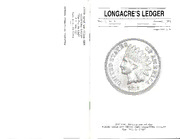
ON THE COVER
Collecting with a Purpose 16
1873 Closed 3 Doubled Die Type 1 by Q. David Bowers
This coin was cherry picked by a keen eyed And the Tribe is Still Gathering 19
collector at the Washington State Coin Show August 17 by Joe Haney
19, 1990. It was later sold to Allstate Coin Co. at the
ANA Show in Seattle August 22 -26, 1990. It is now in The F.IND.ERS~ Report 24
a California specialists collection. All are members by Larry R. Steve
of the "Fly-In Club".
The Romance of the Indian Cent 28
(photo courtesy Tom Mulvaney) by Christopher F. Pilliod
Advertising Rates/Policy .. '" '" 30
Classified Ads 31
Articles, opinions and comments appearing in this Journal reflect the views
of their author and mayor may not agree with those of the Society.
Membership Application 32
All rights reserved.
No part of this Journal may be reproduced, in whole or in part, by any
means, without prior written permission from the Society.
PRESIDENT'S REPORT PRESIDENTtS REPORT (Cont.)
While accumulating information on a book that I am used in my book, which I hope to have near completion
writing on Flying Eagle and Indian Cents, I found many later this year. I would like to hear from any of you
people with the same complaint: ~I can't seem to find with comment or suggestions on this idea.
any good information on these coins.~ Many people
expressed interest in the book project, but could not
wait until the publication. One of these collectors was
Larry Steve. Larry, like myself, has a great enthusiasm
for Flying Eagles and Indians. The club project was in
the back of my mind as being something that needed to - Richard Snow, President
be done, but it was not until I talked to Larry that the
idea became a quest.
EDITOR!S COMMENT
I believe that we are starting this club with more
charter members than any other club of this kind ever. Being neither a publisher nor printer by profession,
The amount of interest and support that we have received I have found that creating this Journal has been both
reflects a great interest in this series and coin a challenge and experience. Perhaps the most difficult
collecting as a whole. The biggest test is yet to come, aspect has been the development of its format. In my
though. We will desperately need your help in the way attempt, I have followed the publication design of some
of articles and advertising for our journal. We will of the other successful collector oriented
constantly be in need of new members, and will always organizations.
need your help in promoting the club. Any comments or
suggestions may be made to me at Allstate Coin Co. (800) Its continued success, however, depends largely
346-4809, or by letter at 3848 E. 5th. ST. Tucson, AZ upon you the members. In order that we may serve, we
85716. need your participation ... Letters to the Editor ...
writing articles ... submitting new discoveries
I want this club to be a truly democratic suggested changes in format ... club sponsored auctions
organization. In forming the club, however, we had to . .. trading post ... whatever is wanted or needed must
install the officers on a basis of whoever expressed the be expressed.
most interest in a position. We will hold our first
national elections at the ANA convention in Chicago this A journal is the cornerstone of any organization
August. and is a measure of its success; and every effort will
be made to make this a first-rate publication.
The idea of preparing a club sponsored exhibit for
the ANA Show has been forwarded. I think that we could Let's have fun and make it work.
put forth an exhibit featuring Flying Eagle and Indian
Cent varieties that could create even greater interest
in the series and in the club. The coins would come from
the general membership. Photos could be made to be
displayed beside the coin. These photos could be also
- Larry R. Steve, Edi tor
2 LoNGACRE'S LEDGER JOURNAL OF THE FLYING EAGLE AND INDIAN CENT COLLECTORS SOCIETY 3
J
OLD KENTUCKY COIN
MEMBERSHIP REPORT Bill Weikel, Ph.D.
Indian Cent Specialist / Constant Buyer
The formation of the Flying Eagle and Indian Cent Member ANA, FUN, LM-KSNA & FEICCS
Collectors Society was first publicly and formally
Vol. I No. I SPECIALS! (My "RB" coi.n.s are mostly red.)
panansot uAncuegdu sat.t the A.N.A. convention held in Seattle this 11885577 MMSS--6604 + $148999 11887777 VVFG +R •e•t•o••n.e.d. ~......••• $254199
1859 CH AU 139 1877 AG-G •••••••••••••••• 159
1862 MS-65 Toned,Choice .. 399 1882 PRF-63 139
A membership drive is currently underway - at last 1862 MS-60............... 89 1892 PRF-65 Art. Color
count we have more than 200+ "interested" individuals. 1862 MS-62/63 112 Awesome 459
1862 MS-63 150 1893 PRF-63RB 149
1863 MS-64 199 1894 MS-64RB Spots 98
We hope that they and many more will become 1863 MS-63 Toned 199 1895 PRF-64RD 259
members. 1864 MS-62 119 1899 MS-62/63RB.......... 30
1864 MS-63 ..•............ 179 1899 MS-63+ Old Dip 60
1864 MS-65RB Bronze,Ho"L" 349 1901 PRF-63+ Awesome Tone 136
1864 MS-64RD Bronze,Ho"L" 165 1901 MS-63+Purple Tone.$29.99
1864 MS-63RB Bronze,No"L" 105 1901 MS-62RB.. . .. .. .. . 29
1869 MS-63RB. . . . . . . . .. . .. 269 1901 MS-60+ BN $18.75
1872 MS-63RB RLI> nicks 289 1902 PRF-64RB 239
1873 MS-64RB Open"3" 265 1902 MS-64 Brilliant 49
1874 MS-60BN $76.50 1904 MS-64RD 139
-Xan Chamberlain, Secretary 1875 MS-64RD. . . . . . • . . . . .. 165 1904 MS-60RB............. 23
1876 MS-64+ RD~ 370 1904 PRF-62RB 150
1876 MS-64RB $199.99 1904 MS-63/61RB 24
ANNOUNCEMENTS SLAB SPECIALS! (Note: I buy the coi.n.s, not the slabsl)
1863 POGS MS-64 $399 1883 NGC PR-63BN $159
1863 POGS MS-63.•.•...$199.99 1884 POGS PR-65BN 219
- Formal elections for officers will be held in 1863 NGC MS-63 189.99 1887 POGS PR-64RB 192
1864CN MGC HS-63 189.99 1891 POGS MS-64RB 149
August at the A.N.A. convention in Chicago. 1864CH HGC HS-62•...... 119.99 1895 AHACS PR-63RB 139
1865 POGS HS-64RB 299 1899 HGC MS-65RB 179
1865 NGC MS-64RB 298 1908S POGS MS-64RB 259
1870 NGC MS-63RB(More BN)279 1909 POGS MS-64RD...•...• 179
- The articles that appear within this Journal are 1874 POGS PR-64RB...•.... 449 1909 NGC MS-64RD 179
1875 NGC MS-63BN...•.... 179 1909 POGS MS-65RB 165
written using Wordperfect 5.0 on a Compaq 286.
CIRCULATED SPECIALS I (Graded right - thousands more/all date,,)
Anyone who wishes to submit an article may do so 1857 Fine $14.25 1864"L'" KF $120.00
1858SL VF.............. 27.00 1866 KF. . • . . . . . . . . . .. 78.00
either handwritten, on a IBM formatted 5 1/4" 1858LL F+ 18.00 1868 F 27.00
diskette or via a modem. Please call first, 1859 VF 23.95 1869 G+ 30.00
1860 VF I0.00 1869/9 G 89.00
however, so that I may turn on my computer; my
1861 AU-58 109.00 1872 VF+ 199.00
telephone number is (301) 557-8508 (Editor). 1862 VF-30........... 8.50 1874 AU 66.00
1863 AU 31.95 19095 F+ 125.00
Terms - 15 day no question return if not removed from holder.
Rick anticipates that his book will be published - VISA/Me add 4X
- Postage/Insurance add $2.50
by the A.N.A. convention this August. - KY residents add 6X sales tax
Old Kentucky Coin
P.O. Box 31 • Flemingsburg, KY 41041-0031
Telephone (606) 849-4785
4 LoNGACRE I S LEDGER JOURNAL OF THE FLYING EAGLE AND INDIAN CENT COLLECTOR SOCIETY 5
THE MIDNIGHT MINTER through 'RICA'. These seem to be R7. (4 to 12 known).
Jack Beymer has a few of these.
by Richard Snow
The next one found, was a Flying Eagle Cent of
Clash marks are impressions that are created when 1857 with clash marks on the obverse from a Double
the dies strike each other without a planchet in Eagle! the profile can be seen behind the eagle in the
between. The result is a backwards image of the obverse letters of 'AMERICA'. I would like to find out who the
die impressed into the reverse die. The converse happens discoverer of this one was. Bill Fivaz called my
to the obverse die also. These occur fairly often on attention to this one, but he did not claim to be the
most coins, especially when the production levels are discoverer. 2 known?
turned up to full capacity.
By their very nature, and because they are seen so
frequently, clash marks are usually delineated to the
back row of variety and error listings, if mentioned at
all. The following discoveries should change the way you
look at clash marks, for 1857 dated coins at least.
In 1977 a keen-eyed Jesse Perrotta of New Jersey
found an 1857 quarter with strange clash marks. He sent
the coin to Tom DeLorey, who at the time was editor of
Collectors Clearinghouse" for "Coin World". Tom had
11
earlier seen strange clash marks on 1857 coins, and had
filed the information for future use.
The clash marks turned out to match exactly the
reverse design of the Flying Eagle Cent! The dies were
aligned with a ' medal turn', which means that they
designs are aligned top to top, as opposed to a 'coin
turn' where the designs are aligned top to bottom.
A backwards E can be seen imbedded into the shield.
The outline of the top of the 'Cornucopia Wreath' is
translated into a zig-zag down the eagles back, and
under her beak. As far as I know, 2 to 3 are known, but
hopefully more will surface.
The same year Bill Fivaz, the consummate cherry
picker, found a 1857 cent that showed clash marks on the
obverse that were caused by the obverse of a Seated
Liberty Half! The designs were also aligned with a medal
turn. The shin of the Liberty seated design can be seen
above the eagles head. The head, hair, arm and pole
portion of the design can be seen above the eagle, and
below 'STAT'. The lower arm of Liberty can be seen (Photo shown as a mirror image)
7
6 LoNGACRE'S LEDGER JOURNAL OF THE FLYING EAGLE AND INDIAN CENT COLLECTORS SOCIETY
In 1986 Bill found the matching cent to the Theodore was later given another chance at The
quarter that I describe above. His 'serendipitous' Mint. By 1857, the young Eckfeldt was placed in the
account was published in Bowers & Merena's 'Rare Coin trusted position as night watchman! Theodore, and
Review'. This coin shows the outline of the eagles head possibly a few cronies, had access to the coining
above 'ONE' on the reverse. Bill relates that two were presses, leftover planchets, and any dies that happened
known to him at that time. to be in the presses at the time. Later, he apparently
gained access to the Die Vault, where Snowden's pet
How could have these clash marks been made? Who projects were kept.
could have made them? One theory was put forward by Tom
DeLorey in his Collector Clearinghouse article when the At first Teddy (My nickname) was apparently just
Perrotta coin triggered some research in 1977. Using fooling around with the presses. He would place
that as a base, I offer you now, the rest of the story: mismatched denomination dies in the press and strike off
a few oddities. Because he could not use the correct
Before 1857, Coin collecting in America was collar size when striking his "mules", many of the dies
confined to a few individuals who, for the most part, clashed. These creations were either not taken out of
were interested in early colonial pieces and Washington the mint, or were retrieved and melted. From these clash
medals. With the advent of the new small cent, and marks we get the truly bizarre story of the 'Midnight
reports of generous offers for ones dated 1856, many Minter' .
more people became interested in collecting. This new
swarm of activity created an opportunity for profit Later as his coining knowledge improved, Teddy
within The Mint. began striking coins for profit. He probably is
responsible for the second restrike 1840-1848 Half
The Director, James Ross Snowden, was adding Cents, and 1827 restrike Quarters. Some of the stranger
Washington medals to the Mint cabinet by trading unusual Flying Eagle patterns may be his making also, like the
patterns and restikes of rare coins to the Philadelphia 1856 / Ornamented Shield (J -184), and the dateless
antiquarian community. Some of the coins that may be pieces (J-178-l79) and (J-20l,2l9).
attributed to these dealings are the Gobrecht Dollar
restrikes, the 1859-60 Transitional Half Dimes, 1851,52 As far as we know, Teddy may also be responsible
and 1858 restrike dollars, possibly the first restrike for the restrike 1801-03 dollars, and the famous 1804
of the 1840-48 Half Cents, and many of the 1858 pattern plain edge restrike dollar(s). His coins were easily
cent combinations. This was all part of the semi-legal detected as restrikes because he did not put any edge
daytime dealings of The Mint at the time, but more lettering on his products. These coins, however, brought
notorious events were occurring in the early morning his activities into the spotlight, and created quite a
hours by a member of the most trusted name in the early scandal at the mint.
mint history.
In 1858, the outcry of jealous collectors and
The Eckfeldt family had been employed by the mint others brought much embarrassment to The Mint. The 1804
throughout its history. Adam Eckfeldt was at various Dollars all had to be bought back by mint officials.
times engraver and chief coiner. His sons Jacob and One was placed in the Mint Collection, the others were
George were employed respectively as principal assayer stored for a few years, and later quietly sold (now with
and foreman of the engraving room. George's sons, John edge lettering added).
and Theodore were also employed at The Mint. John was
sent to San Francisco in 1854 to be chief coiner.
Theodore was given odd jobs at The Mint as a boy, but
was fired for stealing.
8 LoNGACRE'S LEDGER JOURNAL OF THE FLYING EAGLE AND INDIAN CENT COLLECTORS SOCIETY 9
Snowden's pattern business faltered under the WHY INDIAN CENTS?
ethics questioning that followed. As for Teddy, well, by Bill Weikel. Ph.D.
he remained at The Mint, with no more than a stern
warning not to make any more oddities, a warning he
failed to heed, as he is known to have supplied pieces If you're an average Joe, Jane or Jose, you
to the area shops for years to come. probably can t afford to plop down the current Coin
I
Dealer's Newsletter (Grey Sheet) wholesale price (let
As far as the clash marks are concerned, I think alone retail) for a "good" set of Barber quarters at
that there are many more 'odd' clash marks yet to be $1,350, or Barber half dollars at $700. If you've been
identified for 1857 coinage. At this time it seems that collecting some time, you probably have had your fill
they all involve the cents of that year. This area seem of "Gem BU" coins and modern sets and are ready for a
ripe for the cherry-picking. Please let me know what you numismatic challenge. Indian and Flying Eagle Cents are
find. such a challenge. They are both affordable and won't
cost you a month's rent should you make a grading error.
I suggest that you begin by collecting the 59 coins in
a regular set of Indians and Eagles (See Larry Steve's
article elsewhere in this issue). I say 59 simply
because the DANSCO (for example) album # 7101, World
Coin Library, contains 59 holes. As your budget,
Sources:
patience and experience allows, you can expand your
collecting to a yet undetermined figure, as many new
Coin World
types and varieties continue to emerge. Hence the
Collectors Clearinghouse
reason for this journal.
"Was mischief afoot in 1857 die clashes?"
By: Tom DeLorey
You might, for example, complete a set of 59 coins
July, 1, 1977 pg. 56.
in "good" condition for about $550.00 to $700.00, if you
skip the 1869/8 (or 69/9) and the elusive and expensive
Bowers & Merena Galleries
1856 Flying Eagle cent, which is technically a pattern.
Rare Coin Review #62
Grading the series is relatively easy. "Good" examples
"Never in my wildest dreams ... "
should exhibit a full rim, clear date and a full outline
By: Bill Fivaz
of the Indian. The rim may be worn down to the tops of
Winter 1986 pg. 29.
the letters, but the letters should be readable. I do
not suggest buying "about good" coins unless your budget
Photos:
dictates it. Many novices put together a nice set of
1857 Cent /CM $20 Liberty: Bill Fivaz
coins and skimp on the key dates to "save" money. As
a dealer, I can tell you that most dealers look first
at the key coins in determining their offer in buying
a set. If you're completing a set try to be consistent
in grade for the entire set. I believe it will look
better and bring you more when you decide to sell or
upgrade.
If you shoot for a set of "very good", each coin
should show three letters of LIBERTY on the Indian's
headdress, or two full plus two partial letters. If you
10 LoNGACRE'S LEDGER JOURNAL OF THE FLYING EAGLE AND INDIAN CENT COLLECTORS SOCIETY 11
aspire for a "fine" set - a still affordable goal a choice AU-58. Recently II found a nicer uncirculated
foremost, a full (but weak) LIBERTY must show. An example, but the wallet was bare! It took me off and
investment in Photograde or the ANA Grading Guide is one on, 31 years to get my set to this point and it will
that will qUickly pay for itself, especially in grading probably be several more years before I call it
the more difficult Flying Eagle Cents. finished. It's worth the effort to watch fellow
collectors salivate over my 1856 Flying Eagle in Proof
If you seek higher grade coins, from very fine to 63 and my choice semi-prooflike 1877. While I don't
nicer uncirculated pieces, be prepared to spend some tout coins primarily as an investment, these two have
time and money. Many of the coins in the 1860's and certainly appreciated nicely in the few years that
1870's are tough to find, especially in VF, EF and AU. they've been in my possession.
I frequently find uncirculated coins easier than the
same dates in EF. If you advance into types, varieties Novice or advanced collector, the Indian and Flying
and errors, you'll find Walter Breen's new Complete Eagle cent series can offer many hours of pleasure and
Encyclopedia of U.S. and Colonial Coins (1988) and varying degrees of challenge-collect by grade, color
journals such as this to be indispensable. (red to brown with beautiful in-between RB coins)
variety or errors. The choice is up to you and there
Another nice thing about collecting Flying Eagle is never a better time to begin than now!
and Indian cents is that not everyone has a set or a set
in progress. Only God knows how many "baby boomers" who
today are middle aged are prowling the bourse floors,
old Whitman blue books in hand, looking to fill the
BILL WEIKEL IS A COLLECTOR AND DEALER WHO SPECIALIZES IN INDIAN CENTS AND
holes for the 19l4-D, 1922 plain and 1909-5 VDB. EARLY TYPE COINS. HE OWNS OLD KENTUCKY COIN AND IS ALSO A COLLEGE
Naturally the demand runs up the price of the coins so
PROFESSOR.
that 1909-5 VDB Lincoln (mintage 484,000) has a 1991
Redbook value of $250.00 in "good", while the scarcer
1909-5 Indian (mintage 309,000) lists for only $95.00
in the same grade.
The key date 1877 cent (mintage 852,500) will run
you about $200 in good", since few persons realized the
11
coins scarcity until much later and there are few
survivors, especially in higher grades. When buying the
key dates of any series, remember that grading standards
remain the same (note, there are certain coins/dates
with notoriously weak strikes) and that an expensive
difference of opinion can be simply a matter of who owns
the coin. If you attend a good-sized show such as Long
Beach, Florida United Numismatists (FUN) or the American
Numismatic Association's (ANA) you can probably complete
a regular set of Indians, at least in lower grades on
the bourse floor. It can get to be a challenge
collecting in VF and better. An EF/AU set is especially
tough and will strain even some fairly well funded coin
budgets. My set averages MS-63 and is all uncirculated
except for the 1869/8, where the best I could find was
12 LoNGACRE'S LEDGER JOURNAL OF THE FLYING EAGLE AND INDIAN CENT COLLECTORS SOCIETY 13
THE ILLUSIVE/ELUSIVE COMPLETE SET Note, however, that Ilhave intentionally avoided
by Larry R. Steve (photos courtesy Tom Mulvaney) the term "complete set" for the last set. There are
numerous other "error varieties" such as repunched dates
(RPDs), overdates, doubled dies, etc., that should be
Apart from the 1856, a generally accepted considered and included if one is to approach the
definition of a complete set of Flying Eagle and Indian elusive complete set.
Head cents is one that is comprised of fifty-eight (58)
coins - dated from 1857 to 1909-S. Some of these error varieties are well known, being
listed in many of the standard reference books. Other
If we stop for a moment to consider this set, we lesser known, but equally collectable, varieties exist
soon realize that there are some regular issue varieties which should be sought after by any avid collector of
such as the 1858 Lg. Let., 1858 Sm. Let., 1864 Copper the series.
Nickel, 1864 Bronze and the 1864-L that are included
automatically. There are other varieties such as the The generally known varieties of this type (error)
1873 Closed 3 and 1886 Type II that are also generally include the 1858/7, 1869/'8', 1873 doubled LIBERTY and
collected. In fact, many reference books, coin albums the 1888/7 (although I don't believe the last is very
and holders often mention or accommodate these collectable).
additional varieties in a manner that implies that their
inclusion would then constitute a complete set. Some of the other collectable varieties include the
1866/6, 1867/67, 1869/69, and the 1894/1894. There are
There are, however, at least two other varieties many others which are far too numerous to list and whose
that could be considered as "regular varieties". One rarity is such that the collectability of them may be
is the 1860 Type 1 (pointed bust) and the other is the limited. In categorizing these varieties, I would
1865 Fancy 5. Both of these coins are very collectable suggest the following groupings and designations:
and should be included in one's collection.
Basis Variety Set - Extended regular set, plus
1869/69 and 1894/1894
Modified Variety Set - Basic varieties, plus
1866/6 and 1867/1867
Extended Variety Set - Modified varieties, plus
1858/7 and 1873 dbl LIBERTY
1860 Type 1 1865 Fancy 5 (Other combinations could be suggested.)
I would like to suggest that we designate the
fifty-eight (58) coin set as a "regular set", rather Any collection that has more than the above listed
than a complete set. Following this line of thought, coins should simply be designated as an "advanced set".
I would then call the sixty (60) coin set (that which Even if one were to have a set of all the known
includes the 1873 Closed 3 and 1886 Type II] as a varieties, this series is such that yet another variety
"modified regular set". Finally, a third designation could be discovered rendering the set as incomplete.
of "extended regular set" would be one that includes At best, any such set of known varieties would be a
both the 1860 Type 1 and 1865 Fancy 5. temporary and illusory complete set.
14 LoNGACRE'S UDGER JOURNAL OF THE FLYING EAGLE AND INDIAN CENT COLLECTORS SOCIETY 15
COLLECTING WITH A PURPOSE Once you determine what varieties to include, it is
by Q. David Bovers best to formulate an obj ective for the grades you
desire. I like the idea of collecting an evenly matched
set. For the numismatist who does not want to spend a
As a professional numismatist, I have encountered
great deal of money, a collection in EF-40 with a nicely
many coin buyers. Over a long period of years I have
matched surface coloration (I like chocolate brown) will
observed that those who derive the most satisfaction and
form a very beautiful display. In the Uncirculated
register the best financial performance (for investment
category, pieces are available in lustrous brown, a
seems to be at least a part of the motivation of the
mixture of red and brown, or fully red colorations.
majority of collectors) are those who acquire their
This is a tricky area, as many coins, including
coins according to a plan or specific program.
f encapsulated examples, are spotted, dipped or re-toned.
Your best bet is to enlist the advice of a trusted
This is not always easy to do, especially in the dealer who can guide you in the acquisition of coins
.i'
face of advertisements and investment claims that with excellent aesthetic appeal.
implore the prospective buyer to accumulate a quantity
of 1938-D Buffalo nickels, rolls of Morgan silver Proofs offer another possibility, and in today's
dollars, common-date double eagles, or any item the market are les5 expensive than they were 10 years ago
vendor happens to have on hand in quantity. Rare is the - a really remarkable situation. Proofs of all dates
dealer who will suggest, at least in print, that clients from 1859 to 1909 exist, although the 1864 with "L" (for
set about forming a specific collection or selecting a engraver Longacre) on the ribbon are very rare. It is
specialty that might include items the dealer does not estimated that only about 20 were coined. No proofs
have on hand. exist for the 1873 doubled LIBERTY, 1873 "open 3," or
the 1908 and 1909 San Francisco Mint varieties. If you
But, in my opinion, collecting with a purpose is aspire to form a collection of proofs, it is probably
the best way to go. Consider as an example the field practical to add these in Uncirculated grade.
of Indian Head cents. The collector will survey the
series and conclude that from the first issue in 1859 In the Indian Head cent series it is possible to
to the last in 1909 there is a mixture of common and form a collection within a collection" by starting wi th
11
rare pieces. While many sources of information could the 1879, as pieces of this date are truly inexpensive.
be cited, I suggest that A Guide Book of United States A set of Philadelphia Mint cents from 1879 through 1909
Coins (the "Red Book") will provide an ideal beginning comprises 31 pieces, none of them rare. In fact, in EF
point for determining which coins to include, which to 40 grade such a set can be put together for just a few
pass over and the best grade levels for acquisition. hundred dollars.
The first decision addresses how you will collect. From an investment viewpoint, building a set of
Do you want one example of each date and mintmark-the Indian Head cents (or any specialty) makes sense,
standard way to collect-or do you want to include I inasmuch as you automatically form a balanced
subvarieties, such as the 1869 with the repunched 9 in "portfolio" by acquiring one each of every date, some
the date, the 1873 with doubled LIBERTY, the two date l. common and some rare.
varieties ("closed 3" and "open 3") for 1873, the two
feather position varieties of 1886 and the elusive
1888/7 overdate? Among these pieces, the 1873 doubled
LIBERTY is a great rarity; fewer than two dozen pieces EDITOR'S NOTE: THIS ARTICLE FIRST APPEARED IN THE NOVEMBER, 1990 ISSUE
have been identified. Rarer still is the 1888/7 OF The Numisma.tist AND IS REPRINTED, IN PART, WITH PERMISSION OF THE
overdate, discovered by James F. Ruddy in 1970. AMERICAN NUMISMATIC ASSOCIATION.
16 LoNGACRE'S LEDGER JOURNAL OF THE FLYING EAGLE AND INDIAN CENT COLLECTORS SOCIETY 17