Table Of ContentLongacre’s Ledger
The Journal of The Flying Eagle and Indian Cent Collectors’ Society
Volume 22.1, Issue #84 April 2012
www.fly-inclub.org
“Hoosier Flyer Collection” “The ANA 2011 Which Indian Cents Off-center Clash Marks
One Cent Patterns and Summer Seminar are Really Rare, Part 2 by Richard Snow
Flying Eagle Cents Detection of Counterfeit 1990 to 2011 Comparison pg. 20
by Stuart A. Fabe and Altered Coins” by Vernon Sebby
pg. 8 by Jeff Burke pg. 14
pg. 12
Eagle Eye Photo Seal
Rick Snow, the leading expert in Flying
Eagle and Indian Cents has since 1996
personally labeling certified Flying Eagle
and Indian Cents that he deems to be
properly graded. We congratulate CAC in
their success in replicating Rick’s idea to
all U.S. coins.
We are committed to dealing in whole-
some, properly graded coins. Please visit
us at our web site for more informa-
tion on Photo Seal or to see our
inventory of Photo Sealed coins.
Visit www.indiancent.com
Longacre’s Ledger Vol. 22.1 April 2012 Page 2
The Flying Eagle and Indian Cent
Collectors’ Society
Our mission is to gather and disseminate information related to
James B. Longacre (1794-1869), with emphasis on his work as
Chief Engraver of the Mint (1844 -1869) with a primary focus on his
Flying Eagle and Indian Cent coinage.
Founded 1991
www.fly-inclub.org
Club Officers
President ....................................................Chris Pilliod [email protected]
Vice President ......................................Tim Cartwright [email protected]
Secretary ................................................Sheldon Freed [email protected]
Treasurer .....................................................Vern Sebby [email protected]
State Representatives Chairman ...............W.O. Walker [email protected]
Editor ............................................................Rick Snow [email protected]
Webmaster ..................................................Dave Noble [email protected]
State Representatives
The following individuals have indicated their willingness to help promote the club and it’s activities in their state.
Arizona .......................Rick Snow [email protected] Massachusetts ........Gary Sjostedt [email protected]
Delaware ...............Jesse Fury, Sr. [email protected] Missouri ...................Dave Noble [email protected]
California ............Charmy Harker [email protected] Montana ...................M.P. Hamill [email protected]
California ...............Mark Watson [email protected] Nebraska ...............Quent Hansen [email protected]
Connecticut ............Ron Gammill [email protected] North Carolina ....Bob Pedloskey [email protected]
Georgia ..............Norman Thomas [email protected] New York ................W.O. Walker [email protected]
Idaho .................Marvin Erickson [email protected] Pennsylvania ...........Chris Pilliod [email protected]
Indiana .....................David Brody [email protected] Texas ..............Francis Townsend [email protected]
Iowa ...............Thomas Robertson [email protected] Virginia....................Darrell Tyler [email protected]
Kansas .............Mark McWherter [email protected] Virginia......................Joel Cherry [email protected]
Louisiana ...................Lynn Ourso [email protected] Washington..............Kenneth Hill [email protected]
Maryland ...................Larry Steve [email protected] West Virginia ..............John Savio [email protected]
Please help the editor in updating any errors or changes. If you would like to become a
state representative (there can be more than one per state), please contact the editor.
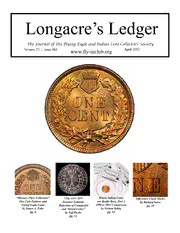
On the cover...
The 1880 Snow-1 off-center clashed die is the best example of this
very unusual die variety. The impression of the denticles and “OF” from an
obverse die are visible on the reverse. What caused this unusual die clash?
Rick Snow discusses possible answers in this issue.
Special thanks to Heritage Auctions for printing this issue of Longacre’s Ledger
Copyright 2012, The Flying Eagle and Indian Cent Collectors’ Society, “The Fly-In Club.” All rights reserved. Articles, opinions and comments appearing in this journal reflect
the views of their authors and may or may not agree with those of the Editor or the Society. The Society specifically reserves the right to edit copy, require payment in advance,
suspend advertising privileges, or decline any article, letter to the editor, advertisement or other submitted material in part or in whole at its sole discretion. No part of this Journal
may be reproduced, in whole or in part, by any means, without permission from the Society.
Longacre’s Ledger Vol. 22.1 April 2012 Page 3
Longacre’s Ledger
2012 Vol. 22.1 Issue #84
Contents
Featured Articles
The “Hoosier Flyer” collection Shallow N Counterfeits
By Stewart Fabe ...................................8 By Richard Snow ...............................17
The 1907 Snow-27 Story Off-Center Clash Marks
By Tony Bohle ....................................11 By Richard Snow ...............................20
The 2011 ANA Summer Seminar Something New
By Jeff Burk ....................................12 By Richard Snow ...............................23
Which Indian Cents are Really Rare? Part 2
1990-2012 Comparison
By Vernon Sebby ................................14 President’s letter ......................................5
The Fly-In Talk Forum Club announcements .................................6
By Dave Noble ....................................16
Submission guidelines
Submission deadlines
If you have a substantive article you would like to contrib-
ute, please follow these guidelines:
Please submit all articles, letters, columns, press releases
√ If you have internet access, you can send text to the
and advertisements no later than the following dates to as-
editor’s e-mail address below. Please send images in
sure inclusion:
separate files.
√ You may also send files and images on a CD-W disk
Issue Deadline Show issue
or other storage device to the editor’s address below.
#85 2012 Vol. 22.2 .....July 1, 2012 ...............ANA 2012
Storage devices will be returned upon request.
#86 2012 Vol. 22.3 .....November 1, 2012 ......FUN 2013
√ Images of material can be made by the editor for use in
#87 2013 Vol. 23.1 .....March 1, 2013 ..........CSNS 2013
the Journal. Please include the necessary return post-
#85 2013 Vol. 23.2 .....July 1, 2013 ...............ANA 2012
age with the submission.
√ Please feel free to contact the editor if you have any
questions.
Editor Membership
$20 per year, $35 for 2 years
Rick Snow
P.O. Box 32891
Fly-In Club
Tucson, AZ 85751
P.O. Box 559
(866) 323-2646 Sandwich, Illinois 60548
www.indiancent.com
[email protected] Special thanks to Charmy Harker for
proofreading the articles.
Longacre’s Ledger Vol. 22.1 April 2012 Page 4
The President’s Letter
By Chris Pilliod
This is my 42nd letter as president and it continues to be During the course of
a fascinating journey working with the Mint on its new Coinage the conversation I asked, as it
Act. There have been hours and hours and more hours of discus- relates to the Mint, where in the
sion with them, with over six screen pages of emails (not includ- pecking order of importance does
ing the ones I have deep-sixed or haven’t read yet). One of the die life rest? Very important. Is
areas that will surprise you most is, during all the pertinent dis- it the main topic of meetings?
cussions being undertaken, how often large sidebars commence, Not every meeting, but it is a hot
seemingly right around every corner. They are omnipresent, to topic. Or does it not matter? It
come up with a fancy term. One minute we might be discussing does matter. Is die life predict-
why one alloy may not blank or upset so well (what a vending able? No. I guess some things
don’t change… die life has been a major concern for the Mint in
machine needs for a coin to function) and then all of a sudden we
its entire history.
commence a discussion of how die life may be affected — nega-
Today’s die life for the cent is NOT all that much better
tively or perhaps be improved for this or that reason. It dawns on
than during the coinage of the Indian cents. What has changed,
you how a seemingly simple task such as changing coining alloy
however, is the standard deviation of die life. Standard devia-
becomes monumentally complicated.
tion is the measure of variation in die life. While the die life
Just a few days ago the Mint called and confided about
for production strikes of 1877 Indians was very long — several
some trials they desire to embark upon with some experimental
hundreds of thousands — without question, there were many
die steels and die steel processing. We talked for almost an hour
dies during this series that lasted only a few thousand strikes,
and all the while I kept thinking back to diemaking during the
and likely some only made it a few hundred strikes. In fact, I
Indian Cent series, and how far the technology has come in the
wouldn’t be surprised if some dies lasted literally a few dozen
last 100 years.
strikes before they had to be retired. In today’s world, at the Mint
average die life for the cent may be 400,000 strikes per die but
most dies make it to 200,000 before being retired.
Keep in mind the main reason for retiring a die is the
exact same reason then as it is today... either premature wear, or
metal fatigue, or die cracks or cuds. At the Mint, a cud is known
as a “piece-out.” The only thing that has changed since 1909
are the standards, with today’s rejection criteria being far more
stringent than in the Indian cent days. Rejection today occurs for
a minor, almost microscopic die crack that would have undoubt-
edly gone unnoticed back in the 1800’s. Unlike many metallurgi-
cal properties, such as strength, hardness, or ductility, fatigue is
the one attribute of a metal part that is at best a guessing game for
metallurgists. One die might last 1 million strikes, and the next
100 strikes before it fatigues and forms a die crack or even a full
cud.
1869 Snow-1 Early die state
1869 Snow-1 Late die state
1869 Snow-1 Middle die state
Longacre’s Ledger Vol. 22.1 April 2012 Page 5
This is why some dies are very common and others are varieties with a full cud in that location. Now, whether the Mint
extraordinarily rare. For example, have a look at the 1869 Snow- inspector back in 1869 rounded them all up or some slipped
1 variety. This is a great repunched date variety which is rarely through, we may never know. I, for one, in decades of searching
encountered. In fact, compared to its more popular and much have not discovered this variety with a full cud, but trust me, I
higher demand Snow-3 counterpart, it is easily ten times as rare. would love to.
Why? As it relates to the Indian Cent series, the keys to die life
For me, the answer came in 1992 at the Michigan State greatly depend on the below input parameters.
Numismatic Convention in Dearborn. There I ran into fellow
Fly-In member and variety specialist Dave Brody from Elkhart, 1. The quality of the die steel, or its metallurgical properties.
Indiana. Dave has long been an ardent student of numismatic va- 2. The processing or method of manufacture of the die itself.
rieties, specializing in Shield nickels and Indian cents. He calmly 3. The inherent properties of the blanks or planchets. Planchet
walked up to me in an aisle and showed me a high-grade 1869/18 properties include how hard the metal blanks are, how well the
Snow-1. It was a choice XF+ with great original brown surfaces metal flows during the striking, and so on. Obviously, the early
but had been holed and crudely plugged at 12 o’clock. Nonethe- use of copper-nickel greatly deteriorated die life as compared to
less, as soon as I examined it I asked for a price and got out my the bronze issues that followed.
checkbook right away. One curious discovery I made during this journey with
This particular example had a very pronounced die break the Mint is that, for the Shield nickels as well as the copper-
along the bottom of the date, as can be readily observed in the nickel coinage and perhaps even the Indian Cents, it appears the
photos showing the die progression of this variety. Undoubtedly coin planchets were not annealed prior to striking, which is very
what transpired with the commencement of this die was prema- surprising and most likely the leading determinant for poor die
ture fatigue cracking near the date. And it progressed quickly to a life.
complete fracture. Being the obverse die, it was positioned in the
hammer location and soon after this particular coin was struck, it 4. The design of the coin. For the Indian cent series, this is
created a “piece-out” or cud. And as soon as it was discovered by a constant, since from 1860 through 1909, only the slightest
the press operator or inspector, the die was retired forever, well changes in design occurred. For example, even during the recent
before the average lifespan of an Indian cent die. But before this State quarter series, each state’s selected design had an impact on
took place, without question, this die struck some 1869 Snow-1 die life.
The Fly-In Club Welcomes Our Newest Members
As an ongoing feature, we’d like to welcome our new Thank you for joining us. If you haven’t already
members: done so, please check out our web site and online talk
forum at
Member State Sponsor
www.fly-inclub.org.
Darren V Ohio none
Robert B Minnesota Rick Snow
If you have any questions or comments about the club,
Michael B New York Karin Lawrence
please contact me, Vern Sebby at PO Box 559, Sand-
Richard A Texas Rick Snow
wich, Illinois, 60548, or email, melva6906@indianval-
Andrew K Georgia none
ley.com.
Greg S Nevada none
Lyle M Indiana none
Tony K Nebraska EERC
Evie P Florida Harry Powers, EAC
Jesse L Maine FUN 2012
Steve P California FUN 2012
Dan T Idaho FUN 2012
Longacre’s Ledger Vol. 22.1 April 2012 Page 6
Let’s start with design, and this is much more criti- condition to facilitate producing a clean blank with no cupping
cal in the eye of the Mint than most collectors realize. They are or crowning. The issue is it becomes problematic to anneal after
constantly analyzing design features, its relief, the spacing and blanking as the pieces are very small and must be cleaned after
taper of letters and numbers, and so on. The new Lincoln cent annealing to de-scale any oxide films that form during the high
with Shield reverse has vexed the Mint with a diminished die life. temperature anneal.
For the Indian cent, the die with the most consternation was the Even though the composition of the Shield nickel and
reverse. In my collection, I have approximately 10 times as many today’s Jefferson nickel are identical, the hardness measured on
cuds and die breaks on the reverse than obverse. The flow of the blank areas show distinct differences.
copper metal during striking between the wreath (as well as the The data suggests that, during the production of Shield
shield) and the rim created enough stress that these areas were nickels and Indian cents, the Mint merely struck the blanks as-
the first to fail. But every series is different, with the Lincoln cent rolled at very high hardnesses, considerably higher than their
showing issues on the obverse more often. counterparts in today’s Jefferson nickels or Lincoln cents prior to
The planchets. Of course, you can imagine how 1982 that were annealed prior to striking. This no doubt helps ac-
troubling maintaining die life would be if blanks were as hard as count for the very low die life seen during the Shield Nickel and
the die itself. So a main attribute of a planchet is softness. But Indian Cent copper-nickel run.
it certainly is not the only characteristic of concern. Obviously, Die manufacturing. This is the area where perhaps the
an alloy that is extremely soft will not wear well in commerce, greatest strides have been made. Without question, die manu-
therefore, a planchet has to be receptive to a strike but last 30 facturing during the Indian cent series was a black art compared
years or more as a coin. to today’s technology. We’ll get to metallurgy below, but to me,
Not only is softness important, but flow, work hardening the biggest issue with Indian cent dies for the Mint was the wide
and other variables come into play. Two different alloys may have variation in the heat treatment.
similar hardness but their “flow” may be entirely different. Flow Today, the Mint heat treats the dies in a vacuum to
is critical in filling the die up fully and metals have their own preserve the qualities of the surface and near-surface metal. But
unique flow properties. The Mint spends an immense amount of no such technology was available back then. The issue with heat
effort not only in coinage design but also the manufacturing of treating in atmosphere, even protected with charcoal or CO2
the blanks. As we speak, they are trialing some “out-of-the-box” atmosphere, is the risk of oxygen interacting with the steel at
initiatives to enhance all coining metals strikeability. very high temperatures. The result is a depletion of carbon from
As mentioned, one interesting item of discovery during the surface of the die. Carbon is the element that is needed for
this process which no doubt had a substantial impact on die life very high hardnesses to promote long die life. If the level of
is that the blanks used for Shield nickels as well as Indian cents carbon becomes too low because of an improper heat treatment,
were likely not annealed prior to striking. Annealing undoubtedly the images become very soft and mushy. In my opinion, this
occurred at some point along the processing line, but in measur- was a major issue in years like 1882, 1883, 1886 Type II, 1887
ing actual hardnesses of off-centered Indian cents from my col- and 1888, where one often sees mint state examples with a very
lection as well as an off-centered Shield nickel Ken Hill provided mushy, almost caved-in look. A lot of copper-nickel issues also
me, the values fall in line with what is expected of a cold-worked take on this look but undoubtedly this is exacerbated by the hard
or cold-rolled planchets. Almost every metal hardens during planchets being struck.
deformation in a phenomenon known as strain-hardening or Die Metallurgy. Next issue, we will explore the tremen-
“work-hardening.” The sheet used to produce coining blanks dous advances made in the metallurgy of die steel production.
is cold-rolled to gauge, or thickness, before being blanked for
planchets. In some cases where an extremely ductile metal is be-
ing employed for coinage, the blanking is done in the cold-rolled
Advertising rates
Send check to
Yearly rate - Three issues.
Fly-In Club
P.O. Box 559
Quarter page $95
Sandwich, Illinois 60548
Half page $150
Full Page $250
Send artwork to
Inside front cover $275
Editor, Longacre’s Ledger
Inside back cover $275
[email protected]
Longacre’s Ledger Vol. 22.1 April 2012 Page 7
“Hoosier Flyer Collection”
~ One Cent Patterns and Flying Eagle Cents ~
By Stuart A. Fabe
It almost goes without saying that building a collec- The “annular” cents with perforations and punched
tion of coins, or anything for that matter, is a highly personal out holes in the center were so unusual that I had to own a few
enterprise. And similarly, the direction in which a collection originals and re-strikes from 1850 and 1851. It was at this point
progresses is often something that takes on a life of its own. Four that I became familiar with the term “billon” and how silver was
years ago, I never would have imagined embarking on a plan, or used to raise the perforated coin’s value to one cent. The undated
even given myself permission to spend the resources, to show the annular cent was an immediate giveaway to its vintage as 1851.
transition in US coinage from the large copper cent to the small Collectors are, no doubt, aware that no pattern cents were struck
cent in the 1850s. However, once I began reading the literature in 1852.
written by coin luminaries such as Q. David Bowers and Rich-
ard Snow, and yes, articles presented in “Longacre’s Ledger,” I
frankly became consumed with wanting to build a unique, well-
defined collection.
First, I think it is important to stress a few points. It was
never my desire to own the very best coins. It would have been
far too costly, and it’s superfluous. Instead, I wanted to have a
very streamlined collection; one that contained excellent ex-
amples of pattern cents and important varieties of Flying Eagles.
As much as anything, I wanted my collection to “tell a story,” and
hopefully I have achieved that goal with the 41 coins in my col-
lection.
I met Rick Snow at the Central States show in Chicago Undated (1851) ring cent. Billon. MS-65 PCGS
in 2009, and he gave me some sage advice: “collect Flying Eagle Shown with actual die alignment
cents.” He told me that there are 50 years’ worth of Indian Heads
(a lot of coins), but there are more than enough interesting variet- In 1853, the Mint switched its design to the one used for
ies of Flying Eagles spanning 1856 – 1858 to hold my attention. the 1853 quarter eagle. This was not meant to be a very imagina-
It made a lot of sense to me. So, I purchased Rick’s attribution tive design approach, and curiously, the Mints new Melter and
guide (2nd edition, Vol. 1), and then a few other books, and I Refiner, James Booth, attempted to use a German silver alloy mix
was on my way. At that same show, I purchased 1854 and 1855 similar to Dr. Feuchtwanger’s composition in 1837. My 1853 Pat-
pattern cents with the large eagle on the obverse and quickly tern cent, Judd-151, is composed of 40% nickel and 60% copper.
discovered that patterns were some of the most fascinating coins The years 1854 and 1855 were landmarks for the cent.
ever conceived. So, now my collecting interest could follow two Relying on Christian Gobrecht’s flying eagle design from the
related paths, patterns cents and Flying Eagles, and if you’re a 1838 half dollar, these patterns are some of the most impressive
collector like me, it helps to switch direction from time to time in coins ever produced (one guy’s opinion)! I fell in love with these
order to keep your interest fresh. coins, and at one point considered specializing in the 1854 and
So, I quickly learned about the storied history involved 1855 dates before deciding there was a broader story to tell. I
in America finally giving up the large copper cents that had been never met Rick Kay, but I certainly respect his admiration of
around since 1793. Dr. Lewis Feuchtwanger deserved a great these intriguing patterns.
amount of credit in attempting to get the US Congress to go to In 1854, other patterns were struck to test alloy compo-
a smaller sized planchet with a composition other than copper. sition, design and planchet size. The J-158 was struck from a die
His 1837 German silver composition with the fierce looking created by reducing the design of an 1854 silver dollar. Curi-
eagle was prophetic of things to come, but the future US Mint’s ously, the crossbar of the 4 in the date was not evident, thus ren-
melter and refiner, Dr. James C. Booth, just didn’t feel that dering an appearance as “1851.” The J-160, made of copper and
Feuchtwanger’s composition was suitable for mintage. He was smaller in size than the currently circulating cents, had the Head
probably correct, and it would be another 19 years before the Fly- of Liberty and a coronet. Various alloys were tested as well.
ing Eagle pattern was adopted. As a collector, I was fascinated Then, of course, the date 1856 issued forth the design of
by Dr. Feuchtwanger’s perspicacity; so the story of my collection the Flying Eagle pattern cent that would become legendary. I’ll
starts with an MS65 specimen. never forget being a youngster in the 1950s with my very modest
Then, upon studying David Bowers’ Buyer’s and Enthu- green folder of coins, and the space for the 1856 wasn’t even
siast’s Guide to Flying Eagle and Indian Heads and immersing punched out. It just said “Rare,” and I thought that only kings
myself in Dr. Judd’s 10th edition of United States Pattern Coins and really rich people would ever be able to own one. It was just
(plus Rick Snow’s guide book), I began to learn about the fasci- that magical! So, when I got older, I finally gave myself per-
nating parade of attempts by the US Mint to produce a suitable mission to purchase a PR65, and I’m glad I did. (I’m still not a
small cent. king or a really rich person, but my dogs think I’m pretty special
Longacre’s Ledger Vol. 22.1 April 2012 Page 8
around feeding time). his Royal Highness had tried to remove a couple of spots. If only
Collecting coins from 1857 brought about an entirely the King had left things alone, this coin would be even more
new set of goals. Premier among those goals was finding an valuable. As it is, I love the coin because it is beautifully struck
outstanding example of the J-186 pattern cent with the head of and quite special with its broad planchet.
Liberty. This was indeed a challenge because as the Judd book
pointed out there were only 4-6 struck (R7); so when I found an
MS65 in an old green PCGS holder, I leaped on it. To this day,
I think it is the rarest coin I own and certainly far rarer than the
legendary 1856 Flying Eagle.
Naturally, I acquired the S-1 and S-2 varieties of the
1857 Obverse of 1856. They’re both great coins, and I appreciate
how they show the Flying Eagle’s subtle transition.
The 1857 multi-denominational die clashes fascinated
me, and this sentiment was reinforced by David Bowers’ com-
ments about them being among the most interesting of American
coins. So, I embarked on collecting the Snow-7, Snow-8 and
Snow-9 with clash marks from the 1857 gold Double Eagle, the 1858 Flying Eagle / Ornamental Shield. Broad planchet
reverse of a quarter and the obverse of the half dollar. Now, my
collection was starting to take shape, and I was beginning to Of course, I focused my attention on proof and mint
understand the nuances of Flying Eagle varieties. state issues of the Large Letter and Small Letter versions of 1858
The year 1858 was a veritable numismatic treasure and key varieties such as the 1858/7. Given the Flying Eagle
trove. I continued to study the literature and review auction cent’s high relief, and its inherent propensity for wearing out
records, and then I began my campaign to own the 1858 12-piece dies, this mythic coin was doomed to a two-year existence. To its
pattern set and key Flying Eagle varieties. I should admit that at credit, the Mint tried to extend its run by changing the 1858 de-
various points along the way I questioned my sanity in pursuing sign from the Large Letters version with its High Leaves reverse
these coins and the amount of money I was spending to acquire to the Small Letters version with the Low Leaves reverse, but
respectable examples. Then, of course like a true out-of-control alas, the more durable Indian Head cent was waiting in the wings.
zealot, I lunged forward with the unbridled enthusiasm that I am proud to also have an early die state version of the 1858/7
only collectors understand. All the while, folks like Rick Snow S-1, and the even rarer yet less well known, 1858/7 S-7. The
must’ve giggled uncontrollably each time I called. story of my collection ends with a final pattern, the 1859 J-228,
I’ll never forget Rick’s office manager, Karin, saying the famous transitional issue.
“we like you!”. I knew I was sunk! And so I came to a point with my Hoosier Flyer Collec-
The beauty of the 1858 12-piece pattern set was that it tion where I had to decide if and how I wanted to proceed. I have
gave me an opportunity to further understand the transition in loved building this collection like very few things I have ever
US coinage from the Flying Eagle to the Indian Head cent, and known. I know there have been far greater collections than mine,
to own several nice Indian Heads without owning their entire but I have been pleased to learn so much of our American history
50-year history. I also smiled to myself knowing that, here in along the way, and to have met many fine and knowledgeable
the early years of the 21st century, I was collecting coins that the collectors and dealers.
US Mint had produced to help entice collectors in the mid 19th Yes, I have been very fortunate indeed, but it’s time to
century. That’s staying power! move on, and I have decided that now it is time to let these little
“medallions” go to other “stewards.” And so, I have consigned
my collection to Stack’s Bowers Galleries for auction at their
Rarities Night event at the ANA’s World’s Fair of Money in
Philadelphia this coming August. Dave Bowers has offered to
personally catalogue my collection for the event, and I am indeed
honored. I plan to attend, and if you come, please say hello and
maybe share a story or two. After all, it’s what we collectors do!
Editor’s note:
Stu Fabe’s fabulous col-
lection is highlighted on a
video
1858 Indian Head / Ornamental shield J-212, PR-65 Cameo by Rick Snow on
www.youtube.com.
Then, I acquired the 1858 J-198 and J-199, with the Search “History of the Small
J-199 being especially intriguing due to its fascinating broad Cent” on that site or scan
planchet. Rick Snow told me that this coin had come from King the QR code to watch.
Farouk’s collection and was well known by the scratches where
Longacre’s Ledger Vol. 22.1 April 2012 Page 9
“The Hoosier Flyer Collection”
(One-Cent Patterns & Flying Eagles)
Denomination Rarity Grade Certification Certification #
1837 Feuchtwanger token MS65 NGC 1816085-019
1850 Large Cent MS65BN PCGS CAC 06620793
1850 J-119 R L6 PR63 PCGS CAC EEPS 11922572
1850 J-124 R L7 RES PR64 PCGS CAC 4854320
1851 J-127 R L6 MS65 PCGS CAC EEPS 3079048
1853 J-151 R L6 PR62 PCGS 16580684
1854 J-158 R H6 PR64 PCGS 14160234
1854 J-160 R 4 PR65BN PCGS 19383378
1854 J-164 R 5 PF64BN (Original) PCGS 20668838
1855 J-172 R L6 PF64BN NGC EEPS 3046364-010
1856 J-180 S-9 PR65 PCGS EEPS 22048059
1857 J-186 R H7 PR65 PCGS 3209773
1857 Obv. of 1856 S-1 MS64 PCGS EEPS 16861751
1857 Obv. of 1856 S-2 MS65 PCGS EEPS 12246012
1857 MS65 PCGS 06636959
1857 $20 Obv. Clash S-7 XF45 PCGS 20569331
1857 25c. Rev. Clash S-8 MS64 PCGS EEPS 22076827
1857 50c. Obv. Clash S-9 MS63 PCGS EEPS 16339530
1857 PR63 PCGS EEPS 21523698
1858 J-191* R 5 PR64 PCGS EEPS 08823772
1858 J-192* R 5 PR64 PCGS 10884778
1858 J-193* R 5 PR65 PCGS CAC 11387437
1858 J-198 R L6 PR64 PCGS EEPS 50088784
1858 J-199 R H7 (Farouk) PR (Genuine) PCGS 06668343
1858 J-202* R 5 PR64 PCGS EEPS 4568389
1858 J-203* R 5 PR65 PCGS CAC 07342935
1858 J-204* R 5 PR63 PCGS 19383381
1858 J-206* R 5 PR63+ PCGS 20569333
1858 J-208* R 1 PR64 PCGS 21144553
1858 J-211* R 4 PR65 PCGS EEPS 12805002
1858 J-212* R 4 PR64CAM PCGS EEPS 12759700
1858 J-213* R 5 PR63 PCGS 20569332
1858 LL (High Leaves) MS65+ PCGS EEPS 06611552
1858 LL S-17 (Low Leaves) MS64 PCGS EEPS 14088017
1858 LL PR65 PCGS EEPS 8341950
1858/7 LL S-1 (EDS) MS64 PCGS EEPS 06611551
1858/7 LL S-7 MS63 NGC EEPS 2171016
1858 SL(Low Leaves) MS65 PCGS CAC 5441829
1858 SL(High Leaves) MS64 PCGS 20332362
1858 SL*(Low Leaves) PR63 PCGS EEPS CAC 06698269
1859 J-228 (Chiro) R 1 MS65 PCGS EEPS 10975572
* 1858 12-Piece Pattern Set
Longacre’s Ledger Vol. 22.1 April 2012 Page 10