Table Of ContentOverSo Year.sin Numismatics
\'X1l!EN IT COMt~ T!i\!E TO seu., choose the company that ofters you
an unsurp;lssed reptlfatin[J of "llegrit)', numismatic profession:dism
and expertise. and proven financial results. Led by Q. Da\rid Bower:..
who can boast over <;0 years in the tick! of numismatics, the staff of
American Num.ismatic Rarities brings you ovcr 2)0 years of
combined experience bringin~ nne numismatic properrtes to auetton.
(). 1)1\ VI D B()\:~TRS r1<,\:) I~EEN III)NORF [) by the Amencan
NllImsmatic Association wixh its two highest awards - the Farran
or
I~fhe IV1cmorial /\v...~ml and Numismatist the Year. Bowers h;l~
sc,\I(:d as president of both the A.ll1eriean Numismat ie Association
(191iJ-19g,\,) and the Profession.ll Nnmismatists Guild (I<l77-197g"l.
who awarded him with their highe~t honor, the Founder's /\ward.
Bowers is the only perf>on to have ~erved as pre~;ident of both these
prestigious organizations.
NA\iEf) BY COJNACE \1M;AzrNE as one of the "Nmnlsmatists of the Century," Bowers is the
author of more than 40 works, mostly on the ropic of rarc: coins; including the ANA Centennial
I-lisfwy, History o(C'niwdStatesCoinajic (for The-Johns Hopkins University), /tdvcnwres with Rare
Coins, the t"\\70-vo[ume Silver DollaJ:s and Trade Do/Jars oftbe 1. THiccd States, and A California GoldR LISh
HisWfY. More of go,vers' books have won "Rook of the Year" honor:; from the Numismatic Literary
Guild and Professional Numismatists (~tllld thar. have those ofany other author. He has catalogued
many of the tlne\t L'olJections ever assembled, including the Eliasberg Collection, the Norweb
Collcchon, the Cant:tt Collenion, and the Harry \V'. BassJr. Collect-ion.
CONTACT \'S 'I O[),\Y to put Dave a.nd our expert staff to work for you!
Chri~tint K'u>tedt .. Or. R.ick Bagg. .!ohn Patk, Fr'lnk Van V~IJcll. John Kraljcvkh
President. AIll..tl\lll. (~{)osignm~n~.) Auction CO!lsignmtflt. Si:ninr Numismati"t Ntlmimiatic Res('arch
rrR.usrrE,D
NAMES, FAMILlAR Fl\CES
,--_···---DYNA1vlIC RESULrrS!
Call toll free: 866·..811-1804
Longacre's Ledger
The Journal of tile Flyin.g Eagle and Indian Cent Collector~ s Society
SU H: ; 11 ! 1 t y: 3
Vol 15.1, Issue #63
www.Fly-inCIUb.org
Our mission is to gather and disseminate information related to James Barton Longacre, with emphasis on his work as Chief
Engraver ofthe Mint from 1844 to1869, with a primary focus on his Flying Eagle and Indian Cent coinage.
4 by Chris Pilliod 17 The Remarkable Coinage of James 2 American Numismatic ~arities
B. Longaore
It Heritage Numismatic Auctions
by Rick J<,ay
24 Indian Cent Clamshell 23 Fly-In Club Membership
by Frank keone Application
5 A Collection of Counterfeit Indian
Cents s.urfaces 2S Classified Ads
by Chfis Pilliod Z5 Back Issues of Ledger
10 Allen Mays, Sr. "The Gentleman 23 The F1y~Iil ClUb Welcomes Our 28 Eagle Eye Rare Coins
Collector" Newest Members
by Chris Pilliod by VemSebby
20 1857 Flying Eagle Cent Clashed
Obverse Die
by Sheldon Freed
12 The Truth About Suying Rare Coins
-Part II
by Tom Becker
Copyright2005,TheFlyingEagleand In4iat'lCent CQilectQ1'SSociety, 'VJ1l~ Fly-In Club". All rights reservero. Articles, opinions and comments
appearing in this journal re:f1ect tbe Views of their authors and mayor tnliY not agree with those of tb¢ editor or the sQCi¢ty. The socltlty spe¢ifi~
caUy reserves the right to edit copy. to reqtlire payment in advanc¢, to suspend udvertizing privil or to uecliffe any article, letter tp the edl~
tor. adveW$eJnent Of other submitted material in part 01' in whole at its $Ole discretion. No part of Journal may be reproduced, in wbole or in
part by any means, without permission fromtbe Society.
s
Longacre Ledger, January 2005 page 3
President.s Letter
by Chris Pilliod
Another summer of coin fun ahead ... can't wait for the number. Then there are those
ANA Money Show in San Francisco. I love the "City made by transfer dies-these
by the Bay". I remember visiting in-laws there about are easily the best quality. And then there are the ubiquitous
ten years ago. It was in July or August and they lived over on altered coins, mainly affecting 1877, 1908-S and 1909-S
the Oakland side in El Cerrito. It was a scorching hot day, pieces.
easily in the 90's. They were talking of having a cookout later
on when someone said, "Chris, why don't you and David (an Most of the Spark erosion counterfeits originated in the New
in-law) go to the Giants Game at Candlestick? They aren't York City area and statted turning up at dealer's shops around
sold out and you'll have no trouble finding tickets." the city and Connecticut in the 1970's. They are plentiful and
encompass even the more common dates, such as 1898 and
"Let's do it," I said. 1899. They are characterized by bumps or pimples on their
surfaces, a result of the sparking process.
So I went inside, cooled off a bit, cleaned up and grabbed my
wallet and keys and yelled at David "Get in the car!" and Before this the market was flooded by a large number of very
headed to the street where the car was parked. Just as we were deceptive Indian cent counterfeits, made on the West coast,
getting ready to leave Aunt Juel came out with a coat and a specifically San Francisco. Thus they were dubbed "Bay
fat wool blanket and handed them to me. Area" counterfeits. This were made by a transfer process
using a genuine coin as the donor. As a result final quality
"What's this for?" I asked perplexed. was very high, and extremely difficult to detect, even for
advanced collectors. Attached is a photo of a very well made
"You may need it for the game. It might get cold." I just 1868 Bay Area counterfeit. The Bay Area counterfeiter,
laughed and humored her by throwing it in the back. known as The Bandit, focused only on the key dates of the
1860's and 1870's.
Man, that might have been the best decision of my life,
because by the time the sun set and the cold mist rolled in off In addition I have attached a chart with diagnostics of all the
the Pacific the temperature must have dropped into the 40's. Indian Cent countetieits I have been able to observe. One of
It was brutally cold. I remember staring out over leftfield and the keys to counterfeit detection in our series is keen knowl
just seeing this frosty mist wafting over the stadium like a edge of the genuine attributes of the pieces. The primary key
meat locker. About the 7th inning I headed to the Refresh to this is knowledge of reverse diagnostics. Mainly Type I vs,
ment stand. Type II reverses. Type I reverses have the "Shallow N" and
Type II reverses have the "Bold N".
"Sorry, sir, we can't serve beer after the 7th inning."
Photos of each are shown here. Type I reverses with a tapered
"I don't want a beer. I need a smokin' hot coffee." or "Sha1low N" and squared middle serifs of the E's. This
reverse hub was used until 1870, and then Type II reverses
I don't even remember who won the game, but I remember were commissioned after this except for all 1877 business
late in the game there were so few people left that when a strikes and a few rare 1871 and 1872 issues. These have
home run was hit into left field, some guy sitting behind third "Bold N's" and trumpet-shaped middle serifs of the E's. As
base was the closest to it. He reluctantly got up, and wandered you can see by studying the chart, countetieiters often
over to pick it up. The whole adventure certainly reminded employed the wrong reverse for their fabrication, obviously
me of Mark Twain's old saying, "The coldest winter of my unaware of the differences.
life was the summer I spent in San Francisco."
If you are planning to attend the ANA Money Show in San
On the numismatic front, it seems like I have encountered a Francisco please stop by the Fly-In Club Table and visit. We
number of Indian cent countetieits lately. I am not quite sure will also be hosting a Club meeting, where perhaps a topic of
why, but I will say they do seem to show up in spurts. I have interest will be this very same field-counterfeit Indian
concluded that they will always present an issue to the col Cents.
lector. Perhaps its time to start sharing more information on
them with Club members. There are really three main popu If you would like to share any thoughts, my new email
lations of counterfeit Indian cents. First there are the ones address is: [email protected]
made by spark erosion dies-this may constitute the largest
Longacre's Ledger, January 2005 page 4
A Counterfeit Collection of
Indian Cents Surfaces
by Chris Pi/liod
Estates containing coin collections can often be "Bay Area" counterfeit hoard produced in the 1960's. A
the news pinnacle of the numismatic year. Take, large number of Bay Area counterfeits surfaced in the
for example, the Eliasberg estate, full of 1960's and 1970's and consisted of high grade key-date
extremely rare gems long off the marketplace. So true Indian Cents, mostly issues from 1864-L through 1877.
for the John Jay Pittman estate. But the unheralded They first showed up in the San Francisco area and
small collector can leave an equally interesting, albeit were presumed to be fabricated there. This was well
less valuable parcel of numismania as well. before the grading services were established and many
Bay Area pieces frequently sold at shows and auctions
On a chilly morning in October of 1997 Mark Roth unwittingly, and to this day still show up.
from American Coin and Stamp Brokerage in Merrick,
Long Island called to inform me that a business They were all struck from transfer dies and all-in-all are
acquaintance of his had just purchased an estate of a considered to be very nice reproductions. Occasionally
recently deceased elderly woman in Brooklyn. the Bay area charlatan even used genuine blanks that
Amongst the nice grouping of US coinage was a half had been upset - Jack Beymer once showed me an
complete Indian Cent collection that was obviously pur 1867 struck on a 1952-D Lincoln cent!
chased by the lady as an investment of high-grade gen
uine pieces. The interesting features, my friend noted, But when Mark read off the dates they did not jibe with
was that while all the key dates were represented the the well-known Bay Area specimens. Several of the
missing dates were the common ones, no slots were dates are considered common, and I questioned whether
filled from 1900 to 1907. Also he said, "I think all but they really might have been cast. I was told no, they
three are bad!". "Bad" is dealer-speak for counterfeit. were all indeed struck. Included in the bogus ranks were
Judging by notations on the 2x2's he figured that the the following dates in Table below.
lady had purchased them sometime around 1983 but
1859 1870 1889
1860 (pointed bust) 1871 1890
1861 1872 1899
1862 1873 (open 3) 1908-8
1864-L 1874 1909 (yes, a liP")
1866 1875 1909-8
1868 1876
1869 1877
Dates ofNew York City counterfeits from collection.
this was the first any professional numismatist had All the dates after 1877 are not known as Bay Area
opportunity to study them. Furthermore, he mentioned counterfeits. Being a metallurgist by profession and
he thought they were all die-struck bogus pieces, much enjoying the study of counterfeits, I implored him to
more interesting than their cast or altered counterparts. ship them to me, which he kindly obliged with the
This perked me up more than my morning java and caveat they were not and would not be for sale.
more than if they were all MS65 Red's.
Upon receipt I visually examined all the pieces without
"In fact," he continued, "I know they are bad~" aid of a loop. At arms length I confirmed all of them as
being bad except the 1864-Land 1890-both of these
Immediately I guessed them to be part of the so-called were well made and quite deceiving. Several others also
Longacre's Ledger, January 2005 page 5
required further scrutiny. In fact I considered about a which I unfortunately returned. The copper-nickel cents
third of the pieces to be well made- no doubt these well in this New York City group were frighteningly similar.
made pieces could have escaped many collectors. With a Then another light went off- where was that dealer
little help on their lustre and a bit more realistic color, from??? Oh yes, then I remembered... A Connecticut sub
some would even fool the advanced numismatist. Sur urb of New York City. He had unknowingly purchased
prisingly, the 1877 was the sloppiest rendition. them well under gray sheet in the 1980's.
These were definitely not Bay Area counterfeits. As men And the reason for this updated article is that once again
tioned the dates did not match, and all the Bay Area in 1995 a set of Indian Cents sold to a dealer friend of
pieces I have seen were a pleasing natural brown, unlike mine in New York contained a NYC counterfeit dated
the reds and deep browns here. Also the Bay area culprit 1878. And just prior to that our editor, Frank Leone,
used transfer dies-these were spark erosion. bought a NYC counterfeit dated 1875 at coin show in
New York, which he then sold to me.
Sometime after examining the pieces a light went off
several years earlier a dealer had shipped me a large Back to the Connecticut dealer and his Flying Eagles,
number of Indian cents. Included in the group were two whose copper-nickel Indians were woefully miscolored,
counterfeits- an 1857 and 1858 Flying Eagle cent, being way too white. I suspected they were alloyed with
ELEMENT us S~ndard CQpp.er New York City US Su.ndard Bronze New York City
Nickel Cent Cent C()Unterl'eit eN Indian Cent Counterfeit lJronze
..
Copper, Cu 88 % 65 % 95 % 96 %
Nickel, Ni 12% 18.5 % - -
Zinc, Zn - 16 % 2.5 % 2.2%
Tin, Sn - 2.5 %
-~ -~
Silicon, Si - - - 1.5 %
Analysis reveals clear metallurgical differences between genuine US coins and the
New York City counterfeits.
tin or possibly zinc, very white metals in their pure ele telltale remnants of the electrical process. These are gen
ment-"whiter than your grandma's linen on the clothes erally evident as pits on the die and are due to voltage
line", an old metallurgy professor would say. "shorts" arcing out metal from the die during transfer.
Conversely, on the coin they are seen as "mumps".
All pieces were die-struck, produced on dies made by
spark-erosion, a process that utilizes electrical current Some of the dates were well done showing sharp detail
from the workpiece (in this case a coin) and passes it and smooth fields. Others showed the mumps and loss of
through a conductant to a blank die. The blank die, often features typical of a poor transfer. Actual chemistries of
not even die but a medium grade mild steel. receives a the pieces were analyzed with an electron microprobe.
reverse image of the piece much like a genuine US die. Analysis revealed that like his Bay Area counterpart, this
charlatan failed to employ the standard alloys governed
But significant differences can be detected. Whereas all by the US Mint. A table of the results is given below. For
Indian cent dies received two deep and hard impressions the copper-nickel cents, a considerable amount of zinc
from a highly detailed working hub, a spark erosion die was indeed alloyed in replacement of some of the nickel
relies on uniform voltage from the features of a host coin and copper. The zinc is responsible for the very white
(already lacking the quality of the die from which it was appearance of the copper-nickel pieces.
produced) to the die, a very difficult achievement. Not
only is there inevitable loss of some detail but also the With the bronze cents, the counterfeiter apparently used
Longacre's Ledger, January 2005 page 6
Three different dated examples ofwhat has come to be known as "New York City" counteifeits. Note that the
counterfeiter has employed a pattern reverse on the 1859 example.
Longacre's Ledger, January 2005 page 7
the same copper-zinc alloy as the Bay Area culprit. This Type I reverse.
****
alloy is devoid of any tin that is found in genuine US Genuine business strike 1877's have a Type I
Indian cents. (Table of Elements) reverse. 1877 Proof issues have a Type II reverse.
A final table on page at right explores in more detail each Individual Review. Several pieces are worth further
of the counteIfeit pieces from this collection. Diagnos numismatic exploration.
tics of problems with the obverses and reverses are
detailed. The last column gives an overan quality rating 1866. This was probably my favorite piece of
based on sharpness of strike, details and freedom from the lot. The reason for this is that the counterfeiter hap
spark erosion "problems". Furthermore photos are pened to use a host coin that exhibits a fairly nice
shown detailing the differences between a Type I and a repunched date. It is listed in Rick Snow's book as
Type II reverse. It is important to learn the differences. Snow-5. The interesting feature of this piece is that it
shows well how the detail is lost during the transfer
Type I vs. Type II Reverses. Study the photos of a process. This is shown in the photos of a genuine Mint
genuine Type I and Type II reverse shown. Type I revers State specimen alongside the counterfeit piece. Also
es have inner middle branches of the "E's" of "ONE notice the microscopic pimples on the coin, a result of
CENT" that look like a sideways "T". Type II reverses the electrical transfer process.
have a middle branch that more closely resembles a
trumpet. Also the lower diagonal portion of the "N" in 1864-L.About half of the 1864-L cents encountered dis
"ONE" slopes into the field of the die on Type I revers playa repunched date, some of which are very nice. I
es, while on Type II's it is much deeper into the die, or was optimistic that a similar coincidence existed for the
"bulging" as some researchers can it. 64-L as the 1866, but unfortunately this was not the case.
However, along with the 1890, the quality of the 1864-L
Genuine Indian cents snuck from 1860 through 1869 all was exceptional and photos are shown on page 7. This
have Type I reverses. 1870 is an intermediate year when piece was well struck, showing excellent feather details.
the Mint changed over to the Type II style reverse. Both
styles are seen this year, including a hybrid which has 1890. This was perhaps the best of the coun
one trumpeted "E" and one sideways-T "E". One very teIfeiter's portfolio. The suIfaces on visual examination
rare business strike 1872 has the type I reverse. Further were very smooth, the color good. The piece would
more all genuine 1877 Indian cent business strike issues grade MS 64 Brown, and one would wonder why some
have the Type I reverse, while all Proof issue 1877's one would exercise to produce a coin with a value of
have the Type II reverse. It has been documented by about $50.00. Nonetheless the piece is interesting to
Larry Steve and Kevin Flynn that the Mint was reissuing study. At first it appeared to be a genuine Proof issue. So
already struck cents during the recessionary 1870's. It is it really took me aback when first laying eyes on this
possible that the Mint had no intention of striking cents piece's reverse and seeing a Type I style which was last
dated 1877, and when realizing a small quantity was seen in 1877. Nonetheless, a close-up of the date area
needed an old die was scavenged to avoid the work of reveals the light pitting of the die that is difficult to avoid
hubbing a new die. The story with Proofs is different. with spark erosion.
\
This knowledge is important in that while the counter 1908-S and 1909-S. It is interesting to take a close
feiter was forced to use the proper obverse for making look at the 1908-S and 1909-S. Both of these were made
his die, he erroneously believed any reverse would work with the same reverse die. In this case the counterfeiter
since "they all looked alike". If he produced 50% Type I used a genuine Philadelphia reverse host coin and subse
and 50% Type II counterfeit dies and used them ran quently carved or punched an "S" into the die. This
domly he would then have a 50-50 chance per coin. He saved the cost of having to buy a high grade 1908-$ or
wasn't quite that lucky- his batting average was only 1909-S Indian cent. Note in the photo the difference
43%. (Table Date, Style Rev) between a genuine "s" mintmark and the snake-like "s"
of the counterfeit.
*
The color of the copper-nickel pieces was unnat
urally white. This fact was not used in rating the Overall It is unsure if any more counterfeit pieces will tum up,
Quality. but the buyer is warned to keep a keen eye out for any
**
1870 is known with both Type I and Type II high-grade raw Indian cents, particularly the key date
reverses. issues. Learn the proper reverses for each year and the
***
One very rare genuine 1872 reverse die has a diagnostics of spark erosion diemaking.
Longacre's Ledger, January 2005 page 8
Date Style Correct? Obverse Remarks Reverse RemarkS' Overall Quality
Reverse
.
1859 Pattern ND, Heavy die gouge below bottom of ribbon. Appears to have used a reverse from Fair.
Oak pattern Judd-226!
.
wreath.
1860 Type II No. Several mumps in field in front and below Pit to 11 O'clock of "0" of "ONE". See Good.
.
(Ty I) chin. photo.
1861 Type II No. Very pitted and rusty in area of "L1BER Pit to 11 O'clock of "0" of "ONE". See Poor to fair.
TY" photo.
1862 Type II No. Very sharp obverse. One large mump in Pit to 11 O'clock of "0" of "ONE". See Very good.•
field in front of necklace. photo.
1864-L Type II. No. Excellent obverse. One of the best Excellent reverse, some weakness on Excellent.
obverses of the group. Slight weakness upper right portion of wreath. Two pits
and blending into fields of letters Df in field-one to 1 O'clDck Df "E" and one
"STATES". tD 1 O'clock of "T".
1866 Type I. Yes Counterfeiter used the obverse die from Fairly well done reverse except for weak Very GDod.
Snow-5. Mumps restricted to date area. denticles, especially from 12 O'clock to
See photD of genuine and counterfeit. 6 O'clock.
1868 Type I. Yes Poorly made obverse with many small Fairly well done reverse except for weak Fair to poor.
pits. One large mump in middle of neck. denticles, especially from 12 O'clock to
6 O'clock. Possibly same reverse as
1866.
1869 Type II No Overall rough looking obverse. Gouge of Well done. A nice looking XF reverse. Fair to poor.
die missing abover headband. Poor
detail around date.
..
1870 Ty II. PDssibly. Sharp tooking obverse with just a mump Die gouge inside upper part of "C" of Excellent
in lower loop of last "S" of STATES and "CENT".
on right upright of "0" of "OF".
1871 Type I. No Very poor obverse detail. Date area is Mumps scattered in field around "ONE Poor
...
very mushy. CENT".
1872 Type II Yes. Fair detail on obverse but with noticeable Bulging noticeable in middle of die. A Fair
mumps on neck. One large mump direct- noticeable mump below and and to right
Iy in front of Miss Liberty's lips. of base of "T".
1873 Type I No Sharp details with only light mumps scat- A significant mump in center of cross- Good to very
(Open 3) tered thrDughout obverse die. bar of "N" in "ONE". Otherwise sharp good.
except for slightly weak denticles from
12 O'clock to 5 O'clock.
1874 Type I No Excellent detail with a few mumps around Excellent detail with a large mump Excellent
date. below and slightly to left of base of "T"
in "CENT".
1875 Type I No Shallow transfer with light die porosity Large mump to left of "0". Very round- Fair to poor.
on entire face. Very rounded rims. ed rims.
1876 Type II Yes Very noticeable die scratch on cheek Well done reverse with exception of Good
directly behind lips. Some mumps on weaknes on upper right portion of
cheek nd neck. wreath.
1877 Type I Yes. **** Very weak and porous obverse, especial- Decent reverse, light mumps on "ONE Poor to fair.
Iy the face and feathers. Dark planchet. CENT".
1889 Type I No Good crisp obverse. Larg, mump below Excellent reverse with slight weakness Very good
"C" of "AMERICA". Large shallow cavity on upper right wreath.
in die field below chin.
1890 Type I No Excellent obverse-best of the entire lot. Same reverse as 1889. Excellent
Prooflike in appearance with good natur
al brown color.
1899 Type II Yes Porous looking Miss Liberty. Face has Well done reverse with exception of Fair to good.
appearance of a sandblasted die. Mump weaknes on upper right pDrtion of
on first "9" in date and on letters "UNI". wreath.
1908-S Type II Yes Decent obverse. Two pits in field directly Slightly rougher reverse with large pim- Good
above 2nd feather. Pits in neck to left of pie in die in field below and right of "0".
second diamond from bottom. Damage in die on lower part of "C".
Mintmark was carved or punched by
counterfeiter rather than use a genuine
"S" coin as host.
1909 Type II Ves Same reverse die as 1908S-used before Good
"pI! an "S" was punched in.
1909-S Type II Yes A slightly better job than the 08S. Same reverse die as 19085. Good
Mumps above feathers #5 and #7.
Longacre sLedger, January 2005 ... , .. page 9
==~ ---~ ==-
Allen Mays, Sr. "The Gentleman
Collector"
by Chris Pilliod
When I receive a Priority Mail slip at the Post home and put them in fruit jars. He also had accumu
Office it can be only one of two things-- the lated a large number of foreign coins during the war.
latest Heritage catalog or a fresh shipment of After retirement Al rediscovered his passion for coin
"sidehill salmon" from Allen Mays, Sr. Always a caring collecting, and found his true love to be Indian cent
and true gentleman, Al will follow up the shipment with varieties. He had an acute passion for Snow varieties
a phone call to see how it all went down (quite a bit and always treasured an unlisted piece not yet discov
more salty than I'd like but I always said how great it ered and listed.
was).
Al developed health issues and bravely fought them off
Those who knew Al also know of his avid interest in until his passing on 08 January 2001. Heritage Rare
collecting Indian cent and Flying Eagle varieties. His Coin Auctions will be auctioning off all of AI's varieties
constant pursuit of repunched dates, doubled dies and in their September 2005 Sale. To participate visit their
other varieties was virtually unparalleled within our website at www.heritagecoin.com
club's ranks. On New Year's Day 1999 I caught up with
Al as he neared his 80th year to get a brief introspective
on his life.
Born on the 11 th of March 1919 Al Mays, Sr also qual
ifies as one of the club's most senior members. After
spending the first six years of his life in Superior, Wis
consin AI's family moved to Tacoma, Washington.
There he graduated from Lincoln High in 1937.
His first job out of school was making cedar shingles
for Smith Mfg. Like most young men of the time, in
1941 he found himself sucked into the vortex of World
War II. Al joined the Marines and headed to the Pacific
theater aboard the steel-hulled USS Baton for the island
hopping campaign. He served alongside "Pappy~ Boy
ington and the famous Black Sheep Squadron. Four
years later he would return stateside with a Purple Heart
for his actions and shrapnel in his ankle from Majuro in
the Marshall Islands.
Upon returning after the war, Al worked a few different
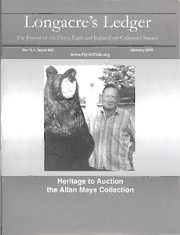
Allen Mays poses with bear in his yard at his home.
jobs until 1952. That year Al landed a job with the
Tacoma Public Water Works, where he would work
until his retirement as a senior supervisor 32 years later.
Before the Water Works, one of the stints he worked
after World War IT included collecting fares for the
Tacoma Transit Authority. There he would come across
a lot of odd coins, including Indian cents. He would
exchange these for coins of his own and took them
Longacre's Ledger, January 2005 page 10