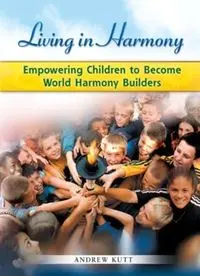
Table Of ContentLIVING IN HARMONY
Empowering Children to Become
World Harmony Builders
Andrew Kutt
LIVING IN HARMONY
Empowering Children to Become
World Harmony Builders
LIVING IN HARMONY WITH OURSELVES
Illustrations by Radha Honig
Copyright 2005, Andrew Kutt
All rights reserved. No portion of this book may be reproduced in any form without
express written permission from the Publisher.
TABLE OF CONTENTS
Introduction
Part I: Discovering Harmony Within Ourselves
Chapter One . . . . 1
Silence and Concentration
Chapter Two . . . . 7
Imagination
Chapter Three . . . . 1 5
Learning about Our Feelings
Chapter Four . . . . 2 5
The Good Things about Ourselves - Our Virtues
Chapter Five . . . . 3 3
Feeling and Expressing Harmony through Art
Chapter Six . . . . 3 9
The Pathway of Writing
Chapter Seven . . . . 4 7
Music
Chapter Eight . . . . 5 7
Building Harmony through Affirmations
Chapter Nine . . . . 6 3
Fitness
Chapter Ten . . . . 7 3
Involvement with Nature
Part II: Creating Harmony in the World
Chapter Eleven . . . . 8 9
Welcome to the Web of Life:
Understanding How Every Relationship Can Build a Positive World
Chapter Twelve . . . . 1 0 5
Creativity: Becoming a Problem-Solver Every Day
Chapter Thirteen . . . . 1 2 1
Let’s Do It Together: Learning the Skills of
Cooperation and Teamwork
Chapter Fourteen . . . . 1 3 9
Conflict Means a Chance to Grow: Learning the Art
of Non-Violent Conflict Resolution
Chapter Fifteen . . . . 1 5 5
Some for You and Some for Me – Learning to Become
Partners in Sharing the World’s Resources
Chapter Sixteen . . . . 1 7 1
Good Morning, Meet your World: Getting to Know the World We Live In
Chapter Seventeen . . . . 1 8 7
Learning from the Past and Making a Better Future
Chapter Eighteen . . . . 2 0 3
The Government Is Us: Gaining the Skills of Active Citizenship
Chapter Nineteen . . . . 2 2 1
Everyone is Born a Leader: Discovering and
Practicing Your Own Leadership Qualities
Chapter Twenty . . . . 2 3 9
Love Starts Here: Building a Just and Peaceful World
Afterword . . . . 2 5 1
Introduction
Living in Harmony is intended to provide a pathway for students and
teachers towards the goals of fostering greater harmony in their schools, in their
communities and in the world. There are two primary aspects of our experience as
human beings – an inner, personal, and individual aspect; and an outer, social and
communal aspect. In order to build a world of greater harmony, we must first
establish some measure of harmony in our own personality. Then we must learn
the skills of creating harmony in our relationships with others. With a sense of
harmony within ourselves, combined with the tools necessary to create harmo-
nious relationships with others, we have the resources with which to build harmo-
nious communities – both local and global.
Living in Harmony focuses on these aspects of human development. The
inner aspect is addressed in Part I and the outer aspect is the focus of Part II. In
Part I, we explore ten ways for students to get in touch with their own inner world
– that is, with their own feelings, thoughts, and dreams. The first and primary
relationship we have is with ourselves. It is on this relationship that all of our
other relationships hinge. Children who are balanced, confident, sensitive indi-
viduals with a healthy self-image are more likely to have positive and productive
relationships with others. Their ability to accept who they are, to appreciate their
own talents, and to express their feelings and ideas in constructive ways will
directly affect their capacity to be caring, understanding, and communicative part-
ners with others
The first ten chapters of this book present a broad spectrum of activities
designed to help foster and guide this inner aspect of development. Studying the
curriculum of the inner life is different from studying math, reading, geography or
science. When we teach ‘normal’ academic subjects, we look to books and to the
world around us. To help students study the subject of their inner world, we turn
their attention to their feelings, ideas, dreams and visions. To study academic
subjects, we encourage students to use their minds, and the aim is to gain knowl-
edge and skills. To study the inner life, we must help students make a connection
to their own private selves - their hearts and souls. The aim here is to help them
gain wisdom, peace, and the development of their nobler qualities. The ‘inner’
curriculum is about helping students become more aligned with their own source,
in order that they may attain greater happiness and be of better service to the
world.
The second ten chapters of the book help teachers and students move from
the realm of the personal to the realm of society. These chapters are aimed at
building what Riane Eisler would call partnership skills - that is, skills in building
relationships based upon mutual trust, respect, and communication. The relation-
ships built by means of partnership skills are ones undertaken with a clear under-
standing of the common benefits working together can bring. Some partnership
skills have to do with helping students gain a better understanding of the geogra-
phy and the history of the world, so that they are able to begin to place their own
culture, perspectives and opinions into a broader global context. Other partner-
ship skills, such as cooperation skills and conflict resolution skills, focus on help-
ing students learn to weave the fabric of relationships – communication – into
productive results. Still other partnership skills have to do with helping students
develop their inborn human capacity for caring, compassion, and empathy. All
of these partnership skills comprise the larger building blocks of leadership qual-
ities that students can develop with the ultimate purpose of building a peaceful
and just society on earth.
The language of Living in Harmony is directed at students. In other words,
it is written to bypass the need of the teacher to interpret the lessons and to put
them into child-oriented language. It is intended to be less like an instructional
manual for teachers and more like a storybook. The teacher of students in grades
1-3 can simply read the book aloud to the students. Students in grades 4-6 can
read some sections silently, but they will benefit from reading aloud to each other,
or teachers of students in these grades can read the entire book aloud to the stu-
dents. Students in grades 7 and 8 can read some sections silently on their own,
read other sections aloud to each other, or they can occasionally read sections to
younger students.
The chapter lessons are intended to appeal to a wide variety of learners.
The activities are designed to appeal to different interests and to involve many
learning modes – imagination, creativity, mind-body fitness, language, nature, etc.
There is a wide enough variety of activities to suit all kinds of learners. By
exposing children to a full spectrum of activities, we enhance their holistic devel-
opment into healthy, balanced, insightful, happy, and confident young adults. The
language, and the topics covered, lend themselves to many opportunities for addi-
tional spelling, vocabulary, writing, reading, and artistic activities that could be
created by the teacher and the students – if they have the space in their curriculum
“The language of the heart is the only language that everybody can under-
stand,” as Sri Chinmoy says. The ultimate goal of this book is to put students in
touch with their own hearts, so that they can ultimately express their nobler quali-
ties and develop their unique talents for the greater good of the world at large.
The world desperately needs a new generation of leaders who understand and
speak the language of the heart. It is hoped that this book will facilitate the stu-
dents’ journey to their own highest and best selves, and from there outward
towards the communities they will be charged with constructing as future leaders.
Riane Eisler has said, “"I see a world where the most highly valued work will
have the consciousness of caring." It is hoped that Living in Harmony will help
students, teachers, and parents alike to move forward towards the fulfillment of
that vision.
I want to thank Sri Chinmoy for all of his work for world harmony and for
inspiring the writing of this book. I want also to thank Riane Eisler for being a
source of spiritual light and wisdom. Thanks to all of my colleagues - especially
Tim Seldin, Jonathan Wolff, Margaret Wolff, Paul Epstein, Ann Epstein and Aline
Wolf for their tireless support and encouragement. Thank you to dear friends, Zoe
Handerson, June Lang, Stefania Rubino and Sahayak Plowman for their invalu-
able contributions. I also want to thank Paula Kleinman for her invaluable help in
editing this book. Finally, thank you to all the students, fellow teachers, and par-
ents throughout the years from whom I have gained insights, ideas, and inspira-
tion in ways great and small.
-Andrew Kutt 2005