Table Of ContentHistoric, Archive Document
Do not assume content reflects current
scientific knowledge, policies, or practices.
USDA
ene) United States Department of Agriculture
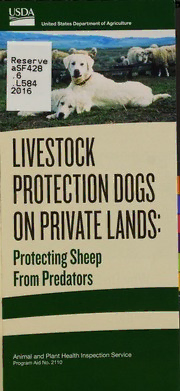
LIVESTOCK
~ PROTECTION DUG
LANDS
ON PRIVATE
~ Protecting Sheep
From Predators
Animal and Plant Health Inspection Service
Program Aid No. 2110
AS THE U.S. population grows and continues to
spur development throughout the country, new
residential communities are springing up in areas
that were traditionally only farmed or ranched.
Many farms are now surrounded by houses and
subdivisions, and once-quiet country roads are
being enjoyed by bikers, hikers, and other outdoor
enthusiasts. These changes have created new
challenges for today’s sheep farmers. Getting to
know your farming neighbors and whether they
use livestock protection dogs (also known as
guardian dogs) on their land can help reduce
potential problems that may arise between people,
domestic pets, and livestock protection dogs.
Photo by Terrianne Warner
Why Do Farmers Use
Livestock Protection
Dj ogs?
IF UNPROTECTED, sheen are eae to
avariety of predators including coyotes, foxes, |
wolves, mountain lions, bears, and domestic dogs. |
Livestock protection dogs are a primary and tradi- _
tional means of protecting sheep from predators,
and they have become an important means of re-
ducing predator attacks on sheep. These dogs live
with the sheep, patrolling the perimeters of sheep
grazing areas to ward off potential predators.
Livestock protection dogs have been used around
the world for centuries and are an essential man-
agement tool in the United States. Without them,
thousands of sheep and lambs would be injured or
killed by predators in the United States every year.
Livestock Protection
Dogs on Patrol
IN ORDER for a livestock protection dog to
protect its flock, the dog must be free to roam
the property to scare away potential predators.
Unfortunately, many livestock protection dogs do
not understand fence boundaries and will some-
times leave their property as they are chasing away
predators. Generally, once the threat to the sheep
is gone, the livestock protection dog will return to
its flock.
Reducing Conflicts
LIVESTOCK PROTECTION dogs are specially
trained working dogs; their job is to protect the
sheep. A loose dog running up to a flock of sheep
to investigate is considered a predator to a livestock
protection dog and may be attacked. If you and your
dog do not appear to be a threat, most of the time,
livestock protection dogs will just watch you pass by.
Many pet owners don’t realize that dogs have
a strong instinct to chase livestock—and that a
curious or playful dog can do great damage to a
flock of sheep if it begins to chase them. Sheep are
easily stressed, which can cause ewes to abort their
lambs. So, even small dogs can pose a big danger to
sheep. In fact, domestic dogs are more of a threat
in many areas to sheep than wild predators. And
in most States, dog owners are financially liable if
their pet kills or injures livestock.
Sheep farmers do not want your pet dog or
hunting dog on their property, and conversely,
they want to ensure that their livestock protec-
tion dogs remain on their property. This can be
challenging because some livestock protection
dogs may pursue predators beyond property
lines. If you are aware of a livestock protection
dog roaming your area, please contact the owner
immediately.
Additionally, if you are concerned about whether
the presence of a livestock protection dog on
adjacent property may impact your ability to
hunt, hike, or enjoy the outdoors, please contact
the dog’s owner prior to the activity to discuss
the situation.
Photo by American Sheep I ndustr
7 i nye’
a j ors
Piins? “
“i
-a-® e
— y <. *
rive i ~*~
If you encounter a livestock protection
dog...
> Keep your dog on a leash and never allow your
dog to run toward or harass the livestock
protection dog(s) or sheep.
Remain calm if a livestock protection dog
approaches.
Tell the livestock protection dog “No” or “Go
back to the sheep” in a firm voice.
If you are on a bike, stop, dismount, and put
the bike between you and the dog(s). Walk
your bike until well past the sheep.
Keep your distance from the sheep and choose
the least disruptive route around them.
Contact the dog’s owner immediately if you
WwW
see a livestock protection dog that has left the
property or is away from the sheep.
Do Not:
> Chase or harass the sheep or dog(s).
Approach the dog(s) or sheep.
Try to outrun the dog(s).
Throw things at the dog(s).
Make quick movements.
Feed the dog(s).
Attempt to befriend or pet the dog(s).
Assume the dog is lost and take it with you.
DAGoMeGJy rlEEne neGE,,,,,
HAAS At TM ONT
Tiara Agroulural Library
MAY 18 2017
Learn More Spe aived
+} ons cae ‘adata Brae Ne
FOR MORE Taeaine oHnaS Ht e use of livestock
protection dogs, contact:
Wildlife Services
Animal and Plant Health Inspection Service
U.S. Department of Agriculture
866-4USDA-WS (866-487-3297)
www.aphis.usda.gov/wildlife-damage
American Sheep Industry Association
9785 Maroon Circle, Suite 360
Englewood, CO 80112-2692
(303) 771-3500
www.sheepusa.org
This brochure is provided to you by:
USDA United States As |©
—S——— #£Pepartment of
see | Agriculture
USDA is an equal opportunity provider, employer, and lender.
Issued March 2012 * Reprinted July 2016