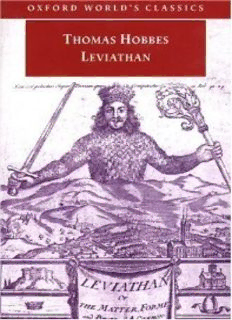
Table Of ContentOXFORD WORLD'S CLASSICS
THOMAS HOBBES
Leviathan
Edited with an Introduction and Notes by
]. C. A. GASKIN
OXFORD
UNIVERSITY PRESS
OXFORD
UNIVERSITY PRESS
Great Clarendon Street, Oxford ox.z 6oP
Oxford Univcrsit) Press is a department of the Uni\ersit) of Oxford.
It furthers the Cnil"ersity's objccti\"c of cxccllcncc in research, scholarship,
and education by publishing \\orldwide in
Oxford New York
:\thcns Auckland Bangkok Hogotoi Buenos Aires Calcutta
Cape Town Chcnnai Dar cs Salaam Delhi Florence Hong Kong Istanbul
Karachi Kuala Lumpur Madrid \lclbournc \1cxico Cit) !\\umbai
;-..;airobi Paris Sio Paulo Shanghai Singapore Taipei Tok~o Toronto \\r'arsan
with associated companies in Berlin lbadan
Oxford is a registered trade mark of Oxford Lni\crsit) Press
in the LX and in certain other countries
Published in the United States
b) Oxford UniH:rsity Press Inc., ~e\\ York
Editorial matter t: J. C. :\. Gaskin 1996
The moral rights of the author ha\·e been asserted
Database right Oxford Cni,·ersity Press (maker)
First published as a World's Classics paperback 1':196
Reissued as an 0:\ford World's Classics paperba<.:k J49H
:\II rights n;scncd. :\'o part of this publication rna~ he reproduced,
stored in a retrie,al s~stem, or transmitted, in an~ form orb~ an~ means,
\\it hour the prior permission in writing of 0:\ford Lni,·ersit~ Press,
or as c\prcssly permitted b} law, or unJer terms agreed with the appropriate
reprographics rights organi;.rations. Enquiries concerning reprodu<.:tion
uutsidc the scope of the abm e should he sent to the Rights Department,
Oxford Lni\·crsit} Press, at the address abmc:
You must not circulate this hook in any other binding or CO\cr
and ~ ou must impose this same condition on an} acquircr
JJritish [.ibrary Cataloguing in Publication l)ata
Data a\ailahle
I .ibrar~ of Congress Cataloging in Publication J)ata
Hobbes, Thomas, 1588-1679.
J.c,·iathan/Thoma.'> Hobbes; edited with an introduction by J. C. :\. Gaskin.
(Oxford world's classics)
Includes hihliographical rcfi.:rences and index.
I. Political ~cicncc-Early works to 1800. 2. State, The. I. Gasl..in,j. C.:\.
Uohn Charle Addison). II. Titk III. Scrie~.
JC15J.H65 1996 J20.1-dc20 95--40506
ISIJ"'-H 9i8-()_I9-28.H98-0
ISIJN-10, ()...19-281-!98-1
13
Printed in Great Britain b~
Clays Ltd, St hcs pk
OXFORD WORLD'S CLASSICS
LEVIATHAN
THOMAS HOBBES was born near Malmesbury in Wiltshire in I s88.
Well taught in local schools and, from his own reports, ill taught at
Oxford, he was employed as tutor and secretary by the Cavendish
family for much of his lite. His three tours of the Continent before
1640 introduced him to the new learning of Galileo and others,
and established the cunnel:tions necessary for his sojourn in Paris,
164o-5I, during the English Civil Wars.
His first substantial original work was The Elements of Law
(1640). Its arguments concerning nature, man, and society
were redeployed and extended in De Cive (1642), his masterpiece
Leviathan (165I), and De Corpore (1655), as well as in numerous
other fiercely controversial publications.
Popularly condemned for his political philosophy, his analysis of
morality, and his 'atheism', his works were nevertheless widely read
in England and Europe. After the Restoration in 166o he survived
his own notoriety under the protection of Charles II and the Earl of
Devonshire. He died at Hardwick Hall in 1679, his character as a
philosopher almost universally denigrated; his character as a man
able to attract the kindness and friendship of almost all who knew
him.
JOHN GASKIN is the Professor of Naturalistic Philosophy and Head
of the Department of Philosophy in the University of Dublin. He
is also a Fellow of Trinity College Dublin. A graduate of Oxford
University, his publications include The Quest for Eternity (1984),
Hume's Philosophy of Religion (1988 and 1993), and Varieties of
Unbelief (1989). He has previously edited a volume of David
Hume's works on religion and Hobbes's The Elements of Law for
Oxford World's Classics. His latest publication is The Epicurean
Philosophers ( 1995), which includes translations of the complete
works of Epicurus and Lucretius.
PREFACE
No one can pretend that editions of Leviathan are now few or hard to
locate. But they often represent editorial extremes. One extreme retains
antique spelling, every odd use of italics or capital letters, and even the
curiosities of seventeenth-century typography. The other extreme changes
italics, punctuation, paragraph lengths, and in short anything (except the
order of the words themselves) which the editor thinks will make the text
easier to read according to the fashion of the moment. The normal reader
will surely look for something between these extremes: something which
reproduces as faithfully as possible what Hobbes actually sanctioned for
publication, but without the accidental impediments which play no part in
what Hobbes meant or what he wished to be read. I have attempted to
provide such a text. It is free from antique spellings and printing conven
tions which had no significance even in the seventeenth century. It is
authentic and complete in all other respects.
The notes-philosophical, textual, historical, and biographical-offer
information if it is wanted. They make a special effort to indicate where the
thought and arguments of Leviathan may be followed in other of Hobbes's
major philosophical works. The Introduction takes up some of the more
obvious issues raised by Leviathan without attempting any grand assess
ment. A great philosophical text should be read with the new eyes of each
generation, sharpened by relevant information, not directed by old judge
ments. The judgements and the overviews can be built into the picture
later. The excitement of the ideas must come first.
To facilitate references to and within the text I have inserted a new run
of paragraph numbers for each chapter, as Hobbes himself did in his other
main philosophical works. For the same reason I have put the page num
bers of the original 16 5 r edition in the margins: a mode of reference used
by a number of commentators.
All the editorial material is new with the exception of two notes and
parts of five paragraphs which are adapted from similar material in my
World's Classics edition of The Elements of Law (Human Nature and De
Corpore Politico). I am grateful to the work done by Richard Tuck in
recording in his edition of Leviathan the variants in the large paper copies.
As explained in the Note on the Text, these are incorporated into the
present edition.
I would like to express my indebtedness to my editor, Judith Luna, for
v
PREFACE
her patience and encouragement, and to William Lyons for his friendly
advice and generous help. I would further like to express my gratitude to
Trinity College Dublin, for awarding me a grant from the Arts and Social
Sciences Benefactions Fund to enable m.e to undertake some of the work
required, to Marsh's Library for allowing me access to their copies of the
Head edition, and finally again to Trinity College for granting me sabbati
cal leave to bring this book to a conclusion.
jOHN GASKIN
VI
CONTENTS
A Scheme of Reference IX
Introduction XI
A Note on the Text xliv
Select Bibliography
Chronology !iii
LEVIATHAN
The Epistle Dedicatory 3
The Contents of the Chapters 5
The Introduction 7
Part I. OF MAN 9
Part 2. OF COMMONWEALTH I II
Part 3· OF A CHRISTIAN COMMONWEALTH 247
Part 4· OF THE KINGDOM OF DARKNESS 403
A Review, and Conclusion 467
Explanatory Notes 477
Index of Subjects 501
Vll
A SCHEME OF REFERENCE
Elements of Law The Elements ofL aw Natural and Politic (1640), Part
I Human Nature, Part II De Corpore Politico, ed.
]. C. A. Gaskin (World's Classics, 1994).
De Cive Philosophical Rudiments concerning Government and
Society (1651), the English version of the Latin De
Cive (1642), ed. Howard Warrender (Oxford, 1983).
Spelling has been modernized in quotations cited.
Leviathan Leviathan, or The Matter, Form, and Power ofa Com
monwealth Ecclesiastical and Civil (1651).
De Corpore Elements of Philosophy, the First Section concerning
Body (1656), the English version of the Latin De
Corpore ( 16 55). Quotations are from the first volume
of the English Works of Thomas Hobbes, ed. W.
Molesworth (London, 1839).
White's De Mundo Examined Thomas White's De Mundo Examined (written c. 1641)
translated from the Latin by H. W. Jones and first
published 1976 (Bradford University Press).
In all the above editions Hobbes or his editors have numbered the chapters
in a single run of numbers from start to finish ignoring the Parts. Except
in the case of Leviathan (where they are supplied in the present text),
Hobbes also numbered the paragraphs or 'articles' in each chapter. This
provides a convenient and brief method of reference to the works. Thus,
for example, De Give, X. 6, means chapter X, paragraph 6. Until the
Clarendon Edition oft he Works ofThomas Hobbes is completed, other works
of his must still be referred to in the English Works of Thomas Hobbes, ed.
W. Molesworth, I 1 vols. (London, 1839). For short reference, English
Works, followed by volume and page.
IX
Description:He that is to govern a whole nation, must read in himself, not this, or that particular man; but mankind. Leviathan is both a magnificent literary achievement and the greatest work of political philosophy in the English language. Permanently challenging, it has found new applications and new refutat