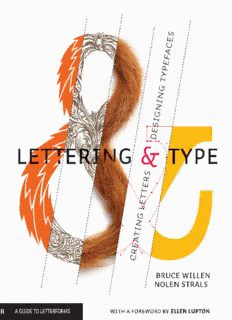
Table Of Contentlettering & TYPE
The works of commercial sign
painters often showcase inventive
and accomplished examples of
custom lettering in use.
lettering & TYPE
creating letters and designing typefaces
bruce willen nolen strals
With A Foreword By Ellen Lupton
Princeton Architectural Press, New York
Published by
Princeton Architectural Press
37 East Seventh Street
New York, New York 10003
For a free catalog of books, call 1.800.722.6657.
Visit our website at www.papress.com.
© 2009 Princeton Architectural Press
All rights reserved
Printed and bound in China
12 11 10 09 4 3 2 1 First edition
No part of this book may be used or reproduced in any manner without
written permission from the publisher, except in the context of reviews.
Every reasonable attempt has been made to identify owners of
copyright. Errors or omissions will be corrected in subsequent editions.
Library of Congress Cataloging-in-Publication Data
Willen, Bruce, 1981-
Lettering & type : creating letters and designing typefaces / Bruce Willen
and Nolen Strals ; with a foreword by Ellen Lupton. — 1st ed.
p. cm. — (Design briefs)
Includes index.
Includes bibliographical references.
ISBN 978-1-56898-765-1 (alk. paper)
1. Type and type-founding. 2. Lettering. 3. Graphic design (Typography)
I. Strals, Nolen, 1978- II. Title. III. Title: Lettering and type.
Z250.W598 2009
686.2'24—dc22
2009003470
Project Editor: Clare Jacobson
Copy Editor: Zipporah W. Collins
Designer: Post Typography
Additional Designers: Sara Frantzman and Eric Karnes
Primary Typefaces: Dolly and Auto, both designed by Underware
Special thanks to: Nettie Aljian, Bree Anne Apperley, Sara
Bader, Nicola Bednarek, Janet Behning, Becca Casbon, Carina Cha,
Penny (Yuen Pik) Chu, Carolyn Deuschle, Russell Fernandez, Pete
Fitzpatrick, Wendy Fuller, Jan Haux, Aileen Kwun, Nancy Eklund
Later, Linda Lee, Laurie Manfra, John Myers, Katharine Myers,
Lauren Nelson Packard, Dan Simon, Andrew Stepanian, Jennifer
Thompson, Paul Wagner, Joseph Weston, and Deb Wood of Princeton
Architectural Press —Kevin C. Lippert, publisher
CONTENTS
viv i Foreword, Ellen Lupton
vviiiiii Preface
xix i Acknowledgments
1 Context 4 Making Letters Work
1 1 Legibility, Context, and Creativity Transforming Type
6 6 A Compressed History 7766 Customizing Type
of the Roman Alphabet 7788 Turning Type into Lettering
881 1 Exercise: Modifying Type
2 Systems & Type-ologies
8822 Ligatures and Joined Letterforms
8844 Interview: Nancy Harris Rouemy
1616 Systems
2200 The Ideal versus the Practical Lettering as Image
2222 Conceptual Alphabets and Lettering 8866 The Opaque Word
2266 Writing, Lettering, or Type? 9944 Interview: Shaun Flynn
3300 Letter Structure
Designing Typefaces
3333 Type and Lettering Classification
9966 Behind a Face
3366 Exercise: Fictional Characters
9999 Character Traits
3388 Book Typefaces
110000 Letterform Analysis
4422 Display Lettering and Type
110001 Lowercase
3 Creating Letters 110088 Uppercase
111166 Numerals
4466 Thinking before Drawing
111177 Punctuation and Accents
4499 The Lettering Process
111188 Type Families
5522 Foundations
112200 Spacing and Kerning
5544 Exercise: Flat-Tipped Pen
112222 Setting Text
5566 Creating Text Letters and Book Type
112244 Interview: Christian Schwartz
6600 Modular Letters
6633 Exercise: Modular Alphabet
112266 Glossary
6644 Screen Fonts
112288 Bibliography
6666 Handwriting
112299 Index
6688 Script Lettering
7700 Casual Lettering
7722 Distressed Type
7744 Interview: Ken Barber
FOREWoRD
ellen lupton
Letters are the throbbing heart of visual communication. For all the talk of the death
of print and the dominance of the image, written words remain the engine of infor-
mation exchange. Text is everywhere. It is a medium and a message. It is a noun and
a verb. As design becomes a more widespread and open-source practice, typography
has emerged as a powerful creative tool for writers, artists, makers, illustrators, and
activists as well as for graphic designers. Mastering the art of arranging letters in
space and time is essential knowledge for anyone who crafts communications for
page or screen.
This book goes beyond the basics of typographic arrangement (line length, line
spacing, column structure, page layout, etc.) to focus on the form and construction of
letters themselves. While typography uses standardized letterforms, the older arts of
lettering and handwriting consist of unique forms made with a variety of tools. Today,
the applications and potential of lettering and type are broader than ever before,
as designers create handmade letterforms, experimental alphabets, and sixteenth-
century typeface revivals with equal confidence.
Type design is a hugely complex and specialized discipline. To do it well
demands deep immersion in the technical, legal, and economic standards of the type
business as well as formidable drawing skills and a firm grasp of history. This book
provides a friendly, openhearted introduction to this potentially intimidating field,
offering a way into not only the vocabulary and techniques of font design but also the
sister arts of lettering, handwriting, calligraphy, and logo design. Simple, inventive
exercises expose readers to creative methods, inviting them to explore fresh ways to
understand, create, and combine forms. Throughout the book, the voices of some of
the world’s leading type and lettering artists illuminate the creative process.
Authors Bruce Willen and Nolen Strals are two of the sharpest young minds on
the contemporary design scene. I first met them as my students at Maryland Institute
College of Art (mica), where they now teach courses in experimental typography and
lettering. Even as students, they were never march-in-line designers. Instead, they
were intellectuals with an iconoclastic edge who pursued their own view of art and
design, connected with music and cultural activism more than with the standard
professional discourse. Along with their maverick spirit, Bruce and Nolen have always
vii
Saks Fifth Avenue brought an incisive and controlled intelligence to their work, which today ranges
Valentine from hand-screened, hand-lettered posters for the Baltimore music scene to sophis-
Lettering, 2008
ticated graphics for the New York Times and the U.S. Green Building Council.
Marian Bantjes
The initial concept and outline for this book were developed in collaboration
Words communicate both visual
and written information. These with MICA’s Center for Design Thinking, which works with its students and faculty
letters’ ornate flourishes eclipse to develop and disseminate design research. The book’s voice and philosophy reflect
the words themselves to form a
the authors’ unique point of view as artists and thinkers. Letters, they suggest,
larger image.
are alive and kicking. Anyone who is fueled with a dose of desire and an ounce of
courage is invited to plunge in and take on twenty-six of the world’s most infamous
and influential characters. The language of letters ranges from the übersophisti-
cation of fonts designed for books to the singular quirks of custom logotypes and
the clandestine mysteries of graffiti. It’s all there to be explored and grappled with.
Anyone who tries a hand at designing letters will walk away with—at the very
least—a deepened respect for the opponent.
PREFACE
Practical information about creating letters and type often amounts to a series of
truisms or guidelines for executing a particular process or style. While a designer
can apply every “rule” or typographic axiom literally, what makes lettering and type
design endlessly fascinating is the flexibility to interpret and sometimes even break
these rules. Lettering & Type aims to present devotees and students of letters with the
background to implement critical lettering and type design principles, discarding
them when appropriate, and to offer readers a framework for understanding and
approaching their own work—not only the “how” but also the “where,” “when,” and
“why” of the alphabet.
Part of our own fascination with letters comes from the endlessly surprising
nature of these common objects. The ubiquity of letters in our daily lives makes them
a familiar subject matter, ready to be interpreted by generations of designers, artists,
and bored schoolchildren alike. Like many other designers, we have loved letters from
an early age, inventing our own comic book sound effects, illustrating our names in
our notebooks, and drawing rock band logos on our desks during math class. We have
yet to outgrow the enjoyment of losing ourselves inside a lettering or type project.
In a world governed by increasingly short deadlines, instant communications, and
machines that let us do more with less, spending an entire day drawing a handful of
letters is indeed a beautiful and luxurious act.
Compliments of the B&O In Lettering & Type we have sought to create a book with a wide focus on
Railroad Company both the methods and the reasons for making letters, something that will appeal to
Dinner menu, 1884
students of type design, fine artists, graphic designers, letterers, and anyone else with
Letters and design respond to
a curiosity about the forms and functions of the alphabet. Our approach to Lettering
new ideas and technologies.
This illustration and its electric & Type comes from our experience teaching at the Maryland Institute College of Art,
lettering herald a newly as well as our own practice, which often extends into graphic design, illustration,
connected world, accessible by
lettering, and type design. We have augmented our firsthand knowledge with the
the telegraph and railroad.
inspiring work of contemporary designers and artists, and with lessons absorbed
Library of Congress, Rare Book and
Special Collections Division. from a wide range of theorists and historians.
Description:No component of graphic design has attracted as much interest or inspired as much innovation in recent years as lettering and type. These fundamentals of design, once the exclusive domain of professional typographers, have become an essential starting point for anyone looking for a fresh way to comm