Table Of Content' '
'.
�, ..:
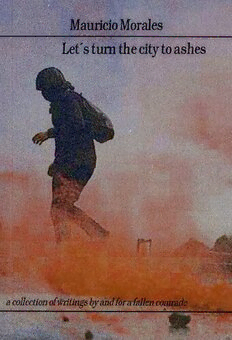
MauricMioor ales
Lestt "u ni.t hcei ttoya shes
Mauricio Morales
Let's turn the city
to
ashes
A collection of writings by and about
compafiero Mauricio Morales
$antiago, $hile
Septiembre Negro 2009
see to it that anarchy lives
Index
7 Introduction
15 Poems
27 Correspondence with Axel Osorio
35 Music
43 Some found writings
49 Conversations
57 Stories
82 Love, kaos and anarchy
87 Words of your brothers
111 The fire spreads
125 Prologue
With each drop of ink,
each breath taken,
we dedicate this work
with love
to all the persecuted.
We also dedicate
this work to Zoe
who lost her life in France,
as a result of the
accidental explosion
of a device
she was constructing
in the early hours of May 1st
2009 ...
... our war
is also for you guys!
Introduction
Since 2004 [in Chile], diverse groups of anarchists and anti-authoritarians
have taken a concrete offensive against the structures of capital. Incendiary
devices and arson have been used against banks, police stations, investigation
headquarters, institutional buildings, newspaper offices, high voltage pylons,
and churches. The objectives of these insurgents have known no limits.
The press has counted roughly one hundred bombings claimed by anti
authoritarian groups. The powerful felt the blow and responded without
respite. They assigned three prosecutors with exclusive dedication, to inves
tigate and identify the authors of these different attacks.
They put the word out that when they had one arrest they would apply to
him or her the "full force of the law," i.e. the Anti-Terrorist Law, with more
aggravations than one could possibly invent.
The beast was thirsty for blood. Day by day, month by month, it suffered
the humiliation of new attacks. The powerful would know how to make up
for that embarrassment, when at last they had an arrestee squirming between
their teeth. A name and a face on which to unload the whole arsenal.
Threat after threat, not the powerful, nor the prosecutors, nor the police,
nor any of the intelligence organisms, had been able to identify or arrest an
yone who had broken the [Anti-Terrorist] law. Facing this situation, the go
vernment, through its spokespersons, decreed a two month period in which
to get concrete results. They rounded up the prosecutors, they demanded
blood.
Facing this pressure, Chahuan (the head Prosecutor) could only mutter
threats on television, while Jacir and Armendiiz (Prosecutors with exclusive
dedication), chose to be silent; better to shut up than to keep looking ridi
culous.
The year 2008 comes to an end with an apparently criminal occurren
ce (as portrayed by sensationalist media), creating a more profound impact
than one could have imagined.
The self-described anarchist Gustavo Fuentes Aliaga (who was comple
ting a reduced sentence for possessing molotov cocktails, and who on many
occasions had been identified by the mainstream media due to his publicised
7
sentences for drug trafficking and confrontation with carabineros), stabbed
his partner and fled, believing her to be dead.
That act created the perfect excuse to have various squatted houses raided.
In the supposed search for "El Grillo" [the Cricket], they went about breaking
into houses that he frequented and also those that he spent little time in.
They weren't really searching for him, as was later verified. Nothing was
taken from the raided houses but bicycles, clothes, tools, gas cans, anarchist
material, etc. What they intended was to verify their thesis that the squats and
the bombings came together in an unmistakable equation.
They searched for the culprits within the squat scene, thus satiating their
thirst for vengeance.
At last "El Grillo" is arrested (before they carry out various house raids),
and after several months in prison, the powers that be make it known that
the subject-in-question is in collaboration with the police. In his dementia
he admits to several bombing attacks and indicates that his stabbed partner
was responsible for other attacks. After learning that she had survived, he
takes back everything, declaring himself innocent, undermining everything
already stated.
The police reports later state that he didn't participate in the actions.
He was just delirious, imagine that!
How did he snitch? By handing over information about how this type
of anarchist organisation works. Bringing light where there was darkness.
Indicating bonds between people and motivations for the attacks. Contribu
ting data that helps them form profiles and a global map of where to strike.
He SNITCHED, managing to get his sentence reduced from that of
attempted murder to just domestic violence.
In spite of the threats and the raids, the bombings don't stop, but at the
end of the fateful May of2009, the story takes a completely different course ...
In the early hours of22 of May, a bicycle moves through a cold Santiago
night. A comrade carries in his rucksack an insurrectional dream. In his
belt he has a revolver which he will use to stop any reaction from the cops.
He's carrying a homemade bomb and his single objective becomes clearer
with each pedal: attack the school of the Gendarmeria.
8
Around 1 :30 in the morning, he makes his last stop, only one block sepa
rates him from completing the action. He stops to check the timing system
that's enclosed inside a fire extinguisher filled with gunpowder. But in an
instant, an unexpected accident sets off the detonation.
A huge blast produces a deafening sound expanding into an echo through
the dilapidated streets of the barrio Malta. The Bomb that should have gnas
hed in the face of the powerful, when activated threw the body of the com
pafzero into the middle of the street. He died instantly.
The cold body belongs to Mauricio Morales Duarte, to the punk Mauri,
to Crusty, Perro Loko, Kiltro, Uncle Panky, Mabri, dozens of names for just
one brother.
The press and the police celebrate the death of an anarchist and they
unleash new raids on squats and social centres. Now they are looking for a
possible accomplice, looking for evidence to gain more data, more suspects.
Mauri hung around squats, therefore, they search them to find supposed
components for the fabrication of bombs.
But who was Mauri? Why are some people determined to remember him
in more than just a personal way? Why, at any cost, do many people want
him to not be forgotten?
In the war against power, in the historic struggle in which thousands of
comrades have freed themselves from domination, in all periods of time and
places of the world, many brothers and sisters have fallen in combat, a lot
of blood has been shed. Hundreds of streets, jails, and cages have witnessed
hearts stop beating in actions against authority.
This is how we understand the death of Mauri; as a possible consequence
of becoming an opponent to all authority, but we won't analyse the subject
of fallen comrades from the terrain of abstraction. Cancelling them out, by
making them just another statistic.
Behind every comrade that has died in combat there is a complete life,
a world of subjectivities, a deepening of analysis, a path traveled, thousands
of reflections leading to determined decisions, and a road taken towards
death. A road taken, not as a pastime, not in search of banal sensations, but
rather for real convictions. Convictions that the way in which the world is
being run must end, that passivity before daily exploitation rums you into
an accomplice, and that the greatest threat for the established order is in our
hands and dependent on our ingenuity.
9