Table Of ContentThe author would like to thank the following people: David Ross, Lisa Brown, Daniel Handler,
Lynn Nesbit, Hannah Davey, Lee Boudreaux, Reagan Arthur, Beatrice Monti della Corte, and
Enrico Rotelli. Much thanks also to numerous people and places around the world, but most
especially to the Santa Maddalena Foundation, Arte Studio Ginestrelle, Art Castle International,
the Evens and Odds, and the Dolphin Swimming and Boating Club.
The characters and events in this book are fictitious. Any similarity to real persons, living or dead,
is coincidental and not intended by the author.
Copyright © 2017 by Andrew Sean Greer
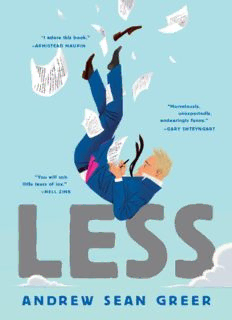
Cover design by Julianna Lee
Cover art by Leo Espinosa
Author photograph by Kaliel Roberts
Cover copyright © 2017 by Hachette Book Group
Hachette Book Group supports the right to free expression and the value of copyright. The
purpose of copyright is to encourage writers and artists to produce the creative works that enrich
our culture.
The scanning, uploading, and distribution of this book without permission is a theft of the
author’s intellectual property. If you would like permission to use material from the book (other
than for review purposes), please contact [email protected]. Thank you for your support
of the author’s rights.
Lee Boudreaux Books / Little, Brown and Company
Hachette Book Group
1290 Avenue of the Americas, New York, NY 10104
leeboudreauxbooks.com
twitter.com/leeboudreauxbks
facebook.com/leeboudreauxbooks
First ebook edition: July 2017
Lee Boudreaux Books is an imprint of Little, Brown and Company, a division of Hachette Book
Group, Inc. The Lee Boudreaux Books name and logo are trademarks of Hachette Book Group,
Inc.
The publisher is not responsible for websites (or their content) that are not owned by the
publisher.
The Hachette Speakers Bureau provides a wide range of authors for speaking events. To find out
more, go to hachettespeakersbureau.com or call (866) 376-6591.
Illustrations by Lilli Carré
ISBN 978-0-31631614-9
E3 20170531_DANF
Table of Contents
Cover
Title Page
Copyright
Dedication
Less at First
Less Mexican
Less Italian
Less German
Less French
Less Moroccan
Less Indian
Less at Last
About the Author
Also by Andrew Sean Greer
Newsletters
For Daniel Handler
Less at First
From
where I sit, the story of Arthur Less is not so bad.
Look at him: seated primly on the hotel lobby’s plush round sofa, blue suit
and white shirt, legs knee-crossed so that one polished loafer hangs free of its
heel. The pose of a young man. His slim shadow is, in fact, still that of his
younger self, but at nearly fifty he is like those bronze statues in public parks
that, despite one lucky knee rubbed raw by schoolchildren, discolor beautifully
until they match the trees. So has Arthur Less, once pink and gold with youth,
faded like the sofa he sits on, tapping one finger on his knee and staring at the
grandfather clock. The long patrician nose perennially burned by the sun (even
in cloudy New York October). The washed-out blond hair too long on the top,
too short on the sides—portrait of his grandfather. Those same watery blue eyes.
Listen: you might hear anxiety ticking, ticking, ticking away as he stares at that
clock, which unfortunately is not ticking itself. It stopped fifteen years ago.
Arthur Less is not aware of this; he still believes, at his ripe age, that escorts for
literary events arrive on time and bellboys reliably wind the lobby clocks. He
wears no watch; his faith is fast. It is mere coincidence that the clock stopped at
half past six, almost exactly the hour when he is to be taken to tonight’s event.
The poor man does not know it, but the time is already quarter to seven.
As he waits, around and around the room circles a young woman in a brown
wool dress, a species of tweed hummingbird, pollinating first this group of
tourists and then that one. She dips her face into a cluster of chairs, asking a
particular question, and then, dissatisfied with the answer, darts away to find
another. Less does not notice her as she makes her rounds. He is too focused on
the broken clock. The young woman goes up to the lobby clerk, then to the
elevator, startling a group of ladies overdressed for the theater. Up and down
Less’s loose shoe goes. If he paid attention, perhaps he would have heard the
woman’s eager question, which explains why, though she asks everyone else in
the lobby, she never asks it of him:
“Excuse me, but are you Miss Arthur?”
The problem—which will not be solved in this lobby—is that the escort
believes Arthur Less to be a woman.
In her defense, she has read only one novel of his, in an electronic form that
lacked a photo, and found the female narrator so compelling, so persuasive, that
she was certain only a woman could have written it; she assumed the name to be
one of those American gender curiosities (she is Japanese). This is, for Arthur
Less, a rare rave review. Little good this does him at the moment, sitting on the
round sofa, from whose conical center emerges an oiled palm. For it is now ten
minutes to seven.
Arthur Less has been here for three days; he is in New York to interview
famous science fiction author H. H. H. Mandern onstage to celebrate the launch
of H. H. H. Mandern’s new novel; in it, he revives his wildly popular Holmesian
robot, Peabody. In the world of books, this is front-page news, and a great deal
of money is jangling behind the scenes. Money in the voice that called Less out
of the blue and asked if he was familiar with the work of H. H. H. Mandern, and
if he might be available for an interview. Money in the messages from the
publicist instructing Less what questions were absolutely off the table for H. H.
H. Mandern (his wife, his daughter, his poorly reviewed poetry collection).
Money in the choice of venue, the advertisements plastered all over the Village.
Money in the inflatable Peabody battling the wind outside the theater. Money
even in the hotel Arthur has been placed in, where he was shown a pile of
“complimentary” apples he can feel free to take anytime, day or night, you’re
welcome. In a world where most people read one book a year, there is a lot of
money hoping that this is the book and that this night will be the glorious
kickoff. And they are depending on Arthur Less.
And still, dutifully, he watches the stopped clock. He does not see the escort
standing woefully beside him. He does not see her adjust her scarf, then exit the
lobby through the washing machine of its revolving doors. Look at the thinning
hair at the crown of his head, the rapid blink of his eyes. Look at his boyish faith.
Once, in his twenties, a poet he had been talking with extinguished her
cigarette in a potted plant and said, “You’re like a person without skin.” A poet
had said this. One who made her living flaying herself alive in public had said
that he, tall and young and hopeful Arthur Less, was without skin. But it was
true. “You need to get an edge,” his old rival Carlos constantly told him in the
old days, but Less had not known what that meant. To be mean? No, it meant to
be protected, armored against the world, but can one “get” an edge any more
than one can “get” a sense of humor? Or do you fake it, the way a humorless
businessman memorizes jokes and is considered “a riot,” leaving parties before
he runs out of material?
Whatever it is—Less never learned it. By his forties, all he has managed to
grow is a gentle sense of himself, akin to the transparent carapace of a soft-
shelled crab. A mediocre review or careless slight can no longer harm him, but
heartbreak, real true heartbreak, can pierce his thin hide and bring out the same
shade of blood as ever. How can so many things become a bore by middle age—
philosophy, radicalism, and other fast foods—but heartbreak keeps its sting?
Perhaps because he finds fresh sources for it. Even foolish old fears have never
been vanquished, only avoided: telephone calls (frenetically dialing like a man
decoding a bomb), taxicabs (fumbling the tip and leaping out as from a hostage
situation), and talking to attractive men or celebrities at parties (still mentally
rehearsing his opening lines, only to realize they are saying their good-byes). He
still has these fears, but the passage of time solved them for him. Texting and
email saved him from phones forever. Credit card machines appeared in taxis. A
missed opportunity could contact you online. But heartbreak—how can you
avoid it except to renounce love entirely? In the end, that is the only solution
Arthur Less could find.
Perhaps it explains why he gave nine years to a certain young man.
I have neglected to mention that he has, on his lap, a Russian cosmonaut’s
helmet.
But now a bit of luck: from the world outside the lobby, a chime rings out,
one, two, three, four, five, six, seven, causing Arthur Less to pop out of his seat.
Look at him: staring at his betrayer, the clock, then running to the front desk and
asking—at last—the essential temporal question.
“I don’t understand how you could think I was a woman.”
“You are such a talented writer, Mr. Less. You tricked me! And what are you
carrying?”
“This? The bookstore asked me to—”
“I loved Dark Matter. There is a part that reminded me of Kawabata.”
“He’s one of my favorites! The Old Capital. Kyoto.”
“I am from Kyoto, Mr. Less.”
“Really? I’ll be there in a few months—”
“Mr. Less. We are having a problem…”
This conversation takes place as the woman in the brown wool dress leads
him down a theater hallway. It is decorated with a lone prop tree, the kind the
hero hides behind in comedies; the rest is all brick painted glossy black. Less
and his escort have run from the hotel to the event space, and he can already feel
the sweat turning his crisp white shirt into a transparency.
Why him? Why did they ask Arthur Less? A minor author whose greatest
fame was a youthful association with the Russian River School of writers and
artists, an author too old to be fresh and too young to be rediscovered, one who
never sits next to anyone on a plane who has heard of his books. Well, Less
knows why. It is no mystery. A calculation was made: what literary writer would
agree to prepare for an interview and yet not be paid? It had to be someone
terribly desperate. How many other writers of his acquaintance said “no
chance”? How far down the list did they go before someone said: “What about
Arthur Less?”
He is indeed a desperate man.
From behind the wall, he can hear the crowd chanting something. Surely the
name H. H. H. Mandern. In the past month, Less has privately gorged on H. H.
H. Mandern’s works, those space operettas, which at first appalled him, with
their tin-ear language and laughable stock characters, and then drew him in with
their talent for invention, surely greater than his own. Less’s new novel, a
Description:Who says you can't run away from your problems? You are a failed novelist about to turn fifty. A wedding invitation arrives in the mail: your boyfriend of the past nine years is engaged to someone else. You can't say yes--it would be too awkward--and you can't say no--it would look like defeat. On y