Table Of ContentLearning from Arguments
An Introduction to Philosophy
Daniel Z. Korman
UCSB
Published open access by the PhilPapers Foundation, 2022
Department of Philosophy, Stevenson Hall, Western University
1151 Richmond St, London, ON, N6A 5B8, Canada
https://philarchive.org/rec/KORLFA
ISBN 978-1-9991763-1-0
Contents
Preface for Students i
Preface for Instructors iv
INTRODUCTION 1
1. The Chapters
2. The Elements of Arguments
3. Premises and Conditionals
4. Common Argumentative Strategies
5. Counterexamples
6. Argument by Analogy
7. Thought Experiments
8. What is Philosophy?
CHAPTER 1: Can God Allow Suffering? 19
1. Introduction
2. The Argument from Suffering
3. Refining the Argument
4. The Appreciated Goods Defense
5. The Character Building Defense
6. The Free Will Defense
7. The Hidden Reasons Defense
8. Conclusion
CHAPTER 2: Why You Should Bet on God 32
1. Introduction
2. Practical Reasoning in an Uncertain World
3. The Expected Utility of Believing in God
4. Challenging the Decision Matrix
5. Is Belief Voluntary?
6. Conclusion
CHAPTER 3: What Makes You You 48
1. Introduction
2. Clarifying the Question of Personal Identity
3. Some Promising and Unpromising Answers
4. Against the Same Body Account
5. Against the Psychological Descendant Account
6. Souls
7. Combining the Psychological and Bodily Accounts
8. Conclusion
CHAPTER 4: Don’t Fear the Reaper 74
1. Introduction
2. Hedonism
3. The Argument from Hedonism
4. Against Post-Mortem Consciousness
5. The Too Many Thinkers Argument
6. Irrational Fears
CHAPTER 5: No Freedom 86
1. Introduction
2. Freedom Unmotivated
3. The Desire Argument Against Free Action
4. The Argument from Undesired Actions
5. The Argument from Desire-Defeating Actions
6. Determinism
7. The Argument from Determinism
8. On Rejecting Determinism
9. Compatibilism
10. Freedom and Responsibility
CHAPTER 6: You Know Nothing 107
1. Skepticism about the Future
2. What It Takes to Know the Future
3. Why Believe the Future Will Be Like the Past?
4. No Inductive Argument for FLP
5. The Dreaming Argument
6. Why You Have to Rule Out the Dreaming Hypothesis
7. Why You Can’t Rule Out the Dreaming Hypothesis
8. Can You Tell You’re Not Dreaming?
9. No Useful Tests for Dreaming
10. Conclusion
CHAPTER 7: Against Prisons and Taxes 126
1. Taxation and Extortion
2. Morally Relevant Differences
3. The Social Contract
4. No Social Contract
5. Immigration
6. What Can the Government Do?
CHAPTER 8: The Ethics of Abortion 140
1. Preliminaries
2. Identifying Wrong-Making Features
3. Some Bad Pro-Choice Arguments
4. Some Bad Pro-Life Arguments
5. The Right to Life Argument
6. The Violinist Argument
7. Risk, Consent, and the Right to the Womb
8. The Future Like Ours Argument
9. Bad Objections to the FLO Argument
10. FLO-Overriding Factors
11. Making Exceptions
12. Making Laws
CHAPTER 9: Eating Animals 167
1. Introduction
2. The Argument from Precedent
3. The Argument from Naturalness
4. The Argument from Necessity
5. Meet Your Meat
6. Fred and His Puppies
7. Morally Relevant Differences
8. The No Impact Objection
9. Beyond Factory Farming
CHAPTER 10: What Makes Things Right 187
1. Utilitarianism
2. Why Accept Act Utilitarianism?
3. Killing One to Save Five
4. Rule Utilitarianism
5. The Trolley Argument
6. Conclusion
APPENDIX A: Logic 202
1. Valid Arguments
2. How to Check for Validity
3. Challenging Modus Ponens and Modus Tollens
APPENDIX B: Writing 214
1. Introducing Your Target
2. Advancing Your Argument
3. Anticipating Possible Responses
4. Editing
5. Likely Criteria for Grading
6. Citation and Plagiarism
APPENDIX C: Theses and Arguments 227
Preface for Students
I’m going to argue that you have no free will. I’m going to argue
for some other surprising things too, for instance that death isn’t
bad for you, taxation is immoral, and you can’t know anything
whatsoever about the world around you. I’m also going to argue
for some things you’re probably not going to like: that abortion is
immoral, you shouldn’t eat meat, and God doesn’t exist.
The arguments aren’t my own. I didn’t come up with them. I
don’t even accept all of them: there are two chapters whose
conclusions I accept, three I’m undecided about, and five I’m
certain can’t be right. (I’ll let you guess which are which.) This
isn’t merely for the sake of playing devil’s advocate. Rather, the
idea is that the best way to appreciate what’s at stake in
philosophical disagreements is to study and engage with serious
arguments against the views you’d like to hold.
Each chapter offers a sustained argument for some
controversial thesis, specifically written for an audience of
beginners. The aim is to introduce newcomers to the dynamics of
philosophical argumentation, using some of the arguments
standardly covered in an introductory philosophy course, but
without the additional hurdles one encounters when reading the
primary sources of the arguments: challenging writing, obscure
jargon, and references to unfamiliar books, philosophers, or
schools of thought.
The different chapters aren’t all written from the same
perspective. This is obvious from a quick glance at the opening
chapters: the first chapter argues that you shouldn’t believe in
God, while the second argues that you should. You’ll also find
that chapters 3 and 4 contain arguments pointing to different
conclusions about the relationship between people and their
bodies, and chapter 7 contains arguments against the very theory
of morality that’s defended in chapter 10. So, you will be exposed
to a variety of different philosophical perspectives, and you
should be on the lookout for ways in which the arguments in one
chapter provide the resources for resisting arguments in other
chapters.
And while there are chapters arguing both for and against
belief in God, that isn’t the case for other topics we’ll cover. For
i
instance, there’s a chapter arguing that you don’t have free will,
but no chapter arguing that you do have free will. That doesn’t
mean that you’ll only get to hear one side of the argument. Along
the way you will be exposed to many of the standard objections
to the views and arguments I’m advancing, and you can decide
for yourself whether those objections are convincing. Those who
need help finding the flaws in the reasoning (or ideas for paper
topics) can look to the reflection questions at the end of each
chapter for some clues.
As I said, the arguments advanced in the book are not my
own, and at the end of each chapter I point out the original sources
of the arguments. In some chapters, the central arguments have a
long history, and the formulations I use can’t be credited to any
one philosopher in particular. Other chapters, however, are more
directly indebted to the work of specific contemporary
philosophers, reproducing the contents of their books and articles
(though often with some modifications and simplifications). In
particular, chapter 7 draws heavily from the opening chapters of
Michael Huemer’s The Problem of Political Authority; chapter 8
reproduces the central arguments of Judith Jarvis Thomson’s “A
Defense of Abortion” and Don Marquis’s “Why Abortion is
Immoral”; and the arguments in chapter 9 are drawn from Dan
Lowe’s “Common Arguments for the Moral Acceptability of
Eating Meat” and Alastair Norcross’s “Puppies, Pigs, and
People.” The quote from Delia Graff Fara at the end of the
introduction is from Steve Pyke’s Philosophers, Volume II.
I’m grateful to Jeff Bagwell, Jacob Berger, Matt Davidson,
Nikki Evans, Jason Fishbein, Bill Hartmann, Colton Heiberg, Will
Huesser, İrem Kurtsal, Leo Iacono, Jeonggyu Lee, Clayton
Littlejohn, Neil Manson, David Mokriski, Charles Perkins, Seán
Pierce, Ryan Ross, David Shoemaker, Neil Sinhababu, Dan
Sturgis, Joshua Tepley, and Travis Timmerman for helpful
suggestions, and to the Facebook Hivemind for help selecting the
further readings for the various chapters. Special thanks are due
to Chad Carmichael, David King, Jonathan Livengood, and
Daniel Story for extensive feedback on earlier drafts of the
textbook, and to the students in my 2019 Freshman Seminar:
Shreya Acharya, Maile Buckman, Andrea Chavez, Dylan Choi,
Lucas Goefft, Mino Han, PK Kottapalli, Mollie Kraus, Mia
ii
Lombardo, Dean Mantelzak, Sam Min, Vivian Nguyen, Ariana
Pacheco Lara, Kaelen Perrochet, Rijul Singhal, Austin Tam,
Jennifer Vargas, Kerry Wang, and Lilly Witonsky. Finally, thanks
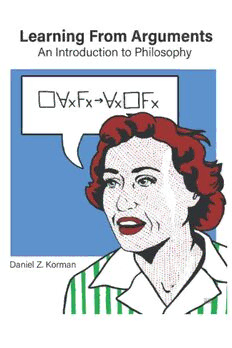
to Renée Jorgensen for permission to use her portrait of the great
20th century philosopher and logician Ruth Barcan Marcus on the
cover. You can see more of her portraits of philosophers here:
www.reneebolinger.com/portraits.html
iii
Preface for Instructors
Learning from Arguments is a novel approach to teaching
Introduction to Philosophy. It advances accessible versions of key
philosophical arguments, in a form that students can emulate in
their own writing, and with the primary aim of cultivating an
understanding of the dynamics of philosophical argumentation.
The book contains ten core chapters, covering the problem of
evil, Pascal’s wager, personal identity, the irrationality of fearing
death, free will and determinism, Cartesian skepticism, the
problem of induction, the problem of political authority, the
violinist argument, the future-like-ours argument, the ethics of
eating meat, utilitarianism (both act and rule), and the trolley
problem. Additionally, there is an introductory chapter
explaining what arguments are and surveying some common
argumentative strategies, an appendix on logic explaining the
mechanics and varieties of valid arguments, and an appendix
providing detailed advice for writing philosophy papers.
Each of the ten core chapters offers a sustained argument for
some controversial thesis, specifically written for an audience of
beginners. The aim is to introduce newcomers to the dynamics of
philosophical argumentation, using some of the arguments
standardly covered in an introductory philosophy course, but
without the additional hurdles one encounters when reading the
primary sources of the arguments: challenging writing,
specialized jargon, and references to unfamiliar books,
philosophers, or schools of thought.
Since the book is aimed at absolute beginners, I often address
objections that would only ever occur to a beginner and ignore
objections and nuances that would only ever occur to someone
already well-versed in these issues. Theses defended in the
chapters often are not ones that I myself accept. Instead, decisions
about which position to defend in each chapter were made with
an eye to pedagogical effectiveness.
Instructors will find the book easy to teach from. The chapters
are self-standing with no cross-referencing, and may be taught in
any order. The central arguments of each chapter are already
extracted in valid, premise/conclusion form, ready to be put up
on the board or screen and debated. The chapters also contain
iv
plenty of arguments that haven’t been extracted in this way, but
that are self-contained in a single paragraph, making for
moderately challenging—but not too challenging—argument
reconstruction exercises. The reflection questions at the end of
each chapter can easily be incorporated into class discussion.
The book can be used in different ways in the classroom.
Instructors may decide to take on the persona of the author of the
chapter, leaving it to the students to find a way of resisting the
arguments—which I have found to be an enjoyable and effective
way of teaching the material. Or they may use the arguments in
the chapter as a jumping-off point for presenting the standard
positions and responses. They may wish to supplement the
chapters with the original sources of the arguments or with
readings representing competing philosophical positions,
possibly drawn from the list of further readings at the end of each
chapter.
Don’t worry about Learning from Arguments being too “one-
sided.” It’s true that whichever view is being defended in the
chapter always gets the last word. But along the way, students are
exposed to clear and charitable presentations of the standard
objections to the views and arguments advanced in the chapter,
and can decide for themselves whether the chapter’s responses to
those objections are convincing. Students who need help finding
the flaws in the reasoning (or ideas for paper topics) can look to
the reflection questions at the end of each chapter for clues about
the most promising places to resist the arguments.
Additionally, I think instructors will find there to be
significant pedagogical advantages to a “one-sided” approach.
When beginners are presented with a full menu of available
views, surveying the pros and cons of each, this can sometimes
give the wrong impression: that, in philosophy, all views are
equally defensible, that it’s all a matter of opinion, and that one
can simply pick and choose whichever view one likes best. What
the approach in Learning from Arguments emphasizes is that it’s
not that easy. If you want to say that abortion is permissible or
that people have free will, you have to work for it, identifying
some flaw in the arguments for the opposite conclusion. In my
experience, students find this sort of challenge exciting.
v