Table Of ContentThe Financial Express
17 May, 2016
LCA Tejas, BrahMos, LCH, Akash missile & AEW&C: 5
defence products India is eyeing for exports
Defence Minister Manohar Parrikar has set himself a target - he wants India's defence
exports to reach $2 billion in the next two years, from the current level of $300 million.
Indigenously developed defence products - be it India's missiles, aircraft or helicopter -
have generated interest in the global market, especially from African and Latin American
countries. From HAL's Light Combat Helicopter and LCA Tejas to BrahMos missile, we
take a look at five defence products that India can look at exporting:
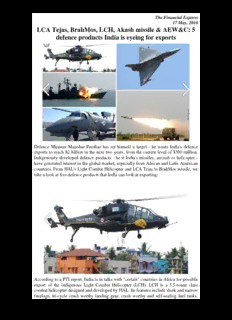
According to a PTI report, India is in talks with "certain" countries in Africa for possible
export of the indigenous Light Combat Helicopter (LCH). LCH is a 5.5-tonne class
combat helicopter designed and developed by HAL. Its features include sleek and narrow
fuselage, tri-cycle crash worthy landing gear, crash worthy and self-sealing fuel tanks,
armour protection, nuclear and low visibility features which makes the LCH lethal, agile
and survivable. (Image: HAL)
Designed for anti-tank and anti-infantry roles with a maximum speed of 275 kilometers
per hour, the LCH is also capable of high-altitude warfare since its operational ceiling
will be 16,000 to 18,000 feet. "With great value for money, the helicopter is an attractive
buy for many countries. The countries interested in the LCH in the current form do not
need high features like air to air missiles. For them turret gun along with some other
features work," a senior defence official has said. (Image: HAL)
The supersonic cruise missile system BrahMos, which is a joint venture between India
and Russia, has caught the attention of countries like Argentina, Venezuela, Chile and
Brazil in Latin America and also of South Africa, which is part of the BRICS grouping,
because it has been developed at a low cost of $300 million. (Image: DRDO)
BrahMos is a supersonic cruise missile developed by DRDO and Russian NPO
Mashinostroyeniya. The missile can be launched from surface, submarine or air. Latin
American countries as well as South East Asian countries have expressed their interest
for the missile particularly for their naval and coastal defence. (Image: DRDO)
The BrahMos missile has a range of 290 km, has a maximum velocity of 2.8 Mach and
cruises at altitudes varying from 10 metres to 15 km, claims BrahMos. It can be launched
in either inclined or vertical configuration based on the type of the ship. (Image: DRDO)
India's Light Combat Aircraft (LCA) Tejas, which was several years in the making, has
now caught the attention of foreign buyers with Sri Lanka and Egypt evincing interest in
the indigenously built fighter jet. Sri Lanka had recently rejected Pakistan's JF-17 aircraft
built with Chinese help, while Egypt had last year signed a contract for 24 French-made
Rafale fighter jets. The two countries are interested in the current version of the Tejas and
not the upgraded one which will be rolled out later. (Image: DRDO)
Tejas is perhaps the world’s smallest lightweight, multi-role single engine tactical fighter
aircraft. Tejas is equipped with a quadruplex digital fly-by-wire flight control system to
ease handling by the pilot. It has intentionally been made longitudinally unstable to
enhance manoeuvrability. (Image: MoD)
Two things that go in favour of the Tejas are its lower cost and flying ability. Sources
have told PTI that enquiries by foreign countries came during the Bahrain air show in
January, the first time that Tejas flew outside the country. The decision to send Tejas
abroad was of Defence Minister Manohar Parrikar, who has put his weight behind the
aircraft. (Image: DRDO)
Parrikar recently said that India is willing to export the Akash missile system. Akash, a
surface-to-air missile, has a range of 25 km. Akash mobile Air Defence Weapon System
has been designed, developed and led to production by DRDO for defending and
protecting the important assets of the country from penetrating aerial attacks. (Image:
DRDO)
AEW&C is one of the flagship programmes of DRDO consisting of state-of-theart
Airborne Early Warning and Control system that can detect, identify and classify threats
present in the surveillance area and act as a command and control centre to support
variety of air operations. "AEW&C India" with Mission Systems, with modular design &
integrated on an Embraer 145 aircraft, are very cost effective, claims DRDO. With an eye
on export, the DRDO had exhibited the plane during air shows in the past. (Image:
DRDO) - Text inputs from Agencies
NDTV
17 May, 2016
Air Chief Arup Raha's 'Test' Flight in Tejas Fighter Aircraft
More than 15 years after he first flew, an Indian Air Force Chief Air Chief Marshal Arup
Raha today took control of the indigenous light combat aircraft (LCA), the Tejas for the
first time.
Air Chief Marshal, a veteran fighter pilot, flew the jet along with a test pilot for thirty
minutes and simulated air-to-air and air-to-ground attacks using different modes of the
jet's advanced Israeli made radar and the helmet mounted targeting system.
After his sortie, the Air Chief said, "It is my first sortie in Tejas, it is a good aircraft for
induction into IAF operations."
Indian Air Force Chief Arup Saha (left).
The Indian Air Force has 120 Tejas fighters on order. Several decades in development,
the Tejas has finally entered the Indian Air Force in limited numbers.
At a time when the Indian Air Force's squadron strength has come down considerably,
the induction of the Tejas is a priority, particularly since the aircraft has overcome several
of the challenges that it faced in its development.
At the moment, a handful of Tejas jets have entered service in the IAF even as Hindustan
Aeronautics completes weapons-firing tests on the aircraft. The first squadron of the
LCA is expected to be formed by July this year.
Meanwhile, test pilots are clearing several weapons including the Israeli Derby and
Python air-to-air missile for use on the fighter.
The Light Combat aircraft programme began in the eighties to replace India's fleet of
Russian designed MiG-21 fighters. The programme ran into several stumbling blocks
particularly after the imposition of US sanctions in the nineties which prevented the
transfer and development of key technologies.
Over the years, aviation technology around the world has shot ahead of where the Tejas
stands today but those in favour of the jet insist that the Tejas remains far superior to the
MiG-21 and displays flies as well as the French built Mirage 2000 also in service with the
Indian Air Force.
Indian Defence Research Wing
17 May, 2016
IAF chief flies in Tejas, signals fighters induction into the
air force.
Air Chief Marshal Arup Raha on Monday flew the homegrown light combat aircraft
Tejas, officially signalling to the Indian Air Force pilots that they can begin flying the
fourth generation fighter in their squadron.
Air Chief Marshal Raha, an experienced fighter pilot with over 3,400 hours of flying
experience, took off on a trainer for a 25 minute sortie over the Bengaluru skies.”It shows
the commitment of the IAF for the aircraft,” says Kota Harinarayana, chief designer and
former programme head of the Tejas aircraft. “In the years to come, Tejas will be the
backbone of the IAF. They have committed order for 120 aircraft, it is now for the
production agency to deliver.”
The test pilots of IAF’s Aircraft and Systems Testing Establishment (ASTE) – the elite
school that tests and certifies every aircraft type used by the force, have flown the single-
engine supersonic fighter over 3145 sorties, according to the Aeronautical Development
Agency.
The aircraft is powered by a GE-404 engine and an advanced version that will see
modifications in the structure will have a more powerful GE-414 power plant made by
General Electric.Tejas uses fly-by wire technology that enables a pilot to control the
plane electronically through on-board computers.
Since the first flight of the LCA’s technology demonstrator in January 2001, Tejas has
flown sorties across regions in India, including desert and high altitude in the Himalayas
have been without any mishap – a rarity in new aircraft testing globally.
The first squadron of Tejas will be raised at the IAF’s Sulur base in Coimbatore by July.
The air force expects to raise six squadrons of the homegrown fighter in a decade.
Hindustan Aeronautics Ltd, the public sector plane maker will manufacture the aircraft at
its facility in Bengaluru.
“The aircraft has to be inducted. Only then will you actually able to use the platform
effectively,” says Harinarayana.
Air Chief Marshal Raha’s sortie on the trainer aircraft also shows the confidence in the
force for the aircraft, once dismissed as a dud project of the DRDO. In 2001, the then IAF
chief Air Chief Marshal A Y Tipnis had to be cajoled to be in Bengaluru to witness the
first flight of the LCA.
The Economic Times
17 May, 2016
First Tejas squadron to come up by July; IAF chief Arup
Raha flies the indigenous jet
New Delhi: It was a routine sortie of the Tejas light combat aircraft, which has so far
clocked well over 3,050 flight tests since its first prototype took to the skies in January
2001. But the message was significant: India's first home-grown fighter has finally come
of age after a meandering developmental saga of 33 years.
Air Chief Marshal Arup Raha became the first IAF chief to fly in the multi-role
supersonic Tejas at the Hindustan Aeronautics facility in Bengaluru on Tuesday morning.
"The twin-seat Tejas trainer will undergo a full-profile sortie. It will convey IAF's
confidence in the indigenous fighter," said HAL chief T Suvarna Raju, speaking to TOI.
That is certainly true. After years of being highly critical of the excruciatingly slow
progress in developing the fighter, which was supposed to replace the virtually obsolete
MiG-21 but kept on missing deadlines, the IAF finally has something to cheer about.
The force, after all, is down to just 33 fighter squadrons (each has 16-18 jets), which
includes 11 squadrons of old MiG-21s and MiG-27s with poor serviceability. This when
45 squadrons are needed to counter a two-front collusive threat from Pakistan and China.
The first Tejas squadron with four jets is slated to come up at Bengaluru by July. "It will
operate from a dedicated HAL hanger, with designers and manufacturers being close by
to resolve teething problems. The squadron will shift to its earmarked airbase at Sulur
after a year," said an official.
The single-engine Tejas, of course, is still not combat-ready. Its final phase of weapon
trials, including firing of BVR (beyond visual range) missiles, is currently under way.
Moreover, the fighter is to get an AESA (active electronically scanned array) radar and
advanced electronic warfare (EW) suite, apart from becoming capable of mid-air
refuelling, for its Mark-IA version that the IAF actually wants.
All this will take another two to three years. Global arms majors like Raytheon , Israeli
Aerospace Industries , Thales, Saab and others have already responded to the "search and
select process" underway to find an AESA-EW package for the fighter. "Tejas jets
produced after 2018 will be up to the Mark-IA standards," said Raju.
In effect, IAF will get the first 20 Tejas Mark-I jets by 2018. With the annual production
being stepped up to 16 jets from the existing 8, another 100 "improved" Tejas Mark-IA
jets will follow by 2026 or so.
While Tejas will certainly help IAF to make up depleting numbers, the light-weight jets
cannot substitute the need for medium-weight multi-role combat aircraft (MMRCA) or
heavy-weight fighters. The 36 Rafales India is negotiating hard to acquire from France
for Rs 60,000 crore, for instance, have more than triple the weapon-load carrying
capacity and range of the Tejas fighters.
Tejas, with a limited reach of just about 400-km, will basically be used for "air defence"
to take on incoming enemy fighters or "close air-to-ground" operations to support the
Army. Strikes deep into enemy territory will have to be undertaken by Russian-origin
Sukhoi-30MKIs or the Rafales.
The Hindu
17 May, 2016
IAF chief takes maiden ride on homegrown Tejas
IAF chief Air Chief Marshal Arup Raha (left) after flying the first fully indigenously designed light combat aircraft
Tejas (for about 30 minutes) at HAL airport, in Bengaluru on Tuesday.
Indian Air Force (IAF) chief Air Chief Marshal Arup Raha on Tuesday took his maiden
flight in India’s home grown light combat aircraft (LCA) Tejas, calling it “good” for
induction.
An ace pilot himself, Mr. Raha is the first Chief of Air Staff to fly the indigenously
designed and produced Tejas in about a 30-minute sortie over Bengaluru skies around the
HAL airport in Bengaluru. Group Captain M. Rangachari was with him in the twin-seater
trainer aircraft.
“It is my first sortie in Tejas, it is a good aircraft for induction into IAF operations,” Mr.
Raha was quoted as saying by the aircraft maker Hindustan Aeronautics Limited (HAL).
The Air Chief Marshal carried out manoeuvres in the entire flying envelope of the
aircraft, an HAL statement said, adding he carried out simulated air to air and air to
ground attacks.
He also assessed the advanced modes of the radar and Helmet Mounted Display Sight
(HMDs).
HAL said Mr. Raha appreciated the flying qualities of the aircraft and congratulated the
entire team of HAL and others involved in getting the LCA programme to this stage.
“It is a morale boosting gesture from the IAF Chief that reposes great confidence of our
valuable customer in our abilities,” HAL CMD T. Suvarna Raju ssaid.
During the sortie, the Mr. Raha checked for himself the take off, climb performances and
agility of the aircraft by carrying out aerobatic manoeuvres, a defence release said.
This was also an opportunity to see the integration of avionics, simulated weapon
integration and to get a feel of operational capability during the flight, it said.
The series production of the Tejas aircraft has already commenced at HAL Bengaluru
and the first squadron of the LCA was expected to be formed by July 2016, HAL said.
The Air Chief also inaugurated LCA Painting hangar at HAL’s LCA Tejas Division, and
took stock of HTT-40 (Basic Trainer) which was parked on the tarmac besides visiting
LCA production line and other facilities.
IAF currently plans to acquire 120 Tejas aircraft, with 100 of these having major
modifications.
The force wants Active Electrically Scanned Array (AESA) Radar, Unified Electronic
Warfare (EW) Suite, mid-air refuelling capacity and beyond the vision range missiles.
As per the production plan, six aircraft will be made this year and HAL will subsequently
scale it up to eight and 16 aircraft per year.
Rediff.com
17 May, 2016
IAF chief Raha takes to the skies in a Tejas
Indian Air Force chief Air Chief Marshal Arup Raha on Tuesday took his maiden
flight in India’s homegrown Light Combat Aircraft Tejas, calling it “good” for
induction.
An ace pilot himself, Raha is the first Chief of Air Staff to fly the indigenously designed
and produced Tejas in about a 30-minute sortie over Bengaluru skies around the HAL
airport. Group Captain M Rangachari was with him in the twin-seater trainer aircraft.
“It is my first sortie in Tejas, it is a good aircraft for induction into IAF operations,” Raha
was quoted as saying by the aircraft maker Hindustan Aeronautics Limited.
The Air Chief Marshal carried out manoeuvres in the entire flying envelope of the
aircraft, an HAL statement said, adding he carried out simulated air to air and air to
ground attacks.
He also assessed the advanced modes of the radar and Helmet Mounted Display Sight.
HAL said Raha appreciated the flying qualities of the aircraft and congratulated the entire
team of HAL and others involved in getting the LCA programme to this stage.
“It is a morale boosting gesture from the IAF chief that reposes great confidence of our
valuable customer in our abilities,” HAL CMD T Suvarna Raju said.
Description:From HAL's Light Combat Helicopter and LCA Tejas to BrahMos missile, we take a look at five defence products that India can look at exporting:.