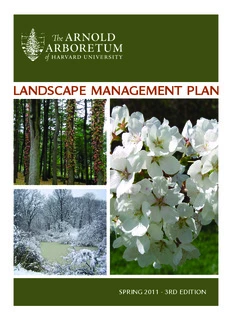
Table Of Contentlandscape management plan
SPRING 2011 - 3RD EDITION
Contents
Contributors iv
Introduction v
Arboretum Map 1
Region 1—Most Highly Visited Area
Region 1 Map 3
1.1 Hunnewell Visitor Center Area 5
1.2 Landscape Surrounding the Visitor Center 9
1.3 Azalea Border along Meadow Road 13
1.4 The Meadow 17
1.5 Willow Path and the Arborway Wall Edge 21
1.6 The Acer and Salix Collection 25
1.7 North Woods with Accessions 29
1.8 Bradley Rosaceous Collection 33
1.9 The Three Ponds: Dawson, Faxon, Rehder 37
1.10 Mass State Lab Slope & Forest Hills Gate Area 41
1.11 Legumes, including Shrubs 45
1.12 Zelkova and Area Below the Esker 49
1.13 Leventritt Shrub and Vine Garden 53
1.14 Linden Path 57
1.15 Leitneria Bowl to Bamboo 61
1.16 Aesculus, Tilia, Phellodendron and Cornus 65
1.17 North Woods 69
1.18 Dana Greenhouse, Nurseries and Bonsai 73
1.19 Main Gate (Hunnewell Building) & Forest Hills Gate 77
Region 2—Bussey Hill
Region 2 Map 81
2.1 Syringa Collection 83
2.2 Forsythia Bank and Accessioned Shrubs 87
2.3 Legume Beds & Catalpa, Ulmus, Moruis, Fraxinus, and Celtis 91
2.4 Historic Bussey Mansion Area 95
2.5 South St. Bank, Upper Slope & Beech Path 99
2.6 Fagus Collection 103
2.7 Quercus Collection and Understory 107
2.8 Oak Path Corridor 111
2.9 The Rockery 115
2.10 The Viburnum Collection 119
2.11 Betula, Euonymus and Prunus Collections 123
2.12 Explorers Garden 127
2.13 Bussey Hill Summit 131
2.14 Centre Street and South Street Gates 135
Region 3—Conifer Area
Region 3 Map 139
3.1 Centre Street Beds 141
3.2 Carya and Centre Street Collections 145
Contents | i
Contents
3.3 Central Woods 149
3.4 City Shack Parcel 153
3.5 Carpinus and Castanea Collections 157
3.6 Juniper Knoll 161
3.7 Old Dwarf Conifers, Chamaecyparis, Thuja 165
3.8 Bussey and Spring Brook Corridor to Road 169
3.9 Conifer Collection 173
3.10 Hebrew Slope and Walter Street Gate Area 177
3.11 Walter Street and Bussey Street Gates 181
Region 4—Peters Hill
Region 4 Map 185
4.1 Peters Hill Summit 187
4.2 Peters Hill Natural Woods 191
4.3 Collections Woodland, Larix Grove 195
4.4 Oaks (Quercus) 199
4.5 Walter Street Burying Ground 203
4.6 Miscellaneous Collections on Slope 207
4.7 Pinus along Walter Street 211
4.8 Shrub Beds along Peters Hill Road 215
4.9 North-facing Hill 219
4.10 The Quarry 223
4.11 Populus, Pyrus and Oak Allée 227
4.12 South Street and Commuter Rail Edge 231
4.13 Rosaceous Orchard 235
4.14 Gate Areas of Peters Hill 239
Region 5—Hemlock Hill
Region 5 Map 243
5.1 Rhododendron/Davison Path Corridor 245
5.2 Hemlock Dominant Slope 249
5.3 Cut Plots 253
5.4 Hardwood, Mixed Hemlock/Deciduous 257
5.5 Accessions, including Understory Road Edge 261
5.6 Bussey Street Gate 265
Region 6—South Street Tract
Region 6 Map 269
6.1 Bussey Brook Meadow, including the Mesa 271
6.2 Blackwell Footpath Corridor 275
6.3 South Street (& Blackwell Path) & Washington St. 279
ii | Contents
Contents
Region 7—Weld Hill
Region 7 Map 283
7.1 Landscape surrounding Weld Hill 285
7.2 Grassy Meadow 289
7.3 Oak Stand 293
7.4 Weld Hill Perimeters; Walter St., Weld St., & Centre St. 297
Appendices
Appendix A Mowing Operations 301
Appendix B Snow Removal Operations 309
Appendix C Infrastructure and Hardscape 313
Appendix D Curation and Plant Records Office 315
Appendix E-1 Noxious Weeds 323
Appendix E-2 Insects 331
Appendix E-3 Diseases 341
Appendix F Secondary Paths 349
Appendix G Drainage 351
Appendix H Arborist Calendar 353
Appendix I Horticulture Team Assignments 383
Contents | iii
Contributors
C :
ontributors
Kevin Block Brendan McCarthy
Matt Connelly Bruce Munch
Julie Coop Jim Papargiris
John DelRosso Sue Pfeiffer
Michael Dosmann Kyle Port
Bob Ervin Nima Samimi
Kit Ganshaw Steve Schneider
Scott Grimshaw Richard Schulhof
Dennis Harris Kyle Stephens
Wes Kalloch Mark Walkama
Jen Kettell
P :
hotos
Arnold Arboretum Archives Jim Harrison
Phyllis Anderson Jon Hetman
Jill K. Conley Wes Kalloch
Jay Connor Jen Kettell
Sheila Connor Jennifer Leigh
Julie Coop T.E. Marr
Linda J. Davison Robert Mayer
John Del Rosso Richard Schulhof
Peter Del Tredici Tom Ward
Michael Dosmann Sheryl White
Eric Gehring Sylvia Winter
Tony Goncalves
C P :
over hotos
Front Cover (L–Clockwise): Gate area Peters Hill gate, Jill K. Conley; Prunus flowers, Bradley Rosaceous
Collection, Jon Hetman; Winter Faxon Pond, Arnold Arboretum Archives
Back Cover (L–Clockwise): Davidia involucrata, Jill K. Conley; Phellodendron, near Meadow Road,
Arnold Arboretum Archives; Acer rubrum, Robert Mayer
D L :
esign anD ayout
Jill K. Conley
iv | Contributors
Introduction
s P
tatement of urPose
This edition of the Landscape Management Plan is the result of the continuing work of the Horticulture
Department of the Arnold Arboretum. It is a detailed game plan that communicates the shared goals and
priorities collectively developed by the horticulture team. The Plan’s goal is to maintain exemplary standards
of horticultural care and management that provide optimal growing conditions for our collections, enhance the
ecological health of the Arboretum environment, and present a landscape of outstanding quality for visitors,
students, the surrounding community and other key constituencies.
m a : o t
anagement PProaCh rganization anD erms
Addressing the full range of biotic and abiotic elements that comprise the Arnold Arboretum environment,
analysis has included botanical collections, natural areas, soils, pests and diseases, hardscape and perimeter
elements, and visitor needs and impacts. Management activities are organized within a geographical framework
that divides the landscape into regions and zones:
Regions: The landscape is organized into 7 regions broadly defined by topography (Bussey, Hemlock,
Weld and Peters Hill), landscape type (natural areas vs. collections areas vs. urban wild) and management
needs. Regions facilitate the broader-scale assignment of tree-work, spraying, and hardscape and
perimeter maintenance.
Zones: The plan organizes the landscape into 70 management zones that provide a structure for staff
assignment and identify specific care needs and projects for collections and landscape areas. Zones
encompass areas that are contiguous and share similar challenges, collections themes or management
requirements. Zones are treated as a unit with common specifications for daily, monthly and annual care.
Specifications are written to attain targeted standards of care and presentation.
The following information is provided to guide the care and management of each zone:
Management Priority: Zones are designated as “high”, “moderate” or “low” priority based upon their
relative importance within a given year, as determined by the Manager of Horticulture. Priorities may
vary annually, depending on special projects, particular landscape issues (e.g., pest outbreaks, winter
damage, etc.) and larger organizational needs.
Management Intensity: The amount of resources (staff time, equipment and materials, team support, etc.)
needed to maintain a given zone at the desired standard is designated as:
High: Intensive care requirements stemming from design (Leventritt Garden, Bradley Collection),
visual prominence (Hunnewell Building landscape) or care needs (Lilac Collection).
Moderate: Areas comprising tree collections (Tilia, Fagus, etc.) or lower-care shrub beds
(legume beds).
Low: Natural areas (North Woods) and urban wilds (Mesa) requiring lesser amounts of care.
Introduction | v
Introduction cont.
Area Profile: A general profile of each area describes distinguishing characteristics, unique resources,
history and special challenges.
Special Priorities: Tasks and projects of high priority that require ongoing attention and commitment.
Annual Care Plan: All tasks needed to maintain an area are listed by season, in descending order of
priority.
Noxious Weeds: Extant weed species requiring management.
Pests and Diseases: Pests and diseases that are currently a problem or may be in the future.
Curation: Curatorial plans or priorities within a zone.
Long-Term Projects/Tasks: Projects and tasks to be accomplished by Arboretum staff, within the
annual operating budget, are listed for each zone within a 2–5 year time frame. These include landscape
improvements, plant acquisition, vegetation management, restoration projects, and pest and disease
abatement.
Capital Projects: These larger projects require capital investment outside the operating budget. They
include hardscape design and construction, irrigation and other projects to be completed within 3–5
years.
vi | Introduction cont.
Arnold Arboretum Map
Region 1
Most Highly Visited Area
Region 2
Bussey Hill
Region 3
Conifer Area
Region 7
Weld Hill
Region 6
South Street Tract
Region 5
Hemlock Hill
Region 4
Peters Hill
Arnold Arboretum Map | 1
r 1 m
egion aP
High Priority
Moderate Priority
Low Priority
MAP 1
1.1
1.19
1.2
MAP 3
MAP 2 1.2
1.14
MAP 4 MAP 5
1.4
MAP 6 MAP 7 MAP 8
1.16
1.3
1.13
1.6 1.5
1.15
MAP 9 MAP 10 MAP 11 MAP 12
1.18
1.7
1.12
1.17
MAP 13 MAP 14 MAP 15 MAP 16 1.19MAP 17
2.14 1.8
1.11 1.9
2.10
2.1
1.9
1.10
1.9
MAP 18 3.1 MAP 19 MAP 20 MAP 21 MAP 22 MAP 23
2.11
2.3 2.2
3.2
2.13
Region 1 Map | 3
MAP 24 MAP 25 MAP 26 MAP 27 MAP 28
2.7
2.7
6.3
3.3 2.9 2.8 2.4 6.1
2.12
MAP 29 MAP 30 MAP 31 MAP 32 MAP 33 6.2
3.5
2.5
3.7
3.4
3.6
3.9
MAP 34 MAP 35 MAP 36 MAP 37 2.6 MAP 38
6.1
3.8 2.146.3
5.5 5.1
5.3
5.3
MAP 393.10 MAP 40 MAP 41 MAP 42 MAP 43
5.2
3.11
5.6
7.2 5.4
7.1 7.4
7.1
7.3
7.1
7.3
WH 1 WH 2 MAP 44 4.14 MAP 45 4.10 MAP 46 MAP 47 MAP 48
7.4 7.1 4.7 4.14
7.2 7.2 4.8 4.11
4.8
4.11
7.4
WH 3 WH 4 WH 5 MAP 49 MAP 50 MAP 51 MAP 52
4.9
4.6
4.13
MAP 53 MAP 54 MAP 55 MAP 56
4.1
4.12
4.5 4.2
4.8
MAP 57 MAP 58 MAP 59 MAP 60
4.3
4.4
MAP 61 MAP 62 MAP 63
4.14
4.4
MAP 64 MAP 65
Description:Secondary Paths. 349. Appendix G. Drainage. 351. Appendix H. Arborist
Calendar. 353. Appendix I. Horticulture Team Assignments. 383. Region 7—
Weld Hill