Table Of Content4
4
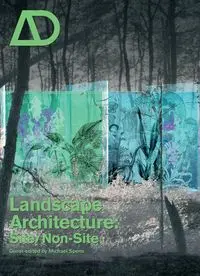
Landscape
Architecture:
Site/Non-Site
Guest-edited by Michael Spens
Landscape
Architecture:
Site/Non-Site
Guest-edited by Michael Spens
Individual backlist issues of 4 are available for purchase
at £22.99. To order and subscribe for 2007 see page 144.
Volume 76 No. 2
ISBN 0470015292
Volume 76 No. 3
ISBN 0470018399
Volume 76 No. 4
ISBN 0470025859
Volume 76 No. 5
ISBN 0470026529
Volume 76 No. 6
ISBN 0470026340
Volume 77 No. 1
ISBN 0470029684
Volume 75 No. 5
ISBN 0470014679
Volume 75 No. 6
ISBN 0470024186
4Architectural Design
Backlist Titles
Volume 76 No. 1
ISBN 047001623X
4Architectural Design
Forthcoming Titles 2007
July/August 2007, Profile No 188
4dsocial: Interactive Design Environments
Guest-edited by Lucy Bullivant
A new breed of social interactive design is taking root that overturns the traditional approach to artistic
experience. Architects and designers are responding to cues from forward-thinking patrons of architec-
ture and design for real-time interactive projects, and are creating schemes at very different scales and
in many different guises. They range from the monumental – installations that dominate public squares
or are stretched over a building’s facade – to wearable computing. All, though, share in common the
ability to draw in users to become active participants and co-creators of content, so that the audience
becomes part of the project.
4dsocial: Interactive Design Environments investigates further the paradoxes that arise when a new form
of ‘socialisation’ is gained through this new responsive media at a time when social meanings are in
flux. While many works critique the narrow public uses of computing to control people and data, and
raise questions about public versus private space in urban contexts, how do they succeed in not just get-
ting enough people to participate, but in creating the right ingredients for effective design?
May/June 2007, Profile No 187
Italy: A New Architectural Landscape
Guest-edited by Luigi Prestinenza Puglisi
Every five or six years, a different country takes the architectural lead in Europe: England came to the
fore with High Tech in the early 1980s; by the end of the 1980s France came to prominence with
François Mitterrand’s great Parisian projects; in the 1990s Spain and Portugal were discovering a new
tradition; and recently the focus has been on the Netherlands. In this ever-shifting European landscape,
Italy is now set to challenge the status quo. Already home to some of the world’s most renowned archi-
tects – Renzo Piano, Massimiliano Fuksas and Antonio Citterio – it also has many talented architects like
Mario Cucinella, Italo Rota, Stefano Boeri, the ABDR group and Maria Giuseppina Grasso Cannizzo, who
are now gaining international attention. Moreover, there is an extraordinary emergence of younger
architects – the Erasmus generation – who are beginning to realise some very promising buildings of
their own.
September/October 2007, Profile No 189
Rationalist Traces
Guest-edited by Andrew Peckham, Charles Rattray and Torsten Schmiedenecht
Modern European architecture has been characterised by a strong undercurrent of rationalist thought.
Rationalist Traces aims to examine this legacy by establishing a cross-section of contemporary European
architecture, placed in selected national contexts by critics including Akos Moravanszky and Josep Maria
Montaner. Subsequent interviews discuss the theoretical contributions of Giorgio Grassi and OM Ungers,
and a survey of Max Dudler and De Architekten Cie’s work sets out a consistency at once removed from
avant-garde spectacle or everyday expediency. Gesine Weinmiller’s work in Germany (among others) offers
a considered representation of state institutions, while elsewhere outstanding work reveals different
approaches to rationality in architecture often recalling canonical Modernism or the ‘Rational
Architecture’ of the later postwar period. Whether evident in patterns of thinking, a particular formal
repertoire, a prevailing consistency, or exemplified in individual buildings, this relationship informs the
mature work of Berger, Claus en Kaan, Ferrater, Zuchi or Kollhoff. The buildings and projects of a younger
generation – Garcia-Solera, GWJ, BIQ, Bassi or Servino – present a rationalism less conditioned by a con-
cern to promote a unifying aesthetic. While often sharing a deliberate economy of means, or a sensual
sobriety, they present a more oblique or distanced relationship with the defining work of the 20th century.
4
Landscape Architecture
Site/Non-Site
Guest-edited by
Michael Spens
Architectural Design
March/April 2007
ISBN-13 9780470034798
ISBN-10 0470034793
Profile No 186
Vol 77 No 2
Editorial Offices
International House
Ealing Broadway Centre
London W5 5DB
T: +44 (0)20 8326 3800
F: +44 (0)20 8326 3801
E: