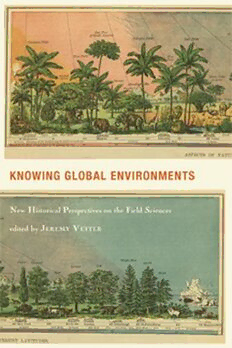
Table Of ContentKnowing Global Environments
STUDIES IN MODERN SCIENCE, TECHNOLOGY, AND THE ENVIRONMENT
Edited by Mark A. Largent
The increasing importance of science over the past 150 years—and with it the
increasing social, political, and economic authority vested in scientists and
engineers—established both scientific research and technological innovations
as vital components of modern culture. Studies in Modern Science,
Technology, and the Environment is a collection of books that focuses on
humanistic and social science inquiries into the social and political implications
of science and technology and their impacts on communities, environments,
and cultural movements worldwide.
Mark R. Finlay, Growing American Rubber: Strategic Plants and the Politics of
National Security
Gordon Patterson, The Mosquito Crusades: A History of the American Anti-
Mosquito Movement from the Reed Commission to the First Earth Day
Jeremy Vetter, ed., Knowing Global Environments: New Historical Perspectives
on the Field Sciences
Knowing Global
Environments
New Historical
Perspectives on the
Field Sciences
Edited by
Jeremy Vetter
Rutgers University Press
New Brunswick, New Jersey, and London
Library of Congress Cataloging-in-Publication Data
Knowing global environments : new historical perspectives on the field
sciences / edited by Jeremy Vetter.
p. cm.
Includes bibliographical references and index.
ISBN 978-0-8135-4875-3 (hardcover : alk. paper)
1. Science—Fieldwork—History. I. Vetter, Jeremy, 1975–
Q175.K557 2010
507.2'3—dc22
2009052308
A British Cataloging-in-Publication record for this book is available from the
British Library.
This collection copyright © 2011 by Rutgers, The State University
Individual chapters copyright © 2011 in the names of their authors
All rights reserved
No part of this book may be reproduced or utilized in any form or by any
means, electronic or mechanical, or by any information storage and retrieval
system, without written permission from the publisher. Please contact
Rutgers University Press, 100 Joyce Kilmer Avenue, Piscataway, NJ
08854–8099. The only exception to this prohibition is “fair use” as defined by
U.S. copyright law.
Visit our Web site: http://rutgerspress.rutgers.edu
Manufactured in the United States of America
Contents
List of Figures and Tables vii
Acknowledgments ix
Introduction 1
Jeremy Vetter
One From the Oceans to the Mountains: Spatial
Science in an Age of Empire 17
Michael S. Reidy
Two Emigrants and Pioneers: Moritz Wagner’s
“Law of Migration” in Context 39
Lynn K. Nyhart
Three Negotiating the Agricultural Frontier in
Nineteenth-Century Southern Ohio Archaeology 59
J. Conor Burns
Four Managing Monocultures: Coffee, the Coffee Rust,
and the Science of Working Landscapes 87
Stuart McCook
Five Rocky Mountain High Science: Teaching, Research,
and Nature at Field Stations 108
Jeremy Vetter
v
vi Contents
Six On the Trail of the Ivory-Bill: Field Science,
Local Knowledge, and the Struggle to Save
Endangered Species 135
Mark V. Barrow Jr.
Seven Playing By—and On and Under—the Sea:
The Importance of Play for Knowing the Ocean 162
Helen M. Rozwadowski
Eight Planetary-Scale Fieldwork: Harry Wexler
on the Possibilities of Ozone Depletion and
Climate Control 190
James Rodger Fleming
Nine History of Field Science: Trends and Prospects 212
Robert E. Kohler
Notes on Contributors 241
Index 245
Figures and Tables
Figures
Figure 1.1. A chart of the cotidal lines of the world’s oceans 24
Figure 1.2. Alexander von Humboldt’s depiction of zones of
vegetation on Mount Chimborazo (ca. 1805) 27
Figure 3.1. The “Marietta Works” 67
Figure 3.2. The “Liberty Works” 68
Figure 3.3. Ancient works in the vicinity of Chillicothe 69
Figure 5.1. Ramaley and colleagues sitting on the steps of
Tolland, Colorado, field station 113
Figure 5.2. Park Lake with town of Tolland in background 117
Figure 6.1. Transporting equipment into the Singer Tract 141
Figure 6.2. A pair of ivory-billed woodpeckers 142
Figure 7.1. Cookbook cover image 183
Figure 8.1. Harry Wexler 199
Figure 8.2. Painting of weather systems over North America 201
Table
Table 5.1. Field stations in the Rocky Mountains 112
vii
Acknowledgments
This book originated from a workshop conference we organized at the
University of Pennsylvania on May 10–12, 2007, under the same title, held in
honor of Robert E. Kohler. To honor Rob’s legacy as a scholar who has always
been eager to engage with new and vital areas of historical inquiry, we
designed the workshop from the beginning not as a traditional festschrift but
instead as a gathering of scholars on a theme of broad importance to both his-
torical scholarship and the public at large: how field scientists in a wide variety
of disciplines have produced knowledge beyond the local level. Participants
were selected not necessarily because of their direct connection to Rob as for-
mer students or colleagues (some were, others were not), but because of their
engagement in exciting research at the forefront of the history of the field sci-
ences. Papers were pre-circulated, and the result was a lively and engaging
workshop that led to further rounds of revision and, ultimately, the book you
now hold in your hands.
I am pleased to acknowledge the other co-organizer for the workshop con-
ference, Susan Lindee of the University of Pennsylvania, as well as the institu-
tional sponsors: Philadelphia Area Center for History of Science, Academy of
Natural Sciences, American Philosophical Society, Chemical Heritage
Foundation, Princeton University, and the University Research Foundation
and Department of History and Sociology of Science at the University of
Pennsylvania. Special thanks are due to the other scholars who participated in
the workshop as presenters or commentators and whose contributions were
crucial to the discussions that shaped the essays in this volume: Michael
Bravo, Emily Brock, Eve Buckley, Graham Burnett, Alex Checkovich,
ix
x Acknowledgments
TomGieryn, Drew Isenberg, Christine Keiner, Scott Kirsch, Henrika Kuklick,
Naomi Oreskes, and Phil Pauly. Appreciation is also due to the many other
attendees at the workshop for their ideas and questions. We are also grateful to
all those in the Department of History and Sociology of Science who helped
make the workshop a success, including the administrative staff, students, and
faculty. To Rob, whose works and ideas have been so important to so many
scholars, we express our enduring gratitude. Finally, thank you to acquisitions
editor Doreen Valentine, series editor Mark A. Largent, and the anonymous
external reviewer for Rutgers University Press for their valuable suggestions
that helped to improve this book.