Table Of ContentISSMGE Bulletin: Volume 5, Issue 4 Page 45
NEWS
Arrigo Croce Lecture
To all members of ISSMGE
Roma, July 15th 2011
Dear members of the ISSMGE,
Since 2000 the Italian Geotechnical Society (Associazione Geotecnica Italiana – AGI) has been organising
every year a series of conferences dedicated to the memory of the late Professor Arrigo Croce, who was
the first professor of soil mechanics in Italy, President of AGI, vice-President for Europe of the ISSMFE and
co-founder of the technical committee devoted to the geotechnical aspects of preservation of historic
sites.
The first Arrigo Croce Lecture was delivered by Prof. Carlo Viggiani, followed by Prof. Michele
Jamiolkowski, Prof. Ruggiero Jappelli, Prof. Giovanni Calabresi, Prof. Giovanni Barla, Prof. Beniamino
D’Elia, Prof. Giuseppe Ricceri, Prof. Luciano Picarelli and Prof. Alberto Burghignoli.
Also written versions of past lectures have been published in the Rivista Italiana di Geotecnica. These
papers (except the last two, not yet available on the site) can be downloaded from the website of AGI
(www.associazionegeotecnica.it), following the path “RIG”, “Croce Lecture”.
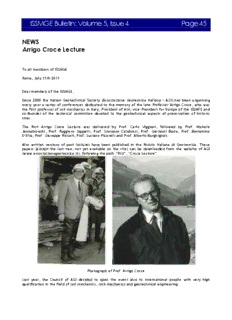
Photograph of Prof. Arrigo Croce
Last year, the Council of AGI decided to open the event also to international people with very high
qualification in the field of soil mechanics, rock mechanics and geotechnical engineering.
ISSMGE Bulletin: Volume 5, Issue 4 Page 46
NEWS
Arrigo Croce Lecture (continued)
I am very happy to announce you that the next lecturer will be:
Prof. Eduardo ALONSO
Universitat Politècnica de Catalunya
who decided to give a lecture with the very stimulating title:
Crystal Growth in Geotechnics
Details of this lecture are presented below.
The Conference is scheduled on December 15th, 2011 in Rome, at 10.30 am in the Conference Room of
CNR (National Research Council). After the lecture, a light buffet will be provided for exchanging
greetings for the coming new year.
The lecture is free of charge and all members of ISSMGE are welcome. We ask you to fill-in the
registration form attached to the present letter and send it by e-mail to the Secretariat of the Italian
Geotechnical Society ([email protected]). The maximum number of 300 people will be allowed to participate;
hence the rule of “first-come, first-service” will be applied.
I hope to see many of you at this occasion, to attend the interesting Lecture of Prof. Alonso and have the
chance of visiting Rome, a very pleasant town also in the period before Christmas.
With my best regards,
Stefano Aversa
President of the Associazione Geotecnica Italiana
CRYSTAL GROWTH IN GEOTECHNICS
Eduardo Alonso
Lilla tunnel and two long viaducts (Pont de Candí and
Pallaressos), all of them being parts of the high speed
Madrid-Barcelona railway link, have suffered in recent
years extreme swelling phenomena immediately after
being built. In all of them the origin of the observed
swelling is crystal growth. The concerned crystals were
gypsum crystals in the case of Lilla tunnel and Pont de
Candí viaduct and ettringite-thaumasite crystals in the
case of Pallaressos.
Lilla tunnel, 2km long, was excavated in hard sulphate
rich claystones of Eocene age by a traditional head and
bench scheme using blasting and a conventional support.
The tunnel floor experienced vertical displacement
reaching in some sections 80 cm in a few months. As a
result, the tunnel was heavily instrumented (continuous Prof. Eduardo Alonso
extensometers, pressure cells, floor displacement monitoring) and large diameter samples were taken for
laboratory testing. In addition, alternative support systems were tested “in situ” with the purpose of
ISSMGE Bulletin: Volume 5, Issue 4 Page 47
NEWS
Arrigo Croce Lecture (continued)
selecting the best design for the repair of the tunnel. A circular cross section lined with a high strength
concrete ring, heavily reinforced, was eventually built at a high cost. Maximum pressures recorded so far
reach 6 MPa.
Pont de Candí Viaduct is founded on large diameter piles of 20 m in length socketed on hard anhydritic
claystones. It has suffered a sustained heave dating from the end of construction at a rate of 1-2
mm/month. An “active layer” was detected and monitored by continuous extensometers. It is located
below pile’s tip. Therefore piles and viaduct are heaving as a single unit.
In Pallaressos Viaduct the two access embankments, 18m high, have experienced severe heaving which has
required a continuous levelling work of the rail tracks. The “active layer” in this case is located in the
upper 8 m of the embankments. The swelling induces a longitudinal compression of the bridge and
abutments resulting in severe structural damage.
The three outlined cases are rather exceptional. Expansive phenomena in tunnels around the Alps in
Triassic sulphated rocks are well known. But Lilla tunnel reached extreme swelling pressures and swelling
displacements. No similar phenomena have been found in the literature for the additional two cases.
The lecture will describe the fundamental observations carried out “in situ” and the attempts to
reproduce the swelling phenomena in the laboratory. Models were developed to simulate the hydro-
mechanical and chemical interactions, and the crystal growth as well as its application to real conditions
will be also presented and compared with real observations.
The lecture will end with a description of the mitigation measures adopted to protect the damaged
structures and to allow the safe operation of the high speed railway line.
Gypsum crystals growing in a discontinuity in Lilla claystone
ISSMGE Bulletin: Volume 5, Issue 4 Page 48
NEWS
Arrigo Croce Lecture (continued)
Lilla tunnel. Heave of the floor
The viaduct of Pont de Candí being repaired
ISSMGE Bulletin: Volume 5, Issue 4 Page 49
NEWS
Arrigo Croce Lecture (continued)
Pallaressos Viaduct and one of the access embankments affected by thaumasite crystal growth
Damage in Pallaressos structure
ISSMGE Bulletin: Volume 5, Issue 4 Page 50
NEWS
Arrigo Croce Lecture (continued)
ISSMGE Bulletin: Volume 5, Issue 4 Page 51
NEWS
INTERNATIONAL SYMPOSIUM ON GEOTECHNICAL
ENGINEERING FOR DISASTER PREVENTION AND REDUCTION
This conference took place from July 26 to 29, 2011, at Far Eastern State Transport University in
Khabarovsk, Russia (Photos 1 to 2). It was organized by Professor Sergey A. Kudryavtsev, General Secretary
of Organizing Committee of 4IGS under auspices of Asian Technical Committee 3 for geotechnical natural
disasters (ATC3), Russian Geotechnical Society and Kazakhstan Geotechnical Society. As shown in its title,
this series of conference is intended to exchange and disseminate in Far East the up-to-date knowledge
and experience both internationally and domestically. The first conference was realized in 2005 in Astana
of Kazakhstan by Prof. Askar Zhussupbekov (Eurasian National University, Kazakhstan) and Prof. Takaji
Kokusho (Chuo University, Tokyo, Japan) under the auspices of ATC3 for geotechnical natural disasters and
this frame work has been maintained during
the following occasions in Yuzno-Sakhalinsk
(2007, Russia) and Harbin (2009, China). This
year, the Khabarovsk conference attracted
more than 150 paper submissions and about
180 participants from China, Korea, Japan,
India, Poland, Russia, and Kazakhstan (Photo
1).
The opening ceremony was led by Prof. Boris
Dynkin who is the rector of the Far Eastern
State Transport University (Photo 4) and
keynote lectures together with oral
presentations followed. The discussed topics
included earthquakes and landslides together
with a special emphasis on soil freezing.
Photographs below show some aspects of the Photo 1 Group photograph of participants
conference.
Photo 2 Conference going on Photo 3 Dinner cruise on Amur River
The main attention is given to sharing knowledge on reliable preventive geotechnical measures directed
towards damage minimization when the available information is either incomplete or inconsistent.
ISSMGE Bulletin: Volume 5, Issue 4 Page 52
NEWS
INTERNATIONAL SYMPOSIUM ON GEOTECHNICAL
ENGINEERING FOR DISASTER PREVENTION AND REDUCTION
(continued)
International experts are invited to take part in the Symposium, present keynote and special lectures,
make oral and poster reports, exhibit the equipments and devices, introduce various achievements in the
geotechnical engineering field, and also discuss the lessons learned from resent disasters in order to share
the modern knowledge and technologies implemented into practice for damage mitigation. As a result it is
expected to receive papers dealing with the improved practical approaches and engineering solutions,
unified new construction, codes and regulations for the purpose of preventing and reducing the disasters
before they strike again.
Photo 4 Opening ceremony of 4IGS,2011: from Photo 5 Prof. Askar Zhussupbekov (VP of ISSMGE
left to right: Dr. V.D. Kalashnikov– Vice- for Asia) awarded of Dr. H. Toyota (Nagaoka
Chairman of Government of Khabarovsky Krai , University of Technology, Japan) for his
Minister of Economic Development and Foreign excellent Keynote Lecture
Policy of Khabarovsky Krai; Prof. B.E. Dynkin-
Rector of Far Easten State Transport University;
Prof. Askar Zhussupbekov-VP of ISSMGE for Asia
Photo 6 Prof. E.C. Shin (University of Incheon, Photo 7 Prof. H. Hazarika (Kyushu University,
Korea)-Chairman of Section 1 “Geomonitoring, Fukuoka, Japan) presented his book “Soil
monitoring the geodynamic processes, prognoses Mechanics Fundamentals” to General Secretary
of natural phenomena awarded of Prof. Ikuo of 4IGS, 2011 Prof. Sergey Kudryavtsev (for
Towhata (Appointed Board Member of ISSMGE, Library of Far Eastern State Transport
University of Tokyo, Japan) for his excellent University, Khabarovsk, Russia)
Special Lecture
ISSMGE Bulletin: Volume 5, Issue 4 Page 53
NEWS
INTERNATIONAL SYMPOSIUM ON GEOTECHNICAL
ENGINEERING FOR DISASTER PREVENTION AND REDUCTION
(continued)
The Organizing Committee of 4IGS invited Prof. M. Okamura (Ehime, Japan) to present a Keynote Lecture
1 “In–situ Air Injection as a Liquefaction Countermeasure.” Dr. H. Toyota (Nagaoka, Japan) gave Keynote
Lecture 2 (Photo 5) about “Observation of Slope Failures during Natural Disasters - Case study in the
Chuetsu Area of Niigata, Japan.” Dr. G. Wang (Kyoto, Japan) gave Keynote Lecture 3 “Role of Pore Fluid
Pressure on the Initiation and Movement of Fluidized Landslides.” Dr. A.T. Bekker (Vladivostok, Russia)
gave Keynote Lecture 4 “Specificity of the Coastal Construction in the Far East.” Keynote Lecture 5 was
presented by Prof. I. Saharov and Prof. V. Paramonov (Saint-Petersburg, Russia) on the decision of a
spatial problem of freezing and heaving for the building which have not been protected for the winter
period.
The Keynote Lecture 6 “Dynamic Response Analysis of Reinforced Embankment Dam and Buried Pipe Using
Kinematic Hardening Constitutive Model” was presented by Prof. T. Tanaka (The Japan Association of
Rural Resource Recycling Solutions, Japan). Prof. Z. Maocai (Harbin, China) gave Keynote Lecture 7 “The
Study on Key Geotechniques of Stockman Nevsky Centre Project in Saint Petersburg City.” Keynote
Lecture 8 “An Analysis of Frost Penetration Depth for Road Design by Field Monitoring in Korea” was
delivered by Prof. E.C. Shin, J.S. Lee, and G.T. Cho (Incheon. Korea). Keynote Lecture 9 “Interaction
Research between the Soil Ground and a Pile Arranged by Displacement Technology” was presented by
Prof. Askar Zhussupbekov (Columbia University, New York, USA and Eurasian National University, Astana,
Kazakhstan).
Prof. T. Kozlowski (Kielce University of Technology, Poland) gave Keynote Lecture 10 entitled
“Characteristic Temperatures of Phase Transitions in Soil-Water Systems below 0ºC.” Keynote Lecture 11
“An Approach of Risk Analysis for Shallow Landslide over a Wide Area” was delivered by Prof. G. Chen
(Kyushu, Japan). Keynote Lecture 12 “Towards Sustainable Countermeasure against Liquefaction – A Smart
Geomaterial and Its Evaluation” was presented by Prof. H. Hazarika (Kyushu University, Fukuoka, Japan);
see Photo 7.
Also Special lectures were given as what follows.
Special Lecture 1: Assessment of seismic damage extent by dynamic analysis and its application to
microzonation - Prof. Ikuo Towhata (Tokyo, Japan) (Photo 6).
Special Lecture 2: Liquefaction-induced damage in the reclaimed lands along Tokyo Bay during the 2011
Tohoku-Pacific Ocean Earthquake in Japan – Prof. S. Yasuda, K. Harada (Tokyo Denki University, Japan).
Special Lecture 3: Seismic site amplification formula using average Vs instead of Vs and effect of soil
30
nonlinearity – Prof. T. Kokusho (Tokyo, Japan).
Special Lecture 4: Standard buildings, structures, territories, acquirements of safety under tsunami
impact- Dr. M. Klyachko, I. Nudner, V. Maximov, E. Peelenovsky, and V. Filkov (Original Alliance for
disaster analysis and reduction ,RADAR, NPO, Saint-Petersburg, Russia).
Special lecture 5: Development of geotechnical approaches and design solutions on making slope
processes stable on “Amur” road section in condition of frost degradation in foundation - Prof. S.A.
Kudryavtsev, Y.B. Berestyany, E.V. Fedorenko, T.Y. Valyseva, R.G. Michailin, and E.D. Goncharova
(Khabarovsk, Russia).
Several social and technical tours were also provided by the organizing committee of 4IGS in Khabarovsk
(Far East Russia); see Photos 8 and 9.
The next venue of the 5th International Geotechnical Symposium on Geotechnical Engineering for Disaster
Prevention and Reduction was decided to be Incheon, Korea, in May, 2013 under auspices of Korean
Geotechnical Society, ATC 3 and University of Incheon. The chairman of organizing committee of 5IGS will
be Prof. Eun Chul Shin, University of Incheon, South Korea.
ISSMGE Bulletin: Volume 5, Issue 4 Page 54
NEWS
INTERNATIONAL SYMPOSIUM ON GEOTECHNICAL
ENGINEERING FOR DISASTER PREVENTION AND REDUCTION
(continued)
Photo 8 Reception at Russian Restaurant at Photo 9 Group photograph of technical tour to
Khabarovsk coastal area of Amur River
Description:Aug 1, 2011 Prevention and Reduction was decided to be Incheon, Korea, in May, 2013
Koryu Kan in Nishi-ku, Osaka (about 150 participants from .. Mr Balzer sums up
the company philosophy: “Our employees are our greatest asset and they . ISC'
4 - 4th International Conference on Date: 18 - 20 Ju