Table Of ContentHISTORIA I ŚWIAT, nr 5 (2016)
ISSN 2299-2464
Adam Lech KUBIK (Siedlce University, Poland)
Introduction to studies on late Sasanian protective armour. The Yarysh-Mardy1
helmet
Keywords: Helmets, Armour, Sasanian Iran, Caucasia, Central Asia, Nomads
In 1968, in a mountainous village of Yarysh-Mardy, situated on the river Argun
in the north-eastern part of the Caucasus, presently within the borders of the Chechen Republic, a find
in the form of a warrior burial place was made by a local, D. Ahmatov, who then handed it over to
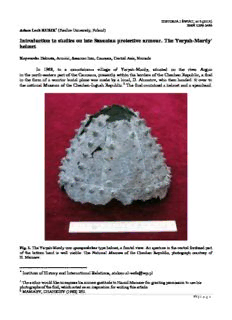
the national Museum of the Chechen-Ingush Republic.2 The find contained a helmet and a spearhead.
Fig. 1. The Yarysh-Mardy iron spangenhelme type helmet, a frontal view. An aperture in the central forehead part
of the bottom band is well visible. The National Museum of the Chechen Republic, photograph courtesy of
H. Mamaev.
Institute of History and International Relations, [email protected]
1 The author would like to express his sincere gratitude to Hamid Mamaev for granting permission to use his
photographs of the find, which acted as an inspiration for writing this article.
2 MAMAEV, CHAHKIEV (1982) 250.
77 | Pa ge
Fig. 2. The Yarysh-Mardy iron spangenhelme type helmet. Left: a side view, right: inside view. The National
Museum of the Chechen Republic, photograph courtesy of H. Mamaev.
The helmet which is the main topic of the present study, is currently in the collection of the National
Museum of the Chechen Republic in Grozny. The find was first reported in 1982 by H. Mamaev and
D. Chahkiev in a yearly journal, Sovetskaya Archeologia.
The helmet, or, as E. Naroznyj3 rightly remarked, more precisely its upper part, is in the form
of a hemispherical, multi-segmental dome. It is 13 cm high and 20,7 cm wide4 and consists of 6
segments conjoined together by decorative ridges. The whole construction is fastened together with
rivets of exceptionally spiky form, each ridge possessing a double row of 6 such rivets at each side.
There is a band attached to the bowl of the helmet by means of rivets of the same form as those used in
the upper part of the helmet. Both the top of the bowl and the bottom part of the band have disappeared
due to corrosion, which makes it difficult to estimate the precise height of the helmet. However,
H. Mamaev and D. Chahkiev’s view that there might have been a round topping or a rosette holding
the whole construction of the bowl at the top5 seems quite likely. In the front part of the bottom band,
more precisely in the central part of the forehead, an aperture can be clearly observed. A thin metal
plate, most probably made of bronze, which is sticking out of the ridge in the central forehead part of
the helmet6 constitutes a rather peculiar form of decoration.
The burial of Yarysh-Mardy has often constituted the subject matter of works on protective
armour,7 It has been associated with the Golden Horde (post-Mongolian) period. Yet, the helmet does
not bear close resemblance to other helmets of that time.8 By virtue of its moderate height,
H. Mamaev and D. Chakiev compare the find to a type of protective headwear called „misiurka” (from
Polish)9 used in the Caucaus which was later also popularized in Russia and other Slavic countries.10
However, as E. Naroznyj11 rightly remarks, the height of the bowl could have been considerably
diminished due to corrosion of the bottom part of the rim. It is noteworthy that the rim band of
the Yarysh-Mardy helmet is damaged along the whole length of its perimeter and hence the estimation
of its width seems impossible.
3 NAROZNYJ (2003) 113.
4 MAMAEV, CHAHKIEV (1982) 250.
5 NAROZNYJ (2003) 113.
6 MAMAEV, CHAHKIEV (1982) 250.
7 MAMAEV, CHAHKIEV (1982); CHAHKIEV (1988); NAROZNYJ (1998); NAROZNYJ (2003); GORELIK
(2002) and others.
8 MAMAEV, CHAHKIEV (1982) 252-253.
9 GRADOWSKI, ŻYGULSKI (2010) 123, 130.
10 MAMAEV, CHAHKIEV (1982) 253.
11 NAROZNYJ (2003) 113.
78 | P ag e
Due to the height of its upper part, E. Naroznyj attempted to find paralells between
the Yarysh-Mardy helmet and a similar find from Beloi Kalitva.12 Nonetheless, apart from the size,
there is not much in common; the two helmets have completely different types of bowl construction.
Both the construction and the decorative form of ridges of the Yarysh-Mardy helmet constitute
the main arguments on which E. Naroznyj rests his analysis.13 The Yarysh-Mardy helmet is, in fact,
a six-ridged helmet, i.e. the so called spangenhelme type with semispherical topping. However, as
already mentioned, the helmet must have been longer at the bottom and therefore it must have had
a shape of an elongated semi-oval slightly flattened at its sides. In contrast, the Beloi Kalitvy helmet is
of cylinder-conical form with the upper part of the bowl consisting of one riveted sheet of metal.
Therefore, it represents a completely different type of helmets, namely those which were particularly
popular in Ruthenia in 15th-17th c. AD.14
M. V. Gorelik, on the other hand, juxtaposes the helmet from Yarysh-Mardy with helmet
found near Ozernoe (presently held in Sterlitamak Museum, Republic of Bashkortostan, Russia) as
well as the helmet from the Perm Museum, suggesting that all of them could be classified as types of
Mongolian helmets from 13th-14th c. AD. However, M. Tsurtsumia is rather skeptical about drawing
too hasty conclusions concerning dating of helmets based solely on their seemingly Mongolian
appearance. He states that “many details of 13th-14th c. AD helmets, that were considered to be
Mongolian, after a thorough study can no longer be thought as such”.15 Such a common a priori
assumption that Mongols were responsible for popularization of new armour solutions has often led to
certain automatization in dating of objects considered as atypical. This excessive willingness to
identify certain finds as those of Mongolian origin is instantiated by M. V. Gorelik’s statement that
Mongols were the carriers of heavy armour solutions on the basis of which European armour
developed.16 However, many scholars, for instance Yu. A. Kuleshov,17 questioned the above view
popularized by M. V. Gorelik.
As far as the comparison of the three aforesaid finds is concerned, it must be stressed that
the mentioned decorative shape of ridges had become a commonplace feature of helmets in Central
Asia by 6th c. AD.18 A. von Le Coq refers to this type of helmets, perhaps not thoroughly adequately,
as Sasanian ridge helmets.19 Additionally, it is noteworthy that the practice of making such decorative
ridges on helmets has survived in the south-eastern Asia virtually until the present time.20 Therefore,
helmets’ highly ornamental form cannot constitute unambiguous evidence for classification of finds.
Other elements of construction should be analyzed in order to consider possibilities of mutual parallels
among the mentioned finds.
The aforementioned helmet found in the vicinity of Ozernoe, a village on the geographical
border between Europe and Asia, was published by V. V. Ovsjannikov in 1990.21 It comprises four
elements conjoined together by means of four decorative ridges. The bottom of the bowl consists of
a two-part band. A suit of lamellar armour made up mainly of elongated rectangular plates with 13
holes was also found in the same grave. Apart from the armour and the helmet, nothing else was found
which could facilitate dating of the burial. Focusing on popularization of plate lamellar armour of
a similar type in Eastern Europe and Central Asia in 13th-15th c. AD, V. V. Ovsjannikov suggests
Mongolian origin of the find. Additionally, he recognizes the burial ritual as typical of the Mongolian
tradition.22
12 NAROZNYJ (1998) 13; NAROZNYJ (2003) 113.
13 GORELIK (2002) 75; NAROZNYJ (2003) 113.
14 ZUKOV (2005) 216-235.
15 TSURTSUMIA (2011) 84.
16 GORELIK (2002) 31; GORELIK (2011) 121-137.
17 KULESHOV (2010) 73.
18 BOBROV, HUDJAKOV (2005) 180.
19 LE COQ (1925) 57 fig. 60-61.
20 LAROCCA (2006) 68-91.
21 OVSJANNIKOV (1990) 141-149.
22 OVSJANNIKOV (1990) 141-149.
79 | Pa ge
There are, however, two fundamental problems with V. V. Ovsjannikov’s thesis. Firstly,
the dubious principle of dating finds on the basis of a burial ritual, which is widely discussed in
a monumental volume on nomadic burials in 10th -14th c. AD by G. A. Fedorov-Davidov.23 It is in
order to mention here his observation that there are types of burial rituals that cannot be confined to
a narrow time window.24 The main thesis of G. A. Fedorov-Davidov comes down to a rather obvious
necessity of carrying out comparative analyses and grouping certain elements found in burial places
despite the difficulties of dating them.25 Secondly V. V. Ovsjannikov does not provide a proper
analysis of the armour plates discovered simultaneously with the helmet. As already mentioned,
the find from Ozernoe also included armour plates of 4 various kinds. The prevailing number of plates
are in an elongated rectangular shape with rounded top edge and 13 holes. The size of these plates
varies between 1,2-2,8 cm in width and 6,8-8,5 cm in length. The plates in the first three types
correspond in shape, size and in the form of binding to type II, VI, 12, b) according to V. V.
Gorbunov’s classification (7,9-10,0 cm x 2,7-3,7 cm). In other words, they resemble the plates found
Fig. 3. From top: left: painting from General Lou Rui’s tomb dated to ca 577 AD, the author’s drawing, iron
spangenhelme type helmet from Verden, 6th-7th c. AD, bottom: iron spangenhelme type helmet from Ozernoe,
Central Asia, 7th-10th c. AD; drawings by D. Wierzbowski.
23 FEDOROV-DAVIDOV (1966) 5-9.
24 FEDOROV-DAVIDOV (1966) 9.
25 FEDOROV-DAVIDOV (1966).
80 | P ag e
in the burial of Kydyrge, og. XIII (possibly dated to 5th -6th c. AD).26 Plates of a similar form, both
with regard to the size and shape as well as the pattern of 13 holes, are also known from several other
burials dated between 7th -10th c. AD,27 for example: the Balyk Sook-I burial (possibly dated to 8th -10th
c. AD)28 or from the armour found in a garrison in Birka (dated to 900-950 AD) which may be
considered as a Far East influence.29 The upper part of the Ozernoe helmet consists of semi-spherical
four-segmental dome with four teeth-like ridges. Each of these ridges possesses a clearly visible axis in
the middle. On top of the helmet there is a round cap, whose uppermost element comes in the form of
a little pin with a horizontal aperture in which a ring for fastening helmet decorations was placed.
Similar solutions are known to have appeared in China towards the end of 6th c. AD. They are
evidenced, for instance, by a painting from General Lou Rui’s tomb dated to ca 577 AD30 or by
a helmet found in Verden (Aller) in Saxony published by W. A. J. Wilbrand. Although the latter find is
typically associated with the Carolingian period,31 it appears quite probable that it may represent
an element of Asian armour brought to Europe by Avars, a scenario which does not seem so unlikely
in 6th-7th c. AD.32 The Ozernoe helmet differs from the mentioned helmets in that it has a bottom band
holding the bowl construction. The band itself consists of two parts,front and rear. As L. A. Bobrov
rightly observes, the construction of a four-segmental spangenhelm with decorative shape of ridges and
a two-piece rim is directly associated with the helmets of the Liao dynasty, which were popular
between 10th -11th c. AD within the territory of present-day China.33 However, he also highlights
a number of features that distinguish the helmet under discussion from those coming from the times of
the Liao dynasty. Namely, L. A. Bobrov points to the lack of decorative diadem on the forehead and to
the same width of the band at its front and rear. Additionally, the Ozernoe helmet displays two peculiar
characteristics that refer it to Iranian culture. One of them is the presence of decorative rivets with big
heavy semi-spherical heads. Such a tradition of decorative riveting on ridge helmets goes back to
Fig. 4. A fragment of the bottom part of a relief from Ṭāq-e Bostān III (western Iran) depicting hemi-spherical
spangenhelme type helmet of a heavy armoured warrior. Despite the damage the eyebrows above the eye cuts are
well visible. From left: frontal view, photograph courtesy of P. Bargassa; side view, photograph courtesy of
M. Vandaee.
26 GORBUNOV (2003) 10.
27 KUBAREV, KUBAREV (2003) 72-73.
28 HUDJAKOV (1986) 156; KUBAREV (1997) 629-645.
29 STJERNA (2004) 32.
30 BOBROV, HUDJAKOV (2005) 180, ris. 15/14.
31 WILBRAND (1914) 48-50.
32 ŚWIĘTOSŁAWSKI (2001) 75-85.
33 BOBROV (2013) 77.
81 | Pa ge
the pre-Sasanid period and thus this feature may be considered as one of the arguments in favour of
the helmet’s Iranian provenance.34 The other typically Iranian feature is decorative eyebrows above
the eye holes.35 As far as semi-spherical ridge helmets are concerned, such a form of embellishment is
also present in the case of the helmet found in Voivode in north-eastern Bulgaria dated to 5th-6th
c. AD36 and in the case of the helmet depicted on the Larger Iwan from Ṭāq-e Bostān,37 which is dated
to the end of 6th or the beginning of 7th c. AD.38 However, the eyebrows on the Ozernoe helmet differ
slightly from the finds mentioned above. Both the eyehole cut and the (just embossed) decorative
eyebrows on the Ozernoe helmet have an almond-like shape with an elongated upward line in the outer
part. Similar forms of eyebrows on Iranian helmets appeared at the turn of 7th and 8th c. AD.39 Taking
the above into account, one may venture a statement that the Ozernoe helmet may be representative of
helmets which could arise due to the mutual Chino-Iranian influence (Central Asia) between the end of
7th and the beginning of 10th c. AD.
The other helmet with which the one from Yarysh-Mardy is often compared is yet another
find from the area marking the European-Asian border in the Ural mountains. It is currently held in
the Perm Museum in Russia. Not much is known about the helmet, however, as until the present time it
has not been properly studied. The Perm helmet constitutes a four segmental construction with
Fig. 5. Turko-Iranian (Central Asian) helmets from 6th -8th c. AD with a characteristic depression of the upper part
of the bowl. From left: iron spangenhelme type helmet from the Nasser D. Khalili Collection, iron spangenhelme
type helmet from the Perm Museum, drawings by D. Wierzbowski, iron spangenhelme type helmet from Niniveh
BM. 22495, British Museum, Trustees of the British Museum©.
34 AHMAD (2015) 145-146.
35 STUDER (1990) 98.
36 VAGALINSKI (1998) 103-105.
37 NICOLLE (1982) 330A, 330E; NICOLLE (1996) 30; FUKAI, HORIUCHI (1971) pl. XXXVI-XXXVIII;
OVERLAET (1982) 192.
38 HERZFELD (1920) 82-103; HERZFELD (1928) 139; HERZFELD (1938) 158; ERDMANN (1937) 79-97;
ERDMANN (1943) 20-24; GHIRSHMAN (1963) 293; GALL (1967) 298; KELLENS (1973) 133-138; FUKAI
(1974) 84; LUSCHEY (1968) 129-147, (1975) 128; VANDEN BERGHE (1984) 85, 205; TANABE (1982) 90-
92; TANABE (1983) 111-112; TANABE (2003) 583, and others.
39 See for example: AZARPAY (1981) pl. 17, Amazon Cycle, Panjikent XXI:1.
82 | P ag e
decorative ridges. A band placed on the inside of the bowl holds the bottom part of the helmet.
The helmet possesses rivets with big decorative heads and it displays a very interesting shape of the
bowl with a characteristic depression in the upper part of its construction. Such a bowl shape is known
mainly from helmets of lamellar construction, for instance from the Niederstotzingen helmet40 or
a helmet from grave number 3 from Kalkni,41 i.e. from helmets belonging to Group V, type 12
according to E. V. Lur’s classification.42 Constructions of spangenhelme type with a similar depression
became widespread in 6th -8th c. AD, which may be evidenced by paintings from Qyzil dated to 5th-8th
c. AD, Tumshuq terracotta figurines dated to 6th -7th c. AD,43 or a helmet from Nineveh dated to 6th-7th
c. AD The Nineveh helmet44 appears to be the closest analogy to the helmet from the Perm Museum.
Apart from the above, the author of the present paper suggests another analogy to both the Nineveh
and the Perm Museum helmets, namely a helmet from the Nasser D. Khalili collection most probably
dated to the same period.45 What is interesting, beside the shape and the type of construction of
the upper part of the bowl as well as decoratively cut narrow ridges, the two helmets share yet another
peculiar feature, i.e. decorative rivets. While in Sasanid helmets the rivets are placed in evenly
dispersed single rows, in this type of helmets they appear in groups of several rivets with intervening
breaks of flat surface. A similar layout of rivets may be observed on several types of Roman helmets,
for example a helmet shown by Ch. Miks.46 These examples indicate that such a pattern of rivets may
have evolved as a characteristic aesthetic feature of “Greater Iranian” helmets in the Sasanid period.
A direct link with Iran of both helmets mentioned in M. V. Gorelik’s theory inevitably entails
the necessity of analyzing the Yarysh-Mardy helmet from the perspective of its possible Iranian
provenance.
As already mentioned, the Yarysh-Mardy helmet has a six-ridge construction of
spangenhelme type. In the Sasanian period it is a widely used form of helmet, though to the best of
author’s knowledge such helmets have not been found in Iran. It may be placed in group IV according
to E. V. Lurie’s classification, that is among oval six-ridge helmets of Deir-el Medineh type.47
The Deir-el Medineh helmet itself, currently housed in the Coptic Museum in Cairo, bears a number of
features that strongly suggest its link to Iranian armour.48 Both the Deir-el Medineh and the Yarysh-
Mardy helmet possess exactly the same number of rivets (i.e. 6 along each side of a ridge) joining
particular ridges with the segments of the bowl. Additionally, in all of the discussed helmets, there are
2 rivets connecting the bottom band with a particular segment of the bowl (with the exception of
the frontal decoration in the Yarysh-Mardy helmet where there appear two additional rivets to stabilize
it). Interestingly, both mentioned finds have a similar form of binding of the top of the helmet with the
main part of the bowl, which in the case of the Yarysh-Mardy helmet was most probably in the form of
a round plate (in some of the ridges there have been preserved apertures). The number of rivets used to
fasten the cap is the same as the number of ridges, the rivets being placed in the central upper part of
each of the spangen. It must be emphasized here that the Deir-el Medineh helmet has often been
regarded as a Roman one.49 Moreover, it is noteworthy that the helmet from Deir-el Medineh has been
properly grouped with two other helmets of similar construction. One of them is an undated helmet
discovered in Egypt on the head of a mummy,50 which is now held in the National Museum of
40 PAULSEN (1967) 133-137.
41 SALICHOV (1985) Fig. V.
42 LUR’E (2013) 274.
43 LECOQ (1925) Fig. 32-33, 53, 62-63.
44 GUIDE (1922) 169; JAMES (1986) 118-119 and others.
45 ALEXANDER (1992) 26-27, SKUPNIEWICZ (2007) Fig. 1.7.
46 MIKS (2009) abb. 5.
47 VOGT (2006) 274-277.
48 As the discussion of the Deir-el Medineh helmet is the subject matter of the author’s another study in
preparation, the issue will not be pursued in detail here.
49 DITTMAN (1940) taf. 15-16; JAMES (1986) fig. 6; MECKENSEN (2007) Abb. 7.
50 EBERT (1909) 163-170.
83 | Pa ge
Fig. 6. From the left: Iron Strap Helmet (spangenhelme) of the baldenheim type, 578-628 AD,
Sinj, Museum of the Cetinska Krajina Region – Sinj, Inventory number MCK-AZ-118, Iron spangenhelme type
helmet, 618-628 AD, Egypt, National Museum of Antiqes, Leiden.
Antiques in Leiden. The piece is quite exceptional in its construction. I. Stephenson states that this
item could be of Roman origin. More interestingly, he argues that this helmet could have arrived in
Egypt from the Uighur Turkish state in Central Asia because such constructions are found on wall
paintings of Kumtura.51 However, this mistaken statement suggesting such late dating can be attributed
to his lack of knowledge of East Asian arms and armours, as clearly similar constructions were present
in East Asia much earlier (as evidenced by, for example, Chinese art from the 4th -6th Centuries AD).52
The other helmet, which is now held in the Museum of the Cetinska Krajina Region in Croatia, comes
from Sinj in Dalmatia. The form of this helmet is slightly similar to the helmet from the Leiden
museum.53 However, the embossed axis on each of the spangen is far more conspicuous, which gives
this item a strong Asiatic look. The presence of such a feature, which is known to appear on some
Sasanian helmets54 and is ubiquitous among Tibetan helmets55 necessitates comparing this helmet with
other Asian helmets. Although these two types of finds are usually described as 5th century helmets,
due to certain similarities with helmets shown on the Arch of Galerius, H. R. Robinson proposes to
date them to a much earlier period, i.e. 3rd c. AD.56 Also S. James argues for their earlier dating, stating
that such forms are present on Trajan’s Column (2nd c. AD). In the opinion of S. James, such helmets
of Roman-Egyptian form entered Europe from the east, most probably from Parthian or Sasanian Iran,
51 STEPHENSON, DIXON (2003, 29).
52 BOBROV, HUDJAKOV (2005) Ris. 8.11.
53 NEGIN (2007) 347.
54 see for example AHMAD (2015) 142.
55 LAROCCA (2006) 68-91.
56 ROBINSON (1970) 73.
84 | P ag e
Fig. 7. From top: left: Iron cross-bandhelme type helmet of “Greater Iranian” or Central Asiatic origin, frontal and
right side view, possibly 4th-6th c. AD, top right: closer view on the fragments of possibly gold-plated decoration
of the helmet, middle: closer view on the fragments of a decorated brass strip going along the lower rim of
the helmet’s bowl, Römisch-Germanisches Zentralmuseum, Mainz, photos by: R. Müller, bottom: left: cross-
bandhelme type helmets (possibly of Greater Iranian or Central Asiatic origin) shown on Chinese figurines 5th-6th
c. AD, drawings by D. Wierzbowski after BOBROV, HUDJAKOV (2005) 175, 178, ris. 10.8,13.9.
85 | Pa ge
Fig. 8. From top: left: Iron multisegmental Korean Vertical-plate type helmet (kor. Jongjangpanju type), front,
right side and back view, 4th c. AD, found in tomb no.44, Bokcheon-ding, Dong-nae, Busan, Pusan National
University Museum, bottom right: Korean multisegmental helmet shown on Japanese 6th c. AD Haniwa, Iizuka-
cho, Ota-shi, Gunma, Kofun period terracotta figurine, helmet most likely under influence of new spangenhelme
forms known from Chinese 5th -6th c. AD art reduced to 4-part bowl and front spang, Tokyo National Museum,
the author’s Drawing.
86 | P ag e
Description:From left: iron spangenhelme type helmet from the Nasser D. Khalili Collection, iron spangenhelme type helmet from . 49 DITTMAN (1940) taf. 15-16