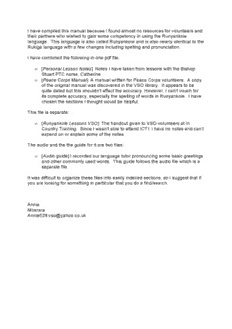
Table Of ContentI have compiled this manual because I found almost no resources for volunteers and
their partners who wished to gain some competency in using the Runyankole
language. This language is also called Runyankore and is also nearly identical to the
Rukiga language with a few changes including spelling and pronunciation.
I have combined the following in one pdf file.
• [Personal Lesson Notes] Notes I have taken from lessons with the Bishop
Stuart PTC nurse, Catherine
• [Peace Corps Manual] A manual written for Peace Corps volunteers. A copy
of the original manual was discovered in the VSO library. It appears to be
quite dated but this shouldn’t affect the accuracy. However, I can’t vouch for
its complete accuracy, especially the spelling of words in Runyankole. I have
chosen the sections I thought would be helpful.
This file is separate:
• [Runyankole Lessons VSO] The handout given to VSO volunteers at In
Country Training. Since I wasn’t able to attend ICT1 I have no notes and can’t
expand on or explain some of the notes.
The audio and the the guide for it are two files:
• [Audio guide] I recorded our language tutor pronouncing some basic greetings
and other commonly used words. This guide follows the audio file which is a
separate file.
It was difficult to organize these files into easily indexed sections, so I suggest that if
you are looking for something in particular that you do a find/search.
Annie
Mbarara
[email protected]
PERSONAL NOTES
Updated: 31 Dec 08
Key to pronunciation:
Ki or ky – ch
J as in Je’ taime.
Omu – is, in, into
Omuri – used with proper names and pronouns
Aha – on, to, to, about, of, concerning
Ahari – used with pronouns and proper nouns
Contents:
Greetings
Basics
Shopping
Times of day – days of week
Who, what, when, where, how, etc.
Vocabulary - misc
Questions – misc
Food/meals
Adjectives
Verbs
Pronouns
Numbers
Parts of the body
GREETINGS:
English Runyankole Pronunciation key
Good morning – how are Oraire ota (ori-rota)
you?
I’m fine. Ndaire gye (indi-regee)
I’m fine. Ndyaho (indi-ya-ho) –anytime
of day
Good morning, did you Oriregye?
sleep well?
Yes. Ego or eh
Did you sleep well? Muriregye?
(group)
Good afternoon – how Osiibirota (o-see’-bur-ota)
are you?
I’m fine. Nsibire gye (insi-bur regee)
How are all of you? Musiibiremuta
Group
Good afternoon, are you Osiibire gye
okay?
Yes. Ego or eh.
Good afternoon, how was Wasibota (wasi-wota)
the day?
Fine. Good. nasibagye soft b nasi-wahgee
How are you? (good Agandi
news?)
I’m good. Good news. nimarungi or nimarunj
or ni gye
How are all of you? A Murire muta (Mireeree moota)
group – morning
Fine. Turyaho or turiregye
How are all of you? – Mwasibamuta ba-nyabo
afternoon – group of na ba-sebo
women or group of men
We are fine. Turyaho or tusiibiregye
Ok, all right, same to you. Kare Car - e
Goodbye, keep well, Osiibegye (o-see’-ba-gee)
enjoy the rest of the day
(morning)
Kare
Same to you.
See you later Turebane bwanyima
Have a good night Oraregye (ora-regee)
Same to you. Kare.
See you tomorrow Turebane nyenkyakare (turay ba nay nyen
cha kare)
See you tomorrow Turebane nyenkyakare
morning akasheshe
omwihangwe
………………afternoon
Nice to see you here – Nashemererwa kukureba
singular
Nice to see you as well Ninye nakira
Nice to see you – more Nashemererwa kubareba
than one
Nice to see you as well Nitwe twakira
Nice to see you (said by Nashemererwa
person arriving to the okukushanga
person already there)
Goodbye to a group-- Musibegye (moo-see’-bagee)
afternoon
What is your name? eiziina ryawe oryoha? (izeena ryowee
oryoha)
My name is…………… Iziina ryangye ni……..
I am Or ndi ………… (izeena ryawngee
nee…….)
After not seeing someone Buhoro? Buhorogye?
for a longish time – are Agandi?
you okay?
Replies: mmm mmmm
Fine. Fine. Fine. nimarungi
Welcome back Kurukayo
Good to be back narugayo
Have a safe journey. Ogyendegye (long O – gyen dege)
Reply: thank you or okay Webare or kare
Thank you for the good Webare omurimo (work)
work you are doing. murungi (good)
gworikukora/guwakora
(you are doing.
Well done Webare oguwakora
BASICS:
English Runyankole Pronunciation key
Sir Sebo (say-bo)
Group of men Ba-sebo
Madame Nyabo
Group of women Ba-nyabo
Bad Nikibi
Too hot – too bad – kanikibi
very unpleasant
Yes Ego (eggo)
No Ngaha (in-ga-ha)
Thank you Webare (way-ba ree)
Thank you very much Webare munonga
You’re welcome Webare kusiima
Home Omuka
My husband Omwami wangye
My Wangye
My wife Omukazi wangye
Pardon, didn’t WanJI
understand? Or in reply
to being called – ie yes,
what?
Or ninga G as in game
SHOPPING
Thank you Webare (way-ba ree)
Thank you very much Webare munonga
You’re welcome Webare kusiima
How much does it cost? Noguza ota? (no-guz-ota)
What do you want? Noyenda ki? Ki - (chi)
I want – I would like…. Ninyenda
(I want a pen) Ninyenda akacumu akachumu
How much does the Noguza ota amate
milk cost?
I have come to buy salt. Nija kugura omwonyo
How much for the tray Noguza ota tureyi ya
of eggs? mahuri.
I have come to buy a Nija kugura tureyi ya (Neeja coogar-a tray-e
tray of eggs. mahuri. ya mahoori)
I want to buy a ½ tray of Ninyenda ekicweka kya Echi–chwayka–cha
eggs. tureyi ya mahuri. traye
(1/2) (of)
(tray)
Small amount Kakye (kachi)
Bakery bekeri
Shop Eduka
shops amaduka
Market akatare
Tailor omubazizi
Pay shashura
I want to pay. Ninyenda kushashura
Make me (build, sew, Nkorera….
etc.)
TIMES OF DAY – DAYS OF THE WEEK - MONTHS
Today Erizooba (aire-e-zoba)
Tomorrow Nyenkyakare (nyen-cha-karee)
Morning Akasheshe
Daytime after noon Omwihangwee
Yesterday Nyemwebazyo
evening omumwaabazyo
Night nyekiro
Tonight zekiro
Noon Eihangwe
Eshaaha Hour/time/clock
Amazoba gesande.
(days of the week)
Monday orwokubanza Soft rw
Tuesday Orwakabiri
Wednesday orwakashatu
Thursday Orwakana
Friday orwakatano
Saturday orwamukaga
Sunday Sande; saabiiti
Days of the week are e.g. aha Rwakana – on
usually preceded by Thursday
ah (on)
Today is Monday Erizooba norwokubanza.
………..Tuesday Erizooba norwakabiri.
…….Weds …………norwakashatu.
…….Thurs ………….norwakana.
……..Fri …………..norwakataano
……..Sat ……….norwamukaaga
……….Sun ……….nisande
Months
January Okw’okubanza
February Okwakabiri
March Okwakashatu
April Okwakana
May Okwakataano
June Okwamukaaga
July Okwamushanju
August Okwamunaana
September Okwamwenda
October Okwikumi
November Okw’ikumi na kumwe
December Okw’ikumi n’ebiri
Months of the year are e.g. omu Kwakashatu –
usually preceded by in March
omu (in)
Sample sentences:
Yesterday I went to Nyemwebazyo ngire omu injeerey
town. town.
I shall go to Kampala on Ninza kuza Kampala aha Aha rwakabiri (run
Tuesday. Rwakabiri. together as one word)
I was born in February. Nkazarwa omu kwakabiri.
I shall pay you a visit in Ninyiija kukutaayaayira
May. omu Kwakataano.
I shall go to America in Ninza kuza America omu
August. Kwamunaana.
I ate too much on Nkarya munonga aha Nkarya (past tense –
Sunday. Sande. not recently)
I am going to have a Ninza kuhuumura omu
holiday in May. Kwakataano.
I am going to drive to Ninza kuvuga QE Park
Queen Elizabeth Park in omu Kwakana.
April.
I eat too much every Nindya munonga buri
Sunday. Sande.
Time in Runyankole
English
Shaha emwe yakashese 7 am
(singular)
Shaha ibiri zakashese 8 am
Shaha ishatu zakashese 9 am
Shaha ina zakashese 10 am
Shaha itaano 11 am
zakashese
Shaha mukaaga 12 noon
zihangwe
Shaha mushanju 1 pm
zihangwe
Shaha munaana 2 pm
zihangwe
Shaha mwenda 3 pm
zihangwe
Shaha ikumi zihangwe 4 pm
Shaha ikumi nemwe 5 pm
zomwabazyo
Shaha ikumi nibiri 6 pm
zomwabazyo
Shaha emwe 7 pm
yomwabazyo
Shaha ibiri zomwabazyo 8 pm
Shaha ishatu 9 pm
zomwabazyo
Shaha ina zekiro 10 pm
Shaha itaano zekiro 11 pm
Shaha mukaaga zekiro 12 midnight
Shaha mushanju zekiro 1 am
Shaha munaana zekiro 2 am
Shaha mwenda zekiro 3 am
Shaha ikumi zekiro 4 am
Shaha ikumi nemwe 5 am
zekiro
Shaha ikumi nibiri 6 am
zakasheshe
Sample sentences:
Ninza kukareba shaha I will see you at 2.30 pm.
munaana nekicweka
zihangwe.
Ninza kuzikuha I am going to give you
orwarataano. money on Friday.
Ninza kukikuha I will give you (item) on
orwakataano. Friday.
Eshaha Time
Shaha Hour
Minutes nedakika
Munaana nedakika 8.15
ikumi nitaano
Munaana nekicweka 8.30
WHO, WHAT, WHEN, WHERE, ETC.
Who? Oha
How? Ota
Where? Nkahi
When? Ryari Soft r (er yari)
Why? Ahabwenki
What? Ki (chi)
Who told you? Noha owakugambira
That ekyo
Is it? tikwo?
When will I see you? Turebane ryari? Soft r – er-yari
Where are you going? Nozahi (no-zahee)
I am going to Mbarara. Ninza Mbarara
I am going to drink tea. Ninza kuynwa chai
I am going dancing. Ninza kuzina.
I am going to class. Ninza omukibina.
I am going to class to Ninza Kushoma.
learn.
Ninza kushomesa.
I am going to teach.
Ninza kwozya.
I am going to do
washing. Ninza kushutama.
I am going to sit.
Where are you coming Norugahi (noru ga hee)
from?
I am coming from… Ninduga
Why are you late? Ahabwenki
wakyerererwa?
What class are you in? Noshoma ekyakangahi (echi kangahi)
(P1,
Replies: Ninshoma ekyokubanza.
I am in Primary 1: Ninshoma ekyakabiri.
P2 Ninshoma ekyakashatu.
P3 Ninshoma ekyakana.
P4 Ninshoma ekyakataano.
P5 Ninshoma ekyamukaaga.