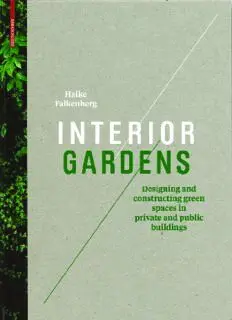
Table Of ContentHaike Falkenberg
Birkhäuser
Basel
CONTENTS
1 2
TYPOLOGIES OF INTERIOR GARDENS GENERAL BASIC PLANNING
12 VERTICAL GARDENS 144 FUNCTION
12 A planted wall in the inner courtyard of 144 Creative and communicative eff ects
the Morris House 145 Symbolic, physical and chemical eff ects
16 Planted lift shaft and canteen for the head- Humidity and air quality in the space
quarters of the Tryg insurance company Noise reduction
22 Vertical garden at the head offi ce 150 CONTEXT
of Mannheimer Swartling law fi rm
152 CREATING SPACE
26 SMALL INDOOR PLANTINGS AND 154 Boundaries
GARDENS IN PRIVATE HOMES 155 Apertures
26 Roofed patio with garden terrace in the 156 Vertical links
Foothills family home in Pokeno
157 Horizontal links
30 Loft apartment with indoor garden 158 Grouping
34 A tree in an Athens apartment 160 PERCEPTION
38 Planting concept for the Seattle Public Library 160 Form, structure, habit
42 Planting concept for the offi ce space at
162 Growth height and the horizontal plane
the Combined Traders company
164 Texture
48 OPEN AND ENCLOSED INNER COURTYARDS 164 Atmosphere
AND PATIOS
165 PRINCIPLES OF DESIGN
48 Tree installation in the Chelsea Harbour
165 Contrasts
Design Centre
Habit contrasts
54 Indoor gardens in the ESO Hotel Desert
Textural contrasts
60 Tropical garden in the roofed patio of
Colour contrasts
the Postmedia building
Light–shadow contrasts
64 Planted atrium in the St. Pölten
167 Rhythm
retirement and care home
68 Planted patio, Giardino delle Ninfee 167 Theme plants
74 A Loft apartment with garden courtyard 167 Tiering
168 Repetition and heightening
78 ATRIA AND LARGE CONSERVATORIES
168 Symmetry and asymmetry
78 Glass Bubble greenhouse
168 Equilibrium
84 Planted atrium in the Covent Garden building
169 THE CREATIVE APPROACH
90 Devonian Gardens indoor gardens
169 Formal variety
98 Themed gardens in the atria of the
Lufthansa Aviation Center 172 Architectural and design development
114 Atrium hall in the Alltours headquarters 174 Use requirements and design
120 Two planted atria for the Alterra laboratory 175 BUDGET
and administration buildings 176 PLANNING DEADLINES
128 Indoor planting for the Genzyme Center
Offi ve Building
134 ‘Gardens in the Sky’ in the Fusionopolis
complex
CONTENTS
3 4
MATERIALS AND CONSTRUCTION APPENDIX
179 MATERIAL PROPERTIES AND 214 PLANT LISTS
MATERIAL QUALITY 220 PICTURE CREDITS
179 Plants 222 LITERATURE
Plant selection criteria 223 ACKNOWLEDGEMENTS
Plant types +
Plant qualities
Acclimatization
182 Substrate, the vegetation support layer
183 Thermal insulation and glazing
Glass qualities
185 INDOOR SITE CONDITIONS
186 Greenhouse eff ect
186 Lighting
188 CONSTRUCTION PRINCIPLES
188 Floor structures PREFACE AND ESSAY
Open and closed systems
Soil strata 4 FOREWORD
Hydroponics 5 ON INTERIOR LANDSCAPING
194 Water features PETER GUINANE
196 Plant technique and care
Grouping by climate and vegetation zone
Special planting features
Nutrient supply
Disease and pest infestations
Trimming and care
201 Vertical systems
Climbing plants in beds or containers
Wall planting systems
206 BUILDING SERVICES
206 Humidity, evaporation, and evaporative
cooling
206 Climatization: heating and ventilation
207 Watering
Tension sensors or electrodes
208 Lighting
Artifi cial light
211 Shading
212 Automatic control
FOREWORD
Foreword
Many companies increasingly see interior planting Plants have a large number of positive qualities, which
as part of the design for a modern working environ- these work in a variety of ways within any approach to
ment. But permanent planted spaces are also being planting. Physical and chemical eff ects, such as fi lter-
introduced in a variety of spaces and buildings types: ing pollutants out of the air, are particularly important
private houses, medical facilities or public buildings. for interiors, along with the symbolic impact created,
A garden’s diff erent elements can be transferred for example by integrating nature into our mainly ur-
to other garden types, independently of its context and ban habitat. Living greenery enhances people’s sense
typology. Given that, the collection of projects in the of well-being and their effi ciency, and is also scientifi -
fi rst chapter of this book should also be considered cally proven to help sick people to recover.
on two levels: as a cross section through the various Ideally, indoor gardens should be designed in
indoor garden typologies, from the vertical garden to close co-operation between client, architect and green
the atrium; and then as examples of the diff erent con- space planners, who will bring in other specialists
ceptual approaches to the subject of planting in detail, such as lighting planners or planting experts. The
from the abstract plant wall carpet to natural-looking principles involved in design planning, such as de-
garden design with the usual elements such as paths, termining function, location and size, and the form
water, walls, trees, bushes, ground cover etc. and orientation of the planting, are presented in the
The selected private indoor gardens that devi- second part of this book.
ate formally from familiar traditional conservatory Indoor gardens are not restricted to particular cli-
planting serve primarily to improve the atmosphere mate zones, and the project selection in the fi rst chap-
in the space, and the air quality. They create private, ter is correspondingly broad in geographical terms.
sheltered places to spend time in or retreat to, and the On the other hand, structural aspects such as thermal
variety in their design takes account of occupants’ in- insulation, glazing, lighting and plant selection also
dividual needs. need to be considered, according to use and climate
Most of the planting examples are public projects zone; this is addressed in chapter 3. A list of plants
that can act as buff er zones within the building’s air in the appendix complements the information about
conditioning system, and they often help to commu- materials and construction.
nicate company values. The individual elements in With the exception of the new design for the De-
these large gardens can usually be reproduced on a vonian Gardens Indoor Park in Calgary, which is due
smaller scale and in diff erent contexts. to re-open in 2011, all the projects selected are com-
Three projects demonstrate the use of wall plant- pleted gardens. Each location has its own individual
ing systems. This relatively recent form, the vertical parameters, and the examples that have been func-
garden, is particularly suitable for planting ‘diffi cult’ tioning well for years are an important source of valu-
spaces and is closely linked with interior design. Prod- able experience when planning new gardens.
ucts and applications for the various systems are rap- This book is intended to present design possi-
idly being developed by specialist companies. bilities for indoor gardens, pass on the fundamen-
tals of construction, and provide stimulus for further
research and personal interpretations of the indoor
planting. Personally, I am looking forward with great
excitement to innovative developments in indoor gar-
dens.
HAIKE FALKENBERG
4
ESSAY
On Interior Landscaping
Eff ective interior landscape design, construction and Our goal was to achieve a tropical eff ect without rais-
management require a special appreciation of the way ing the humidity levels in the building drastically. Dry
plants defi ne a particular environment. Collaboration tropical plant selections tend to be slower growing, and
between the architect, the client and the landscape de- so require fewer replacements for plants that outgrow
signer plays a key role in producing an environment the space. Some of the specimens at CanWest are over
that is aesthetic in its choice of materials, but achieves 20 years old. Once the design and construction plans
maximum functionality of the space. Maintaining a are complete, extensive waterproofi ng is the prima-
relationship between the building architect and the ry phase in building an interior landscape. Damage
landscape designer is vital throughout all phases of due to leaking water can cause serious problems to a
the design and build process. Interior landscape de- building’s foundation and contribute to many of the
sign is a niche market, pairing specialists in landscape issues that discourage more extensive application of
design with progressive architects and clients who interior landscaping.
understand the value of living plants. Many of the challenges often encountered in the
Mature, fl ourishing living features are often un- construction phase can be avoided by thorough plan-
expected elements within interior spaces. Much of the ning during the design phase. Moving quantities of
appeal comes from the juxtaposition of natural ele- plant material, much of which can be very large, is
ments with man-made features. The CanWest project a problem if access to the interior of the building is
(now the Postmedia building) used a combination of limited. Entrance points are rarely wide open, so con-
hard and soft materials. The walkway opens up move- sideration is required in the design phase to limit the
ment through the building, and the circular seating size of the elements. The weight of materials must also
areas set along the path are tucked into the garden, be considered at the design stage, as stone and other
allowing employees to sit and be immersed in a green hardscape elements must be moved by hand, since
space 12 months a year. Seating areas are deliberately machine access is usually not permitted. Organiza-
geometric, to contrast with the natural planting ar- tion, detailed planning, and skilled workers are all
rangement. The plant material selected fl ourishes in vital to ensuring timely progress.
dryer soil and air. The humidity level of the building Indoor gardens provide immeasurable benefi ts
needed to be maintained in order to avoid the build- to the staff who work within the building. Aside from
up of condensation on windows. Plant materials that the obvious improvement in air quality, the gardens
require wet soil will raise the humidity of the build- can reduce noise, increase motivation in the work-
ing and can lead to problems with the building en- place, and decrease absenteeism due to respiratory
velope, the growth of mould and mildew, and insect illnesses, while contributing to improved feelings of
infestations. overall well-being. In particular, the interior land-
scape at CanWest creates a sense of community by
providing a gathering place for the employees to enjoy.
PETER GUINANE
CEO ORIOLE LANDSCAPING, TORONTO, CANADA
5
Typologies of
interior gardens
TYPOLOGIES OF INTERIOR GARDENS
With reference to international projects, the fol- The boundaries between the categories are fl uid:
lowing chapter presents the diff erent types of there are overlaps in terms of architectonic design,
inner gardens: with various possible interpretations. This typology
should not be viewed too dogmatically – it is only a
— Vertical Gardens ¶ p. 12 loose grouping based on the key features of each de-
— Small indoor plantings and gardens in sign. If the designs were classifi ed diff erently (by func-
private homes ¶ p. 26 tion, for instance), they would be grouped diff erently.
— Open and enclosed inner courtyards and The exceptional diversity of the projects pre-
patios ¶ p. 48 sented here is intended to demonstrate the full spect-
— Atria and large conservatories ¶ p. 78 rum of design possibilities for plants inside buildings.
To varying degrees, the descriptions of the designs
Types of planted gardens under glass that are not pri- here concentrate on the aspects that are relevant to
marily intended as places for people to spend time in, the planting and its functions. Many of the design
such as botanical gardens or zoological parks, are not ideas, design elements, and constructions included
included here. Greenhouses of that type are usually here could be applied to other projects on a diff erent
intended primarily for the protection and controlled scale or with diff erent functions.
cultivation of plants, or for food production; their con- The exceptional design, size, layout, and func-
struction is simple and the light-permeable outer shell tions of the Sky Gardens at the Fusionopolis building
is traditionally single-glazed, although it may also in- in Singapore means that the project is in a class by it-
clude fi lm or sheeting. The greenhouse eff ect plays a self. It could be seen as a vision of a future in which
decisive role in heat gain in these structures, which architecture and planting exist as an inseparable who-
are generally not otherwise heated. They are also of- le, with the use concept including ecological concerns,
ten equipped with irrigation and shading systems. energy conservation, and people’s general well-being.
And even though they are not included here, much
interesting information about gardens inside build-
ings can be garnered from plant cultivation and ag-
ricultural designs; for instance, materials generally
used in tomato production were used for the atria of
the Alterra building ¶ p. 120.
9