Table Of Content1
Cover Pictures
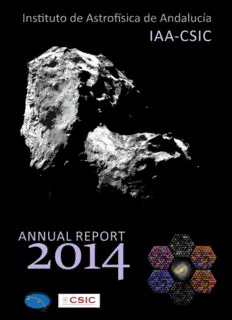
Main cover picture: image of the comet Lower-right corner: the “CALIFA’s mandala”, a
67P/Churyumov-Gerasimenko obtained by the mosaic of datacubes of a sample of galaxies
OSIRIS cameras on board the Rosetta spacecraft, observed by CALIFA showing different physical
an ESA mission. parameters as derived from the spectral analysis.
The OSIRIS cameras are Rosetta’s eyes. The IAA- On 2014 October 1, the CALIFA collaboration
CSIC contributed with hardware to OSIRIS and its released the second public data set (DR2),
staff is currently exploiting the scientific data. The consisting of 400 datacubes of 200 galaxies. Led
OSIRIS cameras have shown a comet nucleus by Dr. García Benito (IAA-CSIC), this release was
consisting of two lobes connected by a short neck. possible as a result of the close collaboration
This shape raises the question of whether the two between the scientists of CALIFA and the technical
lobes merged 4.5 billion years ago, or represent a staff of the Observatory of Calar Alto. Among the
single body where a gap has evolved via mass loss. most impacting results published this year, led
Indeed, activity at the present distance from the from the IAA, we have studied the time evolution
Sun (>3 astronomical units) predominantly arises of the structure of these galaxies (their mass
from the neck, where jets have been seen density, age, metal and dust content) as a function
consistently. The OSIRIS cameras have also been of their total mass and morphology, and how
used to assess the comet rotation period of 12.4 these differ in the inner red bulges and their outer
hours. blue disks. A characteristic metal gradient in the
gas has been found, in accordance with the metals
OSIRIS has witnessed the descent and first
in the younger stars.
touchdown on the surface nucleus of the module
Philae on November 12, 2014. The module did not Enrique Pérez Jiménez
anchor at this first touchdown, but it bounced two
times ending at a location where the solar
insolation has not been sufficient to keep it alive
and working until March 2015.
The story of Rosetta around a comet in a fiery
environment will continue until September 2016
when the spacecraft will softly land on the surface
of the most ever scrutinized primitive body of the
Solar System.
Luisa María Lara López
1
2
3
DIRECTOR’S FOREWORD camera, an instrument designed and built by a
European consortium where IAA is an active
partner. The Rosetta mission is producing a welth
The IAA is a center of the Spanish CSIC devoted to of new science, with excellent results published
the production of top research in space science, in in high impact papers.
conjunction with a high-level technological activity
ESA’s new mission PLATO was approved in 2014,
for the construction of front-line instrumentation
and IAA will participate in the construction of its
for ground based telescopes and space missions.
instrumentation. PLATO, planned to launch in
The diffusion of the IAA research into the public
2024, is to begin a completely new chapter in the
through a variety of outreach activities is also a
exploration of extrasolar planets. During this year,
key objective.
IAA was active working on the instrumentation of
Though the IAA foundation was originally oriented several other ESA space missions (e.g. NOMAD
to the scientific exploitation of the nearby onboard EXO-Mars TGO and, GALA and Janus
observatories of Sierra Nevada (Granada) and onboard JUICE). IMAX, onboard the SUNRISE
Calar Alto (Almería), soon IAA scientists proved to mission –a telescope that observed the Sun from a
be very active adding to that the study of the stratospheric balloon over the Arctic–, unveiled
Earth’s upper atmosphere and, most notably, the the formation and evolution of a magnetic flux
pioneering development of space astrophysics in tube on the solar surface. Also in preparation has
Spain. At present the IAA has four scientific been the mission Solar Orbiter (ESA) expected to
departments which study the Solar system, stellar orbit the Sun to study both, solar physics and the
physics, extragalactic astrophysics and cosmology, Sun’s influence on the interplanetary medium.
and Galactic structure and radioastronomy,
The construction of the new instruments PANIC –
combined with a small but prominent group of
a wide field near-infrared camera– and
theoretical physics. The technological branch
CARMENES –the state-of-the-art planet hunter
allows our institute to afford the construction of
with two arms, optical and near infrared– for the
new instrumentation whereas keeping the center
Calar Alto telescopes continues at good rate, with
ready to participate in future technological
PANIC reaching already an advanced phase near
challenges for space and ground based
commissioning by the end of the year.
instrumentation. The proximity and easy access to
For the observatory of Calar Alto this has been a
our observatories represent an extra asset to
critical year, with a strong shortage in operation
develop the science of massive ambitious surveys
funds. Nevertheless, the enormous scientific value
(like ALHAMBRA, CALIFA and, in the near future,
of the observatory, its competitive
CARMENES) and to provide a useful test bench for
instrumentation and high level staff have been
new instrumentation. The combination of a wide
able to complete very successful projects. The
scope in astrophysics research with technology
success of these international projects, which
and the observatories made the IAA a unique
could not be performed in other telescopes, lead
center in our country.
the observatory far from previously announced
This annual report shows that the year 2014 has
threads. In june 2014 the event “From CALIFA to
been full of exciting results, with demanding
CARMENES” was held at the dome of the 3.5m
challenges for the IAA’ scientists, engineers and its
telescope to present these “big science” projects.
observatories.
This scientific event, chaired by the Secretary
After the successful “wake up” of the Rosetta General for Science and Innovation of the Junta de
mission near the end of 2013, during this year Andalucia, counted also with the participation of
public and scientists have been most enthusiastic several Spanish and international delegates and
with this ESA’s spacecraft, which was succesfull representatives of the wide astronomical
entering in orbit around comet 67P/Churyumov- comunity. This event produced a great impact in
Gerasimenko. The IAA is one of the few centers written press and RTV media.
participating in this unique European mission. The
CALIFA, the large Integral Field Spectroscopy
first images of the comet showing its peculiar
survey conceived at the IAA and carried out at the
structure and surface were taken by the OSIRIS
Calar Alto 3.5m telescope, will provide an
4
unprecedented view of six hundred galaxies of the
local Universe. It will be a reference in the field of
galaxy evolution for the next decade. Its legacy is
offered to the scientific community and the
second data release of this international project
took place on September 30.
Other relevant achievements included in this 2014
annual report of the IAA testify to the rich variety
and quality of the science produced; which goes
from the new challenges about the origin of
massive black holes, Gamma Ray Bursts, to the
discovery of two (water ice) rings in Chariklo, a
Prof. José Manuel Vílchez Medina
Solar system object 250 kilometers in diameter.
Director of the Instituto de Astrofísica de Andalucía
The IAA research activity has been steadily
increasing in 2014. The production of the IAA in
international refereed journals is, on average,
equivalent to an IAA paper published every
working day of the year. This is a very relevant
achievement for the IAA especialy after the recent
downsizing of the national research budget. These
difficulties, far from forcing IAA to abandon the
race, have encouraged our scientists to compite
for funding and support beyond the Spanish
borders. Notably an ERC Consolidator grant was
awarded to one of our young scientists, and the
IAA was the Coordinator of the new ERC network
on Martian space science. This way, the IAA keeps
playing in the "league of stars" of astrophysical
research despite recent shortcuts in money and
human resources.
The IAA applied in the 2014 call of the Severo
Ochoa program for Spanish Research Centers,
obtaining a high score (98 over 100). This is
encouraging and proves the IAA moves in the right
direction. Let me mention just two quantitative
indicators to illustrate here the scope and impact
of our research: i) the average normalized impact
of the IAA publications in the last four years
window (including 2014) is close to 250% the
world average, and ii) among the 128 CSIC
institutes and centers, IAA is the 1st center
according to scientific production in space science
and the 7th in all disciplines.
This report has been prepared with the aim of
showing the reader a panorama of the scientific
and technological activity developed at the IAA in
2014. We hope you can share with us the passion
for science and enjoy the Astrophysics at IAA
presented in this annual report.
5
6
RESEARCH
ACTIVITY
The Instituto de Astrofísica de Andalucía is a center of
the Consejo Superior de Investigaciones Científicas
(IAA-CSIC) devoted to basic astronomical research. This
research activity is carried out in the framework of four
different departments:
1. Extragalactic Astronomy.
2. Radioastronomy and Galactic Structure.
3. Solar System.
4. Stellar Physics.
These departments include a number of research lines
that investigate different astrophysical topics.
Moreover, research and technical activities are carried
out by different units and astronomical observatories,
including the Instrumental and Technological
Development Unit (UDIT), the Computer Center (CC),
and the Observatory of Sierra Nevada (OSN).
The description of the research activity and highlights
of these research departments, units and observatory
during 2014 are next presented.
Additional information on the Observatory of Calar Alto
is included in this document as the IAA is the CSIC
reference center for this international astronomical
observatory.
7
EXTRAGALACTIC
ASTRONOMY
Overview
Research in extragalactic astronomy at the IAA is
focused on two broad avenues: structure and evolution
of galaxies, and quantum and classic gravity. Galaxies
are the main focus of study from three different
perspectives: (i) by themselves, understanding their
dynamics, insterstellar medium, and evolution of their
star (formation, chemistry, and stellar populations); (ii)
how these properties change as a function of their
environment, as isolated, groups, and clusters of
galaxies; and (iii) their role as tracers of the structure
and evolution of the universe, including GRBs as cosmic
lighthouses. Many of these studies take advantage of
the availability of ground-based and space-borne
multiwavelength data, or are performed in the context
of large surveys, some led by our researchers, such as
On 2014 October 1, the CALIFA collaboration released
ALHAMBRA and CALIFA, both carried out at the Calar
the second public data set (DR2), including 400
Alto Observatory. A group of theoreticians work on
datacubes of 200 galaxies. Led by Dr. García Benito
Gravitation and its quantum modifications.
(IAA-CSIC), this project has been possible as a result of
Highlights in 2014 the close collaboration between the CALIFA scientists
IFS (Integral Field Spectroscopy) data of IZw18, the and the technical staff of the Observatory at Calar Alto.
most metal-poor star-forming galaxy in the local Among the most relevant results published in 2014 led
Universe, discover an extended nebular HeII4686- from the IAA, we have studied the time evolution of
emitting region. The observations, in conjunction with the structure of these galaxies (mass density, age,
state-of-the-art stellar model predictions, reveal that metal, dust content) as a function of their total mass
only (nearly) metal-free ionizing stars, similar to PopIII and morphology, and how these differ in the inner red
stars, the first ones that ever shone in the Universe, can bulges and outer blue disks. A characteristic metal
explain the HeII ionization of IZw18. gradient in the gas has been found, in accordance with
the metals in the youngest stars.
VLT zCOSMOS optical deep spectroscopy along with
detailed HST imaging has allowed us to enlarge the Completion of an unprecedented comparison
sample of extreme emission line galaxies up to redshift between the spectroscopic and physical properties of
1. These galaxies, resembling the building blocks from quasars with similar bolometric luminosities, but at
which larger galaxies were created, are metal-poor, UV very different cosmic epochs. We confirm that the two
luminous, compact galaxies with very high specific star different populations present in the local quasar
formation rates. sample (z<0.6) are also present in the higher redshift
sample (z~2.3). Metallicities are nevertheless different,
HII-CHI-mistry is a new code to derive chemical
what is interpreted as reflecting the chemical evolution
abundances using emission lines from gas ionized by
of the Universe.
massive star formation processes taking relative
abundance ratios into account for the first time and The ALHAMBRA survey Gold Catalogue provides
hence improving the understanding of the chemical redshifts and photometry in 20+4 bands for 100000
evolution of galaxies undergoing different types of galaxies, 20000 stars, and 1000 AGN candidates spread
interactions with their environment. over seven sky regions.
AMIGA has shown that, despite the general believe IFU data of the host of the peculiar GRB 060505
that pseudo-bulges are relatively young and blue confirm that it was associated to a massive star but
structures, in isolated galaxies they display colours that GRB sites are not necessarily a region with unique
comparable with those of ellipticals. After going 3D properties within their hosts. High resolution is crucial
using SDSS spectroscopy, the catalogue of isolated to make definite statements about the properties of a
galaxies that remains isolated without satellites is 88%. GRB progenitor inferred from its environment.
AMIGA has been accepted as member of the SKA A new symmetry class (non-point symmetries) has
international consortium designing its Science Data been proposed to characterize the solution manifold of
Processor, applying the developments by the group of Non-Linear Sigma Models as a preliminary essay
services for 3D radio data analysis in Grid, Cloud and towards non-canonical quantization of gravitational
Supercomputing facilities. models.
8
Description:AMIGA has shown that, despite the general believe that pseudo-bulges are .. A study of the binary system “MY Camelopardalis” shows that the most