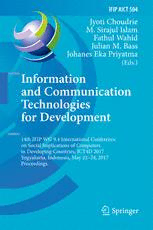
Table Of ContentIFIP AICT 504
Jyoti Choudrie
M. Sirajul Islam
Fathul Wahid
Julian M. Bass
Johanes Eka Priyatma
(Eds.)
Information
and Communication
Technologies
for Development
14th IFIP WG 9.4 International Conference
on Social Implications of Computers
in Developing Countries, ICT4D 2017
Yogyakarta, Indonesia, May 22–24, 2017
Proceedings
123
IFIP Advances in Information
and Communication Technology 504
Editor-in-Chief
Kai Rannenberg, Goethe University Frankfurt, Germany
Editorial Board
TC 1 – Foundations of Computer Science
Jacques Sakarovitch, Télécom ParisTech, France
TC 2 – Software: Theory and Practice
Michael Goedicke, University of Duisburg-Essen, Germany
TC 3 – Education
Arthur Tatnall, Victoria University, Melbourne, Australia
TC 5 – Information Technology Applications
Erich J. Neuhold, University of Vienna, Austria
TC 6 – Communication Systems
Aiko Pras, University of Twente, Enschede, The Netherlands
TC 7 – System Modeling and Optimization
Fredi Tröltzsch, TU Berlin, Germany
TC 8 – Information Systems
Jan Pries-Heje, Roskilde University, Denmark
TC 9 – ICT and Society
Diane Whitehouse, The Castlegate Consultancy, Malton, UK
TC 10 – Computer Systems Technology
Ricardo Reis, Federal University of Rio Grande do Sul, Porto Alegre, Brazil
TC 11 – Security and Privacy Protection in Information Processing Systems
Steven Furnell, Plymouth University, UK
TC 12 – Artificial Intelligence
Ulrich Furbach, University of Koblenz-Landau, Germany
TC 13 – Human-Computer Interaction
Marco Winckler, University Paul Sabatier, Toulouse, France
TC 14 – Entertainment Computing
Matthias Rauterberg, Eindhoven University of Technology, The Netherlands
IFIP – The International Federation for Information Processing
IFIP was founded in 1960 under the auspices of UNESCO, following the first World
ComputerCongressheldinParisthepreviousyear.Afederationforsocietiesworking
in information processing, IFIP’s aim is two-fold: to support information processing in
the countries of its members and to encourage technology transfer to developing na-
tions. As its mission statement clearly states:
IFIP is the global non-profit federation of societies of ICT professionals that aims
at achieving a worldwide professional and socially responsible development and
applicationofinformationandcommunicationtechnologies.
IFIP is a non-profit-making organization, run almost solely by 2500 volunteers. It
operates through a number of technical committees and working groups, which organize
events and publications. IFIP’s events range from large international open conferences
to working conferences and local seminars.
The flagship event is the IFIP World Computer Congress, at which both invited and
contributed papers are presented. Contributed papers are rigorously refereed and the
rejectionrateishigh.
As with the Congress, participation in the open conferences is open to all and papers
may be invited or submitted. Again, submitted papers are stringently refereed.
The working conferences are structured differently. They are usually run by a work-
ing group and attendance is generally smaller and occasionally by invitation only. Their
purpose is to create an atmosphere conducive to innovation and development. Referee-
ing is also rigorous and papers are subjected to extensive group discussion.
Publications arising from IFIP events vary. The papers presented at the IFIP World
Computer Congress and at open conferences are published as conference proceedings,
while the results of the working conferences are often published as collections of se-
lectedandeditedpapers.
IFIP distinguishes three types of institutional membership: Country Representative
Members, Members at Large, and Associate Members. The type of organization that
can apply for membership is a wide variety and includes national or international so-
cieties of individual computer scientists/ICT professionals, associations or federations
of such societies, government institutions/government related organizations, national or
international research institutes or consortia, universities, academies of sciences, com-
panies, national or international associations or federations of companies.
More information about this series at http://www.springer.com/series/6102
Jyoti Choudrie M. Sirajul Islam
(cid:129)
Fathul Wahid Julian M. Bass
(cid:129)
Johanes Eka Priyatma (Eds.)
Information
and Communication
Technologies
for Development
14th IFIP WG 9.4 International Conference
on Social Implications of Computers
in Developing Countries, ICT4D 2017
–
Yogyakarta, Indonesia, May 22 24, 2017
Proceedings
123
Editors
JyotiChoudrie Julian M.Bass
University of Hertfordshire University of Salford
Hatfield Salford
UK UK
M.Sirajul Islam JohanesEka Priyatma
ÖrebroUniversity SanataDharma University
Örebro Yogyakarta
Sweden Indonesia
Fathul Wahid
Universitas Islam Indonesia
Yogyakarta
Indonesia
ISSN 1868-4238 ISSN 1868-422X (electronic)
IFIPAdvances in Information andCommunication Technology
ISBN 978-3-319-59110-0 ISBN978-3-319-59111-7 (eBook)
DOI 10.1007/978-3-319-59111-7
LibraryofCongressControlNumber:2017940627
©IFIPInternationalFederationforInformationProcessing2017
Thisworkissubjecttocopyright.AllrightsarereservedbythePublisher,whetherthewholeorpartofthe
material is concerned, specifically the rights of translation, reprinting, reuse of illustrations, recitation,
broadcasting, reproduction on microfilms or in any other physical way, and transmission or information
storageandretrieval,electronicadaptation,computersoftware,orbysimilarordissimilarmethodologynow
knownorhereafterdeveloped.
Theuseofgeneraldescriptivenames,registerednames,trademarks,servicemarks,etc.inthispublication
doesnotimply,evenintheabsenceofaspecificstatement,thatsuchnamesareexemptfromtherelevant
protectivelawsandregulationsandthereforefreeforgeneraluse.
Thepublisher,theauthorsandtheeditorsaresafetoassumethattheadviceandinformationinthisbookare
believedtobetrueandaccurateatthedateofpublication.Neitherthepublishernortheauthorsortheeditors
give a warranty, express or implied, with respect to the material contained herein or for any errors or
omissionsthatmayhavebeenmade.Thepublisherremainsneutralwithregardtojurisdictionalclaimsin
publishedmapsandinstitutionalaffiliations.
Printedonacid-freepaper
ThisSpringerimprintispublishedbySpringerNature
TheregisteredcompanyisSpringerInternationalPublishingAG
Theregisteredcompanyaddressis:Gewerbestrasse11,6330Cham,Switzerland
Preface
This book comprises the papers presented at the 14th International Conference on
Social Implications of Computers in Developing Countries (IFIP WG 9.4 2017 Con-
ference)heldinYogyakarta,Indonesia,May22–24,2017.Thethemeoftheconference
was “ICTs for Promoting Social Harmony: Towards a Sustainable Information
Society.” A harmonious society is viewed as a peaceful and balanced “connected
whole” in a transformed social dynamic, where there is a sustainable exchange of
resources and development taking place through mutual agreement. As “all problems
of existence are essentially problems of harmony,” the goal of development is appar-
ently not only to ensure social harmony, but also to minimize the elements that
undermineordisrupttheconnectedwhole.Ideally,theinformationsocietyisseenasa
“classless and conflictless” inclusive community, which strives to use technologies to
diminishstructuralbarriers,democratizeinformation,balancepowerwithdependency,
and transform human values. However, in reality, a harmonious society faces several
challenges including political and religious extremism, infringement of privacy and
security,aswellasdisparityofwealthandsocialdisconnection.Asweareunavoidably
intermingling toward a complex environment of the information society, we need to
critically investigate the social construction role of information technology especially
in the contexts of peace and conflict, cooperation, and development of human capital
for creating a sustainable world.
Within this spirit, a call for tracks was distributed and 17 track proposals were
submitted, of which 13 were finally selected:
1. Large-Scale and Complex Information Systems for Development
2. Women Empowerment and Gender Justice
3. Social Mechanisms of ICT-Enabled Development
4. The Data Revolution and Sustainable Development Goals
5. Critical Perspectives on ICT and Open Innovation for Development
6. The Contribution of Practice Theories to ICT for Development
7. Agile Development
8. Indigenous and Local Community-Grounded ICT Developments
9. Global Sourcing and Development
10. Sustainability in ICT4D
11. Information Systems Development and Implementation in Southeast Asia
12. IPID and Graduate Student Track
13. General
TheIFIPWG9.42017Conferencebegananoveltraditionofpublishedproceedings
incollaborationwithSpringerintheIFIPAdvancesinInformationandCommunication
Technology (IFIP AICT) series. The main purpose for this novelty is to sustain and
preserve the papers and offer a digital space that is accessible and visible to a larger
audience.Thisbookconsistingof71papersoffersthreekeynotesubmissions,withthe
VI Preface
remaining68beingselectedfrom118submissions,followingablind,rigorousreview
processassistedbyover150peersfrommorethan40countries.WethankSpringerfor
their service in publishing the proceedings of this conference.
For a large event like this conference to happen, a considerable effort by numerous
individualsisrequired.Forthis,webeginbythankingthe71membersoftheProgram
Committee, the local arrangements chairs, and 123 additional reviewers for their
enormouseffortsinreviewingthesubmittedpapers.Wealsoexpressgratitudetoallthe
sponsors:theIFIPWG9.4(ifipwg94.org),theSwedishProgramforICTinDeveloping
Regions (SPIDER, spidercenter.org), International Network for Postgraduate Students
in the area of ICT4D (IPID, ipid.se), UIINet (uii.net.id), and Cisco Indonesia (cisco.
com/c/en_id/).
Special thanks go to the hosts ofthis conference, Universitas IslamIndonesia (UII,
uii.ac.id) and Sanata Dharma University (USD, usd.ac.id). Both these private univer-
sities are among the pioneers of higher learning in Indonesia and are located in
Yogyakarta,oneofthemostlivablecitiesinIndonesia.Yogyakartahasmorethan100
highereducationinstitutionsandisthecityoftolerance.Yogyakartaisameltingpotof
various cultures from all corners of Indonesia and is perhaps the pre-eminent city of
cultureinIndonesia.ItwasagreatpleasuretoholdtheIFIPWG9.42017Conference
in this special place.
May 2017 Jyoti Choudrie
M. Sirajul Islam
Fathul Wahid
Julian M. Bass
Johanes Eka Priyatma
Organization
Conference Chairs
Fathul Wahid Universitas Islam Indonesia, Indonesia
Julian M. Bass University of Salford, UK
Johanes Eka Priyatma Sanata Dharma University, Indonesia
Program Chairs
Jyoti Choudrie University of Hertfordshire, UK
M. Sirajul Islam Örebro University, Sweden
Local Arrangements Chairs
Mukhamad Andri Setiawan Universitas Islam Indonesia, Indonesia
Paulina Heruningsih Sanata Dharma University, Indonesia
Prima Rosa
Ari Sujarwo Universitas Islam Indonesia, Indonesia
Agnes Maria Polina Sanata Dharma University, Indonesia
Program Committee
Rose Alinda Alias Universiti Teknologi Malaysia, Malaysia
David Allen University of Leeds, UK
Ian Allison University of West of Scotland, UK
Gary Cifuentes Alvarez University of Los Andes, Colombia
Antonio Díaz Andrade Auckland University of Technology, New Zealand
Ime Asangansi eHealth4everyone.com
Arlene Bailey The University of the West Indies at Mona, Jamaica
Julian M. Bass University of Salford, UK
Caitlin Bentley Nanyang Technological University, Singapore
David F. Birks University of Winchester, UK
Stephen Burgess Victoria University, Australia
Gary Burnett Florida State University, USA
Ineke Buskens UNU Computing and Society, Macau, SAR China
Wallace Chigona University of Cape Town, South Africa
Brian Corbitt RMIT University, Australia
Abubakar A. Dahiru Robert Gordon University, UK
Robert Davison City University of Hong Kong, Hong Kong,
SAR China
Andy Dearden Sheffield Hallam University, UK
Teduh Dirgahayu Universitas Islam Indonesia, Indonesia
VIII Organization
Bjørn Furuholt University of Agder, Norway
G. ‘Hari’ Harindranath Royal Holloway, University of London, UK
Roger Harris Roger Harris Associates, Hong Kong, SAR China
Richard Heeks University of Manchester, UK
Noorminshah A. Iahad Universiti Teknologi Malaysia, Malaysia
Stan Karanasios University of Leeds, UK
Saifuddin Khalid Aalborg University, Denmark
Endrit Kromidha Royal Holloway University of London, UK
Sherah Kurnia The University of Melbourne, Australia
Jong Gun Lee UN Global Pulse (Pulse Lab Jakarta), Indonesia
Han-Teng Liao UNU Computing and Society, Macau, SAR China
Tanti Liesman UN Global Pulse (Pulse Lab Jakarta), Indonesia
Hugo Lotriet University of South Africa, South Africa
Miguel Luengo-Oroz UN Global Pulse, New York, USA
Shirin Madon London School of Economics and Political Sciences,
UK
Mario Marais CSIR Meraka Institute, South Africa
Silvia Masiero London School of Economics and Political Science,
UK
Isabel Meyer The Institute for Transdisciplinary Development,
South Africa
Jyoti Mishra University of Bradford, UK
Sikder Monoare Murshed University of Dhaka, Bangladesh
Edgar Napoleon University of Örebro, Sweden
Syed Nasirin Universiti Malaysia Sabah, Malaysia
Brian Nicholson University of Manchester, UK
Petter Nielsen University of Oslo, Norway
Jacki O’Neill Microsoft Research India
Arie Setyaningrum Universitas Gadjah Mada, Indonesia
Pamungkas
Natalie Pang Nanyang Technological University, Singapore
T. Ramayah Universiti Sains Malaysia, Malaysia
N. Ravishankar University of Loughborough, UK
Jaco Renken University of Manchester, UK
Tony Roberts UNU Computing and Society, Macau, SAR China
Markus Rohde University of Siegen, Germany
Johan Sæbø University of Oslo, Norway
Øystein Sæbø University of Agder, Norway
Sundeep Sahay University of Oslo, Norway
Terje Aksel Sanner University of Oslo, Norway
M. Andri Setiawan Universitas Islam Indonesia, Indonesia
Vincent Shaw HISP, South Africa
Harminder Singh Auckland University of Technology, New Zealand
Mira Slavova GIBS Business School, South Africa
Larry Stillman Monash University, Australia
Eswaran Subrahmanian Carnegie Mellon University, USA
Organization IX
Mega Subramaniam University of Maryland, USA
Felix Tan Auckland University of Technology, New Zealand
Angsana A. Auckland University of Technology, New Zealand
Techatassanasoontorn
Devendra Thapa University of Agder, Norway
Alvin Yeo Wee Universiti Malaysia Sarawak, Malaysia
Chris Westrup Manchester Business School, UK
Heike Namibia University of Science and Technology,
Winschiers-Theophilus Namibia
Tariq Zaman Universiti Malaysia Sarawak, Malaysia
Pär-Ola Zander Aalborg University, Denmark
Aljona Zorina University of Leeds, UK
Additional Reviewers
Nor Zairah Ab.Rahim Ellen Fruijtier
Pamela Abbott Mikael Gebre-Mariam
Noor Hazana Abdullah Leila Goosen
Norris Syed Abdullah Farzana Quoquab Habib
Eric Adu-Gyamfi Hasliza Abdul Halim
Noor Hazlina Ahmad Mohd. Rizal Abdul Hamid
Adel Alfalah Nor Aziati Abdul Hamid
Samer Alkhouli Xiong Han
Annika Andersson Haniruzila Hanifah
Gugulethu Baduza Mathias Hatakka
Rehema Baguma Niall Hayes
Ahmad Suhaimi Baharudin Marlien Herselman
Pierre Bakunzibake Roshan Hewapathirana
Peter Bednar Janet Ho
Zakariya Belkhamza Cheah Jun Hwa
David F. Birks Joshua Ignatius
Adele Botha Osama Isaac
Irwin Brown Jens Kaasbøll
Ann Bygholm Normalini Md Kassim
Maria Castro Saifuddin Khalid
Francis Chuah Hanna Krasnova
Stephanie Hui Wen Chuan Kirstin Krauss
Carina de Villiers Caroline Wamala Larsson
Eduardo Diniz Jasmine Yeap Ai Leen
Sifiso Dlamini Han-Teng Liao
Bill Doolin Gan Pei Ling
Mohammad Dalvi Esfahani May Chiun Lo
Haemiwan Z. Fathony Saravanan Nathan Lurudusamy
Schubert Foo Imran Mahmud
Merryl Ford Sreeja Manghat