Table Of ContentInclinations
SQUARE ONE
First-Order Questions in the Humanities
PAUL A. KOTTMAN, Series Editor
INCLINATIONS
A Critique of Rectitude
Adriana Cavarero
Translated by Amanda Minervini and Adam Sitze
STANFORD UNIVERSITY PRESS
STANFORD, CALIFORNIA
Stanford University Press
Stanford, California
English translation ©2016 by the Board of Trustees of the Leland Stanford Junior
University. All rights reserved.
Foreword ©2016 by the Board of Trustees of the Leland Stanford Junior University.
All rights reserved.
Inclinations: A Critique of Rectitude was originally published in Italian under the title
Inclinazioni: Critica della rettitudine © 2014, Rafaello Cortina Editore.
This book has been published with the support of the Department of Philosophy,
Education, and Psychology, University of Verona.
No part of this book may be reproduced or transmitted in any form or by any
means, electronic or mechanical, including photocopying and recording, or in any
information storage or retrieval system without the prior written permission of
Stanford University Press.
Printed in the United States of America on acid-free, archival-quality paper
Library of Congress Cataloging-in-Publication Data is available from the Library of
Congress
isbn 9780804792189 (cloth : alk. paper)
isbn 9781503600409 (pbk. : alk. paper)
isbn 9781503600416 (electronic)
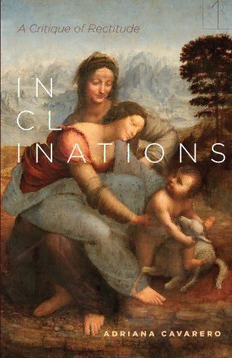
Cover art: Leonardo da Vinci, The Virgin and Child with St. Anne. Wikimedia Commons
Cover design: Rob Ehle
Text design: Bruce Lundquist
Typeset at Stanford University Press in 10/14 Minion Pro
Contents
Foreword vii
Introduction 1
1 Barnett Newman: Adam’s Line 17
2 Kant and the Newborn 25
3 Virginia Woolf and the Shadow of the “I” 35
4 Plato Erectus Sed . . . 45
5 Men and Trees 57
6 We Are Not Monkeys: On Erect Posture 65
7 Hobbes and the Macroanthropos 71
8 Elias Canetti: Upright Before the Dead 81
9 Artemisia: The Allegory of Inclination 89
10 Leonardo and Maternal Inclination 97
11 Hannah Arendt: “A Child Has Been Born unto Us” 107
12 Schemata for a Postural Ethics 121
Coda: Adieu to Lévinas 133
Notes 177
Foreword
Paul A. Kottman
Adriana Cavarero’s Inclinations is not just a “correction” of rectitude,
but a critique of rectitude. That is, this book investigates the discur-
sive conditions of possibility for the characterization of the human
being as upright, erect. Cavarero proposes inclination not simply as
the “real” nature of the human being, by unmasking uprightness as a
wrong characterization of our true essence. Instead, Cavarero inves-
tigates the way in which human beings have been figured or depicted
as upright, in philosophy, psychoanalysis, anthropological writings,
literature and artworks.
Cavarero aims to shed light, in particular, on the effects of this
figuration, the “truths” and “power relations” that these discursive or
artistic figurations produce and install. Given the long-standing de-
piction of human (in particular, male) uprightness and rectitude, it
seems less fruitful to ask whether these figurations were “correct” de-
pictions of human beings. (An emphasis on “correctness” could itself
be seen as one of the effects under investigation.) Cavarero is inter-
ested, rather, in tallying the costs of depicting the human being as up-
right when it comes to our view of women, our overall understanding
and collective self-conception.
One effect of the figuration of the human being as “upright,”
Cavarero suggests, has been to obscure another, perhaps more natu-
ral, figuration for people in their relation to one another: inclination.
Cavarero returns to themes she has discussed thoughtfully in other
viii Foreword
writings over the course of her career: maternity, love, representations
of women. She “distills,” as she puts it, a “rhetoric of inclination,” in
order to superimpose it “like a transparent screen, over the rhetoric of
the philosophical subject, to highlight the differences between the two
ontological, ethical, and political models.”
For Cavarero, artworks, literary texts, and philosophical dis-
courses are not just passive “reflections” of social realities. Nor do art
and philosophy simply mirror the prejudices or belief systems of a
historical era—such as patriarchy, or Christian morality. Instead, she
treats art and philosophy as a matrix for the understanding of our cul-
tural heritage. Cavarero interprets philosophical texts and artworks
in order to see how human lives and interactions have been under-
stood—and, thus, how they might be understood differently. It is in
this sense that Cavarero’s work is concerned with first-order questions
in the humanities.
At a certain point in Inclinations, for instance, Cavarero interprets
the significance of Leonardo da Vinci’s depiction of Mary in his paint-
ing The Virgin and Child with St. Anne. She contrasts Mary’s inclined
body and outstretched arms, in the Leonardo painting, to the immo-
bility of the Byzantine Theotokos, which presents the upright Christ
figure to the viewer. Although Cavarero does not mention Hegel in
this regard, I could not help but recall the way in which Hegel, too—
in his Lectures on Fine Art—saw in Italian painting an emancipation
from the understanding of human beings presented in late Byzan-
tine icons. Like Cavarero, Hegel even singles out Leonardo for praise
in this regard. Hegel, moreover, agrees with Cavarero regarding the
world-historical significance of these painterly depictions of mater-
nity and maternal love, which expand our understanding of what it
is to be human. In Cavarero’s hands, artworks and philosophical texts
shed light on our fundamental self-conceptions—as mothers, chil-
dren, lovers—and how these change over time.
Inclinations