
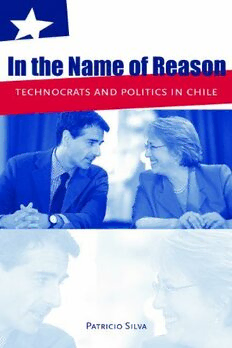
Download In the Name of Reason: Technocrats and Politics in Chile PDF Free - Full Version
Download In the Name of Reason: Technocrats and Politics in Chile by Patricio Silva in PDF format completely FREE. No registration required, no payment needed. Get instant access to this valuable resource on PDFdrive.to!
About In the Name of Reason: Technocrats and Politics in Chile
"In the Name of Reason brilliantly shakes up the pejorative conventional wisdom regarding technocracy and democracy. Patricio Silva links the problem of technocracy to the larger question of the role of the middle class in Latin American politics and socioeconomic development. Largely of middle-class origins, technocrats may make a positive contribution by offering their political masters a buffer from political pressures in the policy process, thereby contributing to political stability and state-building." —Eduardo Silva, University of Missouri, St. Louis"There are many books that look at Chile's political history in the twentieth century, but very few have focused on the critical role that technocrats have had on the country s economy and politics. In The Name of Reason provides an outstanding analysis of the forces that have stimulated the development of technocratic groups in Chile and their impact on the country's economy and society. Patricio Silva presents a new and creative analysis of critical economic policies and the role of technocrats both under democratic and authoritarian regimes. This book is essential reading for those interested in Chilean politics, economic policy making, and the role of technocrats in Chile."—Silvia Borzutzky, Carnegie Mellon University"State organization was highly elaborated in Chile well before it took shape in neighbouring republics. The required technical expertise was supplied by highly developed systems of educational and professional training that nurtured a local technocratic elite. Much that is distinctive about Chilean politics—both under democracy and during the dictatorship—can only be understood in this context. Patricio Silva is a master of this topic, and his analysis not only illustrates the strange dynamics of Chilean political development, it also indicates why that experience has proved difficult to transfer elsewhere"—Laurence Whitehead, Oxford UniversityThe major role played by a technocratic elite in Chilean politics was perhaps most controversial when the "Chicago Boys" ran the economic program of Augusto Pinochet's military regime from 1973 to 1990. But technocrats did not suddenly come upon the scene when Pinochet engineered the coup against Salvador Allende's government. They had long been important contributors to Chile's approach to the challenges of economic development.In this book, political scientist and historian Patricio Silva examines their part in the story of twentieth-century Chile. Even before industrialization had begun in Chile, the impact of positivism and the idea of "scientific government" gained favor with Chilean intellectuals in the late nineteenth century. The technocrats who emerged from this background became the main architects designing the industrial policies of the state through the Ibáñez government (1927—31), the state-led industrialization project of the late 1930s and 1940s, the Frei and Allende administrations, Pinochet s dictatorship, and the return to democracy from the Aylwin administration to the present. Thus, contrary to the popular belief inspired by the dominance of the Chicago Boys, technocrats have not only been the tools of authoritarian leaders but have also been important players in sustaining democratic rule. As Silva shows, technocratic ideology in Chile has been quite compatible with the interests and demands of the large middle classes, who have always defended meritocratic values and educational achievements above the privileges provided by social backgrounds. And for most of the twentieth century, technocrats have provided a kind of buffer zone between contending political forces, thereby facilitating the functioning of Chilean democracy in the past and the present.
Detailed Information
| Author: | Patricio Silva |
|---|---|
| Publication Year: | 2009 |
| ISBN: | 9780271036106 |
| Pages: | 270 |
| Language: | English |
| File Size: | 1.086 |
| Format: | |
| Price: | FREE |
Safe & Secure Download - No registration required
Why Choose PDFdrive for Your Free In the Name of Reason: Technocrats and Politics in Chile Download?
- 100% Free: No hidden fees or subscriptions required for one book every day.
- No Registration: Immediate access is available without creating accounts for one book every day.
- Safe and Secure: Clean downloads without malware or viruses
- Multiple Formats: PDF, MOBI, Mpub,... optimized for all devices
- Educational Resource: Supporting knowledge sharing and learning
Frequently Asked Questions
Is it really free to download In the Name of Reason: Technocrats and Politics in Chile PDF?
Yes, on https://PDFdrive.to you can download In the Name of Reason: Technocrats and Politics in Chile by Patricio Silva completely free. We don't require any payment, subscription, or registration to access this PDF file. For 3 books every day.
How can I read In the Name of Reason: Technocrats and Politics in Chile on my mobile device?
After downloading In the Name of Reason: Technocrats and Politics in Chile PDF, you can open it with any PDF reader app on your phone or tablet. We recommend using Adobe Acrobat Reader, Apple Books, or Google Play Books for the best reading experience.
Is this the full version of In the Name of Reason: Technocrats and Politics in Chile?
Yes, this is the complete PDF version of In the Name of Reason: Technocrats and Politics in Chile by Patricio Silva. You will be able to read the entire content as in the printed version without missing any pages.
Is it legal to download In the Name of Reason: Technocrats and Politics in Chile PDF for free?
https://PDFdrive.to provides links to free educational resources available online. We do not store any files on our servers. Please be aware of copyright laws in your country before downloading.
The materials shared are intended for research, educational, and personal use in accordance with fair use principles.

