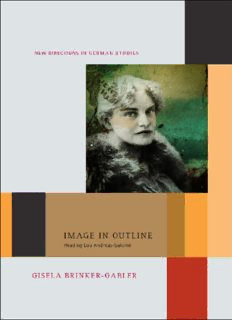
Table Of ContentNew DirectioNs iN GermaN stuDies
Vol. 6
Series Editor:
imke meyer
Editorial Board:
Katherine arens, roswitha Burwick richard eldridge,
erika Fischer-Lichte, catriona macLeod, Jens rieckmann,
stephan schindler, Heidi schlipphacke, ulrich schönherr,
James a. schultz, silke-maria weineck, David wellbery,
sabine wilke, John Zilcosky.
New Directions in German Studies
Volumes in the series:
Improvisation as Art: Conceptual Challenges, Historical Perspectives
by edgar Landgraf
The German Pícaro and Modernity: Between Underdog and Shape-Shifter
by Bernhard malkmus
Citation and Precedent: Conjunctions and Disjunctions of German Law and
Literature
by thomas o. Beebee
Beyond Discontent: ‘Sublimation’ from Goethe to Lacan
by eckart Goebel
From Kafka to Sebald: Modernism and Narrative Form
edited by sabine wilke
Vienna’s Dreams of Europe: Culture and Identity beyond the Nation-State
by Katherine arens (forthcoming)
Thomas Mann in English: A Study in Literary Translation
by David Horton (forthcoming)
image in outline
Reading Lou Andreas-Salomé
Gisela Brinker-Gabler
Continuum International Publishing Group
A Bloomsbury company
80 maiden Lane, New York, NY 10038
50 Bedford square, London wc1B 3DP
www.continuumbooks.com
© Gisela Brinker-Gabler, 2012
all rights reserved. No part of this book may be reproduced, stored in a
retrieval system, or transmitted, in any form or by any means, electronic,
mechanical, photocopying, recording, or otherwise, without the permission
of the publishers.
Library of Congress Cataloging-in-Publication Data
a catalog record for this book is available at the Library of congress.
isBN: 978-1-4411-3338-0
typeset by Fakenham Prepress solutions, Fakenham, Norfolk Nr21 8NN
contents
introduction: reading Lou andreas-salomé today 1
1 Umriss: B(u)ilding woman or sexual Difference 19
2 Lou andreas-salomé’s aesthetics 52
3 icon: B(u)ilding russia or cultural Difference 75
4 Nachtrauer: B(u)ilding rilke or modern creativity 112
5 (un)doing modern thought 137
Bibliography 148
Index 158
The more abstract a truth which one wishes to teach, the more one
must first entice the senses.
Strategy on the part of the good writer of prose consists of choosing his
means for stepping close to poetry but never stepping into it.
Friedrich Nietzsche to Lou salomé, 1882
There is a not-yet-conscious knowledge of what has been: its advancement
has the structure of awakening.
walter Benjamin, Arcades Project
introduction:
reading Lou andreas-salomé today
in 1928, Lou andreas-salomé published a book on her lifelong friend,
the poet rainer maria rilke, who had passed away in December of
1926.1 Her portrait of rilke displays a unique coupling of recollection
with her own reflections on rilke’s poetry and psychoanalytical insight.
in the opening passage of this book, she contemplates—in highly
suggestive ways—the process of mourning that follows the immediate
loss of a loved one; she names this process Nachtrauer (postmourning).
according to andreas-salomé, Nachtrauer is not just the emotional
affect of grief, but also the visualizing of the deceased that was not
possible as long as he or she was alive. thus, death entails not merely
loss, but simultaneously generates Insichtbarkeittreten, a “coming-into-
appearance” that constitutes a new imagery experience and form of
recognition stimulated by a Herantreten, the seemingly stepping toward
us of the departed one. the process that andreas-salomé associates
with Nachtrauer becomes the point of departure of her creative act, i.e.
the crafting of her rilke memorial: a recollection of the life of the poet
combined with both aesthetically motivated and psychoanalytically
informed contemplation.
the extraordinary passage at the beginning of her rilke book
illuminates the crucial role of imagery in andreas-salomé’s significant
form of thought that can be traced back to her early work from the
turn of the century, in which she had explored her manifold interests
in religion, philosophy, and “the woman’s question,” in literature,
theater, and cultural studies. as such, andreas-salomé’s approach to,
and re-visioning of, modern reality is closely tied to the modernist
1 Rainer Maria Rilke (Leipzig: insel, 1928); english translation: You Alone Are Real
to Me: Remembering Rainer Maria Rilke, trans. angela von der Lippe (New York:
Boa editions, 2003; manchester, england: carcanet Press, 2004). the book was
translated into Japanese, italian, spanish, French, czech, and chinese.
2 image in outline
movement of the late 19th and early 20th century and the profound
changes of traditional mimetic approaches associated with it.
one of the defining features of the modernist movement is a new
preoccupation with the image, from which emerged a new language
or signifying relation to the world. images were used to signify
psychological states or sexual, social, and political motifs, which
generated new modes of writing in philosophy, literature, and theory.
the new emphasis on the image reflects a shift from the paradigm of
the consciousness to the paradigm of the conscious/unconscious, or, to
use Jacques rancière’s terms, from the thought to the relation between
thought and non-thought.2 at the turn of the 19th/20th century, this trans-
formation peaked in Lebensphilosophie (life philosophy), hermeneutics,
and phenomenology, the beginning of memory studies and of psycho-
analysis, and the imagistic turn across the arts and literature.
these fields and discourses shape andreas-salomé’s work, and
accordingly, images are of prime importance. Her mode of presentation
and her often-provocative perspective on modern reality bring forth
“different pictures” that liquefy constraints of existing representations
and initiate processes of transformation. she reprocesses images and
discourses from various literary and scientific fields and opens them
for new perceptions, insights, and evaluations by moving back and
forth between imagination and reason, thought and sense perception,
memory and understanding. unlike representations based only on a
rational knowledge of objects, her image epistemology and “imaging-
discursive practice” creates a space for interplay that cannot be simply
folded into the regime of an all-encompassing power.
in my book, i attempt to explore andreas-salomé’s distinctive
modern thought and writing practise, which produced—through the
specifically female lens of a rigorous and creative thinker—multi-
faceted re-visionings of gender and sexuality, culture, religion, and
creativity. at a time of the perception of a “disenchanted world”
(weber) and the “dissolution of metanarratives” (Lyotard) andreas-
salomé offered a model of the conjunction of image and text within the
phenomenology of knowing that—in contrast to the modern rational-
instrumentalist mastering attitude towards reality—remained open
to the continuous participatory experience of existence that renders
mastering undesirable. with regard to current debates on the human
subject that emphasize either social subjection and disciplinary power
or creative constructions of human subjectivities, i would argue that
andreas-salomé takes an affirmative stance toward the human subject
that places her in-between humanist and posthumanist discourses,
2 Jacques ranciére, The Aesthetic Unconscious, trans. Debra Keates, James swenson
(cambridge, ma: Polity, 2009).
introduction 3
thereby anticipating challenges to this particular either/or model in
current thought.
the title of my book, Image in Outline (Bild im Umriss), utilizes an
often-repeated key notion in her work that signifies the shift from
representation to an imaging-discursive practise. the Umriss figures
the transitional moment of temporal-spatial flux of “lived experience”
or remembering with regard to an “object” or motif out of which a Bild
im Umriss is crafted without objectifying or exhausting the image’s
meaning. in this study, i make use of this notion, also, to characterize
my effort of “outlining an image” of andreas-salomé, which brings
both texts and contexts into play and integrates “companion readings”
of both contemporary writers and current theorists.
Her Work and Reception
the russian-born German writer Lou andreas-salomé (1861–1937)
produced a distinct body of philosophical, religious, and psycho-
analytical work, literary criticism, and fiction that positioned her as
both a gifted writer and influential intellectual in her time. andreas-
salomé became well known in 1892 with her book Ibsen’s Heroines,3
which made her the first to publish a study of women in the works
of the Norwegian playwright at the time of the heated debate on the
“question of woman.” in 1894, a portrait of the philosopher Friedrich
Nietzsche, her former friend, followed, which was the first insightful
study of the psychological dimension of his thought.4 Her numerous
essays and reviews on religion, philosophy, and literature contributed
to her growing reputation, as did her novels and stories, which often
focus—with psychological depth—on love and women who seek out
new places for themselves in the turbulent transition from a life shaped
by bourgeois norms to the manifold conflicts of modern life. From 1912
to 1913, she studied psychoanalysis with sigmund Freud in Vienna
and wrote her journal In der Schule bei Freud.5 in the following years,
she began to practice as one of the first women psychotherapists, and
3 Henrik Ibsens Frauengestalten nach seinen sechs Familiendramen (Berlin: H. Bloch,
1892; Jena et al.: Diederichs, 1906); english translation: Ibsens’s Heroines, ed.,
trans., intr. siegfried mandel (redding ridge, ct: Black swan Books, 1985). the
book was translated into Japanese, Korean, and Norwegian.
4 Friedrich Nietzsche in seinen Werken (wien: c. Konegen, 1894 and 1911), ed. ernst
Pfeiffer (Frankfurt am main: insel, 1983); english translation: Nietzsche, trans.
siegfried mandel (urbana and chicago: university of illinois Press, 1988). the
book was translated into Danish, French, Dutch, italian, spanish, Portuguese,
and chinese.
5 Tagebuch eines Jahres, 1912/13, ed. ernst Pfeiffer (Zürich: m. Niehans, 1958;
Berlin, wien: ullstein, 1983); Freud Journal of Lou Andreas-Salomé, trans. stanley
a. Leavy (New York: Basic Books, 1964); trans. into Danish, French, spanish.