
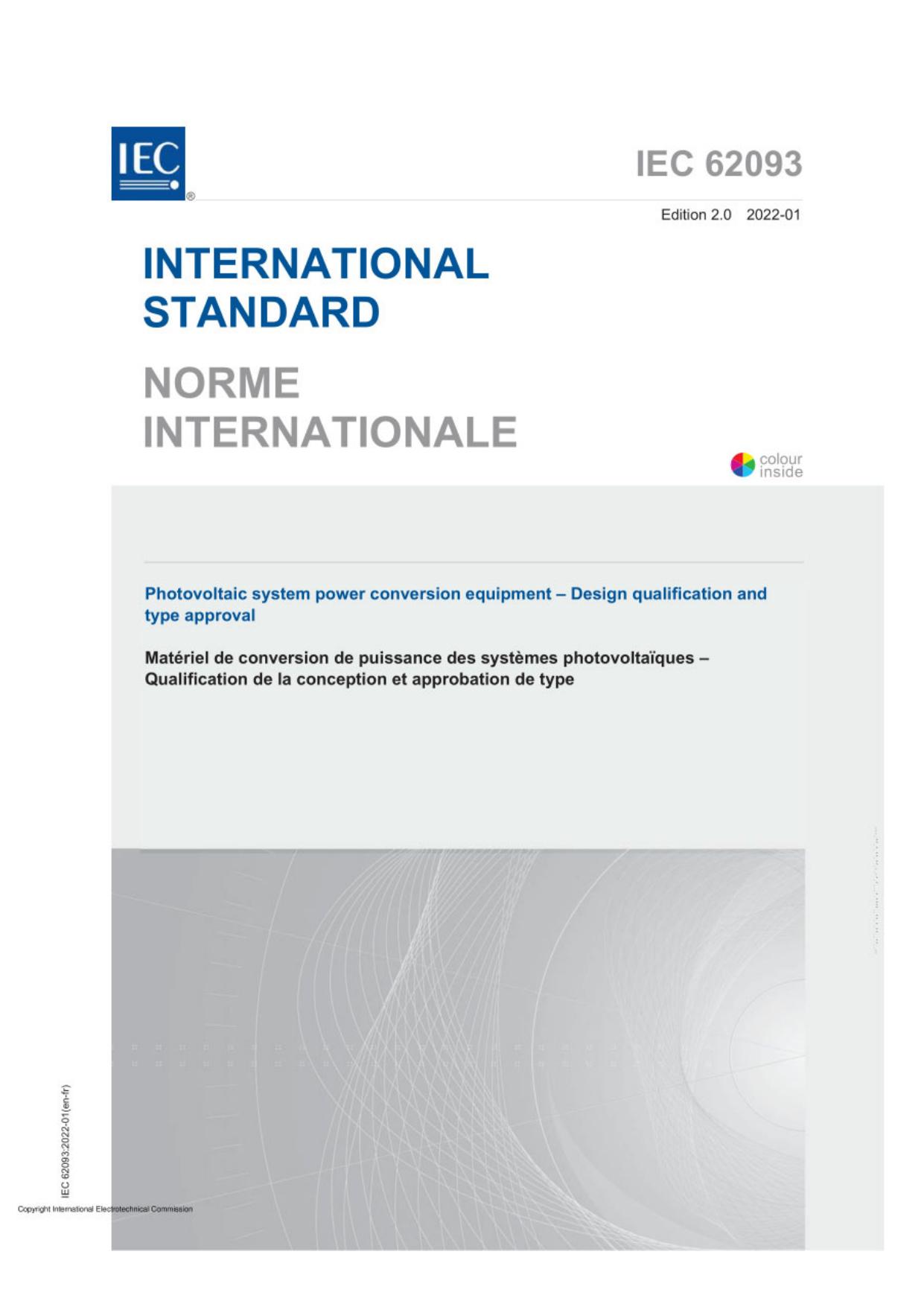
Download IEC 62093-2022 PDF Free - Full Version
Download IEC 62093-2022 by IEC in PDF format completely FREE. No registration required, no payment needed. Get instant access to this valuable resource on PDFdrive.to!
About IEC 62093-2022
<p>PHOTOVOLTAIC SYSTEM POWER CONVERSION EQUIPMENT –</p><p>DESIGN QUALIFICATION AND TYPE APPROVAL</p><p>1 Scope</p><p>This document lays down IEC requirements for the design qualification of power conversion</p><p>equipment (PCE) suitable for long-term operation in terrestrial photovoltaic (PV) systems.</p><p>This document covers electronic power conversion equipment intended for use in terrestrial PV</p><p>applications. The term PCE refers to equipment and components for electronic power</p><p>conversion of electric power into another kind of electric power with respect to voltage, current,</p><p>and frequency. This document is suitable for PCE for use in both indoor and outdoor climates</p><p>as defined in IEC 60721 -3-3 and IEC 60721 -3-4. Such equipment may include, but is not limited</p><p>to, grid-tied and off-grid DC-to-AC PCEs, DC-to-DC converters, battery charger converters, and</p><p>battery charge controllers.</p><p>This document covers PCE that is connected to PV arrays that do not nominally exceed a</p><p>maximum circuit voltage of 1 500 V DC. The equipment may also be connected to systems not</p><p>exceeding 1 000 V AC at the AC mains circuits, non-main AC load circuits, and to other DC</p><p>source or load circuits such as batteries. If particular ancillary parts whereby manufacturers</p><p>and models are specified in the manual for use with the PCE, then those parts are tested with</p><p>the PCE.</p><p>Exceptions:</p><p>a) This document does not address characteristics of power sources other than PV systems,</p><p>such as wind turbines, fuel cells, rotating machine sources, etc.</p><p>b) This document does not address the characteristics of power electronic conversion</p><p>equipment fully integrated into photovoltaic modules. Separate standards exist or are in</p><p>development for those types of devices. It is, however, applicable to devices where the</p><p>manufacturer explicitly specifies the capability of full detachment from and subsequent</p><p>reattachment to the PV module or if the input and output terminals can be accessed and a</p><p>specification sheet for the PCE is available. Devices meeting these requirements may be</p><p>tested as individual samples independent from the PV module.</p><p>c) This document does not apply to power conversion equipment with integrated (built-in)</p><p>electrochemical energy storage (e.g. lead acid or lithium-ion). It is, however, applicable to</p><p>equipment where the manufacturer specifies and permits complete removal of the</p><p>electrochemical energy storage from the PCE so that stand-alone assessment of the PCE</p><p>with the storage removed becomes possible.</p><p>The object of the test sequences contained herein is to establish a basic level of durability and</p><p>to show, as far as it is possible within reasonable constraints of cost and time, that the PCE is</p><p>capable of maintaining its performance after prolonged exposure to the simulated environmental</p><p>stresses described herein that are based on the intended use conditions specified by the</p><p>manufacturer. Optional tests contained herein may be selected depending on the intended</p><p>installation, market, or special environmental conditions that the PCE is anticipated to</p><p>experience. The categorization imposes differentiated test sequences and test severity levels</p><p>reflecting the different requirements of mechanical and electrical components in different</p><p>environments.</p><p>PCEs are grouped into categories based on size and installation environment.</p><p>The actual life expectancy of components so qualified depends on their design, their</p><p>environment, and the conditions under which they are operated. Estimation of a lifetime and</p><p>wear out is not generally covered by this document</p>
Detailed Information
| Author: | IEC |
|---|---|
| Publication Year: | 2022 |
| Pages: | 122 |
| Language: | other |
| File Size: | 21.5811 |
| Format: | |
| Price: | FREE |
Safe & Secure Download - No registration required
Why Choose PDFdrive for Your Free IEC 62093-2022 Download?
- 100% Free: No hidden fees or subscriptions required for one book every day.
- No Registration: Immediate access is available without creating accounts for one book every day.
- Safe and Secure: Clean downloads without malware or viruses
- Multiple Formats: PDF, MOBI, Mpub,... optimized for all devices
- Educational Resource: Supporting knowledge sharing and learning
Frequently Asked Questions
Is it really free to download IEC 62093-2022 PDF?
Yes, on https://PDFdrive.to you can download IEC 62093-2022 by IEC completely free. We don't require any payment, subscription, or registration to access this PDF file. For 3 books every day.
How can I read IEC 62093-2022 on my mobile device?
After downloading IEC 62093-2022 PDF, you can open it with any PDF reader app on your phone or tablet. We recommend using Adobe Acrobat Reader, Apple Books, or Google Play Books for the best reading experience.
Is this the full version of IEC 62093-2022?
Yes, this is the complete PDF version of IEC 62093-2022 by IEC. You will be able to read the entire content as in the printed version without missing any pages.
Is it legal to download IEC 62093-2022 PDF for free?
https://PDFdrive.to provides links to free educational resources available online. We do not store any files on our servers. Please be aware of copyright laws in your country before downloading.
The materials shared are intended for research, educational, and personal use in accordance with fair use principles.

