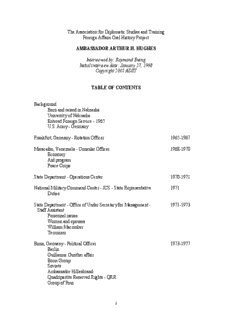
Table Of ContentThe Association for Diplomatic Studies and Training
Foreign Affairs Oral History Project
AMBASSADOR ARTHUR H. HUGHES
Interviewed by: Raymond Ewing
Initial interview date: January 27, 1998
Copyright 2001 ADST
TABLE OF CONTENTS
Background
Born and raised in Nebraska
University of Nebraska
Entered Foreign Service - 1965
U.S. Army - Germany
Frankfurt, Germany - Rotation Officer 1965-1967
Maracaibo, Venezuela - Consular Officer 1968-1970
Economy
Aid program
Peace Corps
State Department - Operations Center 1970-1971
National Military Command Center - JCS - State Representative 1971
Duties
State Department - Office of Under Secretary for Management - 1971-1973
Staff Assistant
Personnel issues
Women and spouses
William Macomber
Terrorism
Bonn, Germany - Political Officer 1973-1977
Berlin
Guillaume Gunther affair
Bonn Group
Soviets
Ambassador Hillenbrand
Quadripartite Reserved Rights - QRR
Group of Four
1
Live Oak
Rudolf Hess
State Department - Special Assistant to Assistant Secretary for 1976-1977
European Affairs
Arthur Hartman
State Department - Spain Desk Officer 1977-1978
Spanish economy
NATO
Post-Franco
State Department - Staff of Executive Secretariat 1978-1980
Duties
Secretary of State travel
President Carter
Copenhagen, Denmark - Deputy Chief of Mission 1980-1983
Common Agricultural Policy [CAP]
Danish policies
Poland
NATO
President Reagan
Soviet submarine
Cultural exchange
The Hague, The Netherlands - Deputy Chief of Mission 1983-1986
Environment
INF modernization
Ambassador Bremer
Tel Aviv, Israel - Deputy Chief of Mission 1986-1989
Ambassador Tom Pickering
Peace process
Consul General Jerusalem relationship
Wat Cluverius
Embassy location issue
Prime Minister Rabin
Terrorism
Gaza
Politics
Intifada
Palestinians
Richard Murphy
Secretary of State Shultz
Congressional delegations
2
Visitors
Judaism
Population
Pollard case
West Bank
Defense Department - International Security Agency [ISA] - 1989-1991
Office of Secretary of Defense - Deputy Assistant Secretary of Defense for Near
East/South Asia
Gulf War
Secretary Cheney
General Schwarzkopf
Saudi mission
Iraq
India-Pakistan issues
Egypt-Israel defense issues
Desert Shield
Desert Storm
Colin Powell
Safwan meeting
Wolfowitz
Kuwait troop evacuation
Skip Gnehm
Yemen - Ambassador 1991-1994
UN vote problem
Economy
U.S. aid
Peace Corps
Civil war
Saudi-Yemeni relations
Politics
Exiles
Aden
Oil
Environment
U.S. interests
State Department - Near East Affairs - Deputy Assistant Secretary 1994-1997
Sinai operation
Gulf States relations
Khobar Towers bombing
Saudi economy
Secretary of State Baker
Status of women
Oman
3
Bahrain
Human rights
[Left government in 1997]
Multinational Force and Observers (Egypt-Israel peacekeeping) -
Director General 1998-present
INTERVIEW
[Note: This interview was not edited by Mr. Hughes]
Q: This is an Oral History interview with Arthur H. Hughes. It's the 27th of
January 1998. I'm Raymond Ewing. It's being conducted under the Foreign
Affairs Oral History Program under the auspices of the Association for
Diplomatic Studies and Training at the National Foreign Affairs Training Center.
Art, good morning, welcome.
HUGHES: Thanks. I'm very happy to participate in the program.
Q: Let me start from the beginning. You came into the Foreign Service, I think, in
1965. Why don't you tell me where you grew up, where you went to school, and
how you got interested in the Foreign Service?
HUGHES: Well, thanks. I grew up mostly in Nebraska. I was born in Nebraska,
and although we spent three years down in Arizona because my father was an
asthmatic, it didn't do him much good, so we went back to Nebraska. I went to
Lincoln High School, graduated from there in '57, and the University of Nebraska,
graduated in '61. I'm not quite sure when I became interested in the Foreign
Service. I did a lot of reading when I was a kid, and somewhere along the line it
just started building, I guess. In high school I took engineering prep and even took
one semester of engineering at the University. Then I decided I wanted to go into
liberal arts and study history and political science, a little economics, German,
and so forth. In those days at the University of Nebraska there was no major in
international relations, so I cobbled together my own by working with the various
departments. Some of the professors were really puzzled about what I planned to
do. I think maybe they were skeptical that I'd ever pass the Foreign Service test.
Fortunately I did pass it in the fall of 1960 actually.
Q: While you were still an undergraduate?
HUGHES: That's right. Graduated in '61. I had gone through ROTC and was
commissioned at the same time. I went to graduate school for one year at
Nebraska. The Foreign Service offered to intercede with the Defense Department
4
or the Department of the Army and allow me to resign my commission to come
into the Foreign Service in 1961. But I thought that that would have been a
mistake in the long run, and so I did serve in the Army in Germany, was in for
two years, and then into the Foreign Service, as you said, in March of 1965.
Q: Your service in Germany involved language study, or you had an opportunity
to use some of the German you had learned in college?
HUGHES: I had a German minor, and I was able to use the German and expand it
while I was in Germany. We had a kind of pre-language lab situation at the
University. That was in the late '50s, of course. I think it was pretty rudimentary
as far as language labs go. So my reading was pretty good, but my speaking was
not much good when I got to Germany, but being there allowed me to improve.
Q: You then came into the Service, as you say, in March of 1965. You did the
usual junior officer orientation and training, and then where were you assigned?
HUGHES: I was assigned to do four weeks of German, hopefully to get me over
the hump, and then I went to Frankfurt, which was right across the street from
what had been my Army headquarters. I was in Fulda actually, 65 miles away up
on the border. But that was our headquarters right across the street on
Seezmyerstrasse from the consulate general.
Q: So you knew how to get there?
HUGHES: Knew how to get there.
Q: And you did the usual first tour counselor work?
HUGHES: First-tour rotation, I think I had five jobs there. That was actually the
most fun of it, the rotation. Because it was a pretty big post, there were a lot of us
junior officers and we made lasting friendships. Still some of our best friends we
met in Frankfurt in those days.
Q: It was a large post, of course, and it had probably a number of junior officers.
HUGHES: It was a real consular factory in a sense. Our main clients were
actually service members. I spent a month or two doing nothing but registering
births of almost all service members, a few businesspeople but almost all service
members.
Q: And I suppose something with marriages too?
HUGHES: Marriages, adoptions, all kinds of interesting social situations.
Q: Citizen services.
5
HUGHES: Yes.
Q: And from Frankfurt you went to where?
HUGHES: Went to Maracaibo, went to Venezuela. My wife Pat had been a
Spanish major, Spanish and English dual major, at the university, and we wanted
to go to a Spanish-speaking post. Since we had served our first tour at a consulate
general, I requested any Spanish-speaking embassy, which I thought was not too
demanding for an FSO-8 [Foreign Service officer - class 8]. I might have been an
FSO-8 still. I should mention this: I took a pay cut from the Army to come into
the Foreign Service. I wasn't smart enough to negotiate to come in as a 7, so I
came in as an 8. But in any event, they sent us to Maracaibo, which was a four-
person post which was reduced to three people, and I was the middle person of
three. But it was a great assignment. We were there for two and a half years,
learned some Spanish, learned about Venezuela, learned about that part of the
world, learned about developing economies, and made some good friends.
Q: Did you have some Spanish yourself before you went there?
HUGHES: I had 12 weeks. The course was shortened a little bit, because we were
coming up against the Christmas holiday, and they decided, instead of having
people go off for a week over the holidays and then coming back for a couple of
weeks, they'd just shorten it, so we finished up just before Christmas. And then I
took Spanish in Venezuela.
Q: And you had had some at the university?
HUGHES: Never.
Q: But Pat had?
HUGHES: Pat had.
Q: Ahead of you?
HUGHES: She was, indeed.
Q: Well, those small posts certainly gave opportunities for fairly new officers that
a large embassy often didn't.
HUGHES: It was a wonderful post. Even going back to Frankfurt was a
wonderful post. The principal officer throughout most of my time there was
Jimmy Johnstone, who was finishing up his career, a career administrative person,
a wonderful gentleman.
Q: This was in Frankfurt?
6
HUGHES: In Frankfurt. He really in many ways took me under his wing. We hit
it off for various reasons. I remember once he teased me because as a new officer
I had done something, I had exceeded my authority, for which the deputy
principal officer chastised me. Jimmy Johnstone kind of winked at me and told
me not to worry about it, that I had done the right thing. But then in Maracaibo I
was also fortunate. I had great bosses. It was a very interesting time in Venezuela.
It was the first time in Venezuelan history in the election of December '68 that
power passed peaceably from one political group to another. Rocco Caldero won
the election. There were five candidates, and he won it with less than 30 percent
of the vote, but there was a peaceful transition. Now he's President again after
Venezuela having gone through a crisis that we thought had been put behind him
as a result of what happened in the late '60s and early '70s.
Q: Was the oil sector booming?
HUGHES: Absolutely booming. Bolivar was rock-solid currency. They were
making a lot of money, and they made a lot of mistakes unfortunately. They
poured a lot of money into Caracas and depopulated the countryside. Venezuela
went from a country which historically had exported food to an importing
country.
Q: Maracaibo is a post that is still open, or it's been closed some years ago?
HUGHES: It's closed again. It's been opened and closed about four times, with the
inflow of the American population in western Venezuela. The nationalization of
the oil sector law was passed just before I arrived in Venezuela, so I was there
during the transition period, which was not a comfortable period for the American
oil companies, for American business community, the international business
community, nor to a large extent for the Venezuelans themselves. What's
interesting now is just in the last few years the Venezuelans have reopened their
oil sector to international investment, not only as operators but as equity partners.
They had some extremely capable engineers. The middle class was growing, and
very competent and capable people, but I think, although I have been away from
them for many years, that probably it was more on the long-term investment and
organizational side as opposed to the technical side where they might have
problems.
Q: You had a broad range of responsibilities at the post and you were in effect the
deputy principal officer?
HUGHES: Well, that's right. There were two officers and then a staff officer.
Fortunately we had excellent people and we all got along famously. There were
good principal officers who gave me some latitude. We had the five western states
of Venezuela, so I was able to travel all around and go off to little towns. That's
where I learned about what I think are still some of the most fun things you do in
7
the Foreign Service, and that is to travel around the country, go into towns, talk
with the mayor, the labor leader, the newspaper editor, the university or upper
school people, and really find out what's going on and show some interest. It's
amazing what you can learn by being interested, being curious, showing
sensitivity toward the culture, and just showing normal human politeness.
Q: You often get a perspective that's different than you do at the top levels of
government in the capital.
HUGHES: The equivalent of outside the Beltway [highway system surrounding
Washington, DC], I guess.
Q: Besides all of these aspects of listening and establishing a rapport and
showing interest and so on, did we have programs that you were able to support
or show interest in - the Peace Corps? There was not an aid program, I don't
think.
HUGHES: There was a small aid program. It had to do with public safety. These
were the days before the law that resulted after some problems in Vietnam in
which we had public safety programs. We had a retired police officer from
Phoenix actually, who was there working with the local police. The programs
were basically forerunners of human rights in police work - proper procedures,
transparency, and so forth. We had Peace Corps there, mostly in the countryside
doing things such as proper nutrition, mother-child health care, which are still
going on. For example, at my last post it's still active. It was interesting because
that was my first direct contact with Peace Corps people on the ground, how they
reacted to us from the consulate. Some were very happy to see us when we came
to the countryside and were very happy to come to our homes for Thanksgiving,
for example, or come by for a meal and a beer or two when they were in town.
Others were absolutely convinced that any relationship between themselves and
the official Americans would completely make it impossible for them to work
effectively in the countryside. So I tried to be sensitive when I went out, to know
what the attitude of the individual Peace Corps person was, and then behave
accordingly.
Q: Ever since the Peace Corps was established, that's been a dilemma for them
and in some ways for other aspects of the government.
HUGHES: Those were tough years - Vietnam, Cambodia. The consulate was
attacked, cars burned. The big signpost out front was all burned down, a lot of
glass smashed when I was there.
Q: Because of Vietnam?
HUGHES: Cambodia.
8
Q: The invasion of Cambodia in '69. 1970 I guess it was.
HUGHES: Yes, spring. We were in, as I said, for two and a half years, from
winter '68 through July of '70.
Q: Where did you go from there, in the summer of 1970?
HUGHES: Well, we went for our first assignment in Washington and went to the
Operations Center, which was a great assignment.
Q: For what, one year?
HUGHES: One year, and a part of that was as State rep to the National Military
Command Center, part of the JCS [Joint Chiefs of Staff].
Q: Which meant that you were actually...
HUGHES: On the floor at the NMCC [National Military Command Center] as a
State Department representative.
Q: The Pentagon?
HUGHES: That was kind of an experiment. I don't recall now exactly how long a
State representative was assigned there, but it ended shortly after my time in it,
which was in the spring of '71.
Q: That was a shift?
HUGHES: Shift work, 24-hour day just like the Ops Center.
Q: And so there would be several other State Department officers who also were
there. And you would advise as international foreign affairs issues affecting the
State Department came up then?
HUGHES: That's right, or questions from the military there. There were also reps
from the Agency, from the NSA and, I think, from the FBI. I'm a little cloudy on
that. It seems to me there were four of us not from the Defense Department, not
from the Defense establishment. The NMCC was headed up on every shift by a ne
star, by a Brigadier General, and there were times when things would happen
around the world and they would ask us, "What's the perspective from State?
What are the ramifications from your perspective?" Sometimes you could answer
from what you knew yourself. Oftentimes you'd get on the phone back to the
Department and find out, get more expertise involved.
Q: Did the Department of State encourage you to keep people in the State
Department posted about things of significance, of interest that were sort of
9
developing that the National Military Command Center was aware of?
HUGHES: Right, it was a two-way kind of flow of information. For one thing, the
State rep would read in on important things happening around the world and try to
maintain in their minds background, perspective, ramifications, implications, and
by the same token were able to keep State informed of thinking over at the
Defense Department regarding possible preparations for actions, preparations for
deployments, give a heads-up that certain contingency planning was needed then
and so forth. I thought it was very useful. It was finally terminated, I guess, just
because of staffing problems, but I thought it served a useful purpose.
Q: In terms of career development, it was probably also useful for you - and this
was your third assignment - to become aware. You had already been in the State
Department Operations Center for a while, and you saw how the State
Department looked from that perspective, and then to see the Pentagon and how it
interacted with State and the White House and others.
HUGHES: I think that's exactly right. I had been in the Army, I had been in
Germany, and one of my jobs was on the East/West German border of dealing
with the illegal border crossers and managing some of those problems. I had been
well immersed in the military life, military culture. I think serving at the NMCC
also helped me later on, because I came into ongoing contact with the senior
officers over there, which gave me inside understanding and sensitivity to how
DOD works and functions. Of course, later on, when we come to that, I did serve
over there as a Deputy Assistant Secretary of Defense. I think the ongoing contact
was very helpful to me, very useful in professional terms and also in personal
human terms.
Q: You, of course, had counterparts, serving military officers who represented the
Joint Chiefs of Staff and, I guess, the Department of Defense in the Operations
Center?
HUGHES: That's right, ongoing colonel-level, O6-level, staff around the clock.
Q: And I think that's continued.
HUGHES: That has continued, yes.
Q: Okay, so after you finished at the Pentagon, what did you do then?
HUGHES: Well, part of that one year in S/S-O [Staff Secretariat-Operations] I
did a stint at the NMCC but also worked in a normal cycle in the Ops Center on
the watch and as an editor.
Q: So this was just in effect part of your assignment during that period.
10
Description:Bonn, Germany - Political Officer. 1973-1977. Berlin. Guillaume Gunther affair State Department - Near East Affairs - Deputy Assistant Secretary .. Joint Chiefs of Staff and, I guess, the Department of Defense in the Operations.