Table Of ContentH O YA NEW
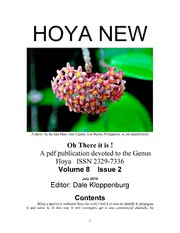
A photo by the late Mary Ann Cajano, Los Banos, Philippines, as yet unpublished.
Oh There it is !
A pdf publication devoted to the Genus
Hoya ISSN 2329-7336
Volume 8 Issue 2
July 2018
Editor: Dale Kloppenburg
Contents
When a species is collected from the wild, I feel it is wise to identify it, propagate
it and name it. In this way it will eventually get it into commercial channels, be
1
distributed to all those interested in this genus and thus be preserved. If in the future the
species is lost through natural causes or forest destruction it will still be here on earth in
your collection.
The following new species are presented in PDF format with ISSN number.
Check posting on my website “http//.hoyardk.wix.com/Kloppenburg’, under publications.
1. Hoya matiensis Kloppenburg 2018
2. Hoya mindorensis subsp. philippinensis Kloppenburg 2018
3. Hoya pseudobicolensis Kloppenburg 2018
4. Hoya obscura subsp. lagunaensis Kloppenburg 2018
5. Hoya densifolia subsp. panchoi Kloppenburg 2018
6. Hoya baguioensis subsp hernaezii Kloppenburg 2018
7. Hoya nova Kloppenburg 2018
8. Hoya infantalensis Kloppenburg 2018
9. Hoya sarawakensis Kloppenburg 2018
10. Hoya garciai Kloppenburg 2018
11. Hoya mcclureii Kloppenburg 2018
12. Hoya negrosensis Kloppenburg 2018
13. Hoya meliflua subsp. breviora Kloppenburg 2018
14. Hoya eumbeitii Kloppenburg 2018
15. Hoya placerensis Kloppenburg 2018
2
Hoya matiensis Kloppenburg 2018
ISSN 2329-7336
Hoya matiensis Kloppenburg, species nova, holotypus 49238 (UC) hie
designatus. Sp. unique, folia opposite, elliptic lanceolate, basi obtusa vel apice acuta,
nervis palmatus - triplinervis. Pedicellis erectis filiformibus glabris 2.0 cn longis, apicem
versus dilaytata, et calycis segmentis late ovato-oblongis obtusis vel suborbicularibus,
glabris, 0.36 cm longis, corolla subrotata 1.9 cm diametro, lobis late triangularibus,
subtus glabris, intus dense papillosis, 0.6 cm longis, basi connatis; coronae foliolis
horizontalibus, progressus modicis umbos, pollinia 0.80 mm longis et 0.32 cm latis.
Collected by Ramos/Edano at Mati Davao, Mindanao, Philippines 1927. Roll 54 Draw 70
Check details of parts below.
Leaves: elliptic lanceolate base obtuse apex acute, palmate to triplinerved.
Pedicels: 2.0 cm x 0.1 cm enlarging toward the apex.
Calyx: top view enlarged about 8x, large and with overlapping sepals,
ligules long. Sepals, ovate 0.36 cm long and 0.30 cm wide; about the
center, glabrous.
Ovaries: narrow cone shaped 0.16 cm tall 0.10 cm at base of pair,
glabrous.
Top view of a flower enlarged about 8x, corolla lobe
extending to bottom of picture. Outside is glabrous inside
puberulous may be papillose ?
Sinus - sinus 0.60 cm
Sinus - apex 0.57 cm
Apex - center 0.95 cm
3
Bottom view of the corona enlarged about 8x.
Lobes are very plump, channeled to near sinuses, Anther wings
with broad sides and prominent, outer apex subacute. Thickened
central column.
Apex - apex 0.40 cm
Apex - center 0.44 cm
Widest 0.24 cm
Aw. - aw. 0.20 cm
Top view of the corona enlarged about 8x. Inner lobes
do not quite reach the center, are extended round to sub
spatulate. Dorsal beyond inner lobe concave with a pair of
small forward umbos and a raised center toward outer apex.
4
Composite Photos of
the pollinarium here
and below.
Pollinium
length 0.80 mm
widest 0.32 mm
Retinaculum
length 0.38 mm
Pollinia inner end
type: RT
Retinacula: RH
Translator/caudicle
type: ls/o
5
6
Hoya mindorensis subsp. philippinensis Kloppenburg 2018
ISSN 2329-7336
Hoya mindorensis subsp. philippinensis Kloppenburg subsp. nova, holotypus
61933 (CAHUP) hie designatus. Similis sp. sed pedicilis longior 2.0 cm contrastre 1.5 cm
et sepala non ciliatus ovatis; corolla diametro complanatus brevior 0.5 cm contrastre 0.9
cm, differt. In addition the pollinia here is not as in Dr. Schlechter’s drawing.
Here again we have a species that is highly variable, many color variations that
also have many differences in the flower parts. This subspecies differs from Dr.
Schlechter’s type in that the sepals here are shorter. The pedicels here are longer 2.0 cm
vs. 1.5 cm, also here the corolla flattened is only 0.50 cm in diameter vs. 0.90 cm inside.
Pedicel: enlarged about 16x. 2 cm long 0.09 cm in diameter,
curved, terete, glabrous, enlarging as it approaches the calyx.
Calyx: enlarged about 16x. Sepals are 0.16 cm long and
at the base 0.15 cm wide with a slight overlap, thickened in the
center and ciliate otherwise glabrous, outside granulose.
Ovaries: are columnar 0.13 cm tall and base pair 0.12
cm wide, glabrous drying dark in color.
Bottom (outside) view of the flower
enlarged about 8x. Ends and sides of the corolla
lobes turn under are dark in color dried, center
greatly thickened, with a collar protruding outward
0.04 cm long.
Sinus - sinus 0.25 cm
Sinus - center 0.25 cm
7
Inside (top) view of the flower enlarged as
above. The coronal lobes are sharply keeled above
and touch in the center. Here the anthers are not
compressed and creped between the lobes but have
loosened up and expanded. They are thin
membranous 0.15 cm long and at the base 0.12 cm
wide. The coronal lobes exceed the corolla sinuses.
Corolla inside pubescent.
Pollinarium enlarged about 165x.
Pollinium
length 0.63 mm
widest 0.29 mm
ext 0.05 mm
Retinacula
length 0.55 mm
shoulder 0.25 mm
Translator
length 0.30 mm
depth 0.03 mm
Caudicle
8
bulb, diam 0.07 mm
Translator/caudicle type: ls/o
Pollinia inner end type: R
Measurements difficult, pollinium of different width possibly the one on top is folded a
little. Retinaculum globose and hard to discern features. The translators appear to twist as
they exit the retinaculum.
9
Hoya pseudobicolensis Kloppenburg 2018
ISSN 1655-3179
Hoya pseudobicolensis Kloppenburg sp. nova, holotypus 5294 (CAHUP) hie
designatus. Similis Hoya bicolensis sed foliis ellipticus et apicie apiculatis non ovato &
apice subacuminatus, aliis partibus breviora. Corolla diametro complanatus brevior autem
pollinia iam 0.40 mm-0.42 mm contrastre 0.35 mm, differt.
This new sp. is similar to Hoya bicolensis Kloppenburg, Siar & Cajano 2014 and
Hoya camphorifolia Warburg 1904 but the foliage is different. Most parts are smaller
except the pollinia are longer.
Collected by Blass Hernaez on 17 March 1990, UP Landgrant, Quezon, Philippines. .
Determination: closest to Hoya bicolensis Kloppenburg & Siar but possibly in Sect.
Otostemma sp.
Internodes: 5.5 - 10 cm. long
Foliage: elliptic apiculate apex acute, base slightly rounded, glabrous, triplinerved, blade
7.8-12.6 x 3.5 - 5.4 cm.; petiole 2.7 cm. long glabrous.0.90 cm contrastre 0.94 cm,
Peduncle: extremely short here with rachis fasciculate.
Photo and data 3/29/99.
Pedicel: filiform, terete, glabrous 1.0 cm long 0.05 cm diam.
Calyx: short, broad, triangular sepals, ciliate, outside surface granulate, glabrous.
Ovaries: dome shaped 0.07 cm tall and base pair 0.05 cm wide, glabrous.
Flower, corolla dark, with corona in
center sitting atop a column, flowers very small
appear to be in Section Otostemma. Outer lobes
raised above the center, dorsal surface sway
backed with center raised, outer apex rounded,
thin, prominent anther wings. Inner lobes round
(dentate?) sloping outward, dorsal with central
ridge.
Sinus - sinus 0.18 cm
Sinus - center 0.15 cm
Sinus - apex 0.30 cm
Apex - center 0.45 cm
Widest 0.25 cm
10