Table Of ContentTable of Contents
Title Page
Table of Contents
Copyright
Dedication
Epigraph
Preface
Acknowledgments
Introduction
NATURE, LOST AND FOUND
Wilding the Mind
The Power of Place
ESSENTIAL ELEMENTS
The Way of Coyote
Hitched to Everything
Mothers All the Way Down
LIFE STAGES
The Playful Scientist
The Age of Competence
The Social Animal
OBSTACLES AND SOLUTIONS
Dangerous Liaisons
The Rewilding Revolution
Epilogue
Notes
Bibliography
Index
About the Author
Copyright © 2015 by Scott D. Sampson
All rights reserved
For information about permission to reproduce selections from this book, write
to Permissions, Houghton Mifflin Harcourt Publishing Company, 215 Park
Avenue South, New York, New York 10003.
www.hmhco.com
Library of Congress Cataloging-in-Publication Data is available.
ISBN 978-0-544-27932-2
NOTE: Readers and the children they mentor should give due regard to safety in
all interactions with nature.
“Ich lebe mein Leben . . . / I live my life in widening,” from Rilke’s Book of
Hours: Love Poems to God by Rainer Maria Rilke, translated by Anita Barrows
and Joanna Macy, translation copyright © 1996 by Anita Barrows and Joanna
Macy. Used by permission of Riverhead Books, an imprint of Penguin Group
(USA) LLC.
eISBN 978-0-544-27919-3
v1.0315
In wildness is the preservation of the world.
—HENRY DAVID THOREAU
For my mother, Catherine June Sampson,
nature mentor extraordinaire,
and
for my sister, Kerry Dawn Sharpe,
who taught me how to live with grace and grit.
I miss you both terribly.
Preface
LIKE MANY CHILDREN, I developed a passion for dinosaurs as a kid.
Without exaggeration, paleontology was one of the first words I learned to spell.
By the tender age of four, I had memorized dozens of multisyllabic names of
prehistoric creatures. I dug for fossils in the backyard (unsuccessfully) and came
home from family camping trips with assortments of rocks (and occasional
fossils), most of which were banished to the backyard. A black-and-white photo
taken when I was four years old shows me hugging a cement Stegosaurus—true
love.
Unlike most children, I never lost my passion for dinosaurs. Some say I never
really grew up. After contemplating several alternative careers, I eventually
chose to pursue a doctorate in zoology at the University of Toronto. My
dissertation involved naming and describing two previously unknown horned
dinosaurs discovered in Montana.
In 1999, I accepted a dual position at the University of Utah in Salt Lake City
as a paleontology curator at the Utah Museum of Natural History (now the
Natural History Museum of Utah) and an assistant professor in the Department
of Geology and Geophysics. It was a dream job for a dino-guy like me, with
museum resources for fieldwork and fossil preparation, access to graduate
students, and plenty of amazing fossils to be discovered within a day’s drive. I
also took advantage of opportunities to hunt dinosaurs (or at least their fossilized
bones) in far-off lands, enjoying many seasons in Africa and elsewhere. It
seemed I was set for life.
But in 2007, now a tenured professor and museum chief curator, I gave it all
up. Well, most of it. I kept fossil hunting in Utah, but my wife Toni and I decided
to move to northern California, where I devoted the bulk of my energies to
public science education and fostering nature connection. Many colleagues
thought I was nuts, and so did I for a while. Why make such a drastic change?
It came down to a pair of compelling insights. First, the current disconnect
between kids and nature threatens the health of children. A childhood lived
almost entirely indoors immersed in technology is an impoverished childhood,
with numerous negative impacts on growth—physical, mental, and emotional.
Second, the current trend toward denaturing childhood also threatens the places
we live and perhaps even the future of humanity. We likely have about one
generation (some say less, some say a little more) to make profound changes and
set ourselves on a sustainable course. After that—well, nature, as they say, bats
last.
If sustainability depends on transforming the human relationship with nature,
the present-day gap between kids and nature emerges as one of the greatest and
most overlooked crises of our time, threatening people and countless other
species. Helping children fall in love with nature deserves to be a top national
priority, on par with reducing greenhouse gas emissions and preserving species
and wild places. Having spent much of my adult life communicating science to
nonscientists, including kids, I felt the need to contribute more directly to this
urgent effort.
Since then, my work has taken several forms, including writing, speaking, and
various media projects. The most high-profile example has been Dinosaur Train,
a PBS KIDS television series produced by the Jim Henson Company that, as of
this writing, airs daily across the United States and in many other countries
around the world. I serve as the show’s science advisor and host, consulting on
scripts and helping to craft the stories for the animated characters, including
Buddy, a young T. rex, and Tiny, a kid Pteranodon (flying reptile). At the end of
each episode, I appear on camera to talk about the science behind the stories,
making connections between the prehistoric world of dinosaurs and our present-
day world. My enthusiastic tagline at the end of every show is, “Get outside, get
into nature, and make your own discoveries!”
Dinosaur Train has been a roaring success, as well as a lot of fun, reaching
millions of children and parents. Through my writing and speaking events, the
show has also afforded me terrific opportunities to promote the cause of
connecting children with nature. Yet a few years ago, a fundamental question hit
me like a T. rex thighbone to the gut: Exactly how do kids connect with nature,
and how does this process change as they grow up? I had some ideas, but really
didn’t know the answer.
Surely, I presumed, with so many organizations engaged in nature connection,
there must be a bevy of books on the topic. A rigorous search revealed no
shortage of offerings on outdoor activities for kids, from birding to gardening,
and plenty of volumes devoted to environmental education. Yet with few
exceptions, these books did not delve directly into nature connection, let alone
how this process changes with the age of the child. No one would argue that
toddlers and teenagers engage with nature in different ways, but exactly what are
those ways? Digging further, I found a stream of academic papers, most written
in the past couple of decades, addressing this very issue. Yet until now these
results have not been summarized in a single volume for a general audience.
Ultimately, the search for answers took me far beyond the scientific literature,
into backyards, classrooms, school gardens, urban parks, nature centers,
museums, and out into the wilderness. I’ve studied nature mentoring, learned
“bird language” with my daughter Jade, and spent time with kids in wild places.
Along the way, I was embarrassed to discover that my own sense of nature
connection was—it has to be said—pitiful. So, while writing this book, I sought
to deepen this connection, both for Jade and for myself. Ultimately, all this
research has led me to a series of conclusions about how nature connection
actually works, and how the process changes as children grow. The implications
of these findings get to the very heart of parenting and teaching, and of
childhood itself. How to Raise a Wild Child is that story, aimed at everyone
interested in the art and science of helping children fall in love with nature. If
you’re interested in becoming a nature mentor to the children in your life, this is
the book for you.
In 2013, just as I began writing this volume in earnest, I moved with my
family from the seaside village of Muir Beach, California, to Denver, Colorado,
to take on another opportunity. The Denver Museum of Nature & Science
offered me an executive position, with the potential to tackle important work on
an urban scale. Now well into my second year, I’m excited to be at such a
forward-thinking institution endeavoring to make a difference. And, thanks to
input from numerous new colleagues and friends, the move to Denver greatly
altered the content of this book.
In the end, the writing of How to Raise a Wild Child was bookended by
sadness. Just as I began to crank out the first chapters, the greatest nature mentor
of my life, my mother, passed away after a lengthy downward spiral in the wake
of a major stroke. Then, about a year later and just a few weeks prior to
completing the manuscript, my sister Kerry died rather suddenly following a
two-year bout with cancer. These deep losses have only cemented in me the need
to push through the daily noise and focus on the things that matter most. It’s my
deep personal hope that this book is one of those things.
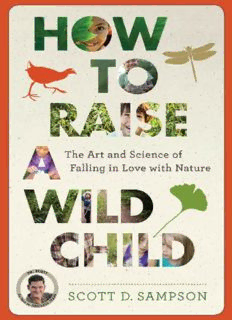
Description:From the beloved host of PBS Kids’ Dinosaur Train, an easy-to-use guide for parents, teachers, and others looking to foster a strong connection between children and nature, complete with engaging activities, troubleshooting advice, and much more American children spend four to seven minutes a day