Table Of Content^.Tk/^T^
i_ 1 x
3 1604 014 798 195
NATIONAL REGISTER
BULLETIN
Technical information on the the National Register of Historic Places:
survey, evaluation, registration, and preservation ofcultural resources
U.S. DepartmentoftheInterior
National ParkService
Cultural Resources
FEDERAL
1PUBLICATION National Register,Historyand Education
HOW
TO IMPROVE THE QUALITY OF PHOTOGRAPHS
FOR NATIONAL REGISTER NOMINATIONS
The mission of the Department of the Interior is to protect and provide
access to ourNation's natural and cultural heritage and honor our trust
responsibilities to tribes.
This material is partially based upon work conducted under a cooperative
agreement with the National Conference ofState Historic Preservation Officers
and the U.S. Department ofthe Interior.
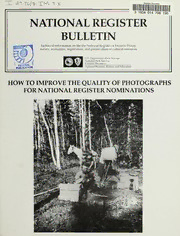
Cover: Wet-plate Photography in the Field. Utah, 1872.
John K. Hitlers, a memberofthe Powell Survey Team, examiningoneofhis plates.
(National Park Service Historic Photograph Collection)
NATIONAL REGISTER
BULLETIN
HOW TO IMPROVE THE QUALITY OF PHOTOGRAPHS
FOR NATIONAL REGISTER NOMINATIONS
BY
FREDERIC ATHEARN
J.
including
On the Road
by
Jeff Dean
U.S. DEPARTMENT OF INTERIOR
NATIONAL PARK SERVICE
NATIONAL REGISTER, HISTORY AND EDUCATION
NATIONAL REGISTER OF HISTORIC PLACES
1979, REVISED 1987, 1996, 1998
Digitized by the Internet Archive
in 2012 with funding from
LYRASIS Members and Sloan Foundation
http://archive.org/details/howtoimprovequalOOathe
TABLE OF CONTENTS
Preface iv
Acknowledgments v
Introduction vi
I. A Brief History of Photography and the Photographic Process 1
Photographic Films 2
Photographic Prints 3
II. Cameras and Lenses 5
Thirty-Five-Millimeter Cameras and Lenses 5
Medium-Format Cameras and Lenses 7
Large-Format Cameras 8
Basic Tips on Using Lenses and Filters to Improve Photographs 9
III. Documenting Historic Places on Film 10
National Register Guidelines for Photographic Coverage 10
Historic Buildings, Structures, Sites, and Objects 11
Interiors 12
Historic Engineering Properties 13
Bridge, Trestles, and Aqueducts 14
Railroads 14
Roads and Trails 16
Historic Districts 16
Landscapes, Streetscapes, and Battlefields 16
Archeological Properties 17
Aerial and Oblique Photography 18
ON THE ROAD byJeff Dean 19
IV. Preparing Photographs for Submission to the National Register 25
Basic Requirements 25
Papers 25
Labeling Photographs 25
V. Storage of Film and Prints 26
Appendix I: Photography for the Historic American Buildings Survey and the Historic
American Engineering Record 27
Bibliography 29
Glossary 31
List ofNational Register Bulletins 33
iii
,
PREFACE
—
Photographs are an essential part Past A View to the Future: A Guide to teaches small-format architectural
ofall National Register of Historic PhotodocumentingHistoric Places, photography for the Mount Carroll
Places nomination documentation Bureau ofLand Management, Cul- Center for Applied Photographic Arts
because they illustrate the property at tural Resource Series, No. 30, 1994. of the Campbell Center for Historic
the time it was nominated, provide a Preservation, Mount Carroll, Illinois.
record of the property's integrity and Jeff Dean, former Wisconsin State
distinguishing features, and support Historic Preservation Officer, added a
the nomination's discussion of the section to this bulletin based on his
property's physical description and experiences since 1970 in the field of Carol D. Shull
historic significance. As of 1997, the historic preservation. Dean was
National Register included documen- awarded a Certificate ofCommenda- Keeper, National Register ofHistoric
tation on more than 69,000 historic tion in Preservationby the National Places
properties. This record ofAmerica's Trust for Historic Preservation for his National Register, History and
heritage is unmatched in its compre- 1981 book, Architectural Photography Education
hensiveness. published by the American Associa- National Park Service
tion for State and Local History. He U.S. Department of the Interior
Because National Register nomina-
tions form a permanent record of
listed historic properties, it is impor-
tant that they include high quality
photographs. Planners, educators,
researchers and other members ofthe
public who consult National Register
nomination files rely on the quality of
the written and visual documenta-
tion. In addition, National Register
photographs are frequently used in
publications to illustrate various
kinds ofhistoric properties. The
purpose of thisbulletin is to improve
the quality ofphotographs in Na-
tional Register nominations by
providing a clear explanation of the
technical aspects ofphotography, as
they pertain to National Register
requirements. The bulletin is not a
comprehensive guide to architectural
photography, nor is the advice it
gives the last word on the subject,
rather it is intended tobe a useful
guide for nonprofessional photogra-
phers who are called upon to submit
photographs to the National Register.
We
are pleased that Dr. Frederic
J.
Athearn of the Colorado State Office
of the Bureau ofLand Management
wrote thisbulletin. The American Theancient Anasazi ruins at Mesa Verde, Colorado. (National Park Service Historic
Association for State and Local Photograph Collection. William Henri/ Jackson, 1874)
listory awarded him a Certificate of
I
Commendation for his pioneering
work in photographic documentation.
The text for thisbulletin isbased, in
part, on Dr. Athearn'sA Window to the
IV
ACKNOWLEDGMENTS
We would like to thank Frederic invaluable editorial comments on the tion, Harper's Ferry, West Virginia;
J.
Athearn, formerly with the Colorado technical aspects ofthe manuscript. Charles Gutierrez, Technical Director,
State Office, Bureau ofLand Manage- Thisbulletin was developed under Hasselblad USA Inc., Fairfield, New
ment, Denver, Colorado, for writing the general editorship ofCarol D. Jersey; Dale Heckendorn, Colorado
the text ofthebulletin. And Jeff Shull, Keeper of the National Register Historical Society; Peter Kurtze,
Dean, former State Historic Preserva- of Historic Places. Beth L. Savage and Maryland Historical and Cultural
tion Officer and Director, Historic Sarah Dillard Pope coordinated the Programs; Margaret Pepin-Donat,
Preservation Division, State Historical publication of the fourth edition of CoTeam Leader, Cultural Resources,
Society, Wisconsin, for his account of this bulletin. Antoinette Lee, Mary Pacific Great Basin System Support
J.
photography on the road for the F. McCutchan, Tanya M. Velt, Rama Office, San Francisco, California;
National Register. And to Marilyn R. Badamo, Susan Begley, Lorena George Miles, Curator, Yale Collec-
Nickels, Manager, Cultural Heritage Gonzales and Matthew Nowakowski tion ofWestern Americana, The
Programs, Bureau ofLand Manage- provided coordination, editorial and Beinecke Rare Book and Manuscript
ment forher support and encourage- technical support for earlier editions. Library, New Haven, Connecticut;
ment in the initial stages ofplanning We would also like to thank Marsha and the staffof the National Register
for thebulletin. In addition to S. Baenziger, Archeologist, Depart- of Historic Places for their helpful
Athearn, Dean, and Nickels, we ment ofAgriculture; Nicholas Dean, suggestions and support.
would especially like to thank His- Photographer, Edgecombe, Maine; Comments on this publication may
toric American Buildings Survey Tom Durant, Curator, National Park be directed to: Keeper, National
photographerJack Boucher for his Service Historical Photograph Collec- Register of Historic Places, National
Park Service, 1849 C Street, NW, NC
400, Washington, D.C. 20240.
INTRODUCTION
Thisbulletin updates the 1996 Also included is a summary of the Thisbulletin also supplements
edition, which replaced the 1987 requirements for Historic American existing guidance in How to Complete
version ofPhotographsforNational Buildings Survey (HABS) and His- theNational Register Registration Form,
RegisterNominations. It provides toric American Engineering Record pp. 63-65, and gives further details on
information on preparing photo- (HAER) documentation. This infor- the use ofphotography to document
graphs for inclusion in National mation helps explain what is involved nominated properties. Other National
Register ofHistoric Places nomina- in preparing formal documentation Register guidance regarding photog-
tions; the use ofvarious types of for historic properties. While this raphy is found in: Guidelinesfor Local
cameras, films, and techniques for level ofdocumentation is not required Surveys: A Basisfor Preservation
photographing historic places; and for National Register nominations, the Planning, pp. 50-51; Guidelinesfor
guidance on documenting several more photographs made for the Evaluatingand Registering Historical
types ofhistoric properties. Itpro- National Register approach these Archeological Sites and Districts, pp. 36-
vides a detailed description ofthe standards, the better they will serve 37; and GuidelinesforIdentifying,
photographic process, guidance on the needs ofpresent and future Evaluating, and RegisteringAmerica's
the care and storage ofimages, and generations. Historic Battlefields, p. 17.
ideas on documenting various types
ofproperties.
"Matthew Brady's New Photographic Gallery, Comer ofBroadway and Tenth Street, New York" Harper's Weekly,
September, 1862, p. 106 (Prints and Photographs Division, Library ofCongress)
VI
A
HISTORY OF
BRIEF
I.
PHOTOGRAPHY AND THE
PHOTOGRAPHIC PROCESS
Until the invention ofcameras and locomotives meeting at Promontory The inventor of the first process
photographs, followed by the develop- Point, Utah? (See page 2.) Photogra- which used a negative from which
ment ofa practical way to print pher, William HenryJackson, spent multiple prints were made was
photographs in newspapers, the years in the West with Ferdinand V. William Henry Fox Talbot, a contem-
reading public pictured an event with Hayden's expeditions recording the porary of Daguerre.
the aid ofan artist's rendering. In the landscape. Jackson was the first to Tintypes, patented in 1856 by
1860s, photographers recorded some photograph Mesa Verde in Colorado Hamilton Smith, were another me-
events in American history for the first (1874) (See page iv.) and the legend- dium that heralded thebirth of
time. When photographer Matthew ary Mount ofthe Holy Cross (1873), photography. A thin sheet of iron
Brady exhibited photographs of near Leadville, Colorado, among was used to provide a base for light-
corpses on thebattlefield in 1862 at his other places. (See page 2.) sensitive material, yielding a positive
New York City gallery, the public saw The first true photographs were image.
the gruesome realism ofbroken bodies exposed on metal that had been Photography advanced consider-
for the first time. (See below.) sensitized to accept an image. ably when sensitized materials could
As the settlers pushed westward, Daguerreotypes, named for their be coated on plate glass. The first
photographers were there. They French inventor L.J.M. Daguerre in glass negatives were wet plate. They
recorded the completion ofthe Trans- 1837, were metal sheets upon which a had tobe developed quickly before
continental Railroad. Who has not positive silver image was affixed. (See the emulsion dried. (In the field this
seen the famous picture of the two page 3.) meant carrying along a portable
Confederatedeadfrom oneofStephen D. Lee's batteries lyingeast ofthe Dunker Church, Antietam, near Sliarpsburg, Man/land,
September, 1862. (National Park Service Historic Photograph Collection. Alexander Gardner, 1862)
darkroom.) By 1879, a dry plate
process had been invented and
patented which freed the photogra-
pher from the necessity ofdeveloping
each print immediately.
In 1889, George Eastman, realizing
the potential ofthe mass market, used
a newly invented film with a base that
was flexible, unbreakable, and could
be rolled. Emulsions coated on a
cellulose nitrate film base, such as
Eastman's, made the mass-produced
box camera a reality. Usingbox
cameras, amateur photographers
began to document everyday life in
America. Eastman's first simple
camera in 1888 was a wooden, light-
tightbox with a simple lens and
shutter that was factory-filled with
film. The photographer pushed a
button to produce a negative. Once
the film was used up, the photogra-
pher mailed the camera with the film
still in it to the Kodak factory where
the film was removed from the
camera, processed, and printed. The
East Meets West at Promontory Point, Utah. Representativesfrom the Central camera was then reloaded with film
Pacificand Union Pacific Railroads shake hands over thefinal spike in the and returned.
Transcontinental Railroad, 1869. (Yale collection ofWestern Americana, Beinecke In the early 1940s, commercially
Rare BookandManuscript Library. AndrewJoseph Russell, 1869) viable color films (except Kodachrome,
introduced in 1935) were broughtto
the market. These films used the
modern technology ofdye-coupled
colors in which a chemical process
connects the three dye layers together
to create an apparentcolor image.
This system is still used for color.
PHOTOGRAPHIC
FILMS
Black and white film is long lasting
and more permanent than color film.
The first flexible films, dating to 1889,
were made ofcellulose nitrate, which
is chemically similar to guncotton. A
nitrate-based film will deteriorate
over time, releasing oxidants and
acidic gasses. It is also highly flam-
mable. Special storage for this film is
required. It is highly explosive and
should be kept at low temperatures,
in sealed bags, in fireproofvaults.
Nitrate film is historically impor-
tantbecause it allowed for the devel-
opment ofroll films. The first flexible
movie films measured 35-mm wide
Mount of the Holy Cross, near Leadville, Colorado. (National Park Service Historic and came in long rolls on a spool. In
Photograph Collection. William Henry Jackson, 1874) the mid-1920s, using this technology,
35-mm roll film was developed for the
camera. By the late 1920s, medium-
format roll film was created. It