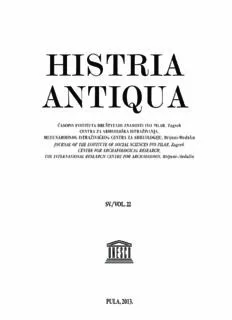
Table Of ContentSV./VOL. 22
PULA, 2013.
HISTRIA ANTIQUA
UDK 902/904 ISSN 1331-4270
Časopis Instituta društvenih znanosti Ivo Pilar, Zagreb
Centar za arheološka istraživanja,
Međunarodni istraživački centar za arheologiju, Brijuni-Medulin
Journal of the Institute of Social Sciences Ivo Pilar, Zagreb
Centre for Archaeological Research,
International Research Centre for Archaeology, Brijuni-Medulin
Svezak / Volume: 22
Pula, 2013.
NAKLADNIK Institut društvenih znanosti Ivo Pilar, Zagreb
/ PUBLISHER
Centar za arheološka istraživanja
Međunarodni istraživački centar za arheologiju, Brijuni - Medulin (Hrvatska)
Institute of Social Sciences Ivo Pilar, Zagreb
Centre for Archaeological Research,
International Research Centre for Archaeology, Brijuni – Medulin (Croatia)
SUNAKLADNIK / Društvo za povijest i kulturni razvitak Istre, Pula
CO-EDITOR
Society for the History and Cultural Development of Istria, Pula
ZA NAKLADNIKA / Prof. dr. sc. Vlado ŠAKIĆ
FOR PUBLISHER
GLAVNA UREDNICA Mr. sc. Kristina DŽIN
/ EDITOR IN CHEF
UREDNIŠTVO / Mr. sc. Kristina DŽIN (Pula) akademik Emilio MARIN (Zagreb),
EDITORIAL BOARD
prof. dr. sc. Robert MATIJAŠIĆ (Pula), prof. Ante RENDIĆ-MIOČEVIĆ (Zagreb),
prof. dr. sc. Isabel RODÀ (Barcelona), prof. dr. sc. Guido ROSADA (Padova),
prof. dr. sc. Francis TASSAUX (Bordeaux), prof. dr. sc. Marin ZANINOVIĆ (Zagreb)
TAJNIŠTVO IZDAVAČA / PUBLISHER CONTACT: 52103 Pula, p.box 554;
e-mail: [email protected]
SAVJET MEĐUNARODNOG ISTRAŽIVAČKOG Akademkinja Vera BITRAKOVA GROZDANOVA (Skopje),
CENTRA ZA ARHEOLOGIJU dr. sc. Lásló BORHY (Budimpešta), mr. sc. Kristina DŽIN
prof. dr. sc. Erwin POCHMARSKY (Graz),
COUNCIL OF THE INTERNATIONAL RESEARCH
dr. sc. Marijeta ŠAŠEL KOS (Ljubljana), akademik Emilio MARIN (Zagreb),
CENTRE FOR ARCHAEOLOGY
prof. dr. sc. Robert MATIJAŠIĆ (Pula), prof. Ante RENDIĆ-MIOČEVIĆ (Zagreb)
prof. dr. sc. Isabel RODÀ (Barcelona), prof. dr. sc. Guido ROSADA (Padova),
prof. dr. sc. Francis TASSAUX (Bordeaux), prof. dr. sc. Marin ZANINOVIĆ (Zagreb)
FINANCIJSKA POTPORA Ministarstvo kulture Republike Hrvatske, Zagreb
/ FINANCIAL SUPPORT
Županija Istarska, Pula
The rewiew Histria Antiqua is referenced in:
BHA, Bibliography of the History of Art (BHA) as the successor of the earlier index (Répertoire dA' rt et dA' rchéologie), through the Research Libraries Group and
Art History Information Program / J. Paul Getty Trust (United States of America) as well as in the Instituts de l'Information Scientifiques et Techniques (INIST) of the of the Centre
National de la Recerche Scientific (CNR) and since 2005 also in the Catalogue of the UNESCO Bibliografic Data Records (UNESDOC)
Copyrighy ©2013 Institute of Social Sciences Ivo Pilar
International Research Centre for Archaeology, Brijuni-Medulin (Croatia)
Histria Antiqua is publisched annually.
Articles are reviwed internationally.
NASLOVNICA / :
COVER
Pula, Menada (?), dio ogradne ploče kazališta, 1. st.
Pula, Maenad (?), segment of theatre parapet, 1st century AD
Histria Antiqua, 21/2012
SADRŽAJ / CONTENTS
UVODNIK GLAVNE UREDNICE 7
FOREWORD BY THE EDITOR-IN-CHIEF 9
Klara BURŠIĆ MATIJAŠIĆ, Pula
Tragovi igara u prapovijesti Istre
Tracce di giochi nella Preistoria dell’Istria 13
Anton KOŽELJ, Manuela WURCH KOŽELJ, Athens
Quelques jeux antiques identifiés a Thasos
Nekoliko igara s agore u Thasosu 25
Zlatko ĐUKIĆ, Osijek
Značaj atletskih igara u Olimpiji za stari vijek
at Olympia in Ancient Times
The Importance of Athletic Games 39
Erwin POCHMARSKI, Graz
Der Hippodrom von Olympia
Hipodrom u Olimpiji i njegov aphesis
43
E. K. GLAZER, Zagreb, D. ŠTRUKLEC, Ivanićgrad
Board Games as a Reflection of Ancient Near Eastern Society
53
Igre na ploči kao odraz drevnih bliskoistočnih društava
Marija BUZOV, Zagreb
Public Games in Rome
Javne igre u Rimu
61
Guido ROSADA, Padua
Oltre gli edifici di spettacolo a Patavium
In flumine oppidi medio.
83
In flumine oppidi medio. S onu stranu zdanja za zabave u Pataviumu
Kornelija A. GIUNIO, Zadar
Knowledge About Public and Private Games from the Roman Period from the Holdings of the Archeological Museum in Zadar
Saznanja o javnim i privatnim igrama u rimsko doba iz fundusa Arheološkog muzeja Zadar 101
Adrian ARDET, Lucia Carmen ARDET, Caransebeş
Gli anfiteatri costruiti dai Romani in Dacia
Rimski amfiteatri u Daciji 117
Marin BUOVAC, Zadar
Rimski amfiteatri na tlu istočnog Jadrana i zaobalja
Römische Amphitheater auf dem ostadriatischen Gebiet und hinterland 129
Miroslav GLAVIĆIĆ, Željko MILETIĆ, Zadar,
Arhitektura amfiteatra u Burnumu
The Architecture of the Amphitheatre in Burnum 157
Annalisa GIOVANNINI, Paola VENTURA, Trieste
Aquileia e il suo anfiteatro: storia di un rapporto “nascosto”
173
Akvileja i njezin amfiteatar: priča o “skrivenom” odnosu
Stefania PERGOLA, Marialetizia BUONFIGLIO, Roma
Stadio di Domiziano e Circo Massimo: riflessioni sullo svolgimento
degli agoni ginnici e dei ludi circensi in relazione agli schemi progettuali dei due edifici di
Domicijanov stadion i circus maximus: Ludi ginnici i ludi circensi – promišljanja o njihovom
odvijanju s obzirom na arhitektonske projekte dvaju zdanja 187
3
Histria Antiqua, 21/2012
† Vesna GIRARDI JURKIĆ, Kristina DŽIN, Pula
Bilješke o kazalištu antičke Pule
Pars superior Coloniae
Notes on Antique Pula’s Theatre Pars Superior Coloniae 199
Benedetta ADEMBRI, Filippo FANTINI, Roma
Dimensioning criteria of ancient buildings for spectacle: case studies from Villa Adriana
223
Kriteriji dimenzioniranja antičkih građevina korištenih za spektakle: primjer iz Hadrijanove vile
Vlasta BEGOVIĆ, Zagreb, Ivančica SCHRUNK, St. Paul, Minnesota
Spaces for Games and Entertainment in the Maritime Villa in Verige Bay, Brijuni
233
Prostori za zabavu i uživanje na maritimnoj vili u uvali Verige na Brijunima
Giancarlo Germanà BOZZA, Catania
Caligola ed i ludi astici a Siracusa (Suet., v. Cal., 20)
Kaligula i ludi astici u Sirakuzi (Svet., V. Cal., 20) 241
Vlatka VUKELIĆ, Dejan PERNJAK, Zagreb
Public and Private Games in Ancient Siscia
251
Javne i privatne igre u antičkoj Sisciji
Nadežda GULYAUVA, St. Petersburg
From Funeral Games to Gladiatorial Fights
Od pogrebnih igara do gladijatorskih borbi 265
Genoa; Fabio MOSCA, Paola PUPPO, Prato
Riflessioni su dadi e giochi da tavolo nel mondo Romano
Razmišljanja o igrama s kockama i na ploči u starom Rimu 271
Katarina BOTIĆ, Zagreb
Dječje igračke i minijaturne posude Sopotske kulture s lokaliteta Krčavina – Novi Perkovci
Children’s Toys and Miniature Vessels of the Sopot Culture from the Krčavina – Novi Perkovci Site 281
Giuseppe CUSCITO, Muggia
Giochi e spettacoli nel Padri della Chiesa
Igre i spektakli u promišljanju crkvenih otaca
293
Elica MANEVA, Skopje
Srednjovjekovno kazalište u Makedoniji - Primjeri kazališta na javnim trgovima
299
Medieval Theatre in Macedonia Theatrical performances in public space
Michele BUENO, Chiara D’INCA, Padua
Giocolieri e spettacoli itineranti tra divertimento privato e occasioni pubbliche
311
Ulični zabavljači i putujuće predstave od privatnih do javnih zbivanja
Nikos ČAUSIDIS, Skopje
The Axis Mundi as a Mythological Base of Acrobatics Performed on a Pole - Diachronic Analyses
Os svijeta kao mitološka baza akrobacija izvođenih na šipci - dijakronijske semiotičke analize 321
VARIA
Naser FERRI, Prishtina
Nalaz kipića iz Poneša blizu Gnjilana na Kosovu
341
A Statuette Finding on Poneš near Gnjilani in Kosovo
Mato ILKIĆ, Zadar
Noviji nalazi rimskih opeka i crijepova s pečatima iz Sotina (Cornacum)
Recent Finds of Roman Bricks and Roof Tiles with Stamps from Sotin (Cornacum) 351
4
NOVITATES
Irena RADIĆ ROSSI, Zadar, Filipe CASTRO, Texas
The Late Sixteenth Century Shipwreck of Gnalić; Preliminary Results of 2012 Research Campaign and Plans for the Future
Brodolom kod otočića Gnalića. Preliminarni rezultati istraživačke kampanje 2012. i planovi za budućnost 365
Irena RADIĆ ROSSI, Zadar, Giulia BOETTO, Aix-en-Provence
Međunarodno inerdisciplinarno istraživanje u uvali Caska na otoku Pagu. Rezultati istraživačke kampanje 2012.
377
International Interdisciplinary Investigation in the Bay of Caskaon the Island of Pag:Results of the 2012 Investigation
M.-B. CARRE, C. ROUSSE, Aix-en-Provence, F. TASSAUX, Bordeaux, V. KOVAČIĆ, Poreč
Lorun-Loron et Busuja-Bossolo, Istria, Les campagnes de recherche 2012
Loron – Lorun i Busuja – Bossolo, Poreč – Parenzo, Istra, Istraživačka kampanja 2012. 391
Tomislav FABIJANIĆ, Irena RADIĆ ROSSI, Zadar, Marko MENĐUŠIĆ, Šibenik
Dokumentiranje postojećega stanja i istraživanje utvrde Turete, luke i sakralnog
kompleksa na prostoru crkve Gospe od Tarca na otoku Kornatu
Documenting of the present condition and excavations of the Tureta fort,
harbor and sacral complex in the area of the church of Our Lady of Tarac on the island of Kornat 401
Igor MIHOLJEK, Zagreb
Podvodno arheološko istraživanje poluotoka Vižule kod Medulina 2012.
Underwater Archaeological Investigations off the Peninsula of Vižula in 2012. 413
Uvodnik glavne urednice (1-15) Histria Antiqua, 21/2012
UVODNIK GLAVNE UREDNICE
Privatne i javne igre od prapovijesti do ranog srednjeg vijeka
Dvadeset i drugi svezak časopisa Međunarodnog istraživačkog centra za arheologiju, Brijuni – Medulin, Cen-
tra za arheološka istraživanja Instituta društvenih znanosti Ivo Pilar posvećen je značajnoj temi o privatnim i
javnim igrama ljudi i ljudske zajednice od najranijih vremena do ranog srednjeg vijeka. To je ujedno bila i tema 18.
međunarodnog arheološkog savjetovanja „Privatne i javne igre od prapovijesti do srednjeg vijeka“, koje je održano u
Puli, Medulinu i Rovinju od 21. do 24. studenoga 2012. g. pod visokim pokroviteljstvom UNESCO-a i u suradnji s
Društvom za povijest i kulturni razvitak Istre u Puli i Centra za povijesna istraživanja u Rovinju. Skup je sa Znan-
stvenim odborom savjetovanja pripremala prof. dr. sc. Vesna Girardi Jurkić, te je u programa i sažecima
Proslovu
priopćenja 22. kolovoza 2012. g. napisala:
Javne i privatne igre od prapovijesti do ranog srednjeg vijeka kao multidisci-
plinarna arheološka, epigrafska, etnografska, povijesna i općecivilizacijska tema dio su ljudskog života, ponekad tajanstvene
i gotovo nepoznate u današnjici, koje je potrebno kontinuirano istraživati, uočavati i definirati u određenim povijesnim
razdobljima. Igre su dio tajni ljudskog bića, njegovih izvora i svrhe postojanja, a svojevremeno kao i danas: manifestacija
života. Grčki filozof Protagova je jednom izrekao da je „Čovjek (je) mjerilo svih stvari“, ali razmatrajući i shvaćajući privatne
i javne igre čovjeka i ljudske zajednice kroz najranija razdoblja ljudskog roda, u višetisućljetnom hodu antike, teško se oteti
(...)
dojmu da je upravo čovjek bilo inicijator i mjerilo svih igara s određenim reakcijama s gledišta ljudske ljestvice vrijednosti
dodajući na kraju riječi cara Augusta : (...) (Igra odigrana).
ovogodišnja „Acta est fabula!“
Skup o javnim i privatnim igrama u antičko i ranosrednjovjekovno vrijeme je održan zbog iznenadne smrti
njegove glavne organizatorice, utemeljiteljice Međunarodnog istraživačkog centra za arheologiju i dugogodišnje
glavne urednice godišnjaka bez njezine nazočnosti, ali njezina misao vodilja i nadalje je prisutna u
Histria antiqua
djelovanju MIC-a za arheologiju i u uređivačkoj politici časopisa.
Kao dugogodišnja tajnica Uredništva, preuzela sam kao glavna urednica prikupljanje, organiziranje, recenziran-
je i sadržajni raspored pristiglih rukopisa za novi svezak godišnjaka koji je pred čitateljima i nadam se da će se ute-
meljena uređivačka politika u najmanju ruku zrcaliti i kroz stranice ovogodišnjeg periodičnog izdanja.
Smatram za potrebnim ipak istaknuti da je u ovom svesku časopisa i ove godine okupljen velik broj renomiranih
suradnika iz Hrvatske i inozemstva (Austrija, Francuska, Grčka, Italija, Kosovo, Makedonija, Sjedinjene Američke
Države, Slovenija, Španjolska, Rumunjska, Rusija), što ukazuje da se krug suradnika proširuje i mlađim generaci-
jama. Do sada objavljeni svesci časopisa, uz ovaj najnoviji, također pokazuju kontinuitet arheoloških otkrića – us-
prkos recesijskim teškoćama.
U okviru osnovne teme o privatnim i javnim igrama od najstarijih vremena do ranosrednjovjekovnog doba
objavljuju se 32 članka, recenzirana i kategorizirana. Sadržajno su razvrstani kronološkim redom. Najstarije raz-
doblje zastupljeno je tragovima igara u istarskoj prapovijesti, igrama s agore na Thasosu, atletskim igrama u grčkoj
Olimpiji, dječjim igračkama i posudicama (sopotska kulture i igrama na ploči kao odrazu drevnih bliskoistočnih
7
Uvodnik glavne urednice (1-15) Histria Antiqua, 21/2012
društava). Slijede članci posvećeni rimskom razdoblju: javnim igrama u Rimu, Zadru i Padovi, rimskim amfiteat-
rima u Daciji i na istočnom Jadranu, istraživanjima vojnog amfiteatra u Burnumu i pretpostavkama o smještaju
amfiteatra u Akvileji, Domicijanovom stadionu i cirkusu u Rimu, malom rimskom gradskom kazalištu u Puli i
kriterijima o dimenzioniranju antičkih građevina za spektakle temeljem otkrića mramorne makete iz Hadrijanove
vile, prostori u rimskim objektima za zabavu (Brijuni, Sirakuza, Sisak), razvitku pogrebnih igara do gladijatorskih
borbi, te igraćim pločama, figuricama i žetonima. Rano srednjovjekovno doba zastupljeno je člancima o nastupima
uličnih zabavljača, akrobata i kazališnim predstavama na javnim trgovima.
Kao i u ranijim svescima časopisa dva se rada objavljuju u rubrici iza koje su tiskani aktualni prilozi u
Varia No-
, koji obrađuju najnovije nalaze na otočiću Gnaliću, u uvali Caska na Pagu, na Kornatima i na Loronu. Znan-
vitates
stveni odbor savjetovanja i Uredništvo časopisa bilo bi izuzetno zadovoljno da se ova rubrika popuni i najnovijim
otkrića širom Sredozemlja.
Veoma mi je žao što za časopis nisu na vrijeme stigli članci o antičkim natpisima sportske tematike iz Hispanije,
epigrafima o rimskim igrama u Srbiji, sjedalima i posjetiteljima amfiteatra u Brigeciju, rimskoj Velikoj majci na lavu
iz Cirkusa i galo-rimskom kazališnim spektaklima, jer bi na taj način svezak časopisa svakako bio sadržajniji. Za
nadati se, da će neki od ovih članaka biti objavljen u narednim svescima kao i sva ona priopćenja koja su kroz 16 g.
bili prikazana na skupovima, ali nisu dostavljeni Uredništvu za tisak.
Zahvaljujem svim suradnicima ovog sveska koji su predali svoje rukopise za tisak na vrijeme, jer oblikovanje
časopisa u suvremenim okolnostima traži preciznu vremensku uredničku i suradničku angažiranost. Kako je to
uobičajeno, zahvaljujem na novčanoj potpori tradicijskim ministarstvima Republike Hrvatske, koji sufinanciraju
izdavanje, a bez čije potpore časopis ne bi mogao na vrijeme biti tiskan. Također izražavam zahvalnost sunakladni-
ku Društvu za povijest i kulturni razvitak Istre, koji obavlja dio poslova oko izdavanja časopisa i njegove distribucije
u hrvatske i inozemne knjižnice.
Glavna urednica:
U Puli, listopad 2013. godine Mr. sc. Kristina Džin
v.d. voditeljica MIC:a za arheologiju,
Brijuni – Medulin
8
Foreword by the editor-in-chief (1-15) Histria Antiqua, 21/2012
FOREWORD BY THE EDITOR-IN-CHIEF
Public and Private Games from Prehistory to the Early Middle Ages
The twenty-second issue of the review of the Centre for Archaeological Research – Interna-
Histria Antiqua
tional Research Centre for Archaeology Brijuni – Medulin of the Institute of Social Sciences Ivo Pilar is dedicated
to the fascinating subject of private and public games of people and their communities from the earliest times to
the Early Middle Ages. This was also the subject of the 18th International Archaeological Symposium “
Public and
”, held in Pula, Medulin and Rovinj from 21 to 24 November
Private Games from Prehistory to the Early Middle Ages
2012, under the high patronage of the United Nations Educational, Scientific and Cultural Organisation (UN-
ESCO), and in cooperation with the Society for the History and Cultural Development of Istria, and the Centre for
Historical Research, Rovinj. The scientific meeting was organised by Professor Vesna Girardi Jurkić, Ph.D, and the
Scientific Council of the Symposium. In the to the Symposium programme, dated 22 August 2012, Vesna
Foreword
Girardi Jurkić wrote the following: “
Public and private games from prehistory to the Early Middle Ages is a multidiscipli-
nary topic embracing archaeology, ethnography, history and civilisation. Such games are part of human experience and, al-
though sometimes wrapped in mystery and almost unknown today, they should be continuously investigated, individualised
and defined through historical periods. Games are part of the human secret, they are of human origin and are even part of the
human’s very purpose. They were, as they are today, a manifestation of life. The Greek philosopher Protagoras once said that
‘Man is the measure of all things’. However, when contemplating and grasping the meaning of private and public games in the
earliest times and through millennia of Antiquity, it is difficult to avoid the impression that it was indeed man who was the
” Professor Vesna Girardi
initiator and the measure of all games, influenced to a certain degree by the human value system.
Jurkić concluded her foreword with the words of Emperor Augustus: “ !” (The performance is over!).
Acta est fibula
Unfortunately, Professor Vesna Girardi Jurkić, the main organiser of the symposium, the founder of the Inter-
national Research Centre for Archaeology, and the Editor-in-Chief of many years of the yearly issue of
Histria An-
, passed away suddenly, and the symposium was held without her. However, her guiding principles continue
tiqua
to permeate the work of the IRC for Archaeology, and the editorial policy of the review.
As secretary of many years of the Editorial Board, I took over responsibility as Editor-in-Chief and engaged in
collecting, organising, reviewing and setting for print the received articles for the new issue of the yearly review
that is now in front of readers. It is my hope that the editorial policy established over time emerges from the pages
of this year’s issue as well.
I do feel I should stress that this year’s issue, as the issues before, continues to draw together a large number of
renowned experts from Croatia and abroad (Austria, France, Greece, Italy, Kosovo, Macedonia, USA, Slovenia,
Spain, Romania, Russia), which indicates that the circle of associates continues to expand and draws on new gen-
erations. The issues of the review so far published, together with the newest one, also show continuity in archaeo-
logical discoveries, despite the difficulties associated with the recession.
9
Foreword by the editor-in-chief (1-15) Histria Antiqua, 21/2012
Thirty-two reviewed and categorised scientific articles are published within the framework of the main topic of
private and public games from ancient times to the Early Middle Ages. The content of the review is in chronological
order. The earliest period is represented by traces of games in Istrian prehistory, games from the agora in Thasos,
Greek athletic games in Olympia, children’s toys and small vessels (Sopot culture) and board games as reflections
of Middle East societies. Articles dedicated to the Roman period follow: public games in Rome, Zadar and Padua;
Roman amphitheatres in Dacia and the eastern Adriatic; investigations conducted at the Roman military amphi-
theatre in Burnum and hypotheses about the location of the amphitheatre in Aquileia; Domitian’s stadium and
circus in Rome; the small Roman city theatre in Pula; the sizing criteria for antique buildings dedicated to specta-
cles based on the discovery of a marble model from Hadrian’s villa; areas of Roman buildings dedicated to enter-
tainment (Brijuni, Syracuse, Sisak); from the development of funerary games to gladiatorial combats; and gaming
boards, figurines and counters. The Early Middle Ages are represented by articles on street entertainers, acrobats
and theatre performances on public squares.
As is customary, the review contains the sections “ ” and “ ”. The former section presents two arti-
Varia Novitates
cles, while the latter outlines the most recent discoveries observed on the small island of Gnalić, in the bay of Caska
on the island of Pag, on the Kornati Islands and at the site of Loron. The Scientific Council of the symposium and
the Editorial Board of the review would be particularly pleased if the latter section were filled with the latest dis-
coveries from all over the Mediterranean.
I regret that the following articles did not arrive in time for publication: antique inscriptions related to sports
from Hispania, epigraphs on Roman games in Serbia, seats and visitors of amphitheatres in Brigetio, the Roman
Great Mother on a lion, and Gallic-Roman theatre spectacles. Hopefully, some of these articles will be published in
future issues of the review, as well as other reports that have been presented over the sixteen years of the symposia,
but that have not reached the Editorial Board.
I wish to thank all associates who submitted their articles promptly for print, since the precise and timely col-
laboration of all parties is particularly important for the preparation of a review in modern circumstances. As is
customary, I should also like to thank the ministries of the Republic of Croatia for their financial support, without
which the review would not be duly published. Special thanks also go to the co-publisher, the Society for the His-
tory and Cultural Development of Istria, which carries out part of the work involved in publishing the review and
distributing it to Croatian and foreign libraries.
Editor-in-Chief
Pula, October 2013 Kristina Džin, M.A.
Acting Director of the
IRC for Archaeology,
Brijuni – Medulin
10
Description:(CNR) and since 2005 also in the Catalogue of the UNESCO Bibliografic Data Records (UNESDOC) K. A. Kamp, N. Timmerman, L. Gregg,.