Table Of ContentThe Hermetica are a body of theological-philosophical texts written in late
antiquity, but believed during the Renaissance (when they became well
known) to be much older. Their supposed author, a mythical figure called
Hermes Trismegistus, was thought to be a contemporary of Moses. The
Hermetic philosophy was regarded as an ancient theology, parallel to the
revealed wisdom of the Bible, supporting biblical revelation and culminat-
ing in the philosophy of Plato, Plotinus and others in the Platonic tradition.
This new translation is the only English version based on reliable texts
of the Greek Corpus Hermeticum and the Latin Asclepius. Professor Copen-
haver's introduction and notes provide a context of interpretation taking
into account recent advances in Hermetic scholarship, making this access-
ible edition an indispensable resource to scholars in ancient philosophy
and religion, early Christianity, Renaissance literature and history, the
history of science, and the occultist tradition in which the Hermetica have
become canonical texts.
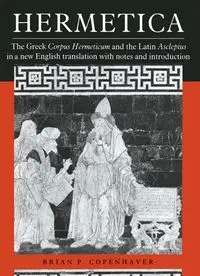
HERMETICA
HERMETICA
The Greek Corpus Hermeticutn
and the Latin
Asclepius in a new English translation, with
notes and introduction
BRIAN P. COPENHAVER
Provost, College of Letters and Science
and Professor of History
University of California, Los Angeles
CAMBRIDGE
UNIVERSITY PRESS
PUBLISHED BY THE PRESS SYNDICATE OF THE UNIVERSITY OF CAMBRIDGE
The Pitt Building, Trumpington Street, Cambridge, United Kingdom
CAMBRIDGE UNIVERSITY PRESS
The Edinburgh Building, Cambridge CB2 2RU, UK
40 West 20th Street, New York, NY 10011-4211, USA
10 Stamford Road, Oakleigh, VIC 3166, Australia
Ruiz de Alarcon 13, 28014 Madrid, Spain
Dock House, The Waterfront, Cape Town 8001, South Africa
http://www.cambridge.org
© Cambridge University Press 1992
This book is in copyright. Subject to statutory exception
and to the provisions of relevant collective licensing agreements,
no reproduction of any part may take place without
the written permission of Cambridge University Press.
First published 1992
Reprinted 1994 (twice)
First paperback edition 1995
Reprinted 1997, 1998, 2000
A catalogue record for this book is available from the British Library
Library of Congress Cataloguing in Publication data
Hermetica: the Greek Corpus Hermeticum and the Latin Asclepius in a new
English translation, with notes and introduction / Brian P. Copenhaver.
p.
cm.
Includes bibliographical references and index.
ISBN 0 521 36144 3
1. Hermeticism. I. Copenhaver, Brian P. II. Corpus Hermeticum.
English. 1992. III. Hermes, Trismegistus. Asclepius. English.
1992
BF 1600.H475 1992 91-25703
135'.4-dc20CIP
ISBN 0 521 36144 3 hardback
ISBN 0 521 42543 3 paperback
Transferred to digital printing 2002
AS
Information on this title: www.cambridge.org/9780521361446
Many bear the wand, but few become Bakchoi:
Frances Amelia Yates, 1899-1981
Daniel Pickering Walker, 1914-85
Charles Bernard Schmitt, 1933-86
CONTENTS
Preface
Introduction
Hor and Manetho
The world of the Hermetica
Technical and theoretical Hermetica
Hermetic collections
Hermes and his readers
A new English Hermetica
Bibliography and abbreviations
Corpus Hermeticum I
Corpus Hermeticum II
Corpus Hermeticum III
Corpus Hermeticum IV
Corpus Hermeticum V
Corpus Hermeticum VI
Corpus Hermeticum VII
Corpus Hermeticum VIII
Corpus Hermeticum IX
Corpus Hermeticum X
Corpus Hermeticum XI
Corpus Hermeticum XII
Corpus Hermeticum XIII
Corpus Hermeticum XIV
Corpus Hermeticum XVI
Corpus Hermeticum XVII
Corpus Hermeticum XVIII
Asclepius
page xi
xiii
xiii
xvi
xxxii
xl
xlv
lix
lxii
1
8
13
15
18
21
24
25
27
30
37
43
49
55
58
62
63
67
Notes
Indexes
93
261
PREFACE
For reasons explained at the end of the introduction, I began this book
about ten years ago; I continued it because a number of friends and
colleagues encouraged me to think that it would be useful. My first debt
is to the late Charles Schmitt, who saw parts of the work in its earliest
form and first put me in touch with Cambridge University Press. Others
who have read the typescript in whole or in part - Michael Allen, Tony
Grafton, Brian Murphy, Doug Parrott - have given me important advice
and criticism for which I am most grateful. Librarians and other staff
at Oakland University and the University of California, Riverside, have
also been most helpful. Though I do not know the names of the three
generous and perceptive readers who examined and corrected the type-
script, I wish at least to thank their nameless genii for rescuing me from
ignorance or imprudence in more cases than I can comfortably contem-
plate. My more public thanks go to Kevin Taylor and Jonathan Sinclair-
Wilson, who handled the project for Cambridge with patience and skill.
Patience, long-suffering patience, has also been the chief virtue of my
wife, Kathleen, and my children, Gregory and Rebecca, while I was lost
in the temples of Hermes. My son, in particular, may at last be convinced,
when he sees the book in print, that it was others and not I who invented
the myth of Hermes Trismegistus.
Riverside, California
Die festo Sancti Valentini, 1991
INTRODUCTION
Hor and Manetho
A few miles west of the Nile and just below the tip of its delta lies the
modern Sakkara, site of the necropolis of ancient Memphis, center of
Lower Egypt from the days of the pharaohs through the time of Egypt's
Roman conquerors. The sacred ibis, the graceful black and white bird
in which the god Thoth showed himself, no longer visits the Nile at
Memphis, but when the Ptolemies and their Roman successors drank
from the holy river, the god's bird still came to its banks in great plenty.
So huge were its flocks that those who wished to honor Thoth with
mummies of his bird were able to prepare thousands of such offerings
every year, thus proving their piety in a cult of the ibis, just as devotees
of Osiris-Apis or Sarapis worshipped their god in the bull cult of the
great Serapeion, the temple that dominated the landscape of Ptolemaic
Memphis. Many gods dwelled in the precincts of the Serapeion: Isis of
the hundred names, whose worship had already begun to spread from
Egypt through the Mediterranean basin; Imhotep or Imouthes, a god
of healing whom the Greeks called Asklepios; and Thoth, god of the
moon and messages and writing, Hermes to the Greeks, and like Hermes
the guide of dead souls. In Sakkara, north of the Serapeion proper,
archeologists have uncovered structures built for Thoth's ibis, a lunar
bird of the night, and also for the hawk of Horus, a solar daytime bird.
In these buildings attendants of the sacred birds hatched, reared, vener-
ated and eventually mummified them for burial in urns. The number
of birds buried in the galleries of "the house of rest of the ibis" has been
reckoned at four million or more, implying that perhaps ten thousand
1 On Thoth, see below, note on C.H. I. Title; notes to the introduction have been kept
to a minimum, but notes to the texts contain fuller documentation with references keyed
to the bibliography that follows the introduction; the bibliography explains abbreviations.
xiii