
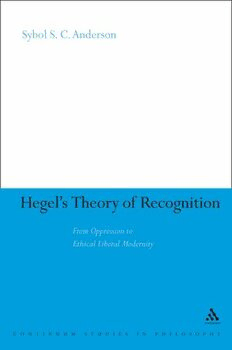
Download Hegel's Theory of Recognition: From Oppression to Ethical Liberal Modernity (Continuum Studies In Philosophy) PDF Free - Full Version
Download Hegel's Theory of Recognition: From Oppression to Ethical Liberal Modernity (Continuum Studies In Philosophy) by Sybol S.C. Anderson in PDF format completely FREE. No registration required, no payment needed. Get instant access to this valuable resource on PDFdrive.to!
About Hegel's Theory of Recognition: From Oppression to Ethical Liberal Modernity (Continuum Studies In Philosophy)
Since the 1960s 'New Left' emancipatory movements have claimed that women, ethnic minorities, gays and lesbians, and other groups are oppressed. Some liberal theorists have treated their demands for equality as matters of toleration, of securing by law the equal treatment of cultures and conceptions of the good. However, much more is involved. Also at stake are conceptions of identity differences that inform social practices and perpetuate inequalities that are beyond the reach of legislation.This book outlines an alternative approach to a liberal politics of difference. Sybol Anderson begins by constructing a definition of oppression that illuminates, from a liberal perspective, its salient features. Exposing the limits of toleration as a response, Anderson reaches beyond it for a viable concept of recognition. Hegel’s theory of recognition proves an indispensable resource in this endeavor. Anderson concludes, contrary to recent critics of Hegelian recognition, that Hegel’s theory can successfully guide modern liberal states toward the achievement of social equality.>
Detailed Information
| Author: | Sybol S.C. Anderson |
|---|---|
| Publication Year: | 2009 |
| ISBN: | 9781847061294 |
| Pages: | 223 |
| Language: | English |
| File Size: | 1.447 |
| Format: | |
| Price: | FREE |
Safe & Secure Download - No registration required
Why Choose PDFdrive for Your Free Hegel's Theory of Recognition: From Oppression to Ethical Liberal Modernity (Continuum Studies In Philosophy) Download?
- 100% Free: No hidden fees or subscriptions required for one book every day.
- No Registration: Immediate access is available without creating accounts for one book every day.
- Safe and Secure: Clean downloads without malware or viruses
- Multiple Formats: PDF, MOBI, Mpub,... optimized for all devices
- Educational Resource: Supporting knowledge sharing and learning
Frequently Asked Questions
Is it really free to download Hegel's Theory of Recognition: From Oppression to Ethical Liberal Modernity (Continuum Studies In Philosophy) PDF?
Yes, on https://PDFdrive.to you can download Hegel's Theory of Recognition: From Oppression to Ethical Liberal Modernity (Continuum Studies In Philosophy) by Sybol S.C. Anderson completely free. We don't require any payment, subscription, or registration to access this PDF file. For 3 books every day.
How can I read Hegel's Theory of Recognition: From Oppression to Ethical Liberal Modernity (Continuum Studies In Philosophy) on my mobile device?
After downloading Hegel's Theory of Recognition: From Oppression to Ethical Liberal Modernity (Continuum Studies In Philosophy) PDF, you can open it with any PDF reader app on your phone or tablet. We recommend using Adobe Acrobat Reader, Apple Books, or Google Play Books for the best reading experience.
Is this the full version of Hegel's Theory of Recognition: From Oppression to Ethical Liberal Modernity (Continuum Studies In Philosophy)?
Yes, this is the complete PDF version of Hegel's Theory of Recognition: From Oppression to Ethical Liberal Modernity (Continuum Studies In Philosophy) by Sybol S.C. Anderson. You will be able to read the entire content as in the printed version without missing any pages.
Is it legal to download Hegel's Theory of Recognition: From Oppression to Ethical Liberal Modernity (Continuum Studies In Philosophy) PDF for free?
https://PDFdrive.to provides links to free educational resources available online. We do not store any files on our servers. Please be aware of copyright laws in your country before downloading.
The materials shared are intended for research, educational, and personal use in accordance with fair use principles.

