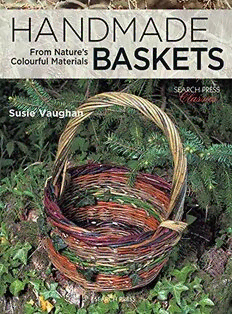
Table Of ContentHANDMADE
From Nature’s BASKETS
Colourful Materials
Susie Vaughan has always had a
passion for making things. She made
her first basket from a sprouting
willow tree that had fallen across
a brook near her home, following
instructions in a magazine.
Her basketmaking began as a
hobby but she soon decided to
specialise in hedgerow baskets,
intrigued by the natural range of
colour and texture that can be found
not only in the countryside but also
in urban areas.
Susie has experimented with
dozens of different woods and has
demonstrated and sold her work in
many countries.
A friend once remarked that if
you left one of her baskets on the
ground it would probably grow. She
loves the idea that she is giving a
new lease of life to Nature’s ‘rubbish’
- prunings that would otherwise
be chopped up by a hedgecutter
or simply discarded. This book will
definitely encourage the first seeds
of enthusiasm for a useful and
fascinating hobby.
HANDM ADE BASKETS
From Nature's Colourful Materials
I'm glad to have this chance to thank publicly my family and friends who have
helped with the birth of this book. Without their encouragement it would never
have happened... So, very grateful thanks to my mother for cutting out that
magazine article, Sheila for those inspiring weekend workshops, Ken for
introducing me to so many varieties of willow, Caroline and Frances for their
helpful encouragement and Linda for patiently waiting for the light to be
photographically just right in a number of gloomy woodland locations. I must
also offer a particular word of thanks to my long-suffering family, Mike, Simon,
Laura and Tessa, who have never really grumbled about the growing invasion
of baskets and 'stuff' all over the house and garden, despite having had to share
the bathroom with soaking rods, the airing cupboard with hardening handles
and the vegetable garden with a forest of special willows.
HANDMADE BASKETS
From Nature's Colourful Materials
Susie Vaughan
Search Press
This edition first published 2015
First published 1994
BASKETMAKERS’ ASSOCIATIONS
Search Press Limited There are basketmakers' associations all over the world,
so contact the one nearest to you for the relevant help
Wellwood, North Farm Road,
and advice. The Basketmakers' Association in the UK
Tunbridge Wells, Kent TN2 3DR
promotes classes, courses, exhibitions, lectures and
discussions: www.basketassoc.org.
Text copyright © Susie Vaughan 2015
Photographs by Charlotte de la Bédoyère,
Search Press Studios, with the exception of pages
10 to 37, which are by Linda Stephens
Photographs and design copyright © Search Press Ltd.
2015
All rights reserved. No part of this book, text,
photographs or illustrations may be reproduced or
transmitted in any form or by any means by print,
photoprint, microfilm, microfiche, photocopier or in any
way known or as yet unknown, or stored in a retrieval
system, without written permission obtained beforehand
from Search Press.
The publishers and author can accept no responsibility
for any consequences arising from the information,
advice or instructions given in this publication.
ISBN 978 1 78221 209 6
Readers are permitted to reproduce any of the items/
patterns in this book for their personal use, or for the
purposes of selling for charity, free of charge and without
the prior permission of the Publishers. Any use of the
items/patterns for commercial purposes is not permitted
without the prior permission of the Publishers.
Suppliers
If you have any difficulty in obtaining any of the materials
and equipment mentioned in this book, then please visit
the Search Press website: www.searchpress.com
Printed in Malaysia
Contents
Introduction
6
Tools and equipment
8
Collecting materials
How to start - What to look for - Where to look - When to cut - How to
store - How to prepare - Commercially grown willow
10
Useful trees, shrubs and climbers
Suckers - Climbers and Trailers - Coppiced and pollarded rods - Garden
primings - Wild primings - Special textures
20
How to make a simple round basket
Basic stages - Choosing materials - The base - The framework - The
upsett - The sides - The border - Finishing off
38
Variations in design and weaves
Shaping the sides - Oval baskets - Frame baskets - Handles - Borders -
Bye stakes - Alternative weaves - Lids
50
Gallery
66
Glossary
79
Index
80
Introduction
Baskets were used by our ancestors from the that needed to be air-lifted to troops in Europe,
cradle to the grave - quite literally. Not only were that the use of commercially grown willow was
the ancient Egyptians placed in woven cribs at banned for any other purpose.
birth, they were also buried in basket coffins. The convenience of the throw-away cardboard
But far earlier than this the craft of weaving box and the ubiquitous plastic carrier-bag have
baskets had become a part of our very existence, made some people dispense with their old
fulfilling the needs of early man's everyday life. shopping basket. However, there is something
Finds of woven twigs pre-date any fragments of quite irresistible about the smell and tactile appeal
woven cloth and even certain forms of pottery. of a country hedgerow basket; it is not only hand
Before the potter's wheel was invented made, but can also be home-grown.
basketwork was used as a mould for clay objects. I made my first basket following instructions
It is even speculated that before the art of firing in a magazine article. I used supple young rods
clay was discovered waterproof bowls were really that had sprouted from the carcase of an old
baskets, lined with mud and left to harden. willow tree which had fallen across a local brook
Over the years the word 'basket' has taken on - and I am ashamed to say I was quite proud of
a number of significant and often derogatory this very poor attempt, imagining that I could
meanings. For instance, if you were 'put in the make all sorts of useful things if I was marooned
basket' you were sent to prison, if you were 'left on a desert island.
in the basket' you were jilted and in Germany the Later, during some inspiring weekends
phrase 'I have got a basket' is still used to indicate working with basketmaker Sheila Wynter, I
that you have failed in something important. discovered that baskets can be made with all
However, the basket's major role has been as a sorts of wild and garden bushes - in fact any one-
container for anything and everything. In almost year-old shoots that can be bent around your
every country in the world there is a tradition of wrist can be incorporated into the weaving.
basketmaking, using plants that are indigenous I returned home from these workshops, eyes
to that particular area. Willow, rush and cane are opened, suddenly aware of potential basket
used nowadays for most commercial baskets, material in practically every local hedge, wood
but in fact it is possible to use any wood that is and garden.
pliable. Since then I have experimented with dozens of
Gypsies have made baskets from hedgerows different trees and shrubs, fascinated by the fact
for generations and even some traditional British that these 'recycled' baskets are giving a new
basketmakers may have been forced to find an lease of life to branches that would otherwise
alternative to willow during the Second World only be destined for the bonfire, or the voracious
War. Willow hampers were considered to be appetite of the hedge-cutter.
such good protection for the food and ammunition This book is not intended for the commercial
6
Introduction
basketmaker - my baskets are labours of love Mediaeval hedge basket. This is made entirely from
woods gathered from one short stretch of a very old
and it often takes hours to gather material and
mediaeval hedge below my garden. It is said that the age
then to weave them. However, I hope the
of such a hedge can be judged by the number of different
instructions and ideas will inspire others who species on one side of a 25-metre (27-yd) length . . . each
enjoy walking in the country and are captivated species indicating a century of growth . . . this hedge
must be at least 700 years old. The basket is made from
by the idea that it is very possible, and immensely
privet, sloe, oak, wild honeysuckle, spindle, wild
rewarding, to salvage and reclaim nature's annual dogwood and three different varieties ofzvillows.
harvest.
7
Tools and equipment
Very few tools are needed to make your first
basket. I started off with just a pair of secateurs,
a screwdriver and a pot of petroleum jelly. If you
are using only fresh material, which does not
need to be soaked, you do not even have to
persuade the family not to use the bath for a
week!
In this chapter I have listed the tools used to
make all the baskets mentioned in this book, but
only the secateurs are essential to begin with -
you can improvise for the rest.
8