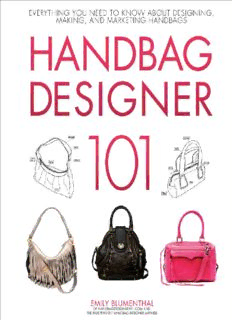
Table Of ContentHANDBAG
DESIGNER 101
EVERYTHING YOU NEED TO KNOW ABOUT DESIGNING,
MAKING, AND MARKETING HANDBAGS
EMILY BLUMENTHAL
CONTENTS
INTRODUCTION
The Anatomy of a Handbag
Handbag Silhouettes
Sewing Skills
Fabric and Thread Tips
PART I THE BAGS
EASY:
Tote
Bucket
Wallet
Facile Frame
INTERMEDIATE:
Satchel
Clutch
Structured Case
Barrel
Drawstring
Messenger
ADVANCED:
Frame
Hobo
Camera
Backpack
Briefcase
PART II THE BUSINESS
1 Getting Started
2 Handbag Design Fundamentals
3 How to Design Your Handbag and Get it Made
4 Designing for Your Market: Guarantee Your Bags Will Sell
5 Going into Production: Everything You Need to Know
6 The Fundamentals of Starting Your Handbag Business
7 Finding Your Place in the Market
8 How to Present and Sell Your Handbag Line
9 Publicity 101
10 Next Steps for Handbag and Business Development
Appendix: Business Skills
Resource Guides
Index
About the Author
INTRODUCTION
For every aspiring actor in Los Angeles, there is an aspiring handbag
designer in New York. Anyone who has attended a tradeshow, craft fair,
or home shopping party will recognize the truth of this statement.
Handbag Designer 101 will review everything you need to know about
handbags: from learning to create fifteen essential handbag silhouettes to
developing a profitable business.
MY STORY
My name is Emily Blumenthal, and I am the creator of the Yasmena handbag.
Without any design experience, I created a bag that hit “the big time,” structured
a licensing contract with a well-known leather goods company, made multiple
appearances on QVC (where my handbags sold out in less than four minutes),
and accrued a major sportswear license. The Yasmena bag even had a cameo on
Sex and the City.
The idea for this small, stylish, practical handbag sprung from my real-life
experiences: After going to work, to grad school, and then out to clubs almost
five nights a week with my then DJ boyfriend, I began to notice a visible lack of
functional handbags. Whether a woman was dancing, drinking, socializing, or
smoking, all handbag options seemed to be cumbersome and uncomfortable.
Women even performed ceremonial dances around their handbags. It was then
that I had an epiphany: there was a void in the handbag market for a “going out
bag”—a fashionable yet functional bag that holds the essentials. The Yasmena
bag was the solution.
Since the launch of my line in 2000, I have become a television “Handbag
Expert” while consulting for many up-and-coming independent handbag
designers and teaching at the Learning Annex in New York City and schools like
the Laboratory Institute of Merchandising and Parsons The New School for
Design. In 2006, I launched the website Handbag Designer 101
(www.handbagdesigner101.com) as a community for handbag designers,
aficionados, and experts. Now with more than 300,000 unique visitors and page
views doubling every month since its launch and currently reaching 2 million,
Handbag Designer 101 is an integral part of the accessories industry.
In June 2007, I held the first annual Independent Handbag Designer Awards
at the Museum of the City of New York. The Independent Handbag Designer
Awards provided an opportunity for budding and existing designers to break into
the notoriously exclusive fashion and accessory business. Designers of the
trendiest and most stylish handbags squared off against one another with awards
given for Handbag Design Excellence. Five years later, the Handbag Awards has
become an industry event. With more than a thousand international applicants,
the IHDA remains the only design competition to salute the independent
handbag designer.
HOW TO BE A HANDBAG DESIGNER OR JUST SEW LIKE
ONE
Through my years in the industry, I’ve gained intimate knowledge of the day-to-
day struggles and successes that independent handbag designers experience, and
I want to share them with you. Whether you plan to sew handbags at home for
your own closet, create handbags for craft fairs and art shows, or make it big and
produce bags that the hottest celebrities want to carry, this book will help you on
your journey.
First, you will find patterns and simple how-to instructions for the fifteen key
handbag silhouettes, including those most popular today: the hobo, clutch,
satchel, and tote. Grouped in terms of difficulty—beginner, intermediate, and
advanced—these bags will help you build up skills as you go along. The bags
pictured are made in white canvas to consistently demonstrate how this bag will
look if you follow the instructions provided. Along with each silhouette are
helpful sewing tips from the Singer Sewing Company, words of wisdom from
industry experts and well-known designers, and anecdotes from independent
designers, plus images of designer bags to serve as inspiration.
The second section of the book is a comprehensive guide to turning your
handbag hobby into a business. As my father said to me when I started out, “You
will always be able to find someone to buy your bag, but that does not mean you
have a business.” Here you’ll find the information I wish I had when I was
have a business.” Here you’ll find the information I wish I had when I was
starting out, or even five years into my line: a pricing sheet, sample request, an
operational flow chart—from designing your bag to getting press—tradeshow
tips, and even an easy-to-follow marketing plan.
Handbag Designer 101 also contains in-depth skills instruction loaded with
advice from experts in the market: fabric and thread tips from Coats and Clark,
interfacing tips from Pellon, and much more.
Whether you seek to build design confidence or a business arsenal, you will
finish reading Handbag Designer 101 feeling self-assured and ready. You have
to be a little daring to join the world of handbag design, but ultimately, taking
that risk can be the most rewarding experience of all because you too can be the
designer of the next “it bag.”
THE ANATOMY OF A HANDBAG
MEASURING A HANDBAG
1. Drop: Measure from the height of the top handle (in the middle of the handle)
down to the top seam of the bag body.
2. Height: Measure from the center top seam of the bag to center bottom seam
of the bag.
3. Length: Measure the front of the bag from the bottom left seam to the bottom
right seam.
4. Width (often referred to as the Gusset): Measure from the front side seam
to the back side seam.
* Keep in mind that handbag sections often taper or widen, so it is a good idea
to specify any size variations of the section that you have measured.
KEY TERMS
Piece Good: Material that a bag is mostly composed of, for example pie, fabric,
etc.
Description:Handbag Designer 101 is the bible for handbag designers or women who aspire to make their own bags. Included in the book are instructions for creating the fifteen essential bag styles—clutch, hobo, tote, and more—made simple with easy-to-follow how-to illustrations, suggested difficulty levels,