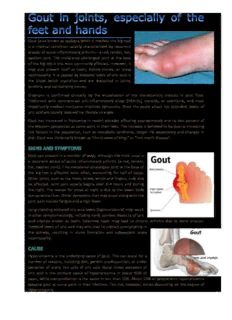
Table Of ContentGout (also known as podagra when it involves the big toe)
is a medical condition usually characterized by recurrent
attacks of acute inflammatory arthritis—a red, tender, hot,
swollen joint. The metatarsal-phalangeal joint at the base
of the big toe is the most commonly affected. However, it
may also present itself as tophi, kidney stones, or urate
nephropathy. It is caused by elevated levels of uric acid in
the blood which crystallize and are deposited in joints,
tendons, and surrounding tissues.
Diagnosis is confirmed clinically by the visualization of the characteristic crystals in joint fluid.
Treatment with nonsteroidal anti-inflammatory drugs (NSAIDs), steroids, or colchicine, and most
importantly medical marijuana improves symptoms. Once the acute attack has subsided, levels of
uric acid are usually lowered via lifestyle changes.
Gout has increased in frequency in recent decades affecting approximately one to two percent of
the Western population at some point in their lives. The increase is believed to be due to increasing
risk factors in the population, such as metabolic syndrome, longer life expectancy and changes in
diet. Gout was historically known as "the disease of kings" or "rich man's disease".
Gout can present in a number of ways, although the most usual is
a recurrent attack of acute inflammatory arthritis (a red, tender,
hot, swollen joint). T he metatarsal-phalangeal joint at the base of
the big toe is affected most often, accounting for half of cases.
Other joints, such as the heels, knees, wrists and fingers, may also
be affected. Joint pain usually begins over 2–4 hours and during
the night. The reason for onset at night is due to the lower body
temperature then. Other symptoms that may occur along with the
joint pain include fatigue and a high fever.
Long-standing elevated uric acid levels (hyperuricemia) may result
in other symptomatology, including hard, painless deposits of uric
acid crystals known as tophi. Extensive tophi may lead to chronic arthritis due to bone erosion.
Elevated levels of uric acid may also lead to crystals precipitating in
the kidneys, resulting in stone formation and subsequent urate
nephropathy.
Hyperuricemia is the underlying cause of gout. This can occur for a
number of reasons, including diet, genetic predisposition, or under
excretion of urate, the salts of uric acid. Renal under excretion of
uric acid is the primary cause of hyperuricemia in about 90% of
cases, while overproduction is the cause in less than 10%. About 10% of people with hyperuricemia
develop gout at some point in their lifetimes. The risk, however, varies depending on the degree of
hyperuricemia.
Dietary causes account for about 12% of gout, and
include a strong association with the consumption
of alcohol, fructose-sweetened drinks, meat, and
seafood. Other triggers include physical trauma
and surgery. Recent studies have found dietary
factors once believed to be associated are in fact
not, including the intake of purine-rich vegetables
and total protein. The consumption of coffee,
vitamin C and dairy products as well as physical
fitness appear to decrease the risk. This is believed
to be partly due to their effect in reducing insulin
resistance.
The occurrence of gout is genetic, contributing to about 60% of variability in uric acid level. A few
rare genetic disorders, including familial juvenile hyperuricemic nephropathy, medullary cystic
kidney disease, phosphoribosylpyrophosphate synthetase super activity, and hypoxanthine-guanine
phosphoribosyltransferase deficiency as seen in Lesch-Nyhan syndrome, are complicated by gout.
Gout frequently occurs in combination with other medical
problems. Metabolic syndrome, a combination of abdominal
obesity, hypertension, insulin resistance and abnormal lipid
levels occurs in nearly 75% of cases. Other conditions which
are commonly complicated by gout include:polycythemia, lead
poisoning, renal failure, hemolytic anemia, psoriasis, and solid
organ transplants. A body mass index greater than or equal to
35 increases a male's risk of gout threefold. Chronic lead
exposure and lead-contaminated alcohol are risk factors for
gout due to the harmful effect of lead on kidney function.
Lesch-Nyhan syndrome is often associated with gouty arthritis.
Without treatment, an acute attack of gout will usually resolve in 5 to 7 days. However, 60% of
people will have a second attack within one year. Those with gout are at increased risk of
hypertension, diabetes mellitus, metabolic syndrome, and renal and cardiovascular disease and thus
at increased risk of death. This may be partly due to its association with insulin resistance and
obesity, but some of the increased risk appears to be independent.
Without treatment, episodes of acute gout may develop into chronic gout with destruction of joint
surfaces, joint deformity, and painless tophi. These tophi occur in 30% of those who are untreated
for five years, often in the helix of the ear, over the olecranon processes, or on the Achilles tendons.
With aggressive treatment, they may dissolve. Kidney stones also frequently complicate gout,
affecting between 10 and 40% of people, and occur due to low urine pH promoting the precipitation
of uric acid. Other forms of chronic renal dysfunction may occur.
Gout affects around 1–2% of the Western population at some point in their lifetimes, and is
becoming more common. Rates of gout have approximately doubled between 1990 and 2010. This
rise is believed to be due to increasing life expectancy, changes in diet, and an increase in diseases
associated with gout, such as metabolic syndrome and high blood pressure. A number of factors
have been found to influence rates of gout, including age, race, and the season of the year. In men
over the age of 30 and women over the age of 50, prevalence is 2%.
In the United States, gout is twice as likely in African American males as it is in European Americans.
Rates are high among the peoples of the Pacific Islands and the Maori of New Zealand, but rare in
Australian aborigines, despite a higher mean concentration of serum uric acid in the latter group. I t
has become common in China, Polynesia, and urban sub-Saharan Africa. Some studies have found
attacks of gout occur more frequently in the spring. This has been attributed to seasonal changes in
diet, alcohol consumption, physical activity, and temperature.
Diuretics have been associated with attacks of gout. However, a low dose of hydrochlorothiazide
does not seem to increase the risk. Other medicines that have been associated include niacin and
aspirin (acetylsalicylic acid). Cyclosporine is also associated with gout, particularly when used in
combination with hydrochlorothiazide, as are the immuno-suppressive drugs ciclosporin and
tacrolimus.
Both lifestyle changes and medications can decrease uric acid levels. Dietary and lifestyle choices
that are effective include reducing intake of food such as meat and seafood, consuming adequate
vitamin C, limiting alcohol and fructose consumption, and avoiding obesity. A low-calorie diet in
obese men decreased uric acid levels. Vitamin C intake of 1,500 mg per day decreases the risk of
gout by 45% compared to 250 mg per day. Coffee, but not tea, consumption is associated with a
lower risk of gout. Gout may be secondary to sleep apnea via the release of purines from oxygen-
starved cells. Treatment of apnea can lessen the occurrence of attacks.
The initial aim of treatment is to settle the symptoms of an acute attack. Different drugs used to
reduce the serum uric acid levels can prevent repeated attacks. Ice applied for 20 to 30 minutes
several times a day decreases pain. Options for acute treatment include nonsteroidal anti-
inflammatory drugs (NSAIDs), colchicine and steroids, while options for prevention include
allopurinol, febuxostat and probenecid. Lowering uric acid levels can cure the disease. Treatment of
co morbidities is also important.
NSAIDs are the usual first-line treatment for gout, and no specific agent is significantly more or less
effective than any other is. Improvement may be seen within 4 hours, and treatment is
recommended for 1–2 weeks. They are not recommended, however in those with certain other
health problems, such as gastrointestinal bleeding, renal failure, or heart failure. While
indomethacin has historically been the most commonly used NSAID, an alternative, such as
ibuprofen, may be preferred due to its better side effect profile in the absence of superior
effectiveness. For those at risk of gastric side effects from NSAIDs, an additional proton pump
inhibitor may be given.
Colchicine is an alternative for those unable to tolerate NSAIDs. Its side effects (primarily
gastrointestinal upset) limit its usage. Gastrointestinal upset, however, depends on the dose, and
the risk can be decreased by using smaller yet still effective doses. Colchicine may interact with
other commonly prescribed drugs, such as atorvastatin and erythromycin, among others.
Glucocorticoids have been found to be as effective as NSAIDs and may be used if contraindications
exist for NSAIDs. They also lead to improvement when injected into the joint; the risk of a joint
infection must be excluded, however, as they worsen this condition.
Pegloticase (Krystexxa) was approved in the USA to treat gout in 2010. It will be an option for the 3%
of people who are not adequately treated with other medications due to their association with
severe allergic reactions. Pegloticase is administered as an intravenous infusion every two weeks. As
of March 2010, however, no double blind, placebo controlled trials have been completed.
A number of medications are useful for preventing further episodes of gout, including xanthine
oxidase inhibitor (including allopurinol and febuxostat) and uricosurics (including probenecid and
sulfinpyrazone). They are not usually commenced until one to two weeks after an acute attack has
resolved, due to theoretical concerns of worsening the attack, and are often used in combination
with either an NSAID or colchicine for the first 3–6 months. They are not recommended until a
person has suffered two attacks of gout, unless destructive joint changes, tophi, or urate
nephropathy exist, as it is not until this point that medications have been found to be cost effective.
Urate-lowering measures should be increased until serum uric acid levels are below (5.0-6.0 mg/dL)
and are continued indefinitely. If these medications are being used chronically at the time of an
attack, it is recommended they be continued.
As a rule of thumb, uricosuric drugs are preferred if there is under secretion of uric acid, in turn
indicated if a 24-hour collection of urine results in a uric acid amount of less than 800mg. They are,
however, contraindicated if the person has a history of renal stones. In contrast, a 24-hour urine
excretion of more than 800mg indicates overproduction, and xanthine oxidase inhibitors are
preferred. Overall, probenecid appears to be less effective than allopurinol.
Xanthine oxidase inhibitors (including allopurinol and febuxostat) block uric acid production, and
long-term therapy is safe and well tolerated, and can be used in people with renal impairment or
urate stones, although allopurinol has caused hypersensitivity in a small number of individuals. I n
such cases, the alternative drug febuxostat have been recommended.
The Dutch scientist Antonie van Leeuwenhoek first described the microscopic appearance of urate
crystals in 1679. In 1848 English physician, Alfred Baring Garrod realized that this excess uric acid in
the blood was the cause of gout.
Gout is a disorder of purine metabolism, an nd occurs when its final metabolite, uric acid, crystallizes
in the form of monosodium urate, precipitating in joints, on tendons, and in the surrounding tissues.
These crystals then trigger a local immune-mediated inflammatory reaction with one of the key
proteins in the inflammatory cascade being interleukin 1β. An evolutionary loss of uricase, which
breaks down uric acid, in humans and higher primates is what has made this condition so common.
The triggers for precipitation of uric acid are not well understood. While it may crystallize at normal
levels, it is more likely to do so as levels increase. Other factors believed to be important in triggering
an acute episode of arthritis include cool temperatures, rapid changes in uric acid levels, acidosis,
articular hydration, and extracellular matrix proteins, such as proteoglycans, collagens, and
chondroitin sulfate. The increased precipitation at low temperatures partly explains why the joints in
the feet are most commonly affected. Rapid changes in uric acid may occur due to a number of
factors, including trauma, surgery, chemotherapy, diuretics, and stopping or starting allopurinol.
Gout is rare in most other animals due to their ability to produce uricase, which breaks down uric
acid. Humans and other great apes have lost this ability, and thus gout is common. The
Tyrannosaurus rex specimen known as "Sue", however, is believed to have suffered from gout.
video.google.com www.medicalcannabis.com
One of marijuana’s oldest recorded uses is relieving swelling and inflammation. Currently, modern
scientists are exploring a network of cannabinoid receptor sites located throughout the body. This
new understandings of cannabinoid research clearly supports the historical references on treating
inflammation with marijuana. Different cannabinoids founds naturally in marijuana have different
benefits for arthritis sufferers. Tetrahydroconnabinol (THC) is beneficial as a pain reliever.
Cannabichromene (CBC) and cannabidiol (CBD) have been shown in clinical studies to have valuable
anti-inflammatory properties.
Arthritis literally means "joint inflammation". It consists of more than 100 different conditions. The
common symptoms for all these conditions are joint and musculoskeletal pain, which is why they are
all considered forms of “arthritis'. Often the pain associated with arthritis is a result of inflammation
of the joint lining. Inflammation is the body's natural response to injury. The warning signs that
inflammation presents are redness, swelling, heat and pain. When a joint becomes inflamed, it can
prevent the normal use of the joint and therefore it can cause the loss of function of joint.
Gout is one of the most painful forms of arthritis. Gout is caused when crystals of uric acid form in
the connective tissue and/or joint spaces.
Arthritis and Cannabinoids: HU-210 and Win-55, 212-2 Prevent IL-1Alpha-Induced Matrix
Degradation in Bovine Articular Chondrocytes In-Vitro.
Mbvundula EC, Bunning RA, Rainsford KD.
Biomedical Research Centre, Sheffield Hallam University, Sheffield, S1 1WB, UK.
Cannabinoids have analgesic, immunomodulatory and anti-inflammatory properties and attenuate
joint damage in animal models of arthritis. In this study the mechanisms of action of the synthetic
cannabinoid agonists, HU-210 and Win-55,212-2, were studied to determine if they affected
interleukin-1 alpha (IL-1alpha)-induced proteoglycan and collagen degradation in bovine nasal
cartilage explant cultures and prostaglandin E2 (PGE2) production in primary cultures of bovine
articular chondrocytes. The effects of the inactive enantiomer, Win-55,212-3, were compared with
those of the active enantiomer, Win-55,212-2, to determine if the effects were cannabinoid (CB)-
receptor mediated. The chondrocytes and explants were stimulated by IL-1alpha (100 U mL(-1)
identical with 0.06 nM and 500 U mL(-1) identical with 0.3 nM, respectively). Proteoglycan
breakdown was determined as sulfated glycosaminoglycan (sGAG) release using the
dimethylmethylene blue assay. Collagen degradation was determined as hydroxyproline in the
conditioned culture media and cartilage digests. ELISA determined PGE2. Expression of cannabinoid
receptors, CB1 and CB2; cyclooxygenase-1 and -2 (COX-1 and COX-2); inducible nitric oxide synthase
(iNOS); as well as activation of nuclear factor-kappa B (NF-kappaB) in chondrocytes were studied
using immunoblotting techniques and immunofluorescence.
The results showed that HU-210 and Win-55,212-2 (5-15 microM) significantly inhibited IL-1-alpha
stimulated proteoglycan (P < 0.001) and collagen degradation (P < 0.001). Win-55,212-2 (5-10
microM) also significantly inhibited PGE2 production (P < 0.01). At 5 microM, Win-55,212-2 inhibited
the expression of iNOS and COX-2 and activation of NF-kappaB. Chondrocytes appeared to
constitutively express cannabinoid receptors CB1 and CB2. It is concluded that biologically stable
synthetic cannabinoids protect cartilage matrix from degradation induced by cytokines and this
effect is possibly CB-receptor mediated and involves effects on prostaglandin and nitric oxide
metabolism. Cannabinoids could also be producing these effects via inhibition of NF-kappaB
activation.
Sativex (CBM) is a marijuana-based drug that was developed by GW Pharmaceuticals in 2005 as a
treatment for Multiple Sclerosis. Sativex has however been shown to have beneficial effects in
rheumatoid arthritis. Tests of Sativex on arthritis patients showed it helped reduce pain, and
improve quality of sleep. Sativex is not psychoactive and comes in the form of a mouth spray
composed mainly of two cannabinoids found naturally in marijuana, Tetrahydroconnabinol (THC)
and cannabidiol (CBD).
Topical application of cannabis extract on cases of arthropathy (gout) were done in So. Calif. Positive
test results: less inflammation, less pain than placebo group.
Make your own Cannabis Liniment: Crush 1 oz of Indica shake. Put it into a container and add on top
of it 12-16 ozs. Isoprophyl Alcohol (70-90 %). Tightly cover the container and shake vigorously. Then
allow mixture to set or steep in the container for 15-30 days. Shake it lightly once everyday. Do not
open the container until the 30 days is up. When it is done, open the container and filter the
contents to remove any solids. Pour the mixture into a dispensing bottle with a good tight cap. Your
liniment is ready to use.
Cannabinoids decrease inflammation by suppressing certain parts of the immune system. You can
also take cannabinoids by vaporizing, edibles, as an extract or tincture (under the tongue), or in a
suppository form.
DMSO, Dimethyl Sulfoxide, is an effective sulfur-containing organic solvent.
At the Gout Clinic we Love sulfur.
Its medical properties were discovered in 1963 by a research team headed by
Stanley W. Jacob, MD.
DMSO is an effective pain killer.
It reduces inflammation and swelling, improves joint mobility and it improves
blood flow to a gout affected area by dilating blood vessels and by reducing
blood platelet stickiness (decreasing blood viscosity).
It is a strong solvent, which penetrate easily the skin, penetrate tissues, and enters the bloodstream.
Being a solvent, we use it as a carrier for other substances or drugs and it also potentiates their
effect.
Topical (with additions of e.g. Iodine, rosemary extract, castor oil, ACV, turpentine, wintergreen
oil, MgCl, etc.)
As an addition in certain foot baths.
As an addition to poultice therapy.
DMSO IS A, SAFE TREATMENT. IT WAS NAMED BY DR. STANLEY "MIRACLE MEDICINE"
Essential oils are aromatic, naturally occurring chemical components of
plants that are usually extracted by (steam) distillation. Thorough lab
testing of these chemical constituents has led to an understanding of
their benefits, and in recent years, interest in therapeutically blended
essential oils for the treatment of gout has increased.
Our favorite essential oil is rosemary, due to its anti-inflammatory
characteristics and for being kidney stimulating.
In the 16th century, Paracelsus, a renowned German-Swiss physician and
botanist, valued rosemary oil because of its ability to strengthen the entire body. He correctly
believed that rosemary oil had the ability to heal delicate organs such as the liver and kidneys.
At the Gout Clinic we use Essential oils in our creams, poultice, baths, massages and in combination
with our DMSO treatment.
Rosemary
Peppermint
Basil
Geranium
Birch
Pine
Cypress
Thyme
Wintergreen
Nutmeg
Ginger
What About Food and Gout
Drink, Drink, Drink Water!
Uric acid in your blood is the culprit. The excessive uric acid that can’t be excreted out of your
system by your kidneys leads to gout. Water helps to expel it out of your body before it gets a
chance to crystallize.
In The Gout Clinic, we replace a lot of the daily water intake by fresh green coconut-water, which has
an ideal composition to cure gout. Minimal daily intake is three coconuts.
PH
The more alkaline the blood, the more soluble uric acid is. Healthy blood is alkaline.
Some people conclude that higher PH is the solution to GOUT and to better health, and you have to
reach it in an efficient way. So baking powder (sodium bicarbonate) becomes the miracle powder,
"The Magic Gout Cure".
WRONG, It temporarily increases the PH of your blood, but does not cure your PH problem.
Furthermore, taking bicarbonate for a prolonged time is dangerous. The first symptom is pale skin,
and it can even lead you to death.
Every cell in your body needs the correct Na/K equilibrium to function well.
(Na = Natrium or Sodium, K = Kalium or Potassium).
Gout is a typical "Modern Lifestyle" epidemic.
Modern Lifestyle results normally in a disturbed Na/K ratio AND
in K deficiencies. Taking sodium bicarbonate, although causing
an immediate gout relieve effect (fixing PH), MAKES YOU MORE
SICK, by further disturbing the Na/K ratio.
But sodium bicarbonate restores the acid/alkaline (PH) balance
temporarily. However, if the same practices that created the
Metabolic Acidosis are continued, the balance will quickly be
lost again.
Taking less Na (salt), as promoted for a healthy life (lowering
blood pressure, etc.), by nearly every doctor, even by the WHO, is not the solution either. It tend to
fix the faulty Na/K ratio, but does not fix the absolute values. It does not correct the K deficiency. We
need K and Na in our body, and we need lots of it, every cell in our body needs it to function well.
The right solution is to increase your K (potassium) intake!
Gout Diet at The Gout Clinic
Nopal Leaves, Nopal Fruit and Other Cactus Fruits
Growing naturally, organically, near The Gout Clinic. It has been
used by the Mexican tribes since time immemorial as medicine and
food. In fact, the Aztecs believed that the nopal cactus was food fit
for the royalty and warriors. Today, the nopal cactus has once again
become popular for its many health benefits. For treating Na/K ratio,
gout, diabetes, metabolic disorders, digestive problems,
cardiovascular and heart problems (lowering cholesterol,
triglycerides and tackling plaque). For Cleansing the colon, the Liver and is used for obesity control.
At The Gout Clinic, we use plenty of them in almost every Juice, and you can eat as much as you like
of it; raw. It is essential in every gout diet.
Jicama, the root of The Gods (Aztecs)
The locally grown Mexican jicama is similar in texture to a turnip
with a taste closer to an apple. It is crisp, white, and has solid
flesh. Locally, Children loves it as a snack with Chili sauce.
At The Gout Clinic we used it both Juiced and whole.
It is low in calories but high in a vital nutrients (restoring Na/K
ratio), and vitamins. Beside protecting against inflammation it is very fiber rich, and the
fibers are infused with oligofructose Inulin, which has zero calories, doesn't metabolize in the body,
but gives jicama its sweet taste, without having fructose. Inulin, besides promoting bone health, has
a prebiotic role in the intestine. Inulin promotes “good” bacteria growth, maintaining both a healthy
colon and balanced immunity.
Furthermore, jicama has a very low glycemic index.
Jicama is a blessing for gout patients, it helps lowering uric acid in the body.
It is the perfect gout diet ingredient.
Aloe Vera
The leaves of the locally grown aloe vera are pure gout medicine.
Google "Aloe Vera Health Benefits," to learn about its other
amazing health properties.
For us, our main interest is in cell regeneration, encouraging
blood circulation and possible anti-inflammatory
characteristics.
We use aloe vera gel fillet in juices and the whole leaf,
juiced, as an implant.
Its claimed blood flow repair capabilities originates
from:
its anti-inflammatory effect on the capillary blood vessels walls, resulting in a larger net flow
area
reinforcing capillary vessel walls by its silicon content
reducing blood viscosity.
"Let food be thy medicine and medicine be thy food"
Hippocrates
Our Body is programmed to heal itself.
Not only external damage, like wounds, but also internal damage like clotted arteries, bad
functioning liver, etc.
However, the body needs the proper tools and material to do this.
The larger the variety of tools and materials (in sufficient amounts), the easier the body can heal
itself.
The tools and materials needed in a gout diet are:
1) Macronutricients:
Proteins (amino acids, which are the large building blocks for organ and gland repair)!
Carbohydrates (they provide energy to the body)
Unsaturated fatty acids
2) Minerals, essential small building blocks
3) Vitamins, essential tools for rebuilding health
4) and very important; ENZYMES, acting as facilitators during health rebuilding.
By just consuming burgers, hot dogs and coke, you neither get the building blocks nor the tools your
body needs to rebuild its health.
At the Gout Clinic, the food you will eat will be your "medicine" to heal gout.
Flax & Chia seeds
The Health benefits of these two seeds are well known.
These seeds are "GOUT MEDICINE".
Raw Honey
Today, in the commercial western world it is nearly impossible to buy RAW honey.
Labels only mislead people. Printing "containing raw honey" or "raw honey
artisan processed" does not mean it is raw honey.
During the Artisanal process heat is normally applied, resulting in
destroying the enzymes in the honey.
These enzymes are why raw honey is so beneficial for your health rebuild.
Bio Available Hydrogen Peroxide is made naturally in honey by an enzyme called glucose oxidase.
This enzyme gives rise to hydrogen peroxide when real raw honey becomes diluted. The heat
involved in (artisanal) honey processing (like pasteurization or reducing viscosity for better flow)
destroys the enzymes that produce hydrogen peroxide. Hydrogen Peroxide, in small amounts,
enables specific enzymes to do their job. It has a very powerful way of working. It is catalyzing a
catalyst!!!!
At the Gout Clinic, we are very lucky to have many local sources of unprocessed raw honey coming
from unpolluted mountain areas.
Whiteout going in detail, below we mention a non complete list of foods we use at The Gout Clinic.
Most of them are grown locally in a biological way.
Coco
Nopal
Cactus Fruits
Jicama
Aloe Vera
Guanábana
Alpiste \milk (for drinking or enemas)
Wheat grass (for drinking or implants), our wheat grass is grown in house.
Lime
Apple Cider Vinegar "ACV", fermented in our facilities.
Raw Honey
Ginger
Turmeric root
Chili Costenjo
Noni
Guayaba
Chayote
Papaya (and it seeds)
Pineapple
Fermented Pineapple juice
Fermented Noni juice
Mango
Description:Gout frequently occurs in combination with other medical problems. Colchicine is an alternative for those unable to tolerate NSAIDs. Its side . Topical application of cannabis extract on cases of arthropathy (gout) were done in So. Calif. "The Internet Classics Archive Aphorisms by Hippocrates".