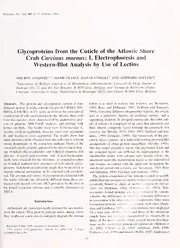
Table Of ContentReference: Bin/. Hull. 202: 61-73. (February 20(12)
from the Cuticle of the Atlantic Shore
Glycoproteins
Crab Carcinus rnaenas: I. Electrophoresis and
Western-Blot Analysis by Use of Lectins
PHILIPPE COMPERE1 *, MARIE-FRANCE JASPAR-VERSALI2, AND GERHARD GOFFINET1
lLaboratoire de Biologic generate et de Morphologic ultrastructurale, Univershe de Liege, Institut de
Zoologie {ID, 22, qtiai Ed. Van Bent-den. B-4020 Liege, Belgium: and 2Groupe de Recherche Chitine-
Cliitosane. Unirersire de Liege. Departement de Boiunii/iii' (B22), Sart-Tilman, B-4000 Liege, Belgium
Abstract. The protein and glycoprotein content of four before it is shed at ecdysis (for reviews, see Stevenson,
M
different neutral or acidic solvent extracts (0.5 KC1, 10% 1985; Roer and Dillamun, 1993; Goffinet and Jeuniaux,
EDTA, 0.1 N HC1. or 2% acetic acid) from the mineralized 1994). Covering different integumental regions, the cuticle
exoskeleton ofadecapodcrustacean, the Atlantic shore crab acts as a protective barrier, an exchange surface, and a
Carcinus maenas, were characterized by quantitative anal- supporting skeleton. In decapod crustaceans, the solid cuti-
ysis of proteins, SDS-PAGE analysis, and probing with cle of sclerites is composed of an outer thin epicuticle and
lectins on blots. The lectins used were Conconavalin A, three fibrous composite layers forming the procuticle (for
Jacalin, soybean agglutinin, Maackici annirensix agglutinin reviews, see Neville, 1975, 1984, 1993; Goffinet and Jeu-
11. and Sainbucus nigra agglutinin. The results show that niaux, 1994; Compere, 1995). The framework of the pro-
many proteinscan be obtained from the crabcuticle without cuticle layers consists of a helicoidal twisted plywood-like
strong denaturants in the extraction medium. Many of the arrangement of chitin-protein microfibers (Neville. 1993).
extracted cuticle proteins appeared to be glycosylated, bear- The two major procuticle layers (the pigmented layer and
ing 0-linked oligosaccharides and TV-linked mannose-rich the principal layer) are stiffened by impregnation of the
glycans. /V-acetyl-galactosamine and A'-acetylneuraminic interfibrillar matrix with calcium salts, mainly calcite; the
acids were revealed, for the first time, as terminal residues innermost layer (the membranous layer) is not mineralized
on AMinked mannose-rich structures of crab cuticle glyco- and remains in contact with the epidermis throughout the
proteins. Sialylated glycoproteins might thus be involved in anecdysial period (for reviews, see Stevenson, 1985; Roer
organic-mineral interactions in the calcified crab exoskele- and Dillaman, 1993: Goffinet and Jeuniaux. 1994).
ton. The amount and variety ofglycoproteins extracted with The protein component ofthe arthropod cuticle is usually
the acidic solvents are obviously different from those ex- subdivided into proteins covalently bound and proteins non-
tracted with neutral solvents. HC1 proved to be the best of covalently bound to chitin or another component (tor re-
the tested extraction solvents and a valuable alternative to view, see Hackman. 1984; O'Brien et ai. 1993). Non-
EDTA. covalently bound proteins are those extracted by various
solvents, the differences in sol reflecting differences
Introduction in association with other cutk : components. Since most
exoskeletal proteins seem vmble each other (Hack-
Arthropods are characteristically invested by an exoskel- man and Goldberg, 1976). Uicularproteins were neglected
eton, the cuticle. They growby periodic molts,during which for a long time (Willis, I'<' -:). and those of the crustacean
they synthesize a new cuticle and partly degrade the old one cuticle have not \et been characterized as extensively as
those of the insect cuticle. From several recent investiga-
tions on the exoskeletal proteins ofcrustaceans (Skinner et
Received 15 June 1999; accepted 21 November 2001.
* To whom correspondence should be addres,ed. E-mail: ai, 1992: O'Brien et ai. 1993; Andersen. 1998. 1999;
[email protected] Coblentz /<//., 1998) and insects (Willis, 1987; Andersen et
61
62 P. COMPERE ET AL.
ai. 1995; Jensen ct ul.. 1998: Andersen. 2000), these pro- composition, duration, temperature). On the other hand,
teins have emerged as among the most important organic because the crustacean solid cuticle is calcified, calcium
constituents of the cuticle, and they are largely responsible salts must be solubilized prior to the extraction of pro-
for its mechanical properties. They are structural compo- teins especially those that are bound to the mineral. Most
nents of the chitin-protein microfibers and are involved in authors have therefore used ethylenediamine tetraacetate
the interactions between microribers, the intertibrillar ma- (EDTA), which has the advantage of promoting decalcifi-
trix, and also the mineral in calcified exoskeletons cation at neutral pH. either in the extraction medium
(Andersen, 1999. 2000; Coblent/. etal.. 1998; Willis, 1999). (O'Brien et ai, 1991; Kumari and Skinner, 1995; Shafer et
In the decapod crustacean cuticle, the amount of protein ai. 1994, 1995; Coblentz etal., 1998), or separately, prior
does not exceed 40% of the decalcified dry weight to the extraction (Andersen. 1991. 1999; Kragh etai, 1997;
(Welinder, 1974). Electrophoretical analyses and amino Nousiainen ctai. 1998). According to Albeck ctal. ( 1993).
acid sequencing studies carried out on several species EDTA probably affects the aggregation state and the Ca-
(Sc\lla semita, Hackman. 1974; Astacim leptodcictylus. binding properties of the proteins, hindering their subse-
EDTA
Vranckx and Durliat, 1980, 1986; Pumktlus horcalis. quent analysis; moreover, is extremely difficult to
Andersen, 1991; Gccarcinns latertilis, O'Brien ct ai, 1991; remove completely by dialysis. To extract proteins from
Skinner er ai, 1992; Kumari and Skinner, 1995: Kumari et exoskeletons. therefore, these authors recommended the use
ai, 1995: Homarns amcricainis. Kragh ct ai. 1997; Nou- ofdilute HCI. which proved more efficient than EDTA as a
siainen et ai, 1998; Cancer pagiints, Andersen, 1999) solvent for solubilizing proteins in an intact state from
showed that most proteins extracted from the calcified cu- molluscan shells and sea urchin tests.
ticles have an acidic pi and are smallerthan 31 kDa. On the The first and main purpose of the present work is to
other hand, many recent reports suggest that acidic macro- characterize the proteins extracted from the calcified cuticle
molecules and notably glycoproteins play a role of of a European marine decapod, the Atlantic shore crab
prime importance in the promotion and inhibition ofcrystal Carciiiiis iiitieiitix, by sodium dodecylsulfate-polyacryl-
growth during calcification ofdiverse extracellular matrices amide gel electrophoresis (SDS-PAGE) and probing glyco-
(teeth: Akita et ai, 1992; bones: Hunter and Goldberg. sylations on blots with various lectins. The second purpose
1993; Hunter et ai, 1996; mollusc shells: Wheeler ct al.. is to compare four non-denaturing or weakly denaturing
1988; avian eggshell: Gaudron ct al.. 1996: sea urchin test solvents (KCI. EDTA, HCI. and acetic acid) for their effi-
and spicules: Herman ct al.. 1990: Harvey et al.. 1995; ciency in solubilizing medium- and high-MW proteins and
Albeck ct al., 1996; for reviews, see Addadi and Weiner, glycoproteins. The present work is also preparatory to a
1992; Sikes et al., 1994: Marsh. 1994). Few authors were forthcoming paper, which tentatively aims to relate the
interested in studying such macromolecules in crustacean present data to the distribution ofpolyanions and glycopro-
exoskeletons (Callinectes sapidus: Shafer ct aI.. 1994; teins in the cuticle layers as determined by cytochemical
1995; Coblentz ct al., 1998; G. lutcralix: Kumari and Skin- techniques and gold-conjugated lectin probes.
ner, 1995). but they extracted glycoproteins that bear man-
nose-rich structures and have a relatively high apparent Materials and Methods
molecular weight (MW). These authors suggested that cu- Biological material andpreparation ofcuticle extracts
ticle glycoproteins are involved in the mineralization pro-
cess. In addition. Shafer ct al. (1995) revealed that the Large specimens of the Atlantic shore crab (Carcinus
glycosylation of the cuticular proteins of the blue crab C. maenas), with a cephalothoracic shield exceeding 5 cm in
Mipiilu* undergoes molt-related changes concurrent with the width, were obtained from a local distributor. Anecdysial
mineralization of the cuticle after ecdysis. More recently crabs were selected according to the criteria of Drach and
confirming that matrix proteins from solid cuticle of the Tchernigovtzeff ( 1967). The cuticle of the cephalothoracic
blue crab influence in vitro crystallization of calcium car- shield was excised and carefully cleaned of adhering tissue
bonate (Gunthorpe ct ai. 1990) Coblentz ct al. (1998) remnants with a wet papertissue. Samples (two setsoffour)
electrophoretically separated several crystal-associated pro- of isolated fresh cuticle, weighing 4 g each, were either
teins (CAPs). probably glycosylated, from extracts of the crushed (first set) or ground to powder (second set), then
cuticle of early post-ecdysial blue crabs. They showed that extracted in the presence of a bactericide (10 mA/ NaN-,)
mM
these CAPs bind to calcite crystals and delay their nucle- and a protease inhibitor (1 phenylmethylsulfonylfluo-
M
ation in in vitro crystallization assays. ride, PMSF) in one of four solvents: 0.5 KCI at pH 7.0.
Although many studies have been devoted tothecuticular 10% ethylenediamine tetraacetate (EDTA) at pH 7.0. 0.1 N
proteins of marine, freshwater, and terrestrial brachyuran HCI at pH 2.0. or 27r acetic acid (HAc) at pH 3.0. Extrac-
4C
decapods, conflicting results have been obtained, and close tion was carried out with stirring for 48 h at in 1 liter
comparisons are hazardous because different species were of solvent, which was renewed three times. The sampMleWs
studied and different extraction conditions used (medium were enclosed in cellulose dialysis tubes (10,000 Da
CRAB CUTICLE GLYCOPROTEINS 63
cutoff) tilled with 10 nil of solvent. The extracts were with the avidin-biotinylated HRP (horseradish peroxidase)
cweenrteridfiuagleydzeatd 1mf4or,M04000 Xh agtf4orC10amgmaiMinn.stan1d0tmhAe/suNpeHrn4aHtCanOt,s cfoolmlpolweexd R(oVhercitnorgernoa.ndA-H2o<Ml>d4e)n. (T1h9e85)p.roTcheedusreecognednaerryalllay-
containing 2.5 NaN, and 1 PMSF. bel was then revealed by the diaminobenzidine (DAB)
staining method (Hsu and Soban. 1982) using the Sigma
Protein quantification assays Fast DAB peroxidase substrate tablet set (Sigma no.
extBreacftosrewelryoephmielaizsautrieond,wtihtehptrhoetebiinccionnctheonntisniocfaaclliddiparloytzeeidn AD-4(4C1o8n).AT.heSibgimotainnyol.ateCd-2l2e7c2t)in.s Juasceadliwner(.elacC.onVceacntaovralnion.
ausssianyg b(oBvCinAepsreortueimnaalsbsuamyinre(aBgeSnAt)kaits.tPhieerscteandnoa.rd2(3S2m2i5t)h, M1i1i5u5c)k,iiisoayibneuarnensaigsglaugtgilnuitnini(nSBIAI,(SMiAgAmaII,no.VecLt-o3r395n)o,.
pctarail.s.on1s98o5f;dWififeecrhenetlmpraonteeilnala.s,sa1y9s8,8)U.VInapbrseolripmtiinoanryatco2m8-0 BB--11320655))., CanodnSAa/neshsieinctuisalnliygrbainadgsgltuotian-imna(nSnNoAs,e aVnedctao-rglnuo-.
nni. Biuret's method, and the BCA method yielded rela- cose residues (a-Man, a-GIc), but not to related sugar
tively close and consistent protein concentrations for crab residues such as cv./3-galactose (a./3-Gal) (Goldstein et al..
cuticle extracts, while Bradford's technique (1976) yielded 1965a, b; Hayat, 1993). Jac preferentially binds to galacto-
values 5 to 10 times lower. The difference is probably due syl (|3-1.3)/V-acetylgalactosamine (Gal(/3-l,3)GalNAc) se-
to the presence ofmany acidic proteins in the extracts, since quences in O-lSiBnkAed oligosaccharides (Hayat. 1993; Shafer
the Coomassie blue is known to stain such proteins weakly. et al.. 1994). recognizes terminal a./3-./V-acetylgalac-
Bergers et til. (1993) also found Bradford's method less tosaminyl (a./3-GalNAc) and a,/3-galactosMamAinAyl (a,/3-Gal)
edfifaitcoime.nt for quantifying proteins extracted from a marine retesia!d.u.es1(9L9o1t)ananedt alS..NA197(3B;roHeakyaate,rt19e9t3)a.l.. 1984I)I (bKinnidbbtso
yV-acetylneuraminic residues (NeuNAc or sialic acids) pref-
Gel electrophoresis erentially in (2,3) and a(2,6) linkages respectively.
The probing procedure was as follows. Nonspecific bind-
SDS-polyacrylamide gel electrophoresis was carried out ing sites on the membranes were blocked overnight at 4C
according to Laemmli (1970) in 15% polyacrylamide gels. with 0.5% gelatin from coldwater-fish skin (Sigma no.
mM
Samples were solubilized by boiling for 5 min in 62.5 G-7765) in the specific lectin buffer. For all three lectins the
Tris-HCl buffer (pH 6.8, 2% SDS, 5% /3-mercaptoethanol. incubation buffer was PBS-Tween (0.01 M Na-phosphate.
M
10% glycerol, 0.002% bromophenol blue). Each well was 0.15 NaCl. 0.05% NaN,. 0.05% Tween 20) containing
loaded with 10 ^,1 ofa sample containing 25 to 100 /u,g total 0.1% fish gelatin. This buffer was adjusted to pH 6.8 for
proteins. Electrophoretical separations were performed for Con A and SBA. and to pH 7.5 forJac. MAA II. and SNA.
r7a0tumsiinn a2t5 1m5M0 VTriwsi-thHCal-Hboufeffeerr(SpEHM6i.8g0h,t0y.1S9m2alMl IgIlyacpipnae-. IftorwaCsonsuAp.plaenmdenwtietdhw0i.t1hm0.M1 mCMaCCIa2Cflor2aSnNdA0.a1nmdA/JacM.nTChKe
0.1% SDS). The 10-kDa Protein Ladder (GibcoBRL) was membranes were incubated for 2 h at 20C. either with 1
used as the molecular weight (MW) standard. Gels were /big/ml lectin for Con A and Jac, or with 5 ^tg/ml lectin for
stained with eitherCoomassie Brilliant Blue R-250(Dzandu SBA, MAA II. SNA. They were washed six times in PBS-
ct ul.. 1984) or silver (Wray et al., 1981 ). Tween and incubated for 2 h at 20"C with 5 ;ug/ml avidin-
biotin peroxidase complex in PBS-Tween at pH 7.5 with
Electroblotting 0.1% fish gelatin. After washing in PBS-Tween, the blots
Proteins were electroblotted under semi-dry conditions were washed five times in TBS (0.05 A/Tils. 0.15 NaCl pH
onto polyvinylidene difluoride (PVDF) membranes (0.2 7.6) and allowed to react for from 30 s to 1 min with 0.5
N/uorvn,abBlooethruinnitge(rP-hMaarnmnahceiiam)Bifootrec7h5).mTirnanisnfearMbuulftfieprhocronI-I Hmg2/Om2lin3,T3B'S-d.iaTmhienyobewnezrieditnheentewtarsahhyeddrotchhrleoeritdiemeasndin1T/BxSM
sisted of 25 mM Tris-HCl, 192 mM glycine (pH 8.3) made and three times in Milli-Q water. To test the specificity of
up in 15% v/v aqueous methanol. Blotting was allowed to the binding, inhibition expMeriment^ (Glass etul., 1981) were
epfrfoicceieedncfyorof1 hpraottceoinnsttarnatnscfuerr,rentthe(4g0elmsA)w.erTeosatsacienretdainwitthhe p(eMrMfPo,rmSedigmawintoh. M0-.62160) formeCtohnylA-aa-nDd-m0.an1n5oMpy/rVa-naocestiydle-
Coomassie blue. The pre-stained 14,300-200,000 MW nMeAurAaminyllactose (sialyllacinse. Sigma no. A-3307) for
Range (GibcoBRL) was used as the protein MW standard. II and SNA. as lectin binding inhibitors in the incu-
bation media.
Lectin pn>hini> To determine the linkage ofthe carbohydrate moieties of
the glycoproteins observed on the gels,extracts were treated
The glycoproteins immobilized on the PVDF membranes with theenzyme A'-glycosidase F(from F. meningoepticum,
were probed with biotinylated lectins secondarily labeled EC 3.2.2.18 and 3.5.1.52) under denaturing conditions be-
64 P. COMPERE ET AL
M 4 HCI EDTA
kDa 1B
100
80-85
70 70-75
50
32-34
30
10
Figure 1. Proteins extracted from the eephalothoracic shield cuticle of anecdysial Curcinn.\ imicinix.
CLoaonmea2s:s0i.e1bNluHeC-Is-teaxitnredacSt;DSL-apnoely3a:cr1y0l%amEiDdTeA-geexlt(r1a5c9t;;),L5a0neju4g:p0r.o5teMin/KlCaIn-ee.xtFirga.et1;A.LaLnaeneM;1:Mo29lrecHuAlca-rexWteriagchtt:
Marker 10 kDa Protein Ladder (GihcoBRL). Fig. IB. Densitometric profiles of the HCI- and EDTA-extracts
lanes (2 and 3).
fore SDS-PAGE, electroblotting, and lectin probing. N- values recorded for the other extracts were from 25% to
glycosidase F specifically cleaves sugars that are /V-linked 75% higher, ranging from 5 to 6 mg/g of initial cuticle FW
to nonterminal asparagines of glycoproteins (Tarentino et in the HCI extract and from 6 to 7 in the HAc and KCI
ni. 1985; Maley etai. 1989). Glycoproteins ( 100 ju,g) were extracts.
denatured by boiling in the presemncMe of 1% SDS (5 jul). Coomassie blue and silver staining yielded quite similar
/pVH-g7l.y2c,os1i0damseMFNbuafNfe3r, 5(045mjaMl; 2E0DTA, N0a.-5p%hoNsopnhiadteetbPu-f4f0e)r belaencdtsroapphopreeatriecdalwiptahttoernnesst(aFiings.and1 naontdth2e),otahletrh,ouagnhd ssoommee
was added, and the mixture was boiled again for 2 min. bands differed as to theirstaining intensity (detailed below).
Protein deglycosylation ( 100 jug protein) was carried out by The molecular weights corresponding with the hand posi-
incubating for 20 h at 37"C in the presence of 2 units of tions were estimated from the densitometric profiles (Figs.
/V-glycosidase F (Boehringer-Mannheim). IB and 2B). All extracts yielded protein bands mainly in
three molecular weight ranges: a few bands in a high-MW
Analysis ofelectrophoretical profiles range (55-100 kDa), many in a medium-MW range (20-50
Banding profiles on SDS-polyacrylamide gels and West- kDa), and some very thick bands in a low-MW range
ern blots were digitized and analyzed with a Bio-Rad den- ( 10-20 kDa). The KCI and EDTA extracts displayed very
sitometer (model GS-670) and with the Molecular Ana- similar banding profiles, with thick bands in the low-MW
lyst/PC program for identification ofcorresponding protein range, major bands in the high- and medium-MW ranges at
bands, molecular weight determinations, and densitomctric 30 kDa. 32-34 kDa. 70-75 kDa. and 80-85 kDa. and a
profile drawing. narrow band at 200 kDa. When extraction was done in an
acidic ratherthan a neutral solvent, the banding pattern was
Results different. The HCI extract displayed most of the protein
bands observed with neutral solvent extracts. The only
Gel electrophoresis exceptions were the 200-kDa band and a weak 38-kDa
Prior [a gel electrophoresis. the protein contents of the band on silver-stained gels. Moreover, the HCI extract
extracts were estimated by the BCA method. The EDTA exhibited several intense additional bands at 17 kDa,
extract displayed the lowest protein content, ranging from 3 24-26 kDa. and 100 kDa. Except for a 45-kDa band that
to 4 mg/g of initial cuticle fresh weight (FW) whatever the appeared in the HAc extract lane on silver-stained gels
sample treatment (crushed or reduced into powder). The only, the banding pattern of the HAc extract closely
CRAB CUTICLE GLYCOPROTEINS
M 3 4 HCI EDTA
kDa
100-
70-
50-
30 - Illl !%
10-
2B
Figure 2. Proteins extracted from the cephulothoracic shield cuticle of anecdysial Carcinus niacnus.
Silver-stainedSDS-polyacrylamidegels (15%).50/xgprotein/lane. Fig. 2A. Lane 1: 2% HAc-extract; Lane
2: 0.1 N HCI-extract; Lane 3: 10% EDTA-extract: Lane 4: 0.5 M KCl-extract: Lanes M; MolecularWeight
Marker 10kDaProteinLadder(GibcoBRL). Fig.2B. Densitometricprofilesofthe HCI-andEDTA-extracts
lanes (2 and 3).
resembled that of the HCI extract in the low-MW ranges, In the low-MW range, few ofthe very thick protein bands
but in the high- and medium-MW ranges, many bands appearing on Coomassie- or silver-stained gels reacted with
were missing or very faint. Con A. Moreover, obvious differences appeared between
As mentioned above, the staining intensity of a protein extracts. Several positive bands appearing in the range of
band could vary drastically with the gel staining method. 10-15 kDa in the lanes loaded with acidic-solvent extracts
The 17-kDaband ofthe HAc and HCI extracts, forinstance, were completely missing in the EDTA-extract lane. Only
was stained only by silver(Fig. 2), and the 16-kDaband that two of them appeared in the KCl-extract lane, and those
was intensely stained by Coomassie blue whatever the ex- were very faint. A 20-kDa band accompanied the 24-26-
tract (Fig. 1) was not revealed by silver staining (Fig. 2). kDa bands in all lanes. This band was faint to undetectable
on Coomassie- and silver-stained gels.
Reaction ofextractedproteins with lectins Con A binding was completely inhibited by methyl-a-o-
Lectin binding revealed that most of the proteins ex- mannopyranoside (MMP) (Fig. 3A, lanes 5 and 6). except
tracted by the described procedure are glycosylated. The for some of the most intensely labeled bands (30-34 kDa).
labeling intensity varied, however, according to the protein When the extracted proteins were treated with /V-glycosi-
band and the lectin used. Conspicuous differences were dase Fpriorto separation, transferred toa PVDFmembrane,
again observedbetween neutral- and acidic-solventextracts. and probed with Con A (Fig. 3A. lanes 7 and 8), none ofthe
ConcanavalinA. Ofthe five lectins tested. Con A labeled low-MW protein bands were labeled, and the high-MW
the greatest numberofprotein bands (Fig. 3). Almost all the protein bands appeared much fainter. This confirms that
protein bands in the high- and medium-MW ranges bound mannose-rich carbohydrates are AMinked to these proteins.
Con A, suggesting that they areglycosylated, primarily with Jnciilin. Like Con A, Jac bound to most of the bands in
mannose. In these ranges, only a few differences were the high- and medium-MW ranges and to some low-MW
observed between the various extracts (e.g.. differences in bands (see Fig. 4, HCI and EDTA extracts). The reacting
the intensity of some high-MW bands between acidic- and bands from the HCI and EDTA extracts were about the
neutral-solvent extracts). The bands exhibiting the strongest same; the only differences were amore pronounced labeling
Con A binding were mostly those staining intensely with of the 65-kDa band and additional 24-26-kDa bands from
Coomassie blue or silver. The 200-kDa band appeared to be the HCI extract and of the 32- and 45-kDa bands from the
labeled in everyextract lane, even when it did not appear, or EDTAextract. Labeling withJac was somewhat less intense
was very faint, after Coomassie or silver staining. than with Con A. Almost all ofthe Jac-positive bands were
66 P. 5COMPE6RE E7T AL.
M 1 3 4 HCI EOTA
200
_.
80-85
66 ^-=70
60-65
45
31
3A 3B
kDa
Figure 3. Glycoproleins of the Ctirciniix nuiciuix cephalolhoracic shield cuticle separated on SDS-poly-
acrylamide gels (15r/r. 25 /Mg protein/lane), electroblotted to PVDF, and probed with Con A (lanes M and I to
4) in the presence ofMMP(lanes 5 and 6) and with previousdeglycosylation by /V-glycosidase F (lanes 7 and
8). Fig. 3A. Blotting membranes Lane M: pre-stamed Molecular Weight Marker 14.300-200.000 Molecular
W7:ei0.g1htNRHaCnIg-eext(rGaicbtc;oLBaRnLelsw3i.t6h.laanbdelSe:d1104'.,3-E.D3T1A--eaxntdr4a5ct-;kDLaanbean4d:s;(1.L5aMneKIC:l-2ec/xctrHaAcct-.e\Ftirga.c3lB:.LDaennessit2.om5e.tarnicd
profiles ofthe HCI- and EDTA-e\tracts lanes (2 and 3).
ones previously found to react with Con A (e.g., the bands itive bands tailed to react with Jac (c.t>.. the bands at 12. 15.
at 29, 30-32, 34. 40. 45. 50. 55. and 100 kDa in both 20. 32. and 200 kDa in the HCl-extract lane: the bands at 20.
extracts: at 10. 15 and 22-24 kDa in the HCI extract; and at 24-26. 70. and 200-kDa in the EDTA-extract lane).
80-85 kDa in the EDTA-extract). but several Con A-pos- Sambucus nigra agglutinin and Maackia amurensis ag-
M HCI EDTA
kDa
-66
|-45
-31
-14
4A
Figure 4. (jlycoprolems i>l ihe Ciin-iini.\ imiciiti* cephalmhoiacic shield cuticle separated on ID SDS-
polyacrylaniide gel (15'.}. 25 /ug protein/lane), electrohlottetl to PVDF. and probed withJae. Fig. 4A. Lane M:
pie-stamed MolecularWeight Marker 14.300-200.000MolecularWeightRange(GibcoBRLlwithlabeled 14.3-
and 45-kDa hands; Lane 1: 0.1 N HCl-e\tract; Lane 2; Kl'r FDTA-extract. Fig. 4B. Densitometric profiles.
45678
CRAB CUTICLE GLYCOPROTEINS 67
M HCI EDTA
66
45
31
14
5A
kDa
Figure 5. Glycoproteins of the Ctircinin maenas cephalothoracic shield cuticle separated on ID SDS-
polyacrylamidegels(15%. 100/xgprotein/lane),electroblottedtoPVDF.andprobedwithMAA II (lanesMand
I to 4), in the presence ofsialyllactose (lanes 5 and 61 and with previous deglycosylation by /V-glycosidase F
(lanes 7 and 8). Fig. 5A. Lane M: pre-stained Molecular Weight Marker 14.300-200,000 Molecular Weight
HRCaln-geextr(aGcit;bcLoaBnReLs)3,w6i,thanldab8:ele1d0%14E.D3T-A-aenxdtr3a1c-tk;DaL;anLea4n:e0.15:M2%KClH-Aecx-terxatcrta.ctFi;g.L5aBn.esDe2n,s5i.ioamnedmc7:pr0o.f1ileNs
ofthe HCI- and EDTA-extracts lanes (2 and 3).
glutin II. In contrast to Con A and Jac labeling, only a few intensely labeled bands appeared in the low-MW range
bands were found to react with the sialic-acid-binding lee- (10-15 kDa) of the HCI and HAc extracts. Two positive
tins MAA II and SNA (Figs. 5 and 6respectively). The most bands (at 12-13 and 15 kDa) were also visible in the KC1
M HCI EDTA
66
45
31
kDa - j -.:' 6A
Figure 6. Glycoproteins of the Cairinn.i nuu'mix cephalothoracic shield cuticle s. pui:'!.(.! on ID SDS-
polyucrylamide gels (15%, 100 jug protein/lane), electroblotted to PVDF. and probed with SNA (lanes M and
I I" 4). in the presence ofsialyllactose (lanes 5 and 6) and with previous deglycosylalu n by /V-glycosidase F
(lanes 7 and S). Fig. 6A. Lane M: pre-stained Molecular Weight Marker 14.30(1-200.000 Molecular Weight
Range (GibcoBRL) with labeled 14.3- and 66-kDa bands; Lane 1: 2% HAc-extract; Lanes 2. 5. and 7: 0.1 N
HCl-extract; Lanes 3,6,and 8: 10% EDTA-extract; Lane4: 0.5 MKCl-extract. Fig. 6B. Densitumetnc profiles
ofthe HCI- and EDTA-extracts lanes (2 and 3).
68 P. COMPERE ICT .\L
M HCI EDTA
7A
97-
66-
45-
31-
14
kDa
Figure 7. Glycoproteins ot Ilie Curiums mucnus cephalothoracic shield cuticle separated on ID SDS-
polyacrylamide gel (\5r/r. 100 jug protein/laneI. electroNotted to PVDF. and probed with SBA. Fig. 7A. Lane
M: pre-stained Molecular Weight Marker 14.300 200,000 MolecularWeight Range (GibcoBRU with labeled
14.3-kDa band: Lane I: O.I N HCl-extract: Lane 2: 10r/r EDTA-e\tract. Fig. 7B. Densitometric profiles.
extract, but they were labeled much less intensely. They Discussion
wlaenree. Imnistshienghigohr-neaanrdlymeunddietuemc-taMbWlerianngtehse, EsDoTmAe-epxotsirtaicvte extWraectehdavferoemlectthreopchaolrceitniecadllcyuticchlaeraocfterthiezedAtltahnetipcrostheoirnes
bands corresponded with ones showing a high affinity for crab Ciirciiius nnicnas. The results confirm previous find-
CKCo1n-,AEDU>T,tA;.-, tahnedbHaCnld-sextartac32t.la3n4e.s)a.nTdhe80H-Cl8-5extkrDaactinlaniehse ings on other decapod crustaceans that many extractable
also exhibited additional, strongly positive 29- and 50-kDa hproowteevienrs,aopfpetaherptroesbeencgleyocfossyilaalitceda.ciTdhsiisn cisrutshteacfierasnt cruetpiorctl,e
bands that were missing in the EDTA-lane but present- extracts. We also provide new information about the type of
Tthhoeusgehbalnedsss (i2n9t-enasneldy50l-abkeDlae)dreainctetdheweKaCkIl-yexwtirtahctColnaneA. glycosylation and the sugar residues present. Our results
raise physiological questions such as the location, origin.
and Jac. In the HAc-extract lane, labeling of the high- and and role of these glycoproteins in the cuticle architecture,
meTdhieuimn-teMnWsitbyanofdsSwNaAs avnedryMpAooAr. II labeling was signifi- emsapterciixalalnydacsalrceiguamrdcsartbhoeniartei.nteractions with the organic
cantly reduced when sialyllactose was present (Figs. 5 and In addition, the results give evidence that the nature and
6, lanes 5 and fi). and labeling was almost completely absent the related extraction capacities of the solvent used are of
when the extracts were previously deglycosylated with N- prime importance for subsequent analyses of proteins and
glycosidase F (Figs. 5 and 6, lanes 7 and 8). This suggests glycoproteins from the calcified crustacean cuticle.
that the sialic acid residues detected belong to TV-linked
oliSgooyshaectcihnaritdiei>sx.lniiiiiii- As illustrated for the HCI and Extmction efficiency of the solvents
EDTA extracts (Fig. 7). SBA reacted with a few bands of Because much of the protein in the decapod exoskeleton
high- and medium-MW. These were bands that also re- is presumably associated with calcium salts, the dissolution
acted with Con A. Jac. or both (c.t>.. the bands at 2l 30. of calcite is generally accepted as a prerequisite to the
34, 45, 50, 80-85 and 100 kDa in both lanes). SBA also extraction of mineral-bound proteins (Gunthorpe el <//..
reacted with a few low-MW bands (in the 10-15 kDa 1990; O'Brien ct til.. 1993). Thus, most of the procedures
range). The HCI extract displayed more labeled bands for extracting proteins from calcified cuticles have included
than the EDTA extract (additional bands at 24-26 and eitherEDTA (0.4 M) togetherwith guanidine thiocyanatc (5
60-65 kDa). M) (O'Brien et ul.. 1991; Kumari and Skinner. 1995: Ku-
CRAB CUTICLE GLYCOPROTE1NS 69
mari cl <//.. 1995). or have involved a separate decalcifica- patterns. Besides displaying the lowest total protein content,
tion step with O.I M EDTA (Andersen. 1991 ) or 109r acetic the EDTA extract had a protein-banding pattern that did not
acid (Kragh ct ul.. 1997: Nousiainen etai, 1998; Andersen. differ much from that of the KCI extract obtained without
1999) priortoextraction by 6Mureain 0.1 % trifluoroacetic dissolving the mineral. In comparison with the HC1 extract,
acid (TFA). But with these procedures, the extraction of the EDTA extract was apparently missing several bands
proteins would he mainly due to the strong denaturants (e.i>.. the 17- and 100-kDa bands observed on Coomassie
(guanidine thiocyanate and urea) in the solvent. In the blue- or silver-stained gels, the Con A-labeled bands at
present study, the amount of protein extracted from the C. 10-15 and 20 kDa, the Jac-labeled bands at 24-26 kDa. the
maenus cuticle by the different solvents is only a small SBA-labeled bands at 24-26 kDa and 60-65 kDa). Partic-
fraction (less than 109;-) of the total protein content of the ularly poorly represented in this extract were the sialylated
MW
cuticle, which does not exceed 40% of the decalcified dry glycoprotein bands of low and medium (i.e.. the SNA-
weight, or about 15% of the cuticle dry weight (Welinder. or MAA II-positive bands at 10-12. 15. 20. 29, and 50
1974). Nevertheless, the results show that many proteins. kDa), even though they were alsopresent in the KCI extract.
and especially glycoproteins, can be obtained from the HC1 (0.1 N) thus emerged as a more efficient solvent than
calcified crab carapace without strong denaturants in the EDTA (10%). HCI also appeared more efficient than 2%
extraction medium, and even without decalcification. In HAc, which also seems to extract different proteins than
addition to some very intense low-MW protein bands, the EDTA from the cuticle of newly molted blue crabs
electrophoretical pattern ofthe extracts from the C. maemis (Coblentz et ul.. 1998). The present electrophoretical anal-
cuticle exhibited many protein and glycoprotein bands in yses and lectin-binding patterns clearly show that many of
the medium- and high-MW ranges (from 30 kDa up to 200 the high-MW bands present in the HCI extract are missing
kDa). as wasthecaseforthe banding patterns recorded from in the HAc extract. The betterextraction efficiency of0.1 N
the 0.1 A/ EDTA extracts (Shafer etui, 1994. 1995) and the HCI (pH 2.0) compared to 2 % HAc (pH 3.0) is presumably
EDTA/guanidine thiocyanate extracts (O'Brien ettil., 1991. due to pronounced electrostatic repulsion between net pos-
1993: Kumari and Skinner. 1995) of several decapod cuti- itive charges at the low pH. With 0.1 N HCI, ofcourse, the
cles. In contrast, in the urea extracts ofpreviously decalci- risk that low pH might affect orbreak the extracted proteins
fied cuticle samples from three other decapods (Pundahis cannot be neglected. For this reason, protein extraction by
borealix: Andersen. 1991; Hmnarux ainericaniix: Kragh et 0.1 N HCI should be performed in the cold. The greater
ul.. 1997; Nousiainen c't <//., 1998; Cancer pui;itnis: extraction efficiency of HCI compared with EDTA agrees
Andersen. 1999), the proteins were mostly oflow MW. and with the conclusion ofAlbeck et ul. ( 1993). who concluded
none of them appeared to be glycosylated. The molecular that HCI extracts approximately twice as much protein from
weight calculateMd Wby these authors from the sequence a molluscan shell (Atrinu rigiilu) or a sea urchin test (Paru-
agreed with the determined by mass spectrometry of centrotiix lividus) as does EDTA. In addition, these authors
the intact proteins, indicating that no residue is missing. As obtained better fractionation by HPLC ofextract from HCI
Kragh et ul. (1997) already implied, this indicates that extracts than from EDTA. as well as more acidic amino
substantial amounts of proteins and glycoproteins were re- acids in the HCI-extracted proteins. They proposed that
moved during the decalcification step prior to the urea traces of EDTA, extremely difficult to remove, can remain
extraction. A comparison of these urea extracts (Andersen, bound to the strongly ionic macromolecules and may inllu-
1991. 1999; Kragh et ul.. 1997: Nousiainen et ul.. 1998) ence theircharge, conformation, and aggregation state. This
with the extracts obtained with decalcifying solvents alone could affect protein quantification, migration on gels, and
(Shafer et ul.. 1994. 1995: present results) indicates that subsequent detection of Ca-binding capability. Other au-
proteins preferentially extracted in neutral or acid solvents thors (Samata and Matsuda. 1986, in Albeck et ul.. IW3)
MW
without denaturants tend to be of high and glycosy- proposedthat protein might be lost during decalcification by
lated. whereas proteins extracted in strongly denaturing EDTA, eitherdue to the breakdown and leakage through the
MW
conditions tend to be of low and non-glycosylated. dialysis membrane, or to the binding via EDTA to the
Their amino acid sequence suggested to Nousiainen et ul. dialysis membrane. Such effect- 1ZDTA would explain
(1998) and Andersen (1999) that such low-MW. non-gly- both the low total protein coi ofour EDTA extract and
cosylated proteins could indeed be strongly bound together its low content of glycoprotep:- especially those bearing
ortothe chitin-protein microfibers. perhaps by hydrophobic sialic acids. Extraction with I ns-HDTA may also bMeAthAe
interactions that would not be broken by salts or acids. reason why Shafer etul. ( 1994. 1995) failed to detect
On the other hand, the results presented here demon- II- and SNA-binding glycoproteins in extracts of blue crab
strated differences between samples extracted with acidic sclerite cuticle. Although EDTA has the advantage of dis-
solvents and those extracted with neutral solvents. These solving the mineral at neutral pH. and thus under conditions
differences were particularly obvious when comparing the more likely to protect the proteins, our data support the
HCI and the EDTA extracts, especially the lectin-binding recommendation of Albeck et ul. (1993) that mild acidic
70 P. COMPERE ET AL
solvents, especially dilute HC1, should be the extraction Some ofthe above-mentioned bands in the medium-MW
media for proteins from mineralized matrices. range might be formed by subunits of crustacyanin. Blue
crustacyanin (/3-form) is an oligomeric carotenoprotein that
colors the carapace of decapods (Zagalsky et ai, 1970;
Comparison ofelectrophoretical patterns
Vranckx and Durliat, 1986). It is easily extracted from the
For the reasons discussed above, comparing the electro- cuticle by neutral and acidic solvents and dissociates irre-
phoretical patterns obtained with cuticle protein extracts versibly into purple subunits (40-50 kDa; a-form) or, upon
from C. maenas and other decapod species is limited to the removal of the carotenoid, into subunits of about 20 kDa.
results ofstudies in which EDTA-containing or mild acidic Thus, several bands obtained with C. maenas cuticle ex-
extraction media were used. Moreover, the apparent molec- tracts in the medium-MW range probably contain or corre-
ular weights of the band-forming proteins should be com- spond to crustacyanin subunits. This may also be true ofthe
pared with special caution, because most of them are gly- 54-. 50-. 48-. 44- and 42-kDa bands observed by O'Brien et
cosylated. Glycosylation causes many proteins to run ai ( 1991 ) with G. lateraliscuticle extracts. These bands are
anomalously on SDS-polyacrylamide gels (Segrest and considered by the authors to be formed of specific proteins
Jackson, 1972). As previously mentioned (O'Brien ct al.. from the epicuticle (so-called the "epicuticular quintet"),
1991; Kragh et ai, 1997), bands obtained on gels are likely which are especially prominent in extracts of the cuticle of
to contain several proteins of similar MW, but different pi pigmented sclerites.
values, forming so-called "charge trains." Thus, determin-
ing whether the different types of glycans and residues Cuticle-protein-associated xl\eans
identified on blots belong to a single glycoprotein or to
MW MAA
several different ones ofsimilar is impossible. Despite Our observation that lectins (Con A. Jac. SBA, II.
these limitations, comparing electrophoretical and western and SNA) recognize various blotted protein bands obtained
blot patterns ofcuticular proteins in different decapod spe- from C. maenas sclerite cuticle extracts, especially HC1
cies may prove informative. extracts, suggests that the glycosylated proteins contain
The prevalence of low-MW proteins (MW < 31 kDa) both A'-linked mannose-rich glycans and CMinked oligosac-
appears to be a common feature in cuticle extracts from charides. These results agree with those obtained by lectin
many arthropod species (Kumari and Skinner. 1993). in- labeling of ultrathin sections (Compere and Goftinct. un-
cluding arachnids (Norup ct ai. 1996). This generalization publ. data).
is supported by the present study. The electrophoretical The affinity ofmany glycoprotein bands for Jac suggests
patterns obtained here with C. maenas cuticle proteins, and the presence of Olinked glycans. Jac is known to bind to
the affinity of these proteins for lectins on blots, were in the Gal(/31,3)GalNAc sequences common in O-linked gly-
good agreement with previous results on other decapod cans. Shafer et al. ( 1994) likewise detected some Jac-posi-
species, such as Gecarcinus lateralis (O'Brien et til., 1991. tive protein bands in Callinectex xapiilux extracts. Our re-
1993; Skinner ct al.. 1992; Kumari and Skinner, 1995) and sults suggest that many C. maenas cuticular proteins of
Cullinectex xapitlnx (Shafer et al.. 1994. 1995). This was different molecular weights are ()-glycosylated.
especially true of the EDTA extract on Coomassie-stained The presence of A'-linked mannose-rich glycans is sup-
gels and on blots probed with Con A. This suggests the ported by the strong affinity for Con A of many glycopro-
presence ofcomparable cuticularproteins and glycoproteins tein bands on our blots and by the drastic reduction ofCon
in the sclerites of different crustaceans, at least among the A labeling after deglycosylation with /V-glycosidase F. The
brachyuran decapods. Remarkably, a band staining with presence of/V-linked glycans in crab cuticularglycoproteins
Coomassie blue, but not with silver, was recorded at 16 kDa was previously suggested by Shafer et al. ( 1994. 1995), but
for C. maenas extracts, and at 15 kDa for G. lateralis not demonstrated. The present results agree with those of
extracts (O'Brien ctai. 1991 ). In C. imienux (present work), Kumari and Skinner ( 1995), who showed that Con A label-
Callinectes sapitlux (Shafer et at.. 1995), and G. lateralis ing of Callinectes sapidus and G. lateralis exoskeletal gly-
(Kumari and Skinner. 1995) extracts. Con A recognized coproteins is sensitive to /V-glyeosidase F deglycosylation.
most of the high- and medium-MW protein bands. More Con A mainly recognizes both internal and terminal ai 1.2)-
precisely, majorCon A-binding protein bands from C. mae- linked mannosyl residues, and requires two successive res-
nas (e.g., the bands at 20, 24-26. 30-32. 34, 45. and 50-55 idues ofthis type to bind tightly (Ogata et al.. 1975; Kobata
kDa) coincided with those recorded from G. lateralis (the and Endo. 1992). Con A is thus known to have an affinity
bands at 22, 26. 32. 34, 52, and 54 kDa). Kumari and for many monoantennary and biantennary complex-type
Skinner (1995). moreover, found some low-MW. Con-A- /V-liiiked oligosaccharides. In contrast to previous results,
positive bands in extracts ofthe procuticular layers (at II.3, however, our experiments suggest that many of these A'-
10.2, and 9.7 kDa) similar to those observed in C. maenas linked glycans bear terminal GalNAc or NeuNAc residues.
extracts notably the HC1 extract. Terminal ,/3 -GalNAc residues are recognized by SBA.