Table Of Content‘a great overview of glaucoma, certainly for those that need to
Fast Facts
F
get acquainted with the subject, but no less for experienced
a
s
ophthalmologists’ t Fast Facts:
F
Peter J. Ringens, Department of Ophthalmology a
c
VU Medical Centre, Amsterdam t
s Glaucoma
G
l
a
u
Fast Facts: c
o
Glaucoma m
a Paul R Healey and Ravi Thomas
9 Definitions and epidemiology
20 Pathophysiology, natural history and prognosis
30 Diagnosis and clinical features
68 Principles of management
78 Medical treatment
92 Laser and surgical treatment
97 Monitoring
118 Prevention
ISBN 978-1-905832-40-8
70 titles by 150 world experts at
www.fastfacts.com
9 781905 832408 >
FF Glaucoma1e pages.qxd 17/2/10 13:56 Page 1
Fast Facts
Fast Facts:
Glaucoma
Paul R HealeyMBBS(Hons) BMedSc(Cell Biol)
MMed(Clin Epidemiol) PhD(Med) FRANZCO
Clinical Senior Lecturer
University of Sydney
Department of Ophthalmology
Centre for Vision Research
Westmead Millennium Institute & Save Sight Institute
New South Wales, Australia
Glaucoma Specialist
Eye Associates
Sydney, Australia
Ravi ThomasMBBS MD FRANZCO
Director of Glaucoma Services
Queensland Eye Institute and
Professor, University of Queensland
Brisbane, Australia
Previously:
Professor & Head, Department of Ophthalmology
Christian Medical College, Vellore, India
Director, LV Prasad Eye Institute
Banjara Hills, Hyderabad, Andhra Pradesh, India
Declaration of Independence
This book is as balanced and as practical as we can make it.
Ideas for improvement are always welcome: [email protected]
© 2010 Health Press Ltd. www.fastfacts.com
FF Glaucoma1e pages.qxd 17/2/10 13:56 Page 2
Fast Facts: Glaucoma
First published March2010
Text © 2010 Paul R Healey, Ravi Thomas
© 2010 in this edition Health Press Limited
Health Press Limited, Elizabeth House, Queen Street, Abingdon,
Oxford OX14 3LN, UK
Tel: +44 (0)1235 523233
Fax: +44 (0)1235 523238
Book orders can be placed by telephone or via the website.
For regional distributors or to order via the website, please go to:
www.fastfacts.com
For telephone orders, please call +44 (0)1752 202301 (UK and Europe),
1 800 247 6553 (USA, toll free), +1 419 281 1802 (Americas) or
+61 (0)2 9698 7755 (Asia–Pacific).
Fast Facts is a trademark of Health Press Limited.
All rights reserved. No part of this publication may be reproduced, stored in a
retrieval system, or transmitted in any form or by any means, electronic, mechanical,
photocopying, recording or otherwise, without the express permission of the
publisher.
The rights of Paul R Healey and Ravi Thomas to be identified as the authors of this
work have been asserted in accordance with the Copyright, Designs & Patents Act
1988 Sections 77 and 78.
The publisher and the authors have made every effort to ensure the accuracy of this
book, but cannot accept responsibility for any errors or omissions.
For all drugs, please consult the product labeling approved in your country for
prescribing information.
Registered names, trademarks, etc. used in this book, even when not marked as such,
are not to be considered unprotected by law.
A CIP record for this title is available from the British Library.
ISBN 978-1-905832-40-8
Healey PR (Paul)
Fast Facts: Glaucoma/
Paul R Healey, Ravi Thomas
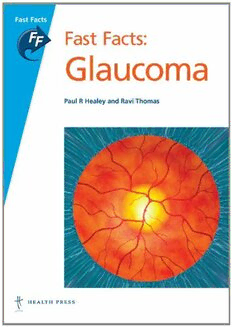
Cover: Glaucoma is an increased pressure in the eyeball due to an excessive amount
of aqueous humour (the fluid that fills the eyeball). Seen here are the blood vessels
(red) and the optic disc (yellow), which is raised with a central bulge or 'cup' (white).
David Mack/Science Photo Library
Medical illustrations by Dee McLean, London, UK.
Typesetting and page layout by Zed, Oxford, UK.
Printed by Latimer Trend and Company Limited, Plymouth, UK.
Text printed on biodegradable and recyclable paper
manufactured using elemental chlorine free (ECF)
wood pulp from well-managed forests.
© 2010 Health Press Ltd. www.fastfacts.com
FF Glaucoma1e pages.qxd 17/2/10 13:56 Page 3
Glossary 5
Introduction 7
Definitions and epidemiology 9
Pathophysiology, natural history and prognosis 20
Diagnosis and clinical features 30
Principles of management 68
Medical treatment 78
Laser and surgical treatment 92
Monitoring 97
Prevention 118
Useful resources 128
Index 130
© 2010 Health Press Ltd. www.fastfacts.com
FF Glaucoma1e pages.qxd 17/2/10 13:56 Page 4
© 2010 Health Press Ltd. www.fastfacts.com
FF Glaucoma1e pages.qxd 17/2/10 13:56 Page 5
Glossary
Amblyopia: a decrease in vision for Iridocorneal angle:the angle created by
which no cause can be found on the junction of the cornea and iris; the
examination; in appropriate cases, outflow channels for aqueous drainage
amblyopia is correctable by therapeutic (trabecular meshwork) are located here
measures
Lamina cribrosa: a sieve-like structure in
(Primary) angle closure: obstruction of the optic nerve head through which
the trabecular meshwork by the iris in nerve fibers from the retina pass; blood
the absence of any detectable preceding vessels enter and leave the eye through
causative disease this structure
Angle-closure glaucoma: glaucomatous Myopia: condition of the eye where,
optic neuropathy due to raised IOP with the accommodation at rest, parallel
caused by obstruction of the rays of light focus at a point in front of
iridocorneal angle by the iris the retina, usually because the axial
length of the eyeball is larger than
CDR:(optic) cup-to-disc ratio
normal
Cyclophotocoagulation:procedure to
Neuroretinal rim: the area of the optic
destroy the ciliary processes, usually
disc occupied by the axons of the optic
performed with a diode laser
nerve (the ‘left over’ space is the cup)
Cycloplegic agent: topical drops used to
Neuroretinal rim notch: a focal area of
paralyse the ciliary muscle; they also
loss of the neuroretinal rim; notches are
dilate the pupil
often seen in glaucoma
Fundus:the inner part of the eye
Open-angle glaucoma: glaucoma in the
visualized on ophthalmoscopy
presence of anatomically normal
(fundoscopy): optic disc, retina, macula,
iridocorneal angle structures, as seen on
blood vessels, etc.
gonioscopy
Hypermetropia:condition of the eye
Optic cup:the space left over in the
where, with the accommodation at rest,
optic disc after accommodating the
parallel rays of light focus at a point
retinal axons that form the optic nerve
behind the retina, usually because the
axial length of the eyeball is smaller than Optic disc: the region of the fundus
normal where the axons aggregate to form the
optic nerve and exit the eye
Hypotony:a syndrome of reduced vision
and/or retinal swelling or folds caused PAS: peripheral anterior synechiae; an
by a very low eye pressure adhesion of the iris to the iridocorneal
angle
IOP: intraocular pressure
PGA:prostaglandin analog
5
© 2010 Health Press Ltd. www.fastfacts.com
FF Glaucoma1e pages.qxd 17/2/10 13:56 Page 6
Fast Facts: Glaucoma
Primary angle-closure suspect:a patient
whose angles are at risk of closure but
who has no structural or functional
signs of the disease
Primary glaucoma: glaucoma with no
detectable preceding causative disease
Relative afferent pupillary defect
(RAPD):an abnormal response in which
one pupil dilates, rather than constricts,
when a light is shone alternately on it
and the other eye
Scotoma:a visual-field defect
Secondary exotropia: an outward
deviation of the eye due to loss of vision
Secondary glaucoma:glaucoma with an
identifiable cause of angle damage
Tonometry: measurement of the pressure
within the eye
Trabecular meshwork: mesh-like
structure at the iridoscleral angle, which
allows aqueous humor to flow from the
eye
Vascular dysregulation: a condition in
which blood flow is not properly
distributed to meet the demands of
different tissues (includes Raynaud’s
phenomenon)
6
© 2010 Health Press Ltd. www.fastfacts.com
FF Glaucoma1e pages.qxd 17/2/10 13:56 Page 7
Introduction
Glaucoma is a chronic neurodegenerative disease of the optic nerve (the
second cranial nerve). It is the most common neurodegenerative disease,
affecting about 70 million people worldwide. Glaucoma is the second
most common disease causing blindness after cataract, although the
speed and degree of vision loss vary. Glaucoma blindness is irreversible
but preventable. However, most people with glaucoma are not
diagnosed or treated.
As yet, we have no tests that show the pathogenic mechanism at
work in glaucoma. So, clinically, the disease is diagnosed and treated
as a syndrome. Unfortunately, symptoms do not usually become
noticeable until the late stages of glaucoma, because of neural
compensation mechanisms. Nevertheless, quality of life can still be
impaired relatively early in the course of the disease.
Clinical diagnosis consists of identifying the signs of structural
damage in the eye (spatially localized loss of ganglion cells on the retina
and at the optic disc) with matching loss of function (reduction in
differential light sensitivity or amplitude of visual evoked potentials in
the corresponding part of the visual field).
A number of risk factors for the onset and progression of glaucoma
have been identified, of which raised intraocular pressure (IOP) is the
most important. Corticosteroid use and contact between the iris and
trabecular meshwork (angle closure) are modifiable risk factors for
glaucoma, which act via raised IOP. Cardiovascular disease (including
high and low blood pressure) is also a risk factor, acting via both raised
IOP and possibly reduced perfusion of the optic nerve.
Treatment of glaucoma is based on reducing risk factors (almost
always IOP) and improving quality of life. Lowering the IOP is a generic
strategy for protecting the optic nerve, even when the initial IOP is not
particularly high. The aim is to keep the IOP at a level at which disease
progression is anticipated to be at an acceptably low rate. Medicines
that may protect the visual pathways at a cellular level are being
researched and developed, but no treatment can regenerate the optic
nerve. 7
© 2010 Health Press Ltd. www.fastfacts.com
FF Glaucoma1e pages.qxd 17/2/10 13:56 Page 8
Fast Facts: Glaucoma
The management of glaucoma requires life-long monitoring for risk
factors and checking optic nerve structure and function to determine
whether the risk or disease state has changed. Results can be fed back
into a management plan and the desired (target) IOP revised where
necessary.
The diagnosis and treatment of glaucoma is made difficult by a
number of factors.
• Visual disability often does not become apparent until the patient is
almost blind.
• The ‘normal’ appearance of the optic disc varies enormously, making
early diagnosis of structural damage difficult.
• Accurate measurement of vision loss from glaucoma requires
expensive visual field analyzers and training for the clinician and their
staff. False positive visual field test results are common in
inexperienced patients.
• Risk factors for glaucoma in the absence of glaucomatous optic
neuropathy are usually not sufficient to warrant prophylactic
treatment (with the exception of a very high IOP or angle closure).
• The degree of IOP lowering required to stabilize glaucoma is different
for each patient.
• Worsening of glaucoma usually occurs over years, making change
difficult to recognize.
• Lowering the eye pressure surgically is challenging.
• We do not fully understand how glaucoma occurs, and have no
treatments to directly prevent or cure it.
The aim of Fast Facts: Glaucoma is to provide a clear understanding
of glaucoma: what it is, how to detect it and how to treat it. We hope
this book will serve as a ready reference for all medical and eyecare
practitioners, an aid for students and scientists involved in the study of
eye disease and a sound overview for anyone interested in this
challenging disease.
8
© 2010 Health Press Ltd. www.fastfacts.com
FF Glaucoma1e pages.qxd 17/2/10 13:56 Page 9
1 Definitions and epidemiology
Several well-conducted population-based studies have investigated the
prevalence and incidence of glaucoma and the risk factors associated
with the disease. Additional information about risk factors and the
natural history of glaucoma has been gleaned from well-conducted
randomized controlled trials of treatment.
Definitions
Because it is diagnosed as a syndrome, the frequency (prevalence) of
glaucoma varies depending on how it is defined. As the condition
develops slowly, most definitions come from cross-sectional studies.
Loose definitions are based on either the appearance of the optic nerve
head or a visual field defect that is typical in glaucoma. The perceived
influence of intraocular pressure (IOP) has been so strong that some
(mostly older) studies defined glaucoma as any eye with a pressure
above the normal range (8–21 mmHg for most populations), even in
the absence of any detectable nerve damage.
Stricter (more modern) definitions of glaucoma require correlation
between structural damage at the optic disc and functional
abnormalities of the visual field typical of glaucoma, or an amount of
nerve tissue in the optic nerve head that is less than the extreme end of
the normal population distribution (i.e. 97.5th or 99th percentile). This
is based on the assumption that the smaller the area of nerve tissue in
the optic nerve head, the more likely it is to have been destroyed by
glaucoma. In longitudinal studies glaucoma is defined as either the loss
of tissue from the neuroretinal rim of the optic nerve head or the new
development of a reproducible visual field defect that is typical of
glaucoma. The ‘typical’ findings of glaucoma are summarized in
Table1.1.
Subtypes of glaucoma
Because IOP is such an important modifiable risk factor for glaucoma,
subtypes of glaucoma are classified according to the cause or mechanism 9
© 2010 Health Press Ltd. www.fastfacts.com