
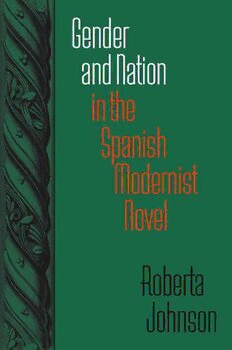
Download Gender and Nation in the Spanish Modernist Novel PDF Free - Full Version
Download Gender and Nation in the Spanish Modernist Novel by Roberta Johnson in PDF format completely FREE. No registration required, no payment needed. Get instant access to this valuable resource on PDFdrive.to!
About Gender and Nation in the Spanish Modernist Novel
Offering a fresh, revisionist analysis of Spanish fiction from 1900 to 1940, this study examines the work of both men and women writers and how they practiced differing forms of modernism. As Roberta Johnson notes, Spanish male novelists emphasized technical and verbal innovation in representing the contents of an individual consciousness and thus were more modernist in the usual understanding of the term. Female writers, on the other hand, were less aesthetically innovative but engaged in a social modernism that focused on domestic issues, gender roles, and relations between the sexes. Compared to the more conventional--even reactionary--ways their male counterparts treated such matters, Spanish women's fiction in the first half of the twentieth century was often revolutionary.The book begins by tracing the history of public discourse on gender from the 1890s through the 1930s, a discourse that included the rise of feminism. Each chapter then analyzes works by female and male novelists that address key issues related to gender and nationalism: the concept of intrahistoria, or an essential Spanish soul; modernist uses of figures from the Spanish literary tradition, notably Don Quixote and Don Juan; biological theories of gender prevalent in the 1920s and 1930s; and the growth of an organized feminist movement that coincided with the burgeoning Republican movement.This is the first book dealing with this period of Spanish literature to consider women novelists, such as Maria Martinez Sierra, Carmen de Burgos, and Concha Espina, alongside canonical male novelists, including Miguel de Unamuno, Ramon del Valle-Inclan, and Pio Baroja. With its contrasting conceptions of modernism, Johnson's work provides a compelling new model for bridging the gender divide in the study of Spanish fiction.
Detailed Information
| Author: | Roberta Johnson |
|---|---|
| Publication Year: | 2003 |
| ISBN: | 9780826514363 |
| Pages: | 365 |
| Language: | English |
| File Size: | 1.918 |
| Format: | |
| Price: | FREE |
Safe & Secure Download - No registration required
Why Choose PDFdrive for Your Free Gender and Nation in the Spanish Modernist Novel Download?
- 100% Free: No hidden fees or subscriptions required for one book every day.
- No Registration: Immediate access is available without creating accounts for one book every day.
- Safe and Secure: Clean downloads without malware or viruses
- Multiple Formats: PDF, MOBI, Mpub,... optimized for all devices
- Educational Resource: Supporting knowledge sharing and learning
Frequently Asked Questions
Is it really free to download Gender and Nation in the Spanish Modernist Novel PDF?
Yes, on https://PDFdrive.to you can download Gender and Nation in the Spanish Modernist Novel by Roberta Johnson completely free. We don't require any payment, subscription, or registration to access this PDF file. For 3 books every day.
How can I read Gender and Nation in the Spanish Modernist Novel on my mobile device?
After downloading Gender and Nation in the Spanish Modernist Novel PDF, you can open it with any PDF reader app on your phone or tablet. We recommend using Adobe Acrobat Reader, Apple Books, or Google Play Books for the best reading experience.
Is this the full version of Gender and Nation in the Spanish Modernist Novel?
Yes, this is the complete PDF version of Gender and Nation in the Spanish Modernist Novel by Roberta Johnson. You will be able to read the entire content as in the printed version without missing any pages.
Is it legal to download Gender and Nation in the Spanish Modernist Novel PDF for free?
https://PDFdrive.to provides links to free educational resources available online. We do not store any files on our servers. Please be aware of copyright laws in your country before downloading.
The materials shared are intended for research, educational, and personal use in accordance with fair use principles.

