Table Of ContentFrom Natural History to Natural Magic:
Francis Bacon’s Sylva sylvarum
Proefschrift
ter verkrijging van der graad van doctor
aan de Radboud Universiteit Nijmegen
op gezag van de rector magnificus prof. mr. S.C.J.J. Kortmann
volgens besluit van het college van decanen
in het openbaar te verdedingen op maandag 16 december 2013
om 14:30 uur precies
door
Doina-Cristina Rusu
geboren op 12 maart 1985
te Boekarest (Roemenië)
Promotores
Prof. dr. Christoph Lüthy
Prof. dr. Ilie Pârvu (University of Bucharest)
Copromotor
Dr. Dana Jalobeanu (University of Bucharest)
Manuscriptcommissie
Prof. dr. J.M.M.H. Thijssen
Prof. dr. Dan Garber (Princeton University)
Dr. Kathryn Murphy (Oxford University)
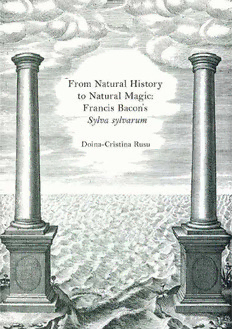
Cover designed by Lucia Dumitrescu and Doina-Cristina Rusu (original image Francis Bacon, Instauratio
magna, London, 1620)
From Natural History to Natural Magic:
Francis Bacon’s Sylva sylvarum
Doctoral Thesis
To obtain the degree of doctor
from Radboud University Nijmegen
on the authority of the Rector Magnificus, Professor dr. S.C.J.J. Kortmann
and from the University of Bucharest
on the authority of Rector Magnificus, Professor Mircea Dumitru
to be defended in public on Monday 16 December 2013
at 14:30 hours
by
Doina-Cristina Rusu
Born on 12 March 1985
in Bucharest (Romania)
Supervisors
Prof. Dr. Christoph Lüthy
Prof. Dr. Ilie Pârvu (University of Bucharest)
Co-Supervisor
Dr. Dana Jalobeanu (University of Bucharest)
Doctoral Thesis Committee
Prof. dr. J.M.M.H. Thijssen
Prof. dr. Dan Garber (Princeton University)
Dr. Kathryn Murphy (Oxford University)
Table of Contents
List of Abbreviations ........................................................................................... 5
Introduction ......................................................................................................... 7
Chapter 1. Bacon, Natural Philosophy and Magic: A Survey of the Status
Quaestionis .......................................................................................................... 17
1. 1. Introduction ............................................................................................................................... 17
1. 2. The beginning of the contemporary debate: Thorndike and Rossi ............................................ 18
1. 3. The issues at stake ..................................................................................................................... 20
1. 4. Bacon’s project, the Instauratio magna .................................................................................... 22
1. 4. 1. Operative philosophy: the influence of alchemy and magic.............................................. 23
1. 4. 2. The history of arts and the role of the efficient cause ........................................................ 27
1. 5. Bacon’s reform of natural history .............................................................................................. 31
1. 6. The role of experiment .............................................................................................................. 34
1. 6. 1. Bacon’s experiments: “the torture of nature” or “legal interrogation”? ............................ 35
1. 6. 2. “Experience” versus “experiment” .................................................................................... 37
1. 6. 3. Experientia literata ............................................................................................................ 39
1. 6. 4. Functions of Bacon’s experiments .................................................................................... 43
1. 6. 5. The relationship between experiment and theory .............................................................. 44
1. 7. Induction and forms ................................................................................................................... 46
1. 8. Bacon’s matter theory ................................................................................................................ 51
1. 8. 1. Tangible and pneumatic matter ......................................................................................... 52
1. 8. 2. Simple natures: schematisms and motions ........................................................................ 53
1. 8. 3. The appetites of matter ...................................................................................................... 55
1. 8. 4. The theory of matter in Bacon’s cosmology ...................................................................... 56
1. 9. Conclusions ............................................................................................................................... 57
Chapter 2: Sylva Sylvarum in the Context of Bacon’s Natural Philosophy . 59
2. 1. Introduction ............................................................................................................................... 59
2. 2. Scholarly studies of Sylva sylvarum .......................................................................................... 61
2. 3. “Experiment” and “experience” in the theoretical works and the Latin natural histories ......... 63
2. 3. 1. A deplorable lack of theory concerning experimentation .................................................. 64
1
2. 3. 2. The issue of terminology: theory, experience and experiment .......................................... 66
2. 3. 3. “Experiments” and the art of experimenting in Latin natural histories ............................. 68
2. 3. 3. 1. The Historia ventorum ............................................................................................... 69
2. 3. 3. 2. The Historia densi et rari ........................................................................................... 70
2. 3. 3. 3. The Historia vitae et mortis ....................................................................................... 72
2. 3. 4. Conclusion ......................................................................................................................... 73
2. 4. The standing of the Sylva sylvarum vis-à-vis the Latin natural histories .................................. 74
2. 4. 1. The mysteries of the book ................................................................................................. 74
2. 4. 2. Bacon’s own distinctions between types of experiments .................................................. 82
2. 4. 2. 1. “Experiment solitary” and “experiments in consort” .............................................. 82
2. 4. 2. 2. “Experiments of light” and “experiments of fruit” ................................................... 83
2. 4. 3. Different types of instances under the title “experiment” ................................................. 86
2. 4. 3. 1. Bacon’s own experiences and borrowings from sources .......................................... 86
2. 4. 3. 2. Theoretical and empirical instances .......................................................................... 88
2. 4. 3. 3. Vulgar experiences and experiments ......................................................................... 89
2. 4. 3. 4. Operative instances: medical receipts, spiritual magic and divination .................... 90
2. 4. 3. 5. Conclusion: Sylva’s variety of instances ................................................................... 93
2. 4. 4. The pedagogical function of experiments.......................................................................... 93
2. 5. Conclusion: Sylva sylvarum in the context of natural and experimental history ....................... 96
Chapter 3: Types of “Experiments of Light” in Sylva sylvarum ................... 99
3. 1. Introduction ............................................................................................................................... 99
3. 2. Scholarly views on the function of Bacon’s experiments in Sylva sylvarum .......................... 101
3. 3. Experiments directed towards the production of knowledge .................................................. 103
3. 3. 1. The first function of experiments: illustrations of matter theory ..................................... 104
3. 3. 2. Second function of experiment: rejection of experiments proposed by ancients and
moderns ....................................................................................................................................... 108
3. 3. 3. Experiments used to refute theories or opinions formulated by Bacon’s predecessors ... 114
3. 3. 4. Experiments exploring the properties of bodies during the development of a process ... 120
3. 3. 5. Experiments directed towards establishing correlations between those properties of the
bodies that cannot be observed by the senses .............................................................................. 126
3. 3. 6. Experiments as models of natural processes ................................................................... 130
3. 4. Conclusion ............................................................................................................................... 137
Chapter 4. A Case Study on Bacon’s Use of Sources: Experiments with
Plants in Sylva sylvarum and the Magia naturalis ........................................ 139
2
4. 1. Introduction ............................................................................................................................. 139
4. 2. Previous Scholarly Views ........................................................................................................ 141
4. 3. Plants in Della Porta and Bacon: the case of grafting ............................................................. 143
4.4. Bacon’s creative use of sources for his Sylva sylvarum ........................................................... 153
4. 4. 1. Methodological criticism ................................................................................................. 156
4. 4. 2. Generalizations ................................................................................................................ 159
4. 4. 3. Addition of causal explanations ...................................................................................... 166
4.5. Conclusion ................................................................................................................................ 174
Chapter 5: Sylva sylvarum and the Baconian Science of Magic .................. 178
5. 1. Introduction ............................................................................................................................. 178
5. 2. State of the scholarly debate .................................................................................................... 180
5. 3. Problems of boundaries: Bacon’s science of magic ................................................................ 183
5. 3. 1. The classification of sciences .......................................................................................... 183
5. 3. 2. Different types of magic .................................................................................................. 185
5. 3. 3. Physics and metaphysics: the discovery of causes .......................................................... 187
5. 3. 4. Physics and metaphysics: discovery of latent schematisms, latent processes, and forms 190
5. 3. 5. Bacon’s definition of form .............................................................................................. 192
5. 3. 6. Appetites, motions and forms .......................................................................................... 197
5. 3. 7. How a magician should manipulate nature ...................................................................... 202
5. 3. 8. Conclusion: Is Sylva about natural magic? ...................................................................... 204
5. 4. Bacon’s transformation of the Science of Magic .................................................................... 207
5. 4. 1. The science of magic in Della Porta’s Magia naturalis .................................................. 209
5. 4. 2. Different interests in the study of plants: Magia naturalis and Sylva sylvarum .............. 212
5. 4. 3. From mechanics to magic ................................................................................................ 214
5. 4. 3. 1. Relations between simple natures ............................................................................ 214
5. 4. 3. 2. Germination and vivification ................................................................................... 217
5. 4. 3. 3. Degeneration and transmutation ............................................................................. 222
5. 4. 3. 4. New species of things ............................................................................................... 227
5. 4. 4. How mechanics becomes natural magic .......................................................................... 231
5. 5. Conclusion: Bacon’s science of magic .................................................................................... 232
Conclusions ...................................................................................................... 235
Bibliography ..................................................................................................... 242
Appendix 1: Bacon’s classification of sciences according to De augmentis
scientiarum ........................................................................................................ 264
3
Appendix 2: Simple schematisms of matter according to the Abecedarium
novum naturae .................................................................................................. 269
Appendix 3: Simple motions and their corresponding appetites according to
the Abecedarium novum naturae .................................................................... 270
Appendix 4: Sums of motions and measurements of motion according to the
Abecedarium novum naturae ........................................................................... 271
Appendix 5: Tables for the experiments exploring the properties of a body
during the development of a process (section. 3. 3. 4.) ................................. 272
Appendix 6: Table of borrowings from Giambattista Della Porta’s Magia
Naturalis and Hugh Platt’s Floraes paradise in Sylva sylavrum, centuries V
and VI ............................................................................................................... 275
Appendix 7: Scheme of Bacon’s borrowing from Della Porta’s Magia
naturalis in Sylva sylvarum, centuries V and VI ........................................... 277
Summary .......................................................................................................... 278
Samenvatting .................................................................................................... 285
Acknowledgements .......................................................................................... 292
Curriculum vitae ............................................................................................. 294
4