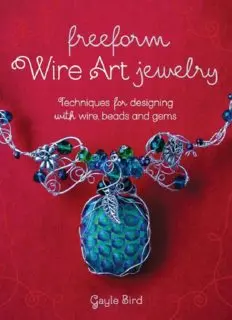
Table Of Contentfreeform
Wire Art jewelry
Techniques for designing with wire, beads
and gems
Gayle Bird
Cincinnati, OH
contents
Introduction
1
The Basics
Wire
Tools
Color Theory
Design Principles
Steps to Creating a Jewelry Design
2
Techniques
Basic Wire Techniques
Organic Wire Techniques
Easy Curls Necklace
3
Projects
Earrings
Rings
Pendants
Necklaces
About the Author
Acknowledgments
Introduction
I absolutely love working with wire. If it’s not nailed
down, it’s likely I’ll eventually try wrapping it in wire!
This book is the result of fifteen years of experiments,
failures, and re-tries. I’ve done all the trying and failing
so you don’t have to!
When I was approached to write this book, I was elated. I truly believe that
anyone can learn to make their own jewelry; more than that, I believe that
everyone can create their own style. Most new artists learn the same techniques
from the same batch of online tutorials. As a result, much of what beginners
make ends up looking the same as everyone else. But it doesn’t have to be that
way! With a bit of freedom and plenty of solid techniques, you can learn to
create your own style and begin making jewelry that is instantly recognizable as
yours alone.
This book is set up more like a textbook or class than a random assortment of
projects. The beginning of the book focuses on unconventional tools, design
techniques, color theory, improvisation and a series of foundational techniques
that are referred to in the projects and used as the basis of many an
improvisation. Each project is interconnected, and the projects later in the book
assume you have completed the earlier projects.
assume you have completed the earlier projects.
I am convinced that you’ll find the text easy to follow, the projects
uncomplicated, and that if you complete the whole book, you’ll effortlessly
begin working towards your own remarkable design style. See for yourself!
1
The Basics
It can be tempting to dive right into the projects in a book
like this, but it’s important that you take the time to
review the basics first. I strongly believe that you need to
understand your materials and your tools before you pick
them up; and that you need to understand color and
design before you can create anything significant. I’ve
been teaching color and design for nearly fifteen years
and trust me, this is only a small segment of the subject.
Wire
Copper-core wire plated with silver
CHOOSING THE RIGHT WIRE
Wire has been sparking my imagination for more than a decade. My first wire
project popped fully formed into my brain, and it was so spontaneous that I
literally used garbage bag ties stripped of their paper. The results were less than
perfect but sometimes creativity just won’t wait!
After that I tried whatever I could get my hands on: beading wire (too soft),
brass wire from the hardware store (too hard), even soldering wire (not
structurally sound), and eventually some silver-plated wire. I wasn’t fully
satisfied with any of them, and I’ve since come up with a few requirements:
1. Materials shouldn’t be so expensive that they stifle creativity.
2. The wire should support both broad strokes and tiny details.
3. Finished pieces should be easy to clean.
I’ve now found a wire that’s up to my standards: copper-core wire plated with
pure silver or permanently enameled with antiqued colors, and then coated with
poly-nylon. It’s inexpensive, so I don’t have to worry about wasting it while I’m
designing; it’s workable in any way I’d like (and can be work-hardened easily),
perfect for intricate details as well as large motifs; and it never tarnishes, so I
don’t have to worry about cleaning the wire. An added bonus is that the wire is
soft: it doesn’t hurt my hands when I work it. It’s like a miracle wire!
Wire comes in many gauges, which can be confusing. The basic thing to
remember is that the bigger the number, the smaller the wire. We’ll mostly be
using wire in the 18–22ga range. There are many brands you can try, such as
Parawire, Artistic Wire and Zebra Wire.
A quick online search for “colored wire” or a trip to your local craft store should
get you started. The coated wire comes on spools of about 25' (7.6m). Feel free
to use any kind of wire you like, but be aware that if you’re using fine metals,
measuring accurately and using scraps becomes important, not something
covered in this book.
Tools
I’ve listed the essential tools here, but you already own the most important tool
of all: your hands. Many of the techniques in this book depend extensively on
using your hands. Becoming less dependent on the use of tools is a big part of
what will give your work that organic, freeform look.
As for the quality of your tools, any no-name brand from the hardware or big
box store will do for now, but once you become seriously interested in producing
more than one or two pieces a week, and as soon as you can afford to do so,
upgrade. Just as with computers and cars, buy the very best you can afford. With
proper care, your tools will last a long time.
ESSENTIAL TOOLS
Whenever I take my wire on the road with me, I bring along four sets of pliers. I
can fudge the rest.
Side Cutters. These are the first pliers you’ll touch as you need them to cut the
wire off the spool. Side cutters have a flat side and a deep “v” side—always cut
with the flat side up against your work so the ends are as flat as possible. If you
invest in any high-end tools, start with your cutters; they’ll make your ends
neater and will be kinder on your hands.