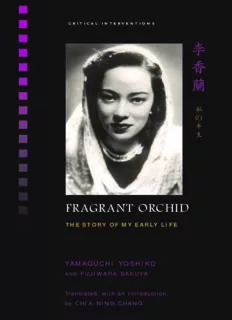
Table Of Contentcritical interventions
李
香
蘭
私
の
半
生
FRAGRANT ORCHID
THE STORY OF MY EARLY LIFE
YAMAGUCHI YOSHIKO
AND FUJIWARA SAKUYA
Translated, with an Introduction,
by CHIA-NING CHANG
Fragrant Orchid
Critical Interventions
Sheldon H. Lu, general editor
Cinema, Space, and Polylocality in a Globalizing China
Yingjin Zhang
Children of Marx and Coca- Cola: Chinese Avant- garde Art
and In de pen dent Cinema
Xiaoping Lin
Uneven Modernity: Literature, Film, and Intellectual Discourse
in Postsocialist China
Haomin Gong
Remaking Chinese Cinema: Th rough the Prism of Shanghai,
Hong Kong, and Hollywood
Yiman Wang
From Fu Manchu to Kung Fu Panda: Images of China in American Film
Naomi Greene
CRITICAL INTERVENTIONS
Fragrant Orchid
The Story of
My Early Life
Yamaguchi Yoshiko
Fujiwara Sakuya
Translated, with an Introduction,
by Chia- ning Chang
University of Hawai‘i Press
Honolulu
Publication of this book has been assisted by a grant from the University of California
at Davis.
Critical Interventions
Sheldon H. Lu, general editor
Critical Interventions consists of innovative, cutting-e dge works with a focus on Asia or
the presence of Asia in other continents and regions. Series titles explore a wide range of
issues and topics in the modern and contemporary periods, especially those dealing with
literature, cinema, art, theater, media, cultural theory, and intellectual history as well as
subjects that cross disciplinary boundaries. Th e series encourages scholarship that com-
bines solid research with an imaginative approach, theoretical sophistication, and stylis-
tic lucidity.
© 2015 University of Hawai‘i Press
All rights reserved
Printed in the United States of America
20 19 18 17 16 15 6 5 4 3 2 1
Library of Congress Cataloging- in- Publication Data
Yamaguchi, Yoshiko
[Ri Kōran watashi no hansei. En glish]
Fragrant orchid : the story of my early life / Yamaguchi Yoshiko, Fujiwara Sakuya ;
translated, with an introduction, by Chia- ning Chang.
pages cm — (Critical interventions)
Includes bibliographical references and index.
1. Yamaguchi, Yoshiko. 2. Actors— Japan—Biography. I. Fujiwara,
Sakuya, 1937– author. II. Chang, Chia- ning, translator. III. Title. IV. Series:
Critical interventions (Honolulu, Hawaii)
PN2928.Y276A313 2015
791.4302'8092—dc23
[B]
2014024857
University of Hawai‘i Press books are printed on acid- free
paper and meet the guidelines for permanence and
durability of the Council on Library Resources.
Printed by Sheridan Books, Inc.
Contents
NOTES ON TRANSLATION | vii
CHRONOLOGY | ix
INTRODUCTION Yamaguchi Yoshiko in War time East Asia:
Transnational Stardom and Its Predicaments | xvii
1. My Fushun Years | 1
2. My Fengtian Years | 15
3. My Beijing Years | 32
4. Th e Tianjin Encounters | 49
5. Th e Birth of Li Xianglan | 65
6. My Xinjing Years | 81
7. Th e Days of “Th e Suzhou Serenade” | 98
8. Th e Nichigeki Incident | 113
9. Th e Spring of My Youth | 131
10. Th e Two Yoshikos | 148
11. Two Phantom Films: Yellow River and My Nightingale | 169
12. Glory to Eternity | 186
13. Rhapsody of “Th e Eve ning Primrose” | 204
14. Shanghai, 1945 | 223
15. Farewell, Li Xianglan | 239
Addendum: Th e Post–L i Xianglan Years | 257
v
vi Contents
Postscript: Yamaguchi Yoshiko | 287
Postscript: Fujiwara Sakuya | 289
NOTES | 293
FILMOGRAPHY | 343
INDEX | 345
ABOUT THE TRANSLATOR | 359
Plates follow page 124.
Notes on Translation
In the introductory essay and the main body of the translation, Chinese and Japa-
nese names and titles are translated into En glish and followed by their romaniza-
tion in parentheses. References to Yamaguchi Yoshiko are complicated by diff erent
readings of her Chinese stage name: Li Xianglan in Mandarin and Ri Kōran in
Japa nese. Additionally, Yamaguchi the autobiographer occasionally adopts a de-
tached narrative perspective, referring to herself in the third person by her Chi-
nese stage name. For the sake of clarity and consistency, I have used her Japa nese
birth name, Yamaguchi Yoshiko, in my essay, except in situations that clearly call
for “Li Xianglan,” as when her name is referred to in China, in a Chinese context,
or by a Chinese person. In the main body of the translation, I have refrained from
using the Japa nese reading “Ri Kōran” in order to avoid undue confusion in the
minds of some readers.
I have included brief explanatory notes from the original text in my transla-
tion whenever I fi nd their inclusions to be helpful to readers. In other instances,
they appear as part of my own annotations to the text. In many instances, I have
rearranged the original paragraph layout to enhance the narrative movement in
the En glish translation.
I have provided notes on historical and literary fi gures, artists, place names,
and other items when additional information off ers helpful contextual or linguistic
clarifi cation. I have generally refrained from providing notes on items mentioned
only once or in passing, and when further elaboration at the point of insertion
contributes little to the account at hand. Th us, there are no notes on such well-
known fi gures as Abe Kōbō, Tanaka Kinuyo, Song Qingling, or Li Lihua, but
additional information is given on Ruan Ling’yu, Umehara Ryūzaburō, Tamura
Taijirō, Amakasu Masahiko’s role in the alleged killing of Ōsugi Sakae and Itō
Noe in 1923, and the controversies surrounding the death of Kawashima Yoshiko
in 1948. Th ere are instances where annotations are provided on certain fi gures,
place names, and events mentioned only fl eetingly— Qi Baishi, the Suzhou temple
vii
viii Notes on Translation
Hanshansi, the 1944 fi lm Chunjiang Yihen, Mei Lanfang’s postwar per for mance
in Shanghai, Niwa Fumio, Ishii Baku, and Hijikata Yoshi, for example— when
additional information helps, I hope, to underscore the dramatic import embedded
in the original text.
Chronology
Th e chronology of Yamaguchi Yoshiko’s life is taken, with revisions, from sources
including “Ri Kōran/Yamaguchi Yoshiko ryakunenpu,” in Ri Kōran o ikite: Watashi
no rirekisho (Tokyo: Nihon Keizai Shimbunsha, 2007), pp. 2–2 1; “Ri Kōran [Yama-
guchi Yoshiko] ryakunenpu,” in Ri Kōran: Futatsu no sokoku ni yureta seishun,
Mainichi gurafu bessatsu, ed. Tanaka Kaoru, Shimizu Kiyoshi et al. (Tokyo:
Mainichi Shimbunsha, June 1991), pp. 169–1 73, and Li Xianglan (Yamaguchi Yoshiko)
Special (1992) for the 16th Hong Kong International Film Festival, pp. 31– 32.
1920:
Yamaguchi Yoshiko is born in Beiyantai in the suburbs of Fengtian (present-d ay
Shenyang in Liaoning Province), the oldest child of Yamaguchi Fumio and Ai. Soon
aft er her birth, the family moved to Fushun and lived on Higashi rokujō-d ori. A
student of Chinese, Yamaguchi Fumio had come to China in 1906 in the aft er-
math of the Russo- Japanese War. Ai was a graduate of Japan Women’s University.
1923: Age 3
Yamaguchi Fumio began teaching Chinese language to employees of the South
Manchurian Railway Company (Minami Manshū Tetsudō Kabushikigaisha, or
Mantetsu).
1924: Age 4
Began studying elementary Mandarin with her father.
1926: Age 6
Entered Yong’an Elementary School and began learning to play the violin, piano,
and koto. Did well in music and Chinese but not in mathematics and sports.
1929: Age 9
As a fourth-g rader, passed National Certifi cation of Chinese Language (Chūgo-
kugo kokka kentei), 4th Class, while studying Chinese with adult students in her
father’s Mantetsu’s class.
ix
Description:The acclaimed actress and legendary singer, Yamaguchi Yoshiko (aka Li Xianglan, 1920-2014), emerged from Japan-occupied Manchuria to become a transnational star during the Second Sino-Japanese war. Born to Japanese parents, raised in Manchuria, and educated in Beijing, the young Yamaguchi learned to