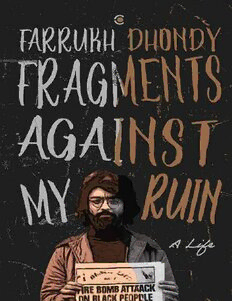
Table Of ContentFirst published by Context, an imprint of Westland Publications
Private Limited, in 2021
1st Floor, A Block, East Wing, Plot No. 40, SP Info City, Dr. MGR
Salai, Perungudi, Kandanchavadi, Chennai 600096
Westland, the Westland logo, Context and the Context logo are the
trademarks of Westland Publications Private Limited, or its affiliates.
Copyright © Farrukh Dhondy, 2021
ISBN: 9789390679126
The views and opinions expressed in this work are the author’s own
and the facts are as reported by him, and the publisher is in no way
liable for the same.
All rights reserved
No part of this book may be reproduced, or stored in a retrieval
system, or transmitted in any form or by any means, electronic,
mechanical, photocopying, recording, or otherwise, without express
written permission of the publisher.
CONTENTS
UNCLES AND CARROM BOARDS
SECRET PASSAGES
BAD WORDS AND BROKEN RECORDS
LAZARUS
PARSI CUSTARD
TOWERS OF SILENCE
A TOWN TOO SMALL
DELIBERATE DISGUISES
INNOCENCE AND EXPERIENCE
AMOR VINCIT OMNIA
BYLINES BY LINES
EENUK-A-POLE HAI HAI!
BLACK IS A POLITICAL COLOUR
DOLLY MIXTURES
FIRE
BIG AS DE ’OUSE
RIGHT TIME, RIGHT PLACE
IN THE BEGINNING WAS THE WORD
HOUSES FOR MR AND MRS BISWASES
PILGRIM’S PROGRESS
ALL THE WORLD’S A TV SET
A TV HACK’S ODYSSEY
THE SERIAL KILLER AND RED MERCURY
FILMS I DIDN’T WRITE
FILMS I DID WRITE
A FRIENDSHIP AND THREE-MINUTE EGGS
AFTERWORD A TARGET AUDIENCE
UNCLES AND CARROM BOARDS
Stepping out of the terminal at Bombay airport with my rucksack and
bottles of duty-free, I was accosted by the taxi drivers competing for
fares to the city.
‘Unkal, unkal, unkal,’ they called out.
The calumny of Time.
When we were teenagers, we would gather on the corners of
the streets of Poona, greeting familiar passers-by and, on occasion,
depending on our mood, would offer mild provocations to strangers.
To those unfortunate passers-by with shiny bald pates, we would
shout, ‘Oi Carrom Board!’ I look in the mirror now, and my thinning
white hair promises to perhaps confer precisely that epithet, the
teasing torment, on me. Calumniating Time.
My earliest memory—though my mother, Shireen Anita, always
disputed its accuracy—was kicking the wall against which my
swinging baby-cot was placed. My mother insisted that I only slept in
that sort of cot till I was a little more than a year old and that it was
never placed against a wall I could reach with my foot. Arguing the
point, my masi, my mother’s sister, recalled that once when the
bedroom in which my mother, sister and I slept was being painted,
the cot had been shifted for a few days to my grandad’s room and
placed against the wall, and that, yes, I had got my foot stuck
between the wooden bars of the cot’s sides and had set up a howl. I
don’t remember it as my first memory of pain but as a way of making
the cot rock. Perhaps that’s fanciful, and I shouldn’t call it a memory
at all as it doesn’t bring to mind an image of my infant leg but only of
the wall and the Coca Cola–shaped brown wood bars of the cot’s
side.
Then, no memories, not even flashes, till I was in Quetta. My
father, Lieutenant Colonel Jamshed Dhondy, was an officer in the
British Indian Army, and a year or more after I was born in 1944, he
was transferred to the Military Staff College in Quetta in the as-yet-
undivided India. We had a house in the cantonment, the army
settlement of the town, and four strong memories of that time stand
out.
I must have been two years old. There was a kitchen window
outside which, in the garden to the side of the house, there was a
chilli tree, and Aslam, my father’s army ‘orderly’, a soldier assigned
to my father’s personal duty, stopped me plucking the chillies and
carried me away from it.
There was a stream somewhere in the distance over barren,
rocky land, and hills far away beyond it. When we were put to bed,
my sister Zareen and I could hear the wolves howling. One day, as
we were taken on a stroll towards the stream, a porcupine appeared
at the edge of it and rolled itself into a spikey ball, which someone,
perhaps Aslam or Chandri, the ayah who came with us from Poona
and looked after us, pointed out.
One day, my mother asked us to assist in making gingerbread
men. She shaped the dough, and Zareen and I placed currants for
the biscuits’ eyes. We expectantly waited for the gingerbread men to
emerge from the oven, but when they did, we noticed that one of the
two was cracked in the middle. Zareen immediately said she was
having the whole one. I said I was. My mother, quite rightly
anticipating a noisy fit of dispute, tried to reason with us. The
gingerbread would crumble in our mouths anyway. We were having
none of it. Then, inspired perhaps by the judgement of Solomon, my
mother took a knife and cracked the whole one precisely like the
other. That was it. The two of us were on the floor, crying and kicking
our legs.
Our father walked in and, hanging up his army hat and stowing
the baton he carried, came into the kitchen to ask what was going
on. Mum, in distress now at the ingratitude of us brats, told him the
story.
My father took charge. He put the two gingerbread men on a
plate and invited us to follow him. We were intrigued. He walked out
the back door from the kitchen and then round to the front of the
house. We followed silently.
‘Now, watch,’ he said and, lowering the plate so we could see,
crushed the two biscuits into crumbs. Then, lifting the plate, he flung
the crumbs with a determined flick onto the roof of our bungalow.
‘The pigeons will have a surprise picnic,’ he said and walked
back into the house.
At the end of the year, perhaps for Christmas, the officers of the
Military Staff College planned a funfair in the campus grounds for the
children of the officers and soldiers of their regiments. The junior
officers dressed as clowns to entertain us. I didn’t understand the
intent of the costumes or the painted faces with huge red lips and
white foreheads. They terrified me. I cried and clung to Chandri. My
sister and other children entered into the spirit of the afternoon. I was
marked as a spoilsport and taken home.
In 1947, when I was three and my sister was just five, the
subcontinent won, or was granted, its independence from British
colonial rule and was consequently divided into India and Pakistan.
Quetta was deep in Pakistani territory. The regiments of what had
been the British Indian Army were divided down religious lines, and
the officers were offered the option of deciding their country. The
Hindu and Sikh officers naturally opted for India. The Muslims from
my father’s regiment and others who came from the territories that
had become Pakistan naturally chose to stay. Other Muslim officers
with families, ties and history in the Indian territory would make their
way to India.
These seemed inherent or even inevitable choices. My father,
being a Parsi Zoroastrian and neither Hindu nor Muslim, was urged
by some colleagues to stay in Pakistan and serve in its army. But our
family belonged to Bombay and Poona, and besides, my father was
ideologically with Mahatma Gandhi, opposed to the division of the
country and thought the creation of Pakistan a tragedy.
Riots broke out in the border towns as millions of Hindus and
Sikhs fled Pakistan and, equally, in the opposite direction, Muslims
crossed the border from India as refugees. Martial law was declared.
My father was called away from Quetta to the Northwestern towns
when his regiment was enlisted to enforce it.
My mother was left with us two children and Chandri. In the
following weeks, all the Indian Army families were loaded onto a
crammed and military-protected train to cross the border to India. I
have no memory of the journey, but my sister remembers the
compartment which was meant for four but had perhaps twelve
women and children in it. What should have been a two-day ride,
guarded by soldiers armed with machine guns on the compartments’
roofs, took four or five days.
My mother, for the rest of her life, would occasionally recall the
horror, the sights and sounds of slaughter, as refugee groups from
both sides crossed each other in bitterness and hatred.
I am spared the memory.
When I was five or six years old, my father was transferred to
Madras. I began school in the Presentation Convent, Church Park,
which was a few hundred yards away from the house in Lloyd’s
Road, where we occupied the spacious first-floor flat. Below us, on
the ground floor, with a porch for parked cars and our terrace directly
above it, lived an American family called the Huxleys.
By this age, the early memories evolve into recollections of day-
to-day existence. Chandri would walk us to school each morning,
and on the opposite side of the pavement sat, or perhaps lived, a
man who suffered from severe leprosy. He had his mat spread out,
with pots and pans and several aids to daily existence by his side. A
canvas cover hung on the wall of the church behind him. He would
grin at us as we passed by and move his head back and forth like a
chicken, perhaps to amuse us. Zareen and I named him ‘Mr
Wookoo’, the word we invented as a verbal description of the bird-
like back-and-forth movement of his head.
Over the weeks—or was it months or even a year?—his leprosy
caused his truncated fingers and toes to ooze pus, and when the
police drove him away from his station at the head of Lloyd’s Road,
he camped a few hundred yards down our front gate. The day after,
he was gone, leaving his mat and the meagre bundles and utensils
of his street-abode on the pavement outside our house. I remember
Mrs Huxley and my mother going out with bottles of disinfectant to
pour on the spot he had occupied.
It was at that age I was made aware of sex. In the next house,
beyond a floral hedge in what I thought was an expensive garden,
there lived a boy called Christopher, who was a few years older than
me. We used to meet by passing through a thinning part of the
dividing hedge. One day, messing about in his garden, he suggested
that we ‘play koonjis’.
I didn’t know what he meant, but he asked me to take down my
shorts just as he was doing so that we could rub our penises
together. I did as he said and rubbed my diminutive prick against his
foreskin but didn’t understand the objective of the activity. At that
age, there was no possible stimulation. It appealed to me as just
something vaguely forbidden, as one’s private parts should remain
private and not be seen by anyone except one’s parents, one’s sister
and Chandri.
I don’t know whether Christopher derived any pleasure from the
‘game’ he initiated or whether he had played it with anyone else.
My awareness that a prick had more uses than as an outlet for
piss came when a lad called Abraham, a Tamil Christian in his late
teens, was assigned to look after me. We used to play a sort of
child’s cricket, and he would take me for walks in the botanical
gardens opposite our house.
My father drove a maroon Mercury whose registration plate,
MSP 9673, remains somehow in my memory. Its garage was to the
side of the house, and I often went in there, got in the driver’s seat
and held the steering wheel, pretending I was zooming down the
roads and highways.
One day, Abraham led me into the garage where the car was
parked. We got into it and pretended, as usual, to drive. Sitting in the
passenger seat, he loosened his trouser belt and fingered himself
erect. He seemed totally absorbed as he masturbated. I asked him
what he was doing, and he said, ‘Soon the milk will come out,
watch.’ I watched, and it did.
Abraham, dragging his trousers up, said I wasn’t to tell anyone.
I was intrigued and couldn’t keep it to myself. I told my father
that Abraham had brought milk out of his ‘soosoo’. My father calmly
said he shouldn’t have done that and it was naughty. I didn’t see
Abraham again, and when I asked where he had gone, was told that