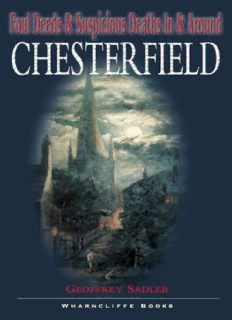
Table Of ContentFirst published in 2003
and reprinted in 2013 by
True Crime
an imprint of
Pen & Sword Books Ltd
47 Church Street
Barnsley
South Yorkshire
S70 2AS
Copyright © Geoffrey Sadler 2003, 2013
PAPERBACK ISBN: 978 1 90342 530 5
PDF ISBN: 978 1 47382 954 1
EPUB ISBN: 978 1 47382 868 1
PRC ISBN: 978 1 47382 911 4
The right of Geoffrey Sadler to be identified as Author of this
work has been asserted by him in accordance with the Copyright,
Designs and Patents Act 1988.
A CIP catalogue record for this book is
available from the British Library
All rights reserved. No part of this book may be reproduced or
transmitted in any form or by any means, electronic or mechanical
including photocopying, recording or by any information storage and
retrieval system, without permission from the Publisher in writing.
Printed and bound by CPI Group (UK) Ltd, Croydon, CR0 4YY
Pen & Sword Books Ltd incorporates the Imprints of
Pen & Sword Aviation, Pen & Sword Family History, Pen & Sword Maritime,
Pen & Sword Military, Pen & Sword Discovery, Pen & Sword Politics,
Pen & Sword Atlas, Pen & Sword Archaeology, Wharncliffe Local History,
Wharncliffe True Crime, Wharncliffe Transport, Pen & Sword Select,
Pen & Sword Military Classics, Leo Cooper, The Praetorian Press,
Claymore Press, Remember When, Seaforth Publishing and Frontline Publishing
For a complete list of Pen & Sword titles please contact
PEN & SWORD BOOKS LIMITED
47 Church Street, Barnsley, South Yorkshire, S70 2AS, England
E-mail: [email protected]
Website: www.pen-and-sword.co.uk
Contents
Introduction
Chapter 1 Murder at St Mary’s, 1434
Chapter 2 ‘To Have Taken Away Her Majesties Lief’, 1586
Chapter 3 Of Six and Twelve, 1637-79
Chapter 4 ‘Many and Frequent Felonys’, 1700s
Chapter 5 Elopement to death, 1758
Chapter 6 Saved By Her Skirts, 1762
Chapter 7 He Could Not Expect Any Mercy, 1786
Chapter 8 Theft, Self-Murder and the Gibbet, 1801-15
Chapter 9 The Government Opposed Must Be, 1817
Chapter 10 The Shocking Affair at Whittington, 1845
Chapter 11 The Cesspit Horror, 1845
Chapter 12 Death by the Highway, 1857
Chapter 13 Killed for a Few Potatoes, 1868
Chapter 14 The Sanguinary Conflict, 1870
Chapter 15 Desperate Encounter with a Pig-Stealer, 1871
Chapter 16 He Did Not Think He Should Recover, 1871
Chapter 17 She Had Drink Every Day, 1872
Chapter 18 A Doctor in the Dock, 1873
Chapter 19 I Have Ended the Job, 1873
Chapter 20 If I Don’t Have Her, 1873
Chapter 21 Scandalous Assault, 1875
Chapter 22 Found Dead in the River Rother, 1875
Chapter 23 A Girl of Good Character, 1875
Chapter 24 He Has Been a Bad ’Un, 1876
Chapter 25 A Disgusting and Villainous Crime, 1881
Chapter 26 You Have Kicked Me to Death, 1882
Introduction
‘We didn’t use to have violence in those days.’
It is a statement we have all become familiar with by now, the resigned
comment delivered with a sad shake of the head by some senior citizen friend or
colleague, harking back to a bygone paradise and convinced that present-day
society is on its way to Armageddon. Nowadays it is often all too easy to agree
with them as we hear of neighbours and relatives having their houses burgled,
their cars stolen and trashed, and old folk afraid to venture on to streets roamed
by violent gangs or ‘druggies’ out for a fix. And if these problems pass us by,
television and the newspapers are always ready to regale us with horror stories
of unfortunates battered and tortured in their homes by sadistic psychopaths, or
children abducted and murdered by paedophile killers. We are right to be
appalled at all of these crimes, but that is no excuse for pretending they never
happened before. Believe me, they did. Violence is deplorable, but it is nothing
new.
Turn to the newspapers of previous ages, or read back into the history books
for even earlier centuries, and the similarities are startling. People in the
fifteenth, eighteenth and nineteenth centuries were convinced they lived at the
height of an unprecedented crime wave, in an age where the country was ‘going
to the dogs’, and where ‘something had to be done’ to prevent total anarchy. I
shall never forget reading through the pages of the Derbyshire Times and
Derbyshire Courier issues for the 1850s and ’60s, and being genuinely shocked
to encounter case after case of crimes we tend to regard as modern aberrations.
Child abduction and abuse, domestic violence, gang rapes, garottings, suicides
and murders featured regularly in these pages. Read the Derby Mercury from
1732 onwards, and the story is much the same.
Chesterfield is the second largest town in Derbyshire, and the largest in the
north of the county. A thriving, attractive market town surrounded by scenic
landscapes, it presents a pleasant face to visitors, but a study of its past reveals
that it has often been a dangerous place to live in. From medieval times to our
own day Chesterfield and its neighbouring towns and villages have seen
desperate encounters and shocking crimes, with suicides and brutal murders that
have frequently achieved country-wide notoriety.
This book explores the darker side of Chesterfield and its outlying areas,
shedding light on a catalogue of crimes, some of them relatively little known,
others still claiming media attention. From the double murder at Chesterfield’s
parish church on 1 January 1434 we follow a blood-stained path that takes in the
multiple executions at Tapton Bridge, and the savage punishment meted out to
the members of the Babington plot and the 1817 ‘Pentrich Revolution’. The
reader is witness to the murder of the luckless runaway couple at Winnats Pass
in 1758, the fate of the victim of Derbyshire’s last gibbet in 1815, and stands
with ‘gallant superintendent’ Dennis Gorman in his vicious hand-to-hand battle
with the Sothall sheep-stealer in 1870. The bloody thread of violence runs on to
the grim Victorian yards and alleys of central Chesterfield, with their batterings,
poisonings and razor murders.
I have been fortunate to have worked for the last seventeen years in the
Chesterfield Local Studies Library, and to have access to its considerable
resources. The library holds microfilm copies of the Derby Mercury, Derbyshire
Courier and Derbyshire Times, together with a substantial file of cuttings from
the Sheffield Star, which between them cover a period from 1732 to the present
day. These newspapers report on crimes and police investigations, often with
detailed accounts of trials and, from the mid-nineteenth century onward, the
findings of coroners’ inquests, where the causes of death are more thoroughly
explored. They have provided me with the basic tools for my research. Standard
works on crime and punishment in Derbyshire in the library stock have also
provided valuable information, among them accounts of the trial of Antony
Babington and of the Pentrich defendants, ‘Annals of Crime in the Midland
Circuit’, and ‘The Complete Book of Emigrants in Bondage’, which lists persons
transported to the American colonies prior to 1776, and gives instructive details
of their offences; I have also found useful facts in periodicals such as the
Derbyshire Life & Countryside and Reflections magazine.
I would like to express my thanks to my colleagues in the Chesterfield Local
Studies Library and County Local Studies Library, Matlock, to Derbyshire
Library Service for use of their images, to Philip Cousins for the kind loan of
information and to the Ordnance Survey for permission to reproduce Old County
Series maps. Special thanks must go to my good friend Dennis Middleton, who
has toured virtually all of north Derbyshire with me to take the excellent
photographs shown in the text, to Brian Davis for reproduction of the cover
illustration, to Alun Waterhouse for his continued help in negotiating the new
technology, and to Ann Krawszik and Sue Crabbe for the kind loan of additional
photographs. Finally my thanks go to Brian Elliott and Wharncliffe Books for
inviting me to take part in this project, and for their help and advice in making it
happen.
Sources
1. Copies of local newspapers including the Derbyshire Times, the Derbyshire Courier, the Derby Mercury,
and the Sheffield Star.
2. Anon. Annals of Crime in the Midland Circuity 1859.
3. Christian, Roy. ‘The Last of the Peasants’ Revolts’, 8 June 1967, Country Life.
4. Coldham, Peter Wilson. The Complete Book of Emigrants in Bondage 1614-1775, 1988.
5. Cooper, William Durrant. ‘Notices of Anthony Babington of Dethick and of the Conspiracy of 1586’,
Reliquary Vol 2, 1861-62.
6. Large, J A. Stories of the Derbyshire Dales, 1997.
7. Pentrich Historical Society. Pentrich Revolution Trail, 2000.
8. Sitwell, Sir George. The Story of the Sitwells, unpublished galleys in Chesterfield Local Studies Library.
9. Society for the Prosecution of Felons, 1744. Photographic copy of original document in Chesterfield
Local Studies Library.
10. Taylor, Philip. May the Lord have mercy on your soul: murder and serious crime in Derbyshire 1732-
1882, 1989.
11. The Trials of Jeremiah Brandreth, William Turner, Isaac Ludlam, George Weightman and others for
High Treason, Under a Special Commission at Derby, 1817.
12. Wood, Thomas Philpot. T P Wood’s Almanac, 1868-1963.
Chapter 1
Murder at St Mary’s 1434
W
hen the Derbyshire landowner Sir Henry Pierrepoint rode into
Chesterfield with his friends and servants to attend Mass on the
morning of Friday 1 January 1434, the day must have seemed like any other. The
party were familiar with the town and its inhabitants, and used to attending the
church services on a regular basis. As they made their way along Saint Mary’s
Gate to the parish church of St Mary and All Saints, they could scarcely have
failed to be impressed by the recently completed spire that reached two hundred
feet high above them; only in later years would it achieve fame as the ‘Crooked
Spire’ as its green timbers twisted to the force of lead and sunlight. Certainly it
presented no threat to its visitors, who entered the building still suspecting
nothing untoward. How could they have known that soon they would be the
victims of a murderous attack from which few of them would escape unscathed,
and where two at least would pay with their lives.
View of St Mary’s church from Church Way. The spire would have been a familiar landmark when Henry
Pierrepoint and his friends rode to Mass in January 1434. Dennis Middleton
In the early years of the fifteenth century, Derbyshire, like England itself, was
a dangerous place to be, and not too much was going right. With the Hundred
Years War against France now clearly lost, the nation lacked territory and
prestige, and since the downfall of Richard II the kings who followed had
struggled to keep a hold on the crown, beating off rebellious nobles only by a
supreme effort. The massive wool boom of the previous century had generated
great wealth for some, but with it had come widespread corruption by officials
and the medieval equivalent of multi-national corporations. The resentment of
the downtrodden lower orders, who stayed poor and oppressed as before, had
exploded into the Peasants’ Revolt of 1388, and although rebellion had been
brutally crushed, the hatred smouldered on. Hardly surprising that law and order
had broken down, and the country was beset by gangs of robbers – several of
them renegade noblemen and their followers - who roamed their chosen ‘turf’
stealing and murdering as they pleased. The ‘rymes of Robin Hood’, whether of
Sherwood or Barnesdale, were already familiar to most, and give a fair
indication of the lawless state of late medieval society. In 1434, with the pious
but ineffectual Henry VI on the throne, rival factions were already gearing up for
Description:Maiming, brutal murders, crimes of passion, suicides and executions; Chesterfield has all these and more in 'Foul Deeds and Suspicious Deaths in Chesterfield'.The scenic landscape of Chesterfield presents a pleasant face to it's visitors, but a study of it's past shows that it has often been a dange